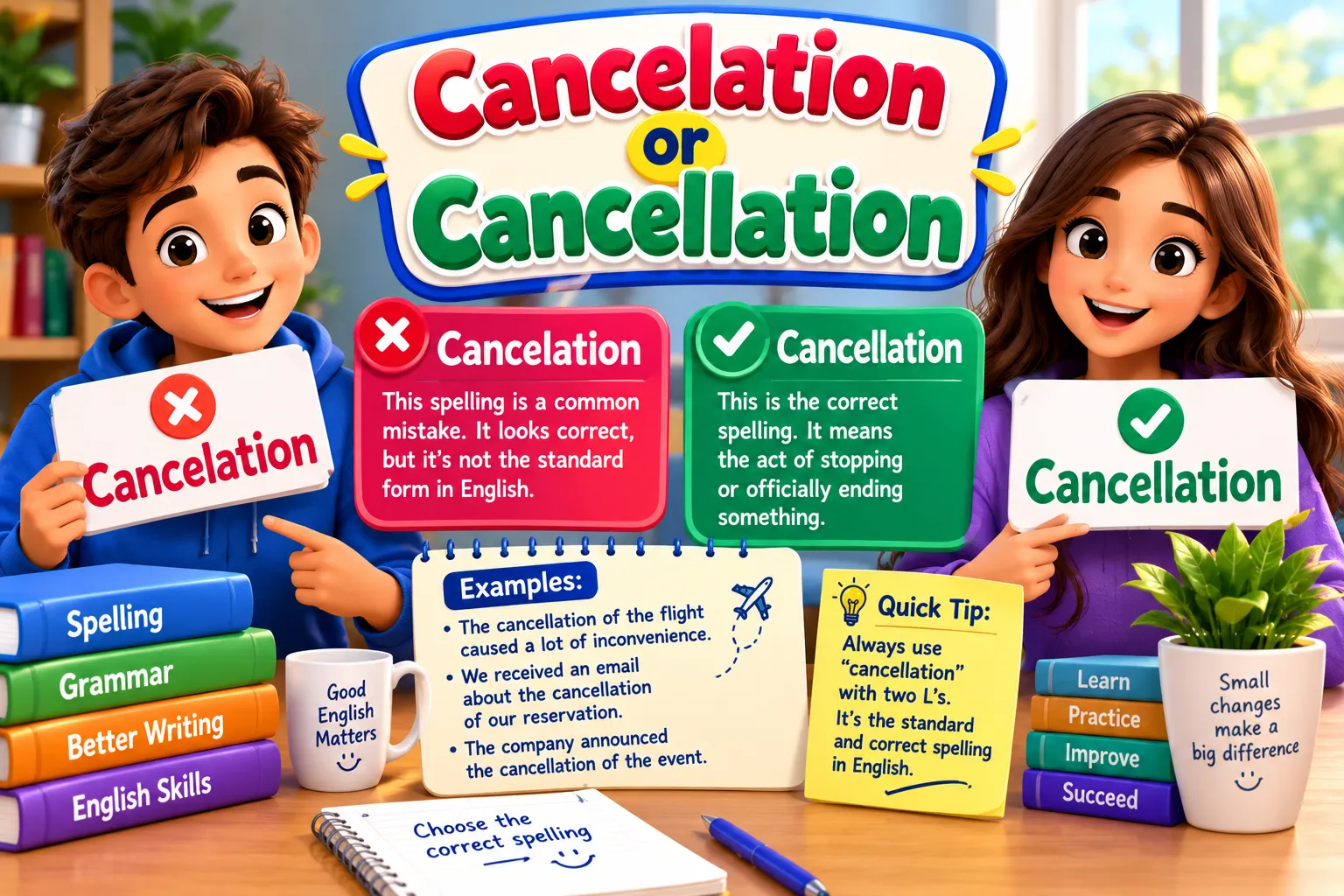
Cancellation is the standard and widely preferred spelling of the noun in English. Cancelation is also accepted as a less common variant, but cancellation is the safest choice for school, work, business, and formal writing.
Have you ever written the word cancellation and wondered whether it needs one L or two? You are not alone. This small spelling choice can confuse even strong English writers.
Imagine you are writing an email to cancel a hotel booking. You type, “Your cancelation request has been approved.” The message looks fine, but then you notice another version: “Your cancellation request has been approved.” Which one should you use?
The answer is simple, but there is a small detail worth knowing.
Both cancelation and cancellation are recognized spellings. However, they are not equally common. Most writers use cancellation, and major dictionaries support it as the standard form. The single-L spelling appears less often.
When I explain this spelling difference to English learners, I recommend learning the common form first. It saves time and helps you write with confidence.
In this guide, you will learn the correct spelling, the meaning of each version, the reason for the double L, and how to use the word in real situations. You will also find practical examples, common mistakes, and answers to frequently asked questions.
By the end, you will know which spelling to choose and why.
Cancelation or Cancellation Quick Answer
Cancellation is the preferred spelling for most English writing. It means the act of stopping something that was planned, arranged, or ordered.
For example:
- The airline announced the cancellation of several flights.
- Please read our cancellation policy before booking.
The word cancelation has the same basic meaning. However, it is much less common.
According to the Oxford University Press, the Oxford Learner’s Dictionary lists cancellation as the main spelling and recognizes cancelation as an American English variant.
The easiest rule to remember is this: use cancellation unless you have a specific reason to use the less common variant.
The Origin and Background of Cancellation
The spelling of cancellation becomes easier to understand when you look at its history.
The word is linked to the verb cancel, which means to stop something that was planned or arranged. Over time, English developed the noun cancellation to describe the act or result of canceling something.
The word also has roots in Latin. Etymological references trace cancel to the Latin cancellare, which had meanings linked to crossing out or marking something off.
This history helps explain why the word is used for many kinds of endings or removals.
For example, you might cancel a meeting, a subscription, a flight, or an order. In each case, something that was expected to happen or continue is stopped.
Why Are There Two Spellings?
English spelling has many variations. American and British English also differ in several spelling patterns.
Consider these examples:
- Canceled / cancelled
- Canceling / cancelling
- Cancellation / cancelation
American English often favors one L in canceled and canceling. British English usually uses two Ls in cancelled and cancelling.
However, the noun follows a different pattern. Cancellation remains the usual spelling in both American and British English.
The Cambridge University Press Cambridge Dictionary lists cancellation as its main noun entry and notes cancelation as an American variant in its Business English definition.
This is why you should not assume that every form of cancel follows the same spelling rule.
Cancelation vs. Cancellation: Key Differences
The main difference between these words is their spelling and frequency of use, not their meaning.
1. Cancellation
Cancellation is the standard and widely used form.
Use it when writing about:
- Flight or train changes
- Event cancellations
- Appointment changes
- Subscription endings
- Order cancellations
- Contract or policy cancellations
Examples:
- The company confirmed the cancellation of the event.
- A fee may apply after the deadline for cancellation.
- We received a notice about the cancellation of our service.
This spelling is suitable for formal and informal writing.
2. Cancelation
Cancelation is a recognized but less common spelling. It appears mainly as an American English variant.
Its meaning is the same as cancellation. It does not describe a different type of cancellation or a different level of formality.
Examples:
- The website recorded the cancelation of the order.
- The customer asked about the cancelation of a membership.
These sentences are understandable. Still, cancellation is the better choice for most readers.
Comparison Table
| Term | Meaning | When to Use | Region/Context |
| Cancellation | The act of stopping a planned event, service, or order | General and formal writing | Standard across English varieties |
| Cancelation | The same meaning as cancellation | When following a source’s established spelling | Less common; recognized as an American variant |
| Cancel | To stop something planned or arranged | When using the verb | Used in American and British English |
| Canceled | The past tense of cancel | To describe an action already completed | Common in American English |
| Cancelled | The past tense of cancel | To describe an action already completed | Common in British English |
Remember: The noun is usually cancellation, even when the past-tense verb is spelled canceled.
Which Spelling Should You Use?
Your choice may depend on your audience, but the decision is usually straightforward.
For Students
Use cancellation in essays, exams, homework, and other school assignments.
It is the more familiar spelling and is widely accepted in dictionaries. It is also a safe choice when your teacher expects standard written English.
For Business Writers
Choose cancellation in emails, contracts, reports, invoices, and customer notices.
For example:
“The cancellation of your booking has been confirmed.”
This spelling looks natural in professional communication and is understood internationally.
For American English Writers
You may see cancelation in American publications, but cancellation remains the stronger default.
The American tendency to use canceled and canceling does not mean you should automatically write cancelation.
For British English Writers
Use cancellation.
It follows the standard spelling used in British English and fits formal documents, news reports, and everyday messages.
For International Readers
If your content is meant for people around the world, use cancellation.
It is widely recognized and avoids an unusual spelling that some readers may mistake for a typo.
Common Mistakes with Cancelation and Cancellation
Even a small spelling error can make your writing look less polished. Here are five mistakes to avoid.
Mistake 1: Assuming Cancelation Is Always Wrong
Incorrect assumption: Cancelation is never a real word.
Better understanding: Cancelation is a recognized variant, but cancellation is more common.
Do not confuse a rare spelling with a completely invalid word.
Mistake 2: Using Cancelation in Every Situation
Less preferred: We received your cancelation request.
Recommended: We received your cancellation request.
The second version is more familiar to most English readers.
Mistake 3: Confusing the Noun with the Verb
Incorrect: The cancellation the meeting yesterday.
Correct: The cancellation of the meeting was announced yesterday.
Also correct: The organizers canceled the meeting yesterday.
Use cancellation as a noun and cancel as a verb.
Mistake 4: Assuming American English Always Uses One L
Incorrect assumption: American English always removes the second L.
Correct understanding: American English commonly uses canceled and canceling, but cancellation remains the standard noun spelling.
Learn each form rather than applying one rule to every word.
Mistake 5: Mixing Spelling Styles in One Document
Less consistent: The event was canceled, but the notice mentioned a cancellation fee and a cancelled booking.
Better: The event was canceled, but the notice mentioned a cancellation fee and a canceled booking.
The second example follows common American spelling for the verb while retaining the standard noun.
Consistency helps readers follow your writing without distraction.
Cancelation or Cancellation in Real World Examples
Seeing the word in everyday situations makes its correct use easier to remember.
1. In a Professional Email
Dear Customer,
We have received your request to cancel your reservation. Your cancellation has been processed successfully.
Please review the refund details in your account. If you have any questions, feel free to contact our support team.
Kind regards,
Customer Support Team
Why it works: Cancellation clearly describes the result of ending a booking.
2. In a News Headline
Example headline: Heavy Rain Leads to Cancellation of Outdoor Festival
Here, cancellation tells readers that the planned festival will no longer take place.
3. In a Social Media Post
Due to unexpected weather conditions, we have announced the cancellation of Saturday’s outdoor event. We apologize for the change and will share new details as soon as they are available.
This example shows how the word can communicate an important update in a short message.
4. In a Formal Report
Example:
“The department reviewed all service cancellation requests received during the reporting period. Each request was checked against the organization’s existing policy.”
In a report, cancellation helps describe a process in a clear and professional way.
Cancelation or Cancellation Data, Trends and Usage
Which spelling appears more often? Available dictionary guidance offers a clear starting point.
Which Form Is More Common?
The double-L form, cancellation, is the more widely used spelling.
The Oxford Learner’s Dictionary lists it as the main entry and identifies cancelation as an American English variant. Cambridge also uses cancellation as its principal entry.
This supports using the double-L form as your default.
What About Search Volume?
Exact monthly search volumes for cancelation and cancellation require current keyword data from a tool such as Ahrefs, Semrush, or Google Keyword Planner.
I do not have verified, current figures for these two queries, so I will not invent monthly search numbers or percentages.
For SEO writers, a sensible approach is to use cancellation naturally in the title, headings, and main text. You can mention cancelation once where relevant to answer readers who search for the alternate spelling.
What Does Corpus Data Tell Us?
Google Books’ Ngram Viewer lets users compare how often words appear in published books over time. Its results depend on the selected language corpus and date range.
A precise frequency comparison for cancellation and cancelation should be run with those exact terms in the same corpus. Without verified results, it would be misleading to provide a numerical ratio.
Why Does This Topic Matter?
People write booking requests, customer notices, refund policies, and business emails every day.
A spelling checker may flag an uncommon variant, even when a dictionary recognizes it. Knowing the standard form helps you make a confident choice rather than relying on a tool alone.
SEO takeaway: Focus on the reader’s main question. Explain the difference, give examples, and recommend the standard spelling without repeating the keyword unnaturally.
A Second Comparison Table: Related Forms of Cancel
The noun cancellation belongs to a family of words. Learning the forms together can help you avoid spelling mistakes.
| Term/Variant | Meaning | Region/Context | Best Used When |
| Cancel | To stop a planned action or arrangement | General English | Describing the action |
| Cancels | Stops something; present-tense verb | General English | Writing about a current or regular action |
| Canceled | The action has already happened | Common American English | Describing a past action |
| Cancelled | The action has already happened | Common British English | Describing a past action |
| Canceling | The act of stopping something | Common American English | Describing an ongoing action |
| Cancelling | The act of stopping something | Common British English | Describing an ongoing action |
| Cancellation | The act or result of canceling | Standard internationally | Referring to the event or process |
| Cancelation | An alternative spelling of cancellation | Less common American variant | Matching a source that uses this spelling |
Notice that the spelling changes depending on the grammatical form. Cancel is a verb, while cancellation is a noun.
These are related words, but they do not all follow the same spelling pattern.
Frequently Asked Questions
Q1: What does cancelation or cancellation mean?
A: Both words refer to stopping something that was planned, arranged, or ordered. For example, ending a hotel booking or calling off a scheduled meeting can be described as a cancellation.
Q2: Is cancelation or cancellation correct?
A: Both spellings are recognized, but cancellation is the standard and more widely used form. Oxford lists cancelation as an American English variant.
Q3: Why does cancellation have two Ls?
A: The spelling of cancellation is established by convention and word history. Although American English often drops the second L in canceled and canceling, the noun generally retains both Ls.
Q4: Is cancelation acceptable in formal writing?
A: It is a recognized variant, but cancellation is the safer choice for formal writing. Use it in school assignments, reports, business documents, and professional emails unless a specific style guide requires otherwise.
Q5: Is cancellation the correct spelling in American English?
A: Yes. American English uses cancellation as the standard noun spelling. The single-L version, cancelation, is also recognized but less common.
Q6: What is the difference between cancellation and canceled?
A: Cancellation is a noun that names the act or result of stopping something. Canceled is a past-tense verb or past participle, as in “The airline canceled the flight.”
Q7: How do you spell cancellation policy?
A: The standard spelling is cancellation policy. This phrase describes the rules for ending a booking, subscription, order, or agreement.
Conclusion: Cancelation or Cancellation?
Choosing between cancelation and cancellation is easier once you understand how the two forms are used.
Both spellings have the same basic meaning, but cancellation is the standard choice for most English writing. It is widely used in American and British English and is the form listed as the main entry in major learner’s dictionaries.
Keep these three points in mind:
- Use cancellation in formal and everyday writing.
- Recognize cancelation as a less common variant rather than a different word.
- Learn the related forms separately: canceled is common in American English, while cancelled is common in British English.
If you are writing a school assignment, preparing a business email, or publishing an SEO article, the double-L form is your best option.
You do not need to second-guess every spelling choice. Once you learn the pattern, it becomes much easier to write clearly and confidently.
Bookmark this guide so you can choose the correct spelling whenever cancelation or cancellation leaves you unsure.
Readmore

I’m **Rubab Naaz**, an English language content writer with over 10 years of experience creating educational and SEO-focused articles. I specialize in spelling comparisons, grammar, vocabulary, synonyms, commonly confused words, and English usage. My passion is helping students, writers, and professionals improve their language skills through accurate, well-researched, and easy-to-understand content. Every article I write is designed to make learning English simple, practical, and engaging.










