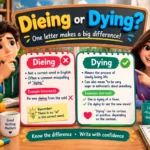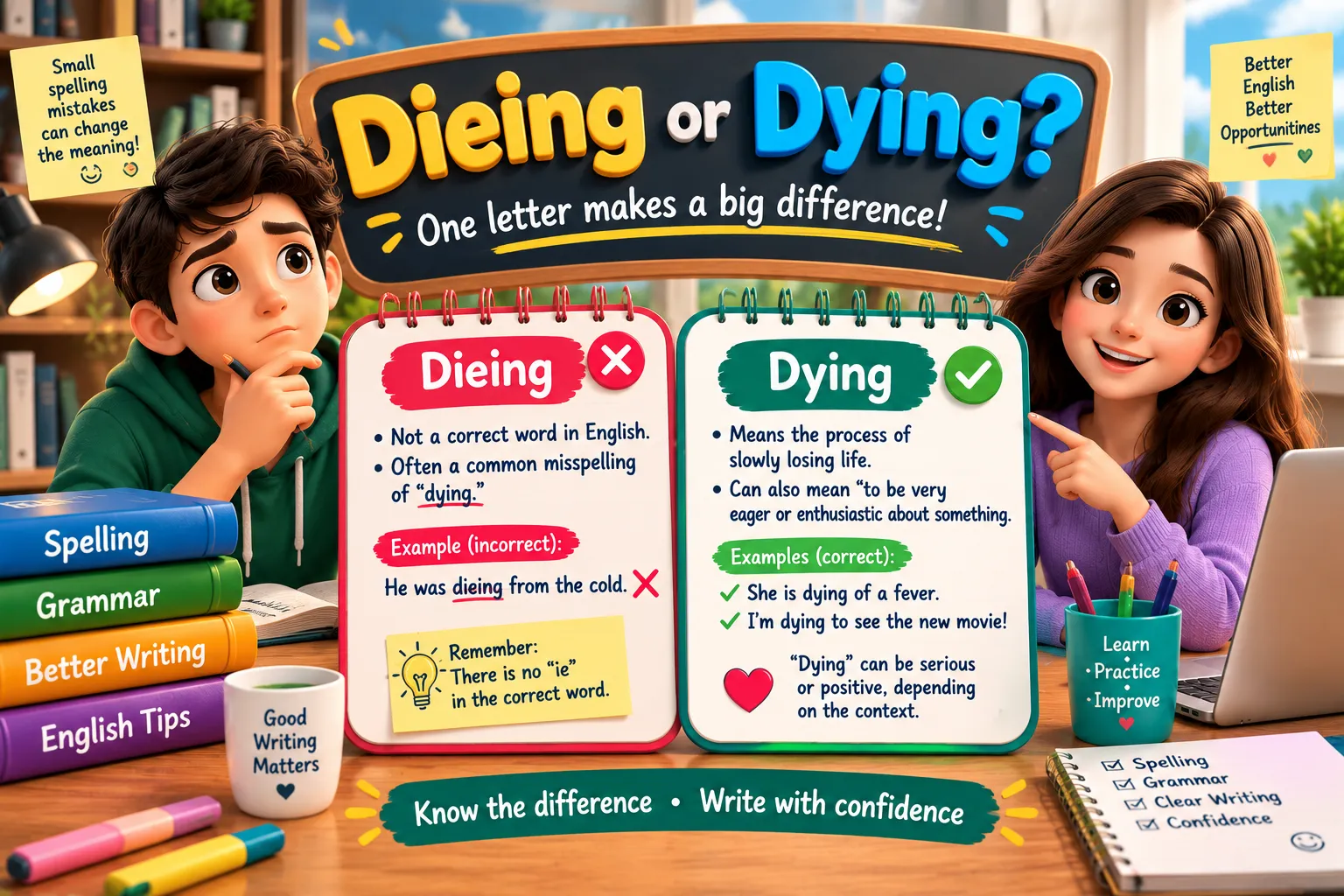
Dying is the correct spelling when someone or something is coming to an end or losing life. Dieing is usually a misspelling in this context. Do not confuse dying with dyeing, which means coloring something.
Have you ever typed a sentence and stopped because you were unsure whether to write dieing or dying? I have seen how a small spelling question can make even a simple sentence feel confusing. You may know what you want to say, but the extra letter can make you pause.
Imagine writing, “The flowers are dieing because I forgot to water them.” The meaning is clear, but the spelling is wrong. The correct sentence is, “The flowers are dying because I forgot to water them.”
At first, the spelling may seem strange. Most verbs take -ing when we talk about an action in progress. For example, help becomes helping, and read becomes reading. So why does die become dying instead of dieing?
The answer lies in a simple English spelling rule. When a verb ends in -ie, we usually change those letters to -y before adding -ing. This rule also applies to words such as lie and tie.
In this guide, you will learn the difference between dieing, dying, and dyeing. You will also see useful examples, common mistakes, and easy ways to remember the correct spelling.
Dieing or Dying Quick Answer
Dying is the standard spelling of the -ing form of the verb die. It can describe a living thing losing life, a machine stopping, or something becoming less active.
The spelling dieing is generally incorrect when you mean that someone or something is dying.
Here are two examples:
- Correct: “The old tree is dying because it has no water.”
- Incorrect: “The old tree is dieing because it has no water.”
There is one more word to remember: dyeing. It means changing the color of something, such as fabric, hair, or clothing.
For example, “She is dyeing her white shirt blue.”
The key is to understand the meaning of your sentence before choosing the spelling.
The Origin and Background of Dying
The word dying comes from the verb die. According to the etymology dictionary, the word has been used since the late 13th century as a noun related to death. Its use as an adjective describing someone or something in the process of dying dates to the mid-15th century.
The verb die has an even older history. The same source traces it to Middle English forms recorded in the mid-12th century. Its earlier roots may be linked to Old Norse and Old Danish words with similar meanings.
But why do we spell it dying instead of dieing?
English has a spelling rule for verbs that end in -ie. When we add -ing, we change -ie to -y.
For example:
- Die → dying
- Lie → lying
- Tie → tying
The rule keeps the spelling clear and consistent.
The confusion also comes from another English word: dye. Since dye means to add color, its -ing form is dyeing. Keeping the e helps distinguish it from dying.
According to cambridge dictionary spelling guide, verbs ending in -ie change those letters to -y before -ing is added. The dictionary also highlights the difference between dying and dyeing.
Dieing or Dying Explained: Key Differences
The main difference is spelling and meaning. Dying is the correct form of die when an action or process is happening. Dyeing comes from dye and describes adding color.
Dieing may appear in rare technical contexts related to the use of a die, a tool used to cut or shape materials. However, it is not the spelling you should use for the process of losing life. In manufacturing, terms such as die-cutting are often clearer.
Here is a simple comparison:
| Term | Meaning | When to Use | Region/Context |
| Dying | Losing life or gradually coming to an end | When describing death, fading, or stopping | Standard English |
| Dieing | A rare or specialized form associated with the word die as a tool; usually a misspelling of dying | Avoid it when you mean losing life | Rare technical use |
| Dyeing | Adding or changing color | When coloring fabric, hair, or other materials | Standard English |
| Die | The base verb meaning to stop living or cease to function | For the base form of the verb | Standard English |
| Died | The past tense of die | For an action that happened in the past | Standard English |
Examples of Each Word
Dying:
- The patient is receiving care while dying.
- My phone battery is dying.
- The old tradition is slowly dying out.
Dieing:
- The machine uses a die-cutting process to shape the material.
In formal writing, it is usually better to use a clear term such as die-cutting when discussing manufacturing.
Dyeing:
- He is dyeing his hair brown.
- The company specializes in dyeing cotton fabric.
Die:
- Some plants die without enough sunlight.
Died:
- The plant died during the dry season.
Notice how each word fits a different meaning or grammatical role. Once you understand the context, choosing the right form becomes much easier.
Which Version Should You Use?
The best choice depends on what you want to say. For most everyday writing, the decision is simple: use dying when you mean the process of losing life or gradually coming to an end.
For Students and English Learners
Use dying when writing about a person, animal, plant, or thing that is losing life or strength.
For example:
- The flowers are dying.
- The battery is dying.
- The language is slowly dying out.
Remember this pattern: die → dying.
For Bloggers and Content Writers
Use dying in articles about health, nature, aging, fading traditions, or things that are becoming less common.
For example:
- Why Are Coral Reefs Dying?
- Are Printed Newspapers a Dying Industry?
Use dyeing when your content discusses hair color, textile production, or fabric crafts.
For example:
- A Beginner’s Guide to Dyeing Cotton at Home
Choosing the correct spelling helps readers understand your topic and makes your content look professional.
For Business and Formal Writing
Use the standard spelling in reports, emails, and professional documents.
If you are describing a machine or manufacturing process, check the correct technical term. Die-cutting is commonly used for cutting materials with a shaped tool.
Avoid using dieing when you mean that a business, system, or living thing is declining.
For Global English
If your readers come from different countries, use dying for the ordinary -ing form of die. The spelling is standard in both American and British English.
There is no need to choose a regional variant for this word.
Common Mistakes with Dieing or Dying
Even experienced writers can make spelling mistakes when words follow unusual patterns. Here are five errors to watch for.
1. Writing Dieing Instead of Dying
Incorrect: The grass is dieing in the heat.
Correct: The grass is dying in the heat.
Why? The verb die changes from -ie to -y before -ing is added.
2. Confusing Dying with Dyeing
Incorrect: She is dying her hair red.
Correct: She is dyeing her hair red.
Why? The sentence describes changing hair color, not losing life. The correct verb is dye.
3. Using Dying for a Past Event
Incorrect: The plant was dying yesterday, but it recovered last night. (This can be correct if the process was happening yesterday.)
Correct for a completed event: The plant died yesterday.
Why? Use died when describing a completed event in the past. Use dying when describing a process that was happening.
4. Adding an Extra Letter to the Base Verb
Incorrect: The injured bird is dieing.
Correct: The injured bird is dying.
Why? The usual spelling rule changes -ie to -y before -ing.
5. Using Dying When You Mean Coloring
Incorrect: I am dying the curtains blue.
Correct: I am dyeing the curtains blue.
Why? Dying and dyeing sound alike, but they have different meanings. The extra e in dyeing helps show that the action involves color.
Dieing or Dying in Real World Examples
The difference matters in everyday messages, headlines, social posts, and reports. Here are examples of how to use these words in different settings.
1. Professional Email
Imagine you are updating a colleague about a computer problem.
Example:
“The laptop battery is dying quickly, so I may need to replace it before the next meeting.”
Here, dying means the battery is losing power. The spelling is correct.
2. News Headline
A news writer might report on a local environmental issue.
Example:
“Experts Warn That Local Forests Are Dying After Months of Drought”
The word dying describes trees and plants that are losing life because of dry conditions.
3. Social Media Post
Someone sharing a hair-coloring project could write:
Example:
“Trying a new shade today! I am dyeing my hair a warm brown.”
The word dyeing is correct because the person is changing their hair color.
4. Formal Report
A researcher might describe a decline in wildlife.
Example:
“The report found that several plant species were dying because of prolonged water shortages.”
The word dying describes a process that was happening during the period studied.
These examples show why context matters. Similar-looking words can have very different meanings, so always check what the sentence is trying to express.
Dieing or Dying: Data, Trends, and Usage
People often search for dieing or dying because they want to know which spelling is correct. The question is mainly about spelling and grammar, not about buying a product or finding a website.
Which Spelling Is More Common?
Dying is the standard spelling used for the present participle of die. Major learner dictionaries, including Cambridge Dictionary, list dying as the form used for the process of losing life.
Dieing is not the normal spelling for this meaning. If you see it in a sentence about death, a fading battery, or a declining tradition, it is usually an error.
Google Books Ngram Viewer lets readers compare how often words appear in books over time. You can use it to investigate the historical frequency of dying and dieing. However, no verified numerical comparison is provided here, so it would be misleading to invent percentages or frequency figures.
What About Search Volume?
Search tools such as Google Trends, Ahrefs, and Semrush can help estimate public interest in spelling questions. Exact monthly search volumes and country rankings require current data from those tools.
Without a verified report, it is better not to claim that one country searches for this phrase more often than another.
Why Does This Question Matter?
People write messages, school assignments, blog posts, and professional emails every day. A spelling checker may catch dieing, but understanding the rule helps you avoid the same mistake with lying and tying.
The main lesson is simple: learn the spelling pattern instead of relying only on autocorrect.
Dieing or Dying: A Quick Comparison Table
This table adds a practical way to choose the right word based on the meaning you want.
| Term/Variant | Meaning | Region/Context | Best Used When |
| Dying | Losing life or gradually fading | Standard English | Describing death, a failing battery, or a fading tradition |
| Dieing | Rare technical usage connected with a die tool; usually an error for dying | Specialized contexts | Only when a specific technical source confirms the form |
| Dyeing | Adding color to a material | Crafts, fashion, hair care, textiles | Describing the process of coloring something |
| Died | Completed action of die | Past tense | Describing an event that happened in the past |
| Dye | To add color | Base verb | Explaining the action of changing a material’s color |
Quick memory tip: If you mean losing life, choose dying. If you mean adding color, choose dyeing.
Frequently Asked Questions
Q: Is dieing or dying correct?
A: Dying is correct when you mean that someone or something is losing life or gradually coming to an end. Dieing is generally a misspelling in this context.
Q: Why is dying spelled with a y instead of ie?
A: English spelling rules change the final -ie to -y before adding -ing. This is why die becomes dying, just as lie becomes lying.
Q: What is the difference between dying and dyeing?
A: Dying comes from die and describes losing life or fading away. Dyeing comes from dye and means changing the color of something, such as fabric or hair.
Q: Is dieing ever a real word?
A: It can appear in rare or specialized technical contexts related to using a die, a tool for cutting or shaping materials. However, it is not the standard spelling for the process of losing life, and most writers should use dying.
Q: Is dying correct in American and British English?
A: Yes. Dying is the standard spelling in both American and British English when it comes from the verb die. You do not need to change it based on the country.
Q: What is the past tense of die?
A: The past tense is died. For example, “The tree died during the drought.” Use dying for an ongoing process, as in “The tree is dying.”
Q: How can I remember the spelling of dying?
A: Remember the pattern die → dying. When a verb ends in -ie, change those letters to -y before adding -ing. You can practice with lie → lying and tie → tying.
Conclusion: Dieing or Dying?
Choosing between dieing and dying may seem difficult at first, but the rule is easy to learn. In everyday English, dying is the correct spelling when you describe someone losing life, a plant fading, or a machine gradually stopping.
Remember these key points:
- Dying comes from the verb die.
- Dieing is generally incorrect when you mean losing life.
- Dyeing means adding color to something.
- Died is the past tense of die.
- The spelling pattern -ie → -y + -ing also applies to lying and tying.
You do not need to memorize a long list of grammar rules. Start by asking yourself what the word means in your sentence. If you are talking about life ending or something fading away, dying is the form you want. If you are talking about color, choose dyeing instead.
Now that you know the difference, try using these words in your next sentence. Bookmark this guide so you can check the spelling whenever you need it.
Readmore

I’m an English language educator and SEO content writer having experience creating clear, accurate, and engaging English learning content. I specialize in spelling differences, grammar, vocabulary, synonyms, commonly confused words, and English usage. My goal is to publish well-researched, easy-to-understand articles that help students, writers, educators, and professionals improve their English with confidence through practical explanations and real-world examples.