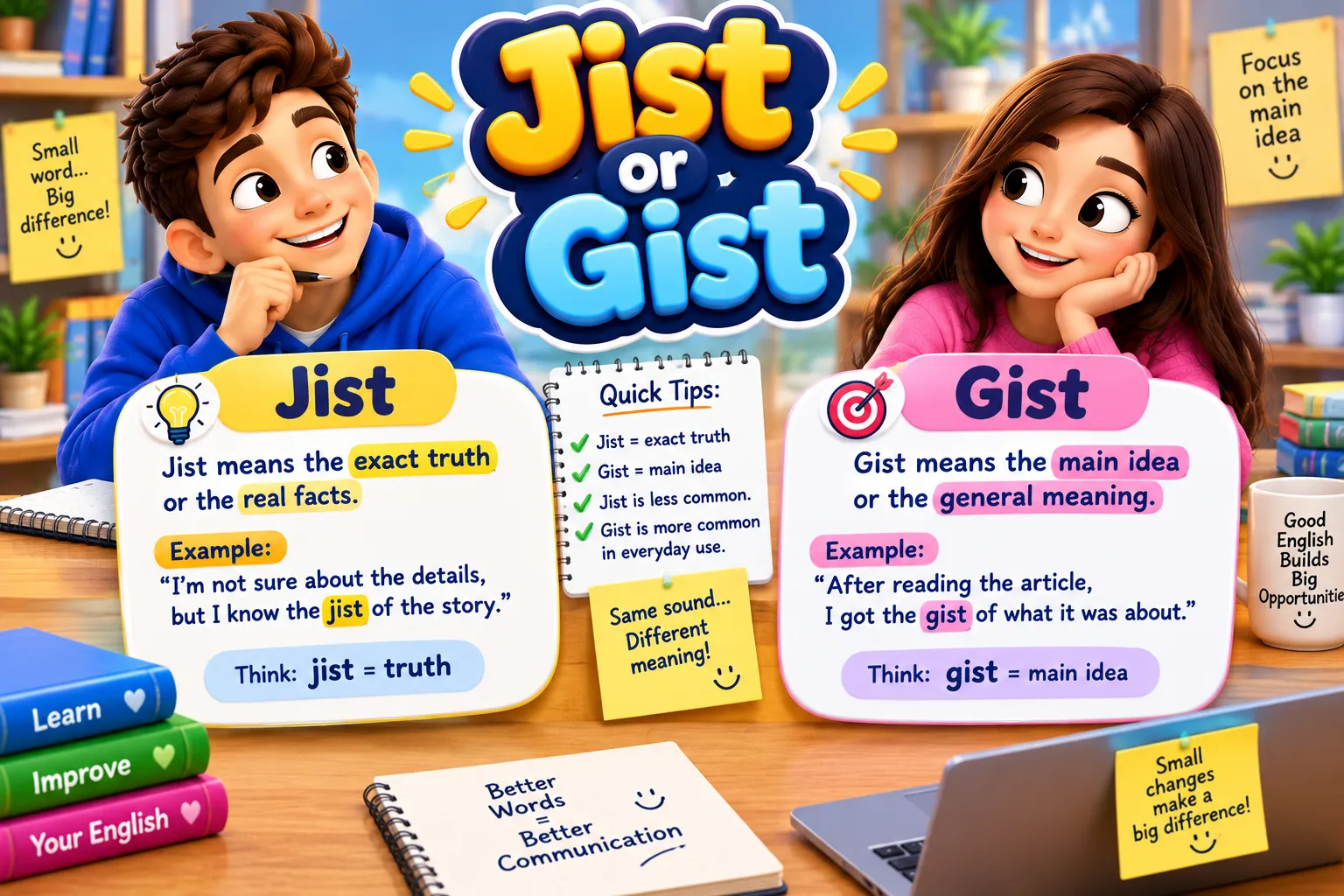
Gist is the correct standard spelling for the main idea or essential meaning of something. Jist is generally a misspelling of gist and should be avoided in formal and professional writing.
Have you ever heard someone say, “I got the jist of it,” and wondered if that spelling was correct? You are not alone. This is a common spelling mistake because the word gist begins with a soft J sound, even though it starts with the letter G.
Imagine reading a long report for school or work. You do not have time to remember every detail, but you understand the main point. You might say, “I got the gist of the report.” That is the correct spelling.
The confusion happens because English spelling does not always match pronunciation. Words like giant, gentle, and gist begin with a G that sounds like J. This can make the wrong spelling seem natural.
The good news is that the rule is simple. When you mean the main point, central idea, or essential meaning of something, write gist, not jist.
In this guide, you will learn the meaning, pronunciation, origin, and correct usage of gist. You will also see real-world examples, common mistakes, and easy tips to help you remember the correct spelling.
Jist or Gist Quick Answer
Gist is the correct spelling in standard English when you mean the main point or general meaning of something. Jist is generally considered a spelling error for this meaning.
For example:
- Correct: I understood the gist of the lesson.
- Incorrect: I understood the jist of the lesson.
The word gist is a noun. It refers to the most important part of a message, story, speech, or discussion.
According to the cambridge dictionary, gist means the most important information about something, without all the details. You can use it when you understand the main idea but not every word
The Origin and Background of Jist or Gist
The word gist has an interesting history. Its spelling comes from older legal language rather than from the way the word sounds today.
According to online etmology dictionary, gist appeared in English in the early 18th century. It came from Anglo-French legal expressions, including cest action gist, meaning roughly “this action lies.” The word later developed its familiar sense of the main point or essence of something.
Today, people use gist in everyday conversations, schoolwork, business writing, and news reports.
Why Do People Write Jist Instead of Gist?
The main reason is pronunciation.
The word gist is pronounced /dʒɪst/, with the same first sound as the word jump. The letter G can represent different sounds in English.
For example:
- G sounds like J in giant.
- G sounds like J in gentle.
- G sounds like J in gist.
- G sounds like G in garden.
This is why people may guess that the word should start with J.
However, standard spelling does not always follow the sound of a word. The correct spelling for the main idea of something remains gist.
Jist vs. Gist Explained: Key Differences
The difference between jist and gist is mainly a matter of standard spelling.
1. Gist: The Correct Standard Word
Gist is a noun that means the main idea, central point, or essential meaning of something.
You can use it when discussing:
- The main point of a conversation
- The central idea of a book
- The essential meaning of a speech
- The key message in an email
- The main argument in a report
For example:
- The teacher explained the gist of the chapter.
- Can you tell me the gist of the meeting?
- I understood the gist of the news story.
The word is especially useful when you want a short summary without every detail.
2. Jist: A Common Spelling Error
When you mean the main point of something, jist is not the standard spelling.
People often write it this way because the pronunciation sounds like it begins with J. However, this does not make jist an accepted alternative in standard writing.
For example:
- Incorrect: Please explain the jist of the story.
- Correct: Please explain the gist of the story.
The grammerly guide to gist or jist, also identifies gist as the correct spelling and jist as a common misspelling.
Comparison Table: Gist vs. Jist
| Term | Meaning | When to Use | Region/Context |
| Gist | Main point or essential meaning | Summaries, discussions, and explanations | Standard English |
| Jist | Usually a misspelling of gist | Avoid when referring to the main idea | Nonstandard spelling |
| Essence | The most important quality or meaning | Explaining the core nature of something | Standard English |
| Summary | A short account of the main points | Condensing a long text or discussion | Academic and everyday writing |
Remember: If you mean the main point of something, choose gist. You do not need to choose between two standard spellings.
Which Version Should You Use?
The correct choice is simple for most readers. Use gist when you want to describe the main idea or essential meaning of something.
For Students
Use gist in essays, homework, reading tasks, and exam answers.
For example:
“The gist of the poem is that kindness can change a person’s life.”
If your teacher asks you to explain the gist of a passage, they want you to describe its main message rather than repeat every detail.
For Professionals
Use gist in emails, meeting notes, reports, and presentations.
For example:
“Please send me the gist of the client discussion before the afternoon meeting.”
This sentence asks for the key information, not a full transcript.
For Everyday Conversations
You can use gist in casual speech and messages.
For example:
“I missed the beginning of the film, but I got the gist of the story.”
This means you understood the main idea despite missing some details.
For Formal and Global English
Use gist in formal documents and standard English writing. It is recognized in British and American English.
Avoid jist when writing an assignment, business email, article, or report.
Common Mistakes with Jist or Gist
Here are five common errors and how to correct them.
Mistake 1: Using Jist in a Sentence
Incorrect: I got the jist of the conversation.
Correct: I got the gist of the conversation.
Why? The standard spelling of the noun is gist.
Mistake 2: Using Gist When You Mean Every Detail
Incorrect: I know the gist of every word in the document.
Better: I understand the gist of the document, but I have not checked every detail.
Why? Gist refers to the main idea, not every small piece of information.
Mistake 3: Writing “The Jist of It”
Incorrect: Here is the jist of it.
Correct: Here is the gist of it.
Why? The common phrase uses the standard spelling gist.
Mistake 4: Confusing Gist with a Full Summary
Incorrect: Give me the gist of the report, including every detail and figure.
Better: Give me the gist of the report, including its main findings.
Why? A gist focuses on the central point. A detailed summary may include many supporting facts.
Mistake 5: Using Gist Without Clear Context
Unclear: I got the gist.
Clearer: I got the gist of the manager’s instructions.
Why? The shorter version can be correct when the context is clear. Adding the subject helps readers understand what you mean.
Jist or Gist in Real World Examples
The word gist works in many forms of communication. Here are four examples showing how to use it naturally.
1. Professional Email
Hello Team,
Could you please send me the gist of today’s client meeting?
I would like to review the main concerns, key decisions, and next steps before preparing the project update.
Thank you for your help.
Best regards,
Alex
2. News Headline
New Report Explains the Gist of Proposed Education Reforms
In this headline, gist refers to the main ideas behind the proposed changes.
A news article may give readers the essential points first, then explain the background and details.
3. Social Media Post
Quick spelling tip! ✍️
The correct spelling is GIST, not jist, when you mean the main point or central idea of something.
Example: “I read the article and understood the gist.”
Remember: It sounds like “jist,” but the correct spelling starts with G.
Save this tip to improve your English!
4. Formal Report
Executive Summary
The gist of the survey findings is that customers want faster service and clearer product information. The full report provides additional data, supporting comments, and recommendations.
This wording gives readers the main message before they review the complete findings.
Jist or Gist Data, Trends, and Usage
People search for jist or gist because they want to know which spelling is correct. The search intent is mainly informational.
However, it is important to separate confirmed language facts from search statistics.
Search Volume and Google Trends
No verified monthly search-volume figures for jist or gist are available in this article. Exact numbers should not be guessed because search volume changes by location, date, and keyword research tool.
You can check interest in related searches using google trends. Compare phrases such as:
- Jist or gist
- Gist meaning
- Gist in a sentence
- The gist of it
- Correct spelling of gist
Google Trends measures relative search interest on a normalized scale. Its scores are not the same as monthly search counts. For exact search-volume estimates, use a keyword research tool and record the date and location of the data.
Word Frequency and Everyday Usage
The standard word gist appears in everyday English, education, business communication, and legal writing.
It is especially common in phrases such as:
- Get the gist
- The gist of the story
- The gist of the conversation
- Give me the gist
The spelling jist is commonly treated as an error when the intended meaning is the main point or essential meaning.
No exact corpus frequency or regional search figures are claimed here because a specific dataset has not been verified.
Why This Spelling Matters
A single spelling error can distract readers from your message. This matters in school assignments, professional documents, online articles, and emails.
Learning the correct form also helps English learners understand how pronunciation and spelling can differ.
Jist or Gist: A Standalone Comparison Table
This table adds related words that can help you choose the best term for your sentence.
| Term/Variant | Meaning | Region/Context | Best Used When |
| Gist | Main point or essential meaning | Standard English | Explaining the central idea |
| Jist | Common misspelling of gist | Nonstandard in this meaning | Avoid in formal writing |
| Essence | Core nature or most important quality | Standard English | Describing what matters most |
| Main idea | The central message or thought | Education and everyday English | Explaining a passage or discussion |
| Summary | A shortened account of key points | Academic and professional writing | Condensing a longer text |
| Overview | A general description of a subject | Reports and presentations | Introducing a topic before details |
Although these words are related, they are not always interchangeable.
A gist is the core meaning. A summary may include several key points. An overview gives a broad picture of a subject.
Frequently Asked Questions
Q1: What does gist mean?
A: Gist means the main point or essential meaning of something. It helps you describe the central idea without including every detail.
Q2: Is jist ever the correct spelling?
A: When you mean the main point or essential meaning, gist is the standard spelling. Although rare or dialectal forms may appear in some historical or regional sources, use gist in standard modern writing.
Q3: How do you use gist in a sentence?
A: You can use gist when talking about the main idea of a text, conversation, or explanation. For example, “After listening to the instructions, I understood the gist of the task.”
Q4: Is gist acceptable in formal writing?
A: Yes. Gist is a standard English noun that can be used in reports, essays, business documents, and academic discussions. Choose a more specific word if your sentence requires greater detail.
Q5: Why is gist pronounced like jist?
A: In this word, the letter G represents the same sound heard at the start of jump. English uses both hard and soft G sounds, so pronunciation alone does not always reveal the correct spelling.
Q6: Where does the word gist come from?
A: The word entered English through Anglo-French legal language in the early 18th century. Its meaning later expanded to include the main point or essence of a matter.
Q7: What is the difference between gist and summary?
A: Gist refers to the central meaning or most important point. A summary is a shortened account that may include several important ideas and supporting details.
Conclusion: Remember the Correct Spelling of Jist or Gist
The difference between jist and gist is easy to remember once you focus on standard spelling rather than pronunciation.
Gist is the correct standard word when you mean the main idea, central point, or essential meaning of something. The spelling jist is generally considered incorrect for this meaning.
You can use gist when discussing a book, article, conversation, speech, report, or set of instructions. It is useful when you want to communicate the main message without repeating every detail.
Remember these key points:
- Write gist, not jist, in standard English.
- Use gist to describe the main point or essential meaning.
- Do not confuse a gist with a full summary.
- Check spelling carefully in academic and professional writing.
The next time you hear the word pronounced, remember that its first sound may resemble J, but its standard spelling begins with G.
Bookmark this guide and share it with someone who wants to improve their English spelling!
Readmore

I’m Daniel sultan, an English language writer and SEO content specialist with experience researching spelling, grammar, vocabulary, and English usage. Through SpellComparison.com, I create clear, accurate, and well-researched guides that help readers understand commonly confused words, spelling differences, and grammar rules with confidence.
Every article I write is based on trusted language references, established style guides, and real-world usage to ensure it is accurate, practical, and easy to understand. My goal is to make learning English simple and reliable by providing fact-checked content, clear explanations, and real-life examples that students, writers, educators, and professionals can trust.










