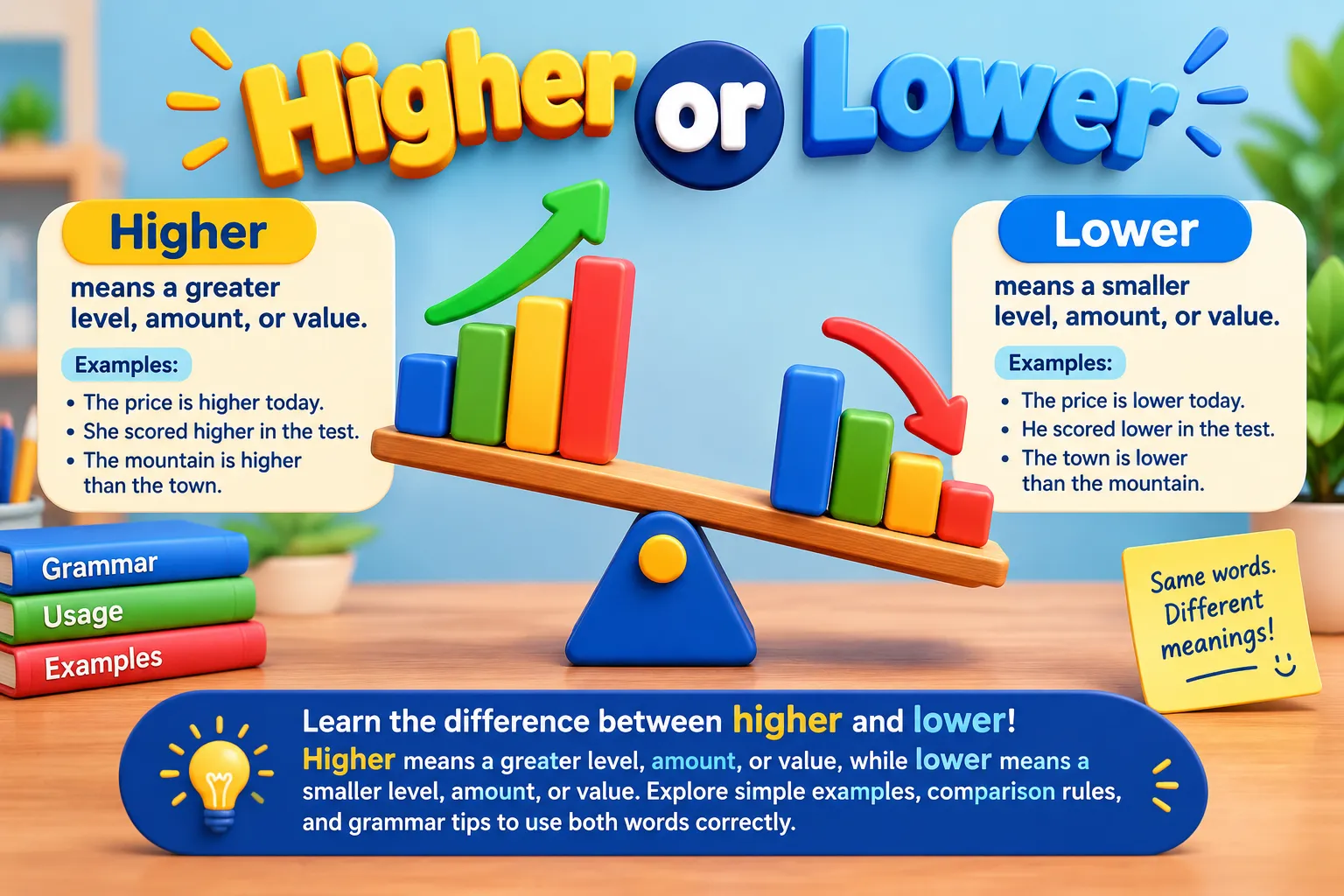
Higher means greater in height, amount, level, or degree, while lower means less in height, amount, level, or degree. Use higher or lower to compare prices, temperatures, scores, levels, and many other things.
Have you ever checked a price, looked at a test score, or compared two numbers and wondered whether to use higher or lower? These words are simple, but choosing the right one depends on what you want to compare.
Imagine checking the weather before leaving home. The temperature was 20°C yesterday and 28°C today. You might say the temperature is higher today. Now imagine your monthly bill drops from $100 to $75. You would say the bill is lower this month.
I often see learners struggle with these words because they focus on the numbers instead of the direction of change. The good news is that the rule is easy to learn.
Both words help us compare two or more things. However, they point in opposite directions. One shows an increase or a greater level, while the other shows a decrease or a smaller level.
In this guide, you will learn the meaning of higher or lower, the difference between them, their grammar rules, and common mistakes. You will also find practical examples for school, work, daily life, and online conversations.
Let’s start with the basic meanings.
Higher or Lower Quick Answer
Higher means that something has a greater height, amount, value, or level than something else. Lower means that it has a smaller height, amount, value, or level.
Here are two simple examples:
- The new building is higher than the old one.
- The price of the product is lower this week.
Think of a ladder. Moving up takes you higher, while moving down takes you lower. The same idea applies to numbers, costs, temperatures, and many other measurements.
According to the Cambridge Dictionary, higher is the comparative form of high. Comparative words help us show how two things differ.
The Origin and Background of Higher or Lower
The words higher and lower come from the adjectives high and low. Adding -er creates their comparative forms.
English uses comparative forms to compare people, objects, places, and ideas.
For example:
- High → Higher → Highest
- Low → Lower → Lowest
The first form describes a level or quality. The second compares two things. The third usually identifies the greatest or smallest level in a group.
The Cambridge Dictionary are useful resources for checking word meanings, forms, and usage. Cambridge explains that comparative adjectives show differences in a quality or amount.
Why Do People Confuse Higher and Lower?
The main reason is that the meaning depends on the thing being measured.
A higher price means more money. A higher score means more points. A higher temperature means a warmer reading.
However, a lower price means less money, a lower score means fewer points, and a lower temperature means a cooler reading.
The words are opposites, but both are correct. You simply need to choose the one that matches the comparison.
Higher vs. Lower: Key Differences Explained
The easiest way to understand these words is to compare their meanings and uses.
1. Higher
Use higher when something has a greater value, amount, position, or level.
Examples:
- The airplane flew at a higher altitude.
- This school has a higher pass rate.
- My internet bill is higher this month.
- She hopes to get a higher score on her next test.
Higher can describe physical position. It can also describe abstract ideas, such as standards, costs, and education levels.
For example, higher education refers to education beyond school, such as college or university study.
2. Lower
Use lower when something has a smaller value, amount, position, or level.
Examples:
- The plane moved to a lower altitude.
- Our team had a lower pass rate.
- The shop offered a lower price.
- He wants to keep his monthly expenses lower.
Lower can also describe a physical position, such as a lower shelf or a lower floor.
In other situations, it describes a reduction in cost, risk, speed, or level.
Comparison Table: Higher vs. Lower
| Term | Meaning | When to Use | Example |
| Higher | Greater in amount or level | Prices, scores, temperatures, height | The score is higher today. |
| Lower | Smaller in amount or level | Costs, risks, numbers, position | The cost is lower now. |
| Highest | Greater than all others in a group | Finding the maximum | This is the highest score in class. |
| Lowest | Smaller than all others in a group | Finding the minimum | January had the lowest sales. |
Quick tip: Higher and lower compare things. Highest and lowest usually identify the top or bottom value in a group.
Which Word Should You Use?
Your choice depends on what you are trying to say.
For Students
Use higher when comparing better or greater numerical results.
For example, a student who gets 90 marks has a higher score than a student who gets 75 marks.
Use lower when the number is smaller.
For example, a score of 60 is lower than a score of 80.
Remember that a higher number does not always mean better performance. In some grading systems, a lower numerical grade may represent better performance.
For Professionals
Use higher and lower to compare prices, sales, costs, risks, targets, and performance levels.
Examples:
- The company reported higher sales in June.
- We found a supplier with lower delivery costs.
- The new plan carries a higher risk.
- The revised budget sets a lower spending limit.
In professional writing, these words help you communicate changes without using long explanations.
For Everyday Conversations
Use these words when talking about ordinary things.
Examples:
- The shelf is too high for me to reach.
- Please move the chair to a lower position.
- Today’s temperature is higher than yesterday’s.
- This phone has a lower price than the other one.
For Global or Neutral English
Both words are standard in British and American English.
You do not need to choose between different regional spellings. Instead, focus on the meaning and the context.
Common Mistakes with Higher or Lower
Even experienced English users can make mistakes when comparing values. Here are five errors to avoid.
Mistake 1: Using Higher When You Mean Lower
Incorrect: The shop reduced the price, so it is higher now.
Correct: The shop reduced the price, so it is lower now.
Why? A reduction means the price has decreased.
Mistake 2: Using Lower When You Mean Higher
Incorrect: The temperature increased from 15°C to 25°C, so it is lower.
Correct: The temperature increased from 15°C to 25°C, so it is higher.
Why? The new temperature is greater than the old one.
Mistake 3: Using More Higher
Incorrect: This tower is more higher than that one.
Correct: This tower is higher than that one.
Why? Higher already expresses comparison. You do not normally need more before it.
Mistake 4: Using More Lower
Incorrect: This price is more lower than the other price.
Correct: This price is lower than the other price.
Why? Lower is already the comparative form of low.
You can say much lower or far lower when you want to make the difference stronger.
Mistake 5: Confusing Higher with Highest
Incorrect: This is the higher mountain in the country.
Correct: This is the highest mountain in the country.
Why? Higher usually compares one thing with another. Highest normally identifies the greatest height in a group.
These rules follow the standard patterns for comparative and superlative adjectives explained in cambridge gramer.
Higher or Lower in Real World Examples
The words higher and lower appear in emails, reports, headlines, and everyday posts. Here is how to use them naturally in different settings.
1. Professional Email
Subject: Updated Project Costs
Hello Team,
The latest review shows that material costs are higher than we expected. We have found another supplier that offers lower rates.
Please review both options before we approve the final budget.
Best regards,
Alex
2. News Headline
Food Prices Rise as Household Costs Reach Higher Levels
This headline uses higher to show that household costs have increased.
A different headline could read:
New Policy Aims to Bring Housing Costs Lower
Here, lower expresses the goal of reducing costs.
3. Social Media Post
Today’s challenge: Can you spot the higher and lower numbers?
📈 145
📉 98
The higher number is 145, while the lower number is 98.
Try making your own comparison in the comments!
4. Formal Report
Quarterly Performance Summary
The report shows higher customer demand during the second quarter. At the same time, the company recorded lower operating costs after reviewing its supply process.
These changes may support improved financial performance in the next quarter.
Each example uses the words to show a clear comparison. The meaning changes with the subject, but the basic rule stays the same.
Higher or Lower Data, Trends, and Usage
Higher and lower are useful in many fields because people often need to compare numbers and levels.
However, it is important to separate general language facts from measured search data.
Search Volume and Google Trends
There is no verified search-volume figure included here for the exact phrase “higher or lower.” Giving a monthly number without checking a keyword research tool would be misleading.
You can compare search interest using google trends. Its results show relative search interest over a selected period and location. They do not directly provide the same information as a keyword tool’s monthly search-volume estimate.
For SEO research, compare phrases such as:
- Higher or lower meaning
- Higher vs. lower
- Difference between higher and lower
- How to use higher and lower
These searches may reflect different needs. Some people want a definition, while others need help with grammar or a specific comparison.
Word Frequency and Common Uses
Higher and lower are both standard comparative forms. Their frequency depends on the topic and context.
For example, financial reports may use higher costs and lower profits. Weather reports may use higher temperatures and lower temperatures. School reports may compare higher marks and lower marks.
A reliable frequency comparison would require a defined corpus, such as a collection of books or news articles, and a specific time range. No exact frequency figures are claimed here.
Why These Words Matter Today
People compare numbers every day. They read prices online, check exam results, review bills, and study business reports.
Clear comparisons help readers understand changes quickly. This is also useful for people learning English as a second language.
For writers, the goal is simple: choose the word that matches the direction of the change, then give enough context for readers to understand the comparison.
Higher or Lower: A Standalone Comparison Table
This table adds related terms and shows when each one is most useful.
| Term/Variant | Meaning | Region/Context | Best Used When |
| Higher | Greater in height, amount, or level | Standard English | Comparing two values or levels |
| Lower | Smaller in height, amount, or level | Standard English | Showing a smaller value or position |
| Highest | Greater than all others in a group | Standard English | Identifying the maximum |
| Lowest | Smaller than all others in a group | Standard English | Identifying the minimum |
| Increase | To become or make greater | General and formal writing | Describing a rise in a value |
| Decrease | To become or make smaller | General and formal writing | Describing a fall in a value |
| Greater than | More than a given amount or value | Mathematics and formal writing | Comparing numerical values |
| Less than | Below a given amount or value | Mathematics and formal writing | Showing that one value is smaller |
Remember: Higher and lower describe comparisons. Increase and decrease describe changes. Greater than and less than are especially useful when working with numbers.
Frequently Asked Questions
Q1: What does higher or lower mean?
A: Higher means greater in height, amount, value, or level. Lower means smaller in one of these areas. The correct word depends on what you are comparing.
Q2: How do you use higher and lower correctly?
A: Use higher when the value or level is greater than the comparison point. Use lower when it is smaller. For example, a 40-point score is higher than a 30-point score.
Q3: Is higher the opposite of lower?
A: Yes. Higher and lower usually express opposite directions or levels. A higher shelf sits above a lower shelf, while a higher price costs more than a lower price.
Q4: Are higher and lower correct in formal writing?
A: Yes. Both words are suitable for academic, professional, and formal writing. You can use them in reports, research papers, business emails, and presentations when the comparison is clear.
Q5: What is the difference between higher and highest?
A: Higher generally compares one thing with another. Highest usually identifies the greatest value or level among three or more things, or within a group. For example, one building can be higher than another, but the tallest building in a group is the highest.
Q6: Can I say “more higher” or “more lower”?
A: These forms are not standard in ordinary English comparisons. Use higher or lower on its own. If you want to add emphasis, say much higher, far higher, much lower, or far lower.
Q7: Can higher and lower describe things other than physical height?
A: Yes. They often describe amounts, prices, temperatures, scores, risks, and levels of quality. For example, a company may report higher profits or lower expenses without referring to physical height.
Conclusion: Remember the Difference Between Higher and Lower
Learning the difference between higher and lower is simple once you understand the direction of comparison.
Higher describes a greater value, amount, height, or level. Lower describes a smaller one. Both words work in everyday conversations, academic tasks, business writing, and formal reports.
Keep these three tips in mind:
- Use higher when the value or level is greater.
- Use lower when the value or level is smaller.
- Use highest and lowest when identifying the top or bottom value in a group.
Also, avoid phrases such as more higher and more lower. The words already express comparison, so extra words are not needed.
The best way to learn is to practise with things you see every day. Compare prices at a shop, check the temperature, or look at two numbers. Then make a sentence with each word.
Now you know how to use higher or lower with confidence. Bookmark this guide and share it with someone who wants to improve their English!
Readmore

I’m **Rubab Naaz**, an English language content writer with over 10 years of experience creating educational and SEO-focused articles. I specialize in spelling comparisons, grammar, vocabulary, synonyms, commonly confused words, and English usage. My passion is helping students, writers, and professionals improve their language skills through accurate, well-researched, and easy-to-understand content. Every article I write is designed to make learning English simple, practical, and engaging.










