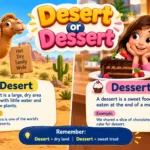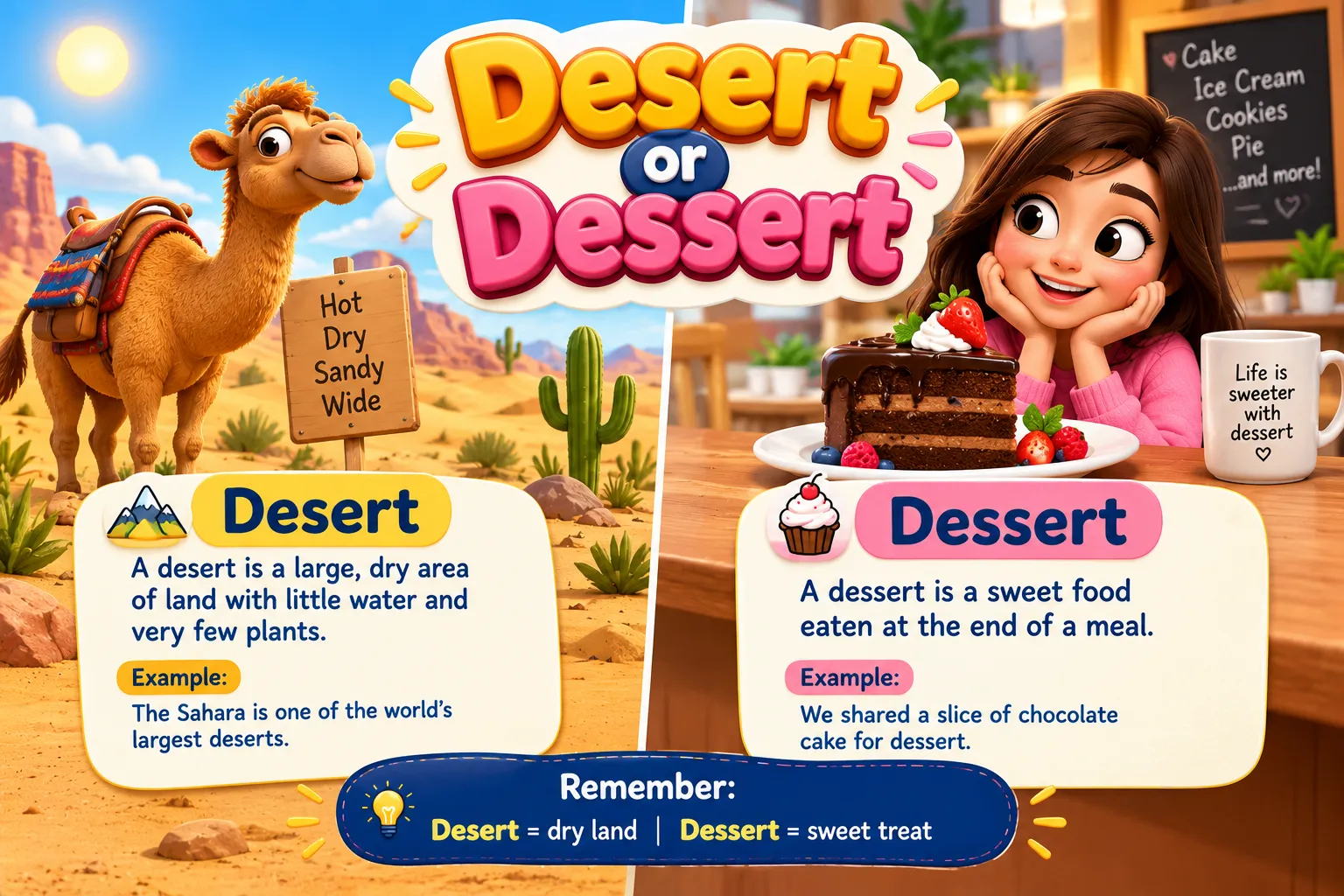
Desert means a dry area with little rain, while dessert means a sweet food served at the end of a meal. Remember: dessert has two S’s, like the two S’s in strawberry shortcake.
I remember wondering whether desert or dessert was the correct word when writing about a delicious cake. At first, the two words seemed almost identical, and I sometimes found it difficult to remember which spelling meant a sweet treat and which referred to a dry, sandy place. Over time, I learned that one extra “s” makes all the difference.
For example, if I write that I enjoyed the desert after dinner, readers might imagine a hot, dry landscape instead of a slice of chocolate cake! This made me realize how easily a small spelling mistake can change the meaning of a sentence. In this guide, I’ll share the simple differences between desert and dessert, along with examples and an easy memory trick to help you choose the right word confidently.
As an English teacher and writer, I find that simple memory tricks can make confusing words much easier to learn. The key is to connect each spelling with a clear idea. One S belongs to sand. Two S’s belong to sweets.
In this guide, you will learn the meanings, pronunciation, word history, and correct use of desert or dessert. You will also discover common mistakes, practical examples, and an easy way to remember which spelling to choose. Let’s make this tricky word pair simple.
Desert or Dessert Quick Answer
Both desert and dessert are correct English words, but they mean different things.
- Desert: A dry region that gets very little rain.
- Dessert: A sweet dish, such as cake, pudding, or ice cream, often served after a meal.
For example:
- The travelers crossed the desert in search of water.
- We ordered chocolate cake for dessert.
The spelling rule is simple: use desert for a dry place and dessert for a sweet treat.
There is one more detail to know. Desert can also be a verb meaning to abandon someone or leave a place. In that case, it has a different pronunciation from the noun.
The Origin and Background of Desert or Dessert
The difference between these words becomes easier to understand when you look at their history.
Where does “desert” come from?
According to Dictionary.com, the noun desert, meaning a dry or barren place, was recorded in English during the Middle English period. It came through Old French and ultimately traces back to the Latin word dēserere, meaning “to abandon” or “to forsake.”
The connection makes sense. A desert is often seen as a place with little water, few plants, and wide areas of bare land.
A desert does not always have to be hot or covered in sand. Some cold regions also receive very little rain or snow and are classed as deserts.
Where does “dessert” come from?
The word dessert came into English through French. Dictionary.com links it to the French verb desservir, which refers to clearing the table after a meal. The word became linked to the sweet course served at the end of a meal.
This history gives you a useful way to think about the word. Dessert comes after the main meal, once the table has been cleared.
Why are the words so easy to mix up?
There are three main reasons:
- Similar spelling: The words differ by only one letter.
- Similar sounds: The words can sound alike, depending on which meaning of desert is used.
- Different meanings: One word can describe a place, while the other describes food.
This is a spelling problem, not a case of two words with the same meaning. Learning the context and using a memory trick can help you choose the right one.
Desert or Dessert Explained Key Differences
Let’s look at each word more closely.
1. Desert as a noun
As a noun, desert means a large, dry area with very little rain and limited plant life.
Examples:
- Many animals have adapted to life in the desert.
- The desert can become very cold at night.
- Our geography class studied the Gobi Desert.
The noun is usually pronounced DEZ-ert, with the stress on the first syllable.
2. Desert as a verb
Desert can also be a verb. It means to leave someone, a place, or a duty behind.
Examples:
- The captain refused to desert the crew.
- He did not want to desert his friends during a hard time.
- The streets were deserted after the storm.
As a verb, desert is pronounced dih-ZERT, with the stress on the second syllable. Cambridge Dictionary lists both the geographical noun and the verb meaning “to leave” or “abandon.”
3. Dessert as a noun
Dessert is a sweet dish often eaten at the end of a meal. It may be a cake, pie, pudding, ice cream, or fruit dish.
Examples:
- The chef prepared a lemon tart for dessert.
- We shared a bowl of fresh fruit after lunch.
- The restaurant offers several homemade desserts.
Cambridge Dictionary defines dessert as sweet food eaten at the end of a meal.
The word is usually pronounced dih-ZERT, with the stress on the second syllable.
Comparison table
| Term | Meaning | When to Use | Region/Context |
| Desert (noun) | A dry area with little rain | When discussing land, climate, travel, or geography | Standard English |
| Desert (verb) | To abandon or leave someone or something | When describing someone leaving a duty or person behind | Standard English |
| Dessert (noun) | Sweet food served at the end of a meal | When discussing meals, menus, recipes, or food | Standard English |
| Deserts in “just deserts” | The rewards or punishments someone deserves | In the fixed phrase “get one’s just deserts” | Standard but less common usage |
Notice that desert can have more than one meaning. Always check the sentence before deciding which word is correct.
Which Version Should You Use?
The right spelling depends on what you want to say. Use these simple rules.
For students and English learners
If you are writing about a dry region, choose desert. If you are writing about cake or another sweet dish, choose dessert.
Try linking each word to a picture:
- Desert: Imagine sand, rocks, and a cactus.
- Dessert: Imagine cake, cookies, or ice cream.
This visual method can help you remember the difference during exams and everyday writing.
For food writers and restaurant owners
Use dessert when writing menus, food blogs, recipes, or restaurant reviews.
For example, a menu might list “vanilla pudding” under the dessert section. Spelling it correctly helps readers understand the dish and makes the menu look professional.
For travel writers and geography students
Use desert when discussing dry regions, landscapes, wildlife, or climate.
You might write about a desert journey, desert plants, or the challenges of living in a dry area.
For formal and professional writing
Both words are correct in formal English when used with the right meaning. The main task is to check the context.
If you mean a sweet dish, write dessert. If you mean a dry region or the act of abandoning someone, write desert.
Best tip: Before you finish a sentence, ask yourself, “Am I talking about sand or something sweet?”
Common Mistakes with Desert or Dessert
Even strong English writers can mix up these words. Here are five mistakes to avoid.
1. Using “desert” for sweet food
Incorrect: We had ice cream for desert.
Correct: We had ice cream for dessert.
Why? The sentence refers to food served after a meal, so the word needs two S’s.
2. Using “dessert” for a dry region
Incorrect: The camel walked across the dessert.
Correct: The camel walked across the desert.
Why? The sentence describes a landscape, not a sweet dish.
3. Forgetting the verb meaning of “desert”
Incorrect: The soldier chose to dessert his post.
Correct: The soldier chose to desert his post.
Why? The verb desert means to abandon a place or duty. Dessert refers to sweet food.
4. Mixing up pronunciation
The noun desert, meaning a dry region, is usually pronounced DEZ-ert. The verb desert and the noun dessert are usually pronounced dih-ZERT.
Tip: Listen for the stress, then check the meaning. Pronunciation can help, but the sentence provides the clearest clue.
5. Misspelling “just deserts”
Incorrect: He finally got his just desserts.
Standard form: He finally got his just deserts.
The phrase just deserts means the reward or punishment someone deserves. It is an exception that surprises many readers because it sounds like desserts but uses one S in the middle.
Desert or Dessert in Real World Examples
Here are examples from different kinds of writing. Each one shows how the words fit into a real situation.
1. Professional email
Subject: Catering for Friday’s Meeting
“Please confirm the dessert options for Friday’s meeting so we can finalize the catering order.”
This example uses dessert because the email concerns food.
2. News headline
“New Study Explores How Plants Survive in the Desert”
Here, desert refers to a dry natural region. The word fits a science or environment story.
3. Social media post
“Tonight’s dessert is homemade mango pudding, and it tastes amazing!”
This casual post uses dessert to describe a sweet dish.
4. Formal document or report
“The research team examined how limited rainfall affects plant growth in desert environments.”
This sentence uses desert in a formal scientific context.
5. Everyday conversation
“Please save me a slice of pie for dessert.”
The sentence refers to a sweet dish planned for later in the meal.
These examples show why the meaning matters more than the small spelling difference.
Desert or Dessert Data, Trends & Usage
People often search for desert or dessert because they want a quick way to remember the correct spelling. The topic also appears in English lessons, spelling guides, food writing, and geography resources.
Search volume and Google Trends
Exact monthly search volumes for desert and dessert are not provided here because no verified keyword-tool figures are available for this article.
You can compare search interest using Google trends. It lets you explore search terms over time and across regions. However, Google explains that Trends uses sampled, normalized data and does not represent exact search counts. Low-volume searches may also appear as zero.
For a useful comparison, search for “desert or dessert” and select your target country and time range. This can help you understand when and where people show interest in the topic.
Which word appears in more types of content?
The word desert appears in geography, climate science, travel, wildlife, and everyday speech. It can also work as a verb.
The word dessert appears mainly in food-related content, including menus, recipes, restaurant reviews, and cooking blogs.
A simple comparison of these words in a general English corpus may not show the full picture. Search results and corpus counts depend on the data set, time period, and whether different meanings are counted separately.
What is the search intent?
The main search intent is informational. Readers usually want to know:
- Which spelling is correct for food.
- How to spell the name of a dry region.
- How to pronounce each word.
- Why just deserts has only one S in the middle.
- How to remember the difference.
Why does this topic matter?
Correct spelling helps readers understand your meaning. It matters in school assignments, work emails, menus, travel articles, and online posts.
Spelling and grammar tools can flag possible errors, but they may not always understand the intended meaning. A quick review of the sentence is still useful.
Desert or Dessert: A Second Comparison Table
This table adds related terms and useful edge cases to help you make the right choice.
| Term/Variant | Meaning | Region/Context | Best Used When |
| Desert | A dry region | Geography and nature | Describing land with very little rainfall |
| Dessert | A sweet course or dish | Food and dining | Naming cake, pudding, pie, or another sweet treat |
| Deserted | Empty or abandoned | Travel, stories, and general writing | Describing a place with no people present |
| Desert (verb) | To abandon someone or something | General and formal English | Describing someone leaving a duty or person behind |
| Just deserts | What someone deserves, often as a result of their actions | Fixed English expression | Talking about a fitting reward or punishment |
The most useful distinction is the number of S’s. Desert has one S in the middle, while dessert has two. The related word deserted also uses one S.
Frequently Asked Questions
Q: What is the main difference between desert and dessert?
A: A desert is a dry area with little rainfall. Dessert is sweet food often served at the end of a meal. The extra S in dessert can remind you of sweet.
Q: How do I remember whether dessert has one S or two?
A: Think of the two S’s in dessert as standing for strawberry shortcake or sweet stuff. A desert has one S, like the single sandy landscape in your mental picture.
Q: Is desert or dessert correct in a sentence about cake?
A: Use dessert when you mean cake or another sweet dish. The word desert would refer to a dry region or, as a verb, the act of abandoning someone or something.
Q: Is desert a noun or a verb?
A: It can be both. As a noun, it refers to a dry region. As a verb, it means to abandon someone or something, and the stress shifts to the second syllable.
Q: Why is “just deserts” spelled with one S?
A: In this phrase, deserts means what a person deserves. It comes from a different word history than dessert, the sweet course of a meal, even though the two sound alike.
Q: Do desert and dessert sound the same?
A: The noun desert, meaning a dry place, is usually pronounced with stress on the first syllable. Dessert and the verb desert are usually stressed on the second syllable, so the context and pronunciation help distinguish them.
Q: Is dessert always served after dinner?
A: No. Dessert is often served after dinner, but it can follow lunch or another meal. The word refers to the sweet course, not to a fixed time of day.
Conclusion
The difference between desert or dessert is simple once you connect each spelling with its meaning. A desert is a dry region, while a dessert is a sweet dish. One S points to sand, and two S’s point to something sweet.
Remember that desert has another meaning as a verb. It can describe leaving someone or abandoning a duty. The phrase just deserts is also worth learning because it refers to what someone deserves and uses only one S in the middle.
When you write, look at the whole sentence instead of relying on spelling alone. Ask yourself whether you mean a landscape, an action, or a sweet treat. That small check can prevent a confusing mistake.
With practice, these words will become easier to use in schoolwork, emails, menus, and everyday conversation. Bookmark this guide so you can check the difference whenever you need it, and share it with someone who mixes up these words.
Readmore

I specialize in English grammar, spelling, word choice, and language usage. My content is based on research from grammar references, style guides, dictionaries, and real-world usage to ensure it is accurate and practical.
At Spelling Comparison, I write guides that explain why words are confused, how they are used, and which form is correct in context. I also include proofreading tips, examples, and writing advice readers can apply immediately.
My goal is to publish clear, reliable content that helps readers make better writing decisions. Each guide is written for accuracy, clarity, and usefulness in school, work, business, and everyday communication.