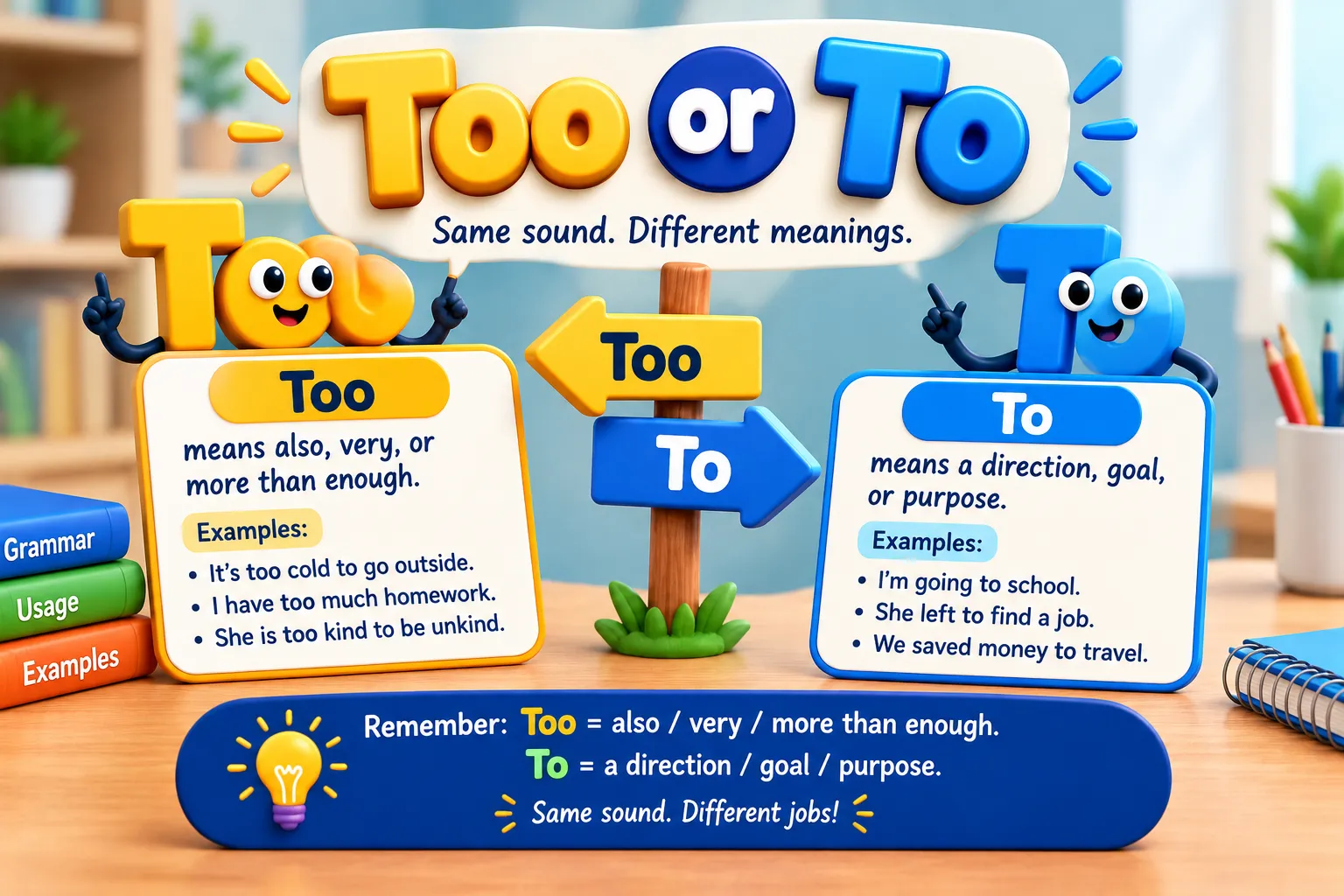
Too means “also” or “more than needed,” while to shows direction, destination, or purpose and is used before a verb in its infinitive form.
Have you ever written a sentence and wondered whether you should use too or to? You are not alone. These two words sound the same, but their meanings and uses are different.
Imagine sending a message to a friend. You want to say that you would like to join a party as well. Should you write, “I want to come to” or “I want to come too”? The second sentence is correct if you mean that you also want to attend.
Small spelling mistakes like this can change the meaning of a sentence. They can also make an email, school assignment, or social media post look less polished.
As an English learner, you do not need to memorize a long list of grammar rules to master these words. You only need to understand what each word does in a sentence.
In this guide, you will learn the difference between too and to, explore their meanings and origins, and discover simple ways to use them correctly. You will also find practical examples, common mistakes, and easy tricks to help you remember the rules.
Let’s begin with the basic difference.
Too or To Quick Answer
Use too when you mean “also” or “more than enough.” Use to when you talk about a direction, destination, recipient, or action.
Here are two examples:
- I want to visit the museum too. (I also want to visit.)
- We walked to the museum. (The museum was our destination.)
The words are pronounced alike in ordinary speech. In linguistics, words that sound the same but have different meanings and spellings are called homophones.
According to the cambridge dictionary, too is an adverb, while to often works as a preposition or as the marker of an infinitive verb. Knowing their roles makes the difference easier to understand.
The Origin and Background of Too or To
The words too and to have a long history in English. Their similar sounds and related spelling histories help explain why people often confuse them.
According to dictionary.com, too comes from an Old English form. Its modern spelling developed over time, with the spelling too established by the 16th century.
The word to has long been used to express relationships such as direction and movement. Today, it also serves as a grammatical marker before a verb.
For example:
- She went to the library.
- He wants to learn French.
- She wants to learn French too.
In the last sentence, to introduces the action learn, while too means “also.”
Why Are Too and To So Easy to Confuse?
The main reason is pronunciation. In everyday English, both words sound alike, so you cannot always choose the correct spelling by listening.
Their grammar is different, however.
- Too is an adverb.
- To is commonly a preposition.
- To also introduces the infinitive form of a verb, as in to read or to write.
These differences are useful in grammar, writing, and language learning.
Too vs. To Explained: Key Differences
Let’s look at the main uses of each word.
1. When to Use Too
The word too has two common meanings: “also” and “more than needed or wanted.”
Too Means Also
Use too when you want to add information.
Examples:
- My brother enjoys football, and I do too.
- Sarah is coming to dinner too.
- You can join our study group too.
In these sentences, too means that something is included in addition to something else.
It often appears at the end of a sentence or clause.
Too Means More Than Needed
Use too before an adjective or adverb to show that something exceeds a suitable or desired level.
Examples:
- The soup is too salty.
- He speaks too quickly.
- This suitcase is too heavy for me to carry.
The Cambridge Dictionary explains this use of too as expressing more than is needed, wanted, or suitable.
Remember that too does not always have a negative meaning. In “I like you too,” it means “also.” In “The room is too small,” it means that the room is smaller than needed.
2. When to Use To
The word to has several common grammatical uses.
To Shows Direction or Destination
Use to when someone or something moves toward a place or destination.
Examples:
- We drove to the airport.
- Please send this letter to your teacher.
- The children ran to the playground.
Here, to shows where someone or something is going, or who receives something.
To Introduces an Action
Use to before the base form of a verb to make an infinitive.
Examples:
- I want to study medicine.
- They plan to travel next summer.
- She needs to finish her homework.
In these examples, to comes before the base verbs study, travel, and finish.
To Shows a Limit or Connection
You can also use to to show a range, relationship, or endpoint.
Examples:
- The shop is open from 9 a.m. to 6 p.m.
- Please turn to page 20.
- The temperature rose from 10 to 15 degrees.
The exact meaning depends on the sentence.
Comparison Table: Too vs. To
| Term | Meaning | When to Use | Example |
| Too | Also | Adding information | My sister is coming too. |
| Too | More than needed | Describing excess | The bag is too large. |
| To | Direction or destination | Showing movement | We went to the park. |
| To | Infinitive marker | Before a base verb | I hope to win. |
| To | Limit or endpoint | Showing a range | Read pages 5 to 10. |
Which Word Should You Use?
The best way to choose between too and to is to check what you want the word to mean.
For Students
When writing an essay, answer, or assignment, check whether you mean “also” or “more than needed.”
If you do, use too.
If you are describing a destination or introducing an action, use to.
For example, “I need to study” uses to before a verb. “I need more time too” uses too to add another point.
For Professionals
In work emails and reports, use to when identifying a recipient or an action.
Examples:
- Please send the document to the manager.
- We need to review the figures.
Use too when adding information or describing an excessive amount.
Examples:
- The finance team will attend too.
- The proposed cost is too high.
Correct word choice helps keep professional communication clear.
For Everyday Conversations
Think about the message you want to express.
If you mean “also,” choose too. If you mean “toward,” “for the purpose of,” or the infinitive marker, choose to.
For example, “I want to eat” expresses an action. “I want dessert too” means you want dessert in addition to something else.
For Global English
Both spellings are standard in British and American English. Neither word is a regional spelling of the other.
The key is meaning, not location. Once you understand their different roles, you can use them confidently in almost any English-speaking setting.
Common Mistakes with Too or To
Here are five frequent errors and how to correct them.
Mistake 1: Using To Instead of Too
Incorrect: I want to come to!
Correct: I want to come too!
Why? The final word means “also.” Therefore, too is the correct choice.
Mistake 2: Using Too Instead of To
Incorrect: She wants too learn Spanish.
Correct: She wants to learn Spanish.
Why? The word before learn is the infinitive marker to.
Mistake 3: Writing “Too Much” Incorrectly
Incorrect: There is to much sugar in this drink.
Correct: There is too much sugar in this drink.
Why? The sentence means there is more sugar than needed, so use too.
Mistake 4: Confusing To and Too in Directions
Incorrect: We are going too the station.
Correct: We are going to the station.
Why? The word to shows the destination.
Mistake 5: Forgetting the Difference in a Longer Sentence
Incorrect: I want too finish the report, and my colleague wants to help to.
Correct: I want to finish the report, and my colleague wants to help too.
Why? The first to introduces an action. The final too means “also.”
An Easy Memory Trick
Use this simple test whenever you are unsure:
Ask yourself: Can I replace the word with “also”?
- If yes, too is usually correct.
- If no, check whether to shows direction, a relationship, a limit, or an action.
For example, “I want to come also” is awkward but understandable. The natural sentence is “I want to come too.”
This trick will not replace every grammar rule, but it works well in many everyday situations.
Too or To in Real World Examples
The difference matters in many kinds of writing. Here are four examples that show how to use both words naturally.
1. Professional Email
Hello Team,
I would like to move the meeting to Thursday. The current time is too late for some team members, so an earlier slot may work better.
Please let me know if you are available to attend. I will invite the design team too.
Best regards,
Alex
2. News Headline
New Study Finds That Screen Time Can Be Too High Among Young Children
In this headline, too means that screen time exceeds a suitable level.
A related sentence could read: “Parents are encouraged to speak to teachers about healthy screen habits.” Here, to introduces the person they should speak with.
3. Social Media Post
Quick English tip! ✍️
Use too when you mean “also” or “more than needed.”
Use to for direction or before an action word.
Examples:
- I want to read.
- I want to read too.
One small spelling change can make a big difference. Save this tip for your next writing task!
4. Formal Report
Project Review Summary
The team needs to complete the final review before the deadline. The proposed schedule is too tight to allow for all planned checks.
Additional staff will be assigned to the project to help meet the target date. The quality team will review the results too.
Too or To Data, Trends, and Usage
Too and to are common English words, but reliable SEO analysis requires more than guessing which one receives more searches.
Search Volume and Google Trends
No verified monthly search-volume figures for the exact keyword “too or to” are provided here. These numbers can change by location, date, and keyword research tool, so reporting an unverified figure would be misleading.
For current research, use google trends to compare search interest in phrases such as:
- Too or to
- Too vs. to
- Difference between too and to
- How to use too and to
Google explains that Trends uses a sample of searches and normalizes results on a scale from 0 to 100. These scores represent relative interest, not absolute search counts.
For monthly search estimates, you can also use an SEO keyword research tool. Be sure to record the country and date of the report.
Word Frequency and Everyday Usage
Both to and too appear in written and spoken English, but they serve different purposes.
To is used in many grammatical structures, including infinitives and prepositional phrases. Too often adds information or expresses excess.
A proper frequency comparison would require a defined corpus, such as a collection of books or news articles. This guide does not claim exact word counts or a specific ratio.
Search Intent: Why Do People Look Up Too or To?
The main search intent is informational. Readers usually want to understand the difference, check a sentence, or learn a simple spelling rule.
The topic is especially useful for students, English learners, bloggers, and professionals who want to avoid common writing mistakes.
Grammar tools can help flag possible errors, but understanding the rule lets you judge whether the suggested correction fits your meaning.
Too or To: A Standalone Comparison Table
The table below includes a related word that learners often confuse with both terms.
| Term/Variant | Meaning | Region/Context | Best Used When |
| Too | Also or more than needed | Standard English | Adding information or showing excess |
| To | Direction, relationship, or infinitive marker | Standard English | Showing a destination or introducing an action |
| Two | The number 2 | Standard English | Counting or describing quantity |
| Too much | More than needed or wanted | Standard English | Referring to an excessive amount |
| To do | The infinitive form of a verb | Standard English | Describing an action, aim, or plan |
| Me too | I also feel or do that | Informal conversation | Agreeing with another person’s statement |
Do not forget two. It is pronounced like too and to, but it refers to the number 2.
For example, “I gave two books to Mia, and she gave me two more books too” uses all three forms correctly.
Frequently Asked Questions
Q1: What is the main difference between too and to?
A: Too means “also” or “more than needed.” To commonly shows direction, a relationship, or an infinitive verb form. The correct choice depends on the meaning of your sentence.
Q2: How can I remember when to use too?
A: Think of too as the word for “also” or “excess.” If you can replace it with also without changing the main idea, too is often the right choice.
Q3: Is too or to correct in formal writing?
A: Both words are correct in formal writing when used properly. Choose too to express addition or excess, and choose to for its grammatical functions.
Q4: What is the difference between too, to, and two?
A: Too means “also” or “more than needed.” To often shows direction or introduces a verb. Two is the number after one and before three.
Q5: Why do too and to sound the same?
A: They are homophones in ordinary English pronunciation. Their sounds are alike, but their spellings, meanings, and grammatical roles differ.
Q6: Where do the words too and to come from?
A: Both have historical roots in Old English, though their meanings and uses developed over time. Dictionary.com traces the spelling too to a historical form whose modern spelling became established by the 16th century
Q7: Can too appear before an adjective?
A: Yes. You can use too before an adjective to show that something exceeds a suitable level. For example, “The box is too large for the shelf” means the box is larger than the shelf can accommodate.
Conclusion: Master Too or To with Confidence
The difference between too and to may seem small, but choosing the right word makes your writing clearer.
Remember that too has two main everyday uses. It can mean “also,” or it can show that something is more than needed. To often points toward a place, identifies a recipient, or introduces an action in its infinitive form.
Keep these simple habits in mind:
- Check the meaning before choosing the spelling.
- Use the “also” test to identify many uses of too.
- Look for a destination, relationship, or verb when deciding whether to is correct.
- Remember that two is a separate word for the number 2.
You do not need to memorize every example at once. Start by checking your own messages and assignments. When you spot a sentence containing either word, ask yourself what the word is doing.
With a little practice, the choice will become much easier. Bookmark this guide and share it with someone who wants to improve their English grammar!
Readmore

I’m Daniel sultan, an English language writer and SEO content specialist with experience researching spelling, grammar, vocabulary, and English usage. Through SpellComparison.com, I create clear, accurate, and well-researched guides that help readers understand commonly confused words, spelling differences, and grammar rules with confidence.
Every article I write is based on trusted language references, established style guides, and real-world usage to ensure it is accurate, practical, and easy to understand. My goal is to make learning English simple and reliable by providing fact-checked content, clear explanations, and real-life examples that students, writers, educators, and professionals can trust.










