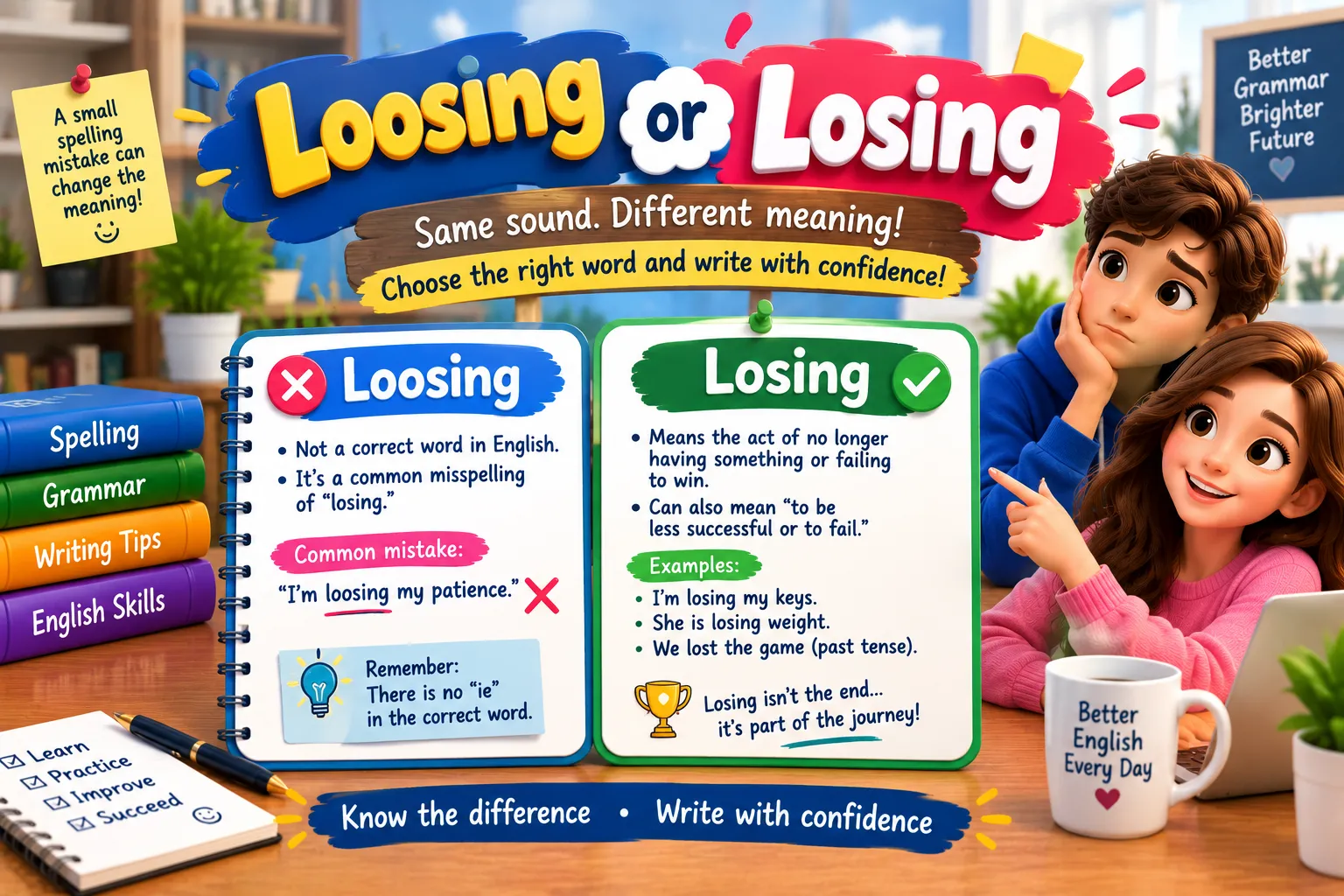
Losing means no longer having something, failing to win, or becoming less. Loosing means releasing or setting something free, and it is much less common.
Have you ever typed a message and stopped because you were unsure whether to write loosing or losing? I have often noticed how one extra letter can make a simple sentence confusing. Both words look almost the same, but their meanings are quite different.
Imagine you are talking about a football match. Your favorite team is behind, and you want to tell a friend what is happening. You might write, “Our team is loosing the game.” It may look right at first, but the correct sentence is, “Our team is losing the game.”
This mistake happens because many people connect losing with the word loose. After all, the two words share similar letters. However, losing comes from lose, while loosing comes from loose.
The good news is that you do not need to memorize a long grammar lesson. Once you understand the meaning of each word, the choice becomes much easier.
In this guide, you will learn when to use losing and loosing, why people confuse them, and how to avoid common spelling mistakes in schoolwork, emails, and everyday writing.
Loosing or Losing Quick Answer
Losing is the correct word when you mean failing to win, misplacing something, or having less of something. It is the present participle of the verb lose.
Loosing is the present participle of loose. It means releasing, freeing, or letting something go. It is a real English word, but it is less common in everyday writing.
Consider these examples:
- Losing: “She is losing confidence before the competition.”
- Loosing: “The archer is loosing an arrow toward the target.”
In the first sentence, someone is gradually losing confidence. In the second, someone is releasing an arrow.
The easiest rule to remember is this:
Lose → Losing = no longer having or winning something.
Loose → Loosing = releasing or setting something free.
The Origin and Background of Loosing and Losing
The words losing and loosing come from two different verbs: lose and loose. Their similar spelling can make them look interchangeable, but their meanings developed along different paths.
According to the etymology dictionary, lose comes from Old English losian, meaning to be lost or perish. The word later developed meanings related to misplacing something, failing to keep it, or failing to win. These meanings explain common phrases such as losing money, losing a game, and losing hope.
The verb loose is connected to the idea of releasing or making something less tight. As a verb, it can mean freeing something, unfastening it, or allowing it to move freely.
The cambridge dictionary identifies it as the present participle of loose. Its examples include releasing something and firing an arrow.
Why Are These Words So Easy to Confuse?
There are three main reasons:
- Similar spelling: The words differ by only one letter.
- Different base verbs: Losing comes from lose, while loosing comes from loose.
- Similar sentence patterns: Both words can describe actions that are happening now.
Pronunciation can also help. Losing usually has a z sound in the middle, while loosing has an s sound.
Once you connect each word to its base verb, the difference becomes much clearer.
Loosing or Losing Explained: Key Differences
The main difference is what the action means. Use losing when something is going away, becoming less, or not being won. Use loosing when something is being released or set free.
Here is a simple comparison table.
| Term | Meaning | When to Use | Region/Context |
| Losing | Failing to keep, find, or win something | Talking about games, money, possessions, confidence, or opportunities | Standard English |
| Loosing | Releasing, freeing, or letting something go | Describing the release of an arrow, animal, or other object | Standard English, but less common |
| Lose | The base verb related to loss or defeat | Talking about losing something in general | Standard English |
| Loose | Not tight; also a verb meaning to release | Describing loose clothing or the act of freeing something | Standard English |
| Loosening | Making something less tight | Talking about a knot, screw, grip, or other fastening | Standard English |
Examples of Losing
Use losing in sentences about loss, defeat, or reduction.
- “I keep losing my notebooks.”
- “The business is losing customers.”
- “He is losing interest in the course.”
- “Our team is losing by two points.”
- “She is losing patience with the delays.”
In each example, something is being lost or reduced.
Examples of Loosing
Use loosing when the intended action is release or freedom.
- “The archer was loosing arrows at the target.”
- “The keeper is loosing the horses into the field.”
- “The old rope is loosing its hold on the wooden post.”
The third example is less natural than saying the rope is coming loose. In modern English, words such as releasing, freeing, and letting go are often clearer alternatives.
Remember that loosing is correct only when it matches the intended meaning. It is not another spelling of losing.
Which Version Should You Use?
Choosing between loosing and losing becomes easy when you think about your audience and the message you want to share.
For Students and English Learners
Use losing for most sentences about losing an object, failing to win, or having less of something.
For example:
- I am losing my focus.
- The player is losing the match.
- She is losing her keys again.
Use loosing only when you mean releasing something. This meaning is less common, so check your sentence carefully.
For Bloggers and Content Writers
If you write articles, captions, or website content, use the word that matches the meaning.
For example:
- “Why People Are Losing Interest in Traditional Newspapers”
- “Five Ways to Stop Losing Important Files”
If you are writing about archery, you might use loosing an arrow. However, releasing an arrow may be easier for general readers to understand.
For Business and Professional Writing
Use losing when describing declining sales, lost clients, reduced profits, or a missed opportunity.
For example:
“The company is losing market share because of increased competition.”
Use loosing only if your sentence genuinely describes releasing something. Since it is uncommon, a simpler alternative may improve clarity.
For Global English
For readers around the world, losing is the usual choice in everyday communication. It appears in common phrases such as losing weight, losing money, and losing a game.
The spelling difference does not depend on whether you use American or British English. Both forms follow the same basic distinction.
Common Mistakes with Loosing or Losing
Here are five common mistakes and how to correct them.
1. Writing Loosing Instead of Losing
Incorrect: “I am loosing my phone every week.”
Correct: “I am losing my phone every week.”
Why? The sentence describes repeatedly misplacing a phone. The correct base verb is lose, so the form is losing.
2. Confusing Losing with Loose
Incorrect: “My shoelaces are losing.”
Correct: “My shoelaces are loose.”
Why? The sentence describes shoelaces that are not tight. Loose is an adjective that describes their condition.
3. Using Losing When You Mean Releasing
Incorrect: “The archer is losing an arrow.”
Correct: “The archer is loosing an arrow.”
Why? If the archer is releasing an arrow from a bow, loosing is the correct verb. In everyday writing, releasing an arrow may sound more natural.
4. Confusing Loosing with Loosening
Incorrect: “The mechanic is loosing the bolt to remove the wheel.”
Better: “The mechanic is loosening the bolt to remove the wheel.”
Why? Loosening means making something less tight. Loosing generally means releasing or setting something free.
5. Using Losing for a Past Event
Incorrect: “I am losing my wallet yesterday.”
Correct: “I lost my wallet yesterday.”
Why? The event happened in the past, so use lost, the past tense of lose. Use losing for an ongoing action or in a suitable continuous tense.
Loosing or Losing in Real World Examples
These examples show how the two words work in different settings.
1. Professional Email
Imagine you need to update your manager about a project.
Example:
“We are losing valuable time because the required files have not arrived. Could you please confirm when we can expect them?”
Here, losing means wasting or no longer having time available.
2. News Headline
A news report about a local business might use this headline:
Example:
“Small Businesses Are Losing Customers as Costs Continue to Rise”
The word losing describes a decline in the number of customers.
3. Social Media Post
A person sharing a fitness update might write:
Example:
“Progress takes time! I am losing weight slowly and focusing on healthy habits rather than quick results.”
The word losing describes a reduction in weight.
4. Formal Report
A wildlife report might include this sentence:
Example:
“The research team observed that the birds were losing their natural habitat because of changes in land use.”
The word losing describes the gradual loss of a place where the birds live.
5. A Sentence Using Loosing
In a historical story about archery, you might read:
“The archer stood behind the wooden barrier, loosing arrows toward the distant target.”
Here, loosing means releasing arrows.
These examples show why you should focus on meaning instead of choosing a word based on appearance alone.
Loosing or Losing: Data, Trends, and Usage
The question loosing or losing has a clear informational search intent. Readers usually want to know which spelling is correct, what each word means, and how to use it in a sentence.
Which Word Is More Common?
Losing is much more common in everyday English because it applies to many situations. People can lose possessions, money, games, time, confidence, patience, or opportunities.
By comparison, loosing has a narrower meaning. It is mainly used when describing release or setting something free.
The cambridge dictionary identifies it as the present participle of lose and gives examples related to losing things, money, confidence, and other advantages.
What Do Search Trends Tell Us?
Search tools such as Google Trends, Ahrefs, and Semrush can help writers study interest in spelling questions. However, exact monthly search volumes and country rankings require current data from those tools.
No verified search-volume figures are available here, so it would be misleading to invent monthly totals or percentages.
For a more detailed historical comparison, Google Books Ngram Viewer can show how often losing and loosing appear in its book collection over time. Its results reflect published books, not all everyday English or current search behavior.
Why Does This Difference Matter?
A spelling mistake can change the meaning of a sentence. Writing losing weight is very different from writing loosing weight. The first means reducing body weight; the second suggests releasing something and does not express the intended meaning.
Grammar checkers can help, but they may not always understand the meaning you want. Learning the difference allows you to check your writing with confidence.
Loosing or Losing: A Quick Comparison Table
Use this second table as a practical guide when editing a sentence.
| Term/Variant | Meaning | Region/Context | Best Used When |
| Losing | Experiencing loss or failing to win | All major English varieties | Describing a defeat, missing item, or reduction |
| Loosing | Releasing or setting free | Less common in everyday writing | Describing an arrow being released |
| Lost | The past tense and past participle of lose | Standard English | Describing a completed loss |
| Loose | Not tight or firmly attached | Standard English | Describing clothing, a knot, or a screw |
| Loosening | Making something less tight | Standard English | Describing a grip, bolt, or knot becoming less tight |
Easy memory trick:
Lose one thing → losing.
Set something loose → loosing.
Frequently Asked Questions
Q: What is the difference between loosing and losing?
A: Losing means failing to keep something, being defeated, or experiencing a reduction. Loosing means releasing or setting something free. The correct choice depends on the action described.
Q: Is loosing a real English word?
A: Yes. It is the -ing form of the verb loose. It is correct in sentences about releasing something, but it is uncommon compared with losing.
Q: Is losing spelled with one o or two?
A: Losing has one o after the l. It comes from lose, not loose. Adding an extra o changes the base word and usually makes the spelling wrong for this meaning.
Q: Is losing or loosing correct in formal writing?
A: Both can be correct, but they have different meanings. Use losing for loss or defeat and loosing for release. In formal writing, choose a clear word that expresses your meaning accurately.
Q: What is the difference between losing and loosening?
A: Losing means no longer having something or failing to win. Loosening means making something less tight, such as a knot or screw. These words come from different verbs and are not interchangeable.
Q: What is the past tense of losing?
A: The past tense of lose is lost. For example, “She lost her ticket on the bus.” Losing is used for ongoing actions or in other grammatical structures, such as “She is losing her patience.”
Q: How can I remember when to use losing or loosing?
A: Connect each word to its base verb. Losing comes from lose, while loosing comes from loose. If you mean failing to keep or win something, use losing.
Conclusion: Loosing or Losing?
The difference between loosing and losing becomes simple when you focus on the meaning of each word. Although their spelling looks similar, they come from different verbs and describe different actions.
Losing is the word you will need most often. Use it when someone misplaces something, fails to win, or has less of something. It works in everyday conversations, school assignments, professional emails, and online articles.
Loosing is also a real word, but its meaning is more specific. It describes releasing or setting something free. If you are writing about an arrow being released from a bow, for example, loosing can be correct.
Remember that loose and loosening have their own meanings, too. Something can be loose without anyone losing it, and you can loosen a knot without losing it.
The best way to avoid confusion is to identify the base verb before adding -ing. This small habit can improve your spelling and make your writing clearer.
Bookmark this guide and share it with someone who often confuses loosing and losing. A simple spelling rule can make a big difference in clear English writing.
Readmore

I’m Daniel sultan, an English language writer and SEO content specialist with experience researching spelling, grammar, vocabulary, and English usage. Through SpellComparison.com, I create clear, accurate, and well-researched guides that help readers understand commonly confused words, spelling differences, and grammar rules with confidence.
Every article I write is based on trusted language references, established style guides, and real-world usage to ensure it is accurate, practical, and easy to understand. My goal is to make learning English simple and reliable by providing fact-checked content, clear explanations, and real-life examples that students, writers, educators, and professionals can trust.










