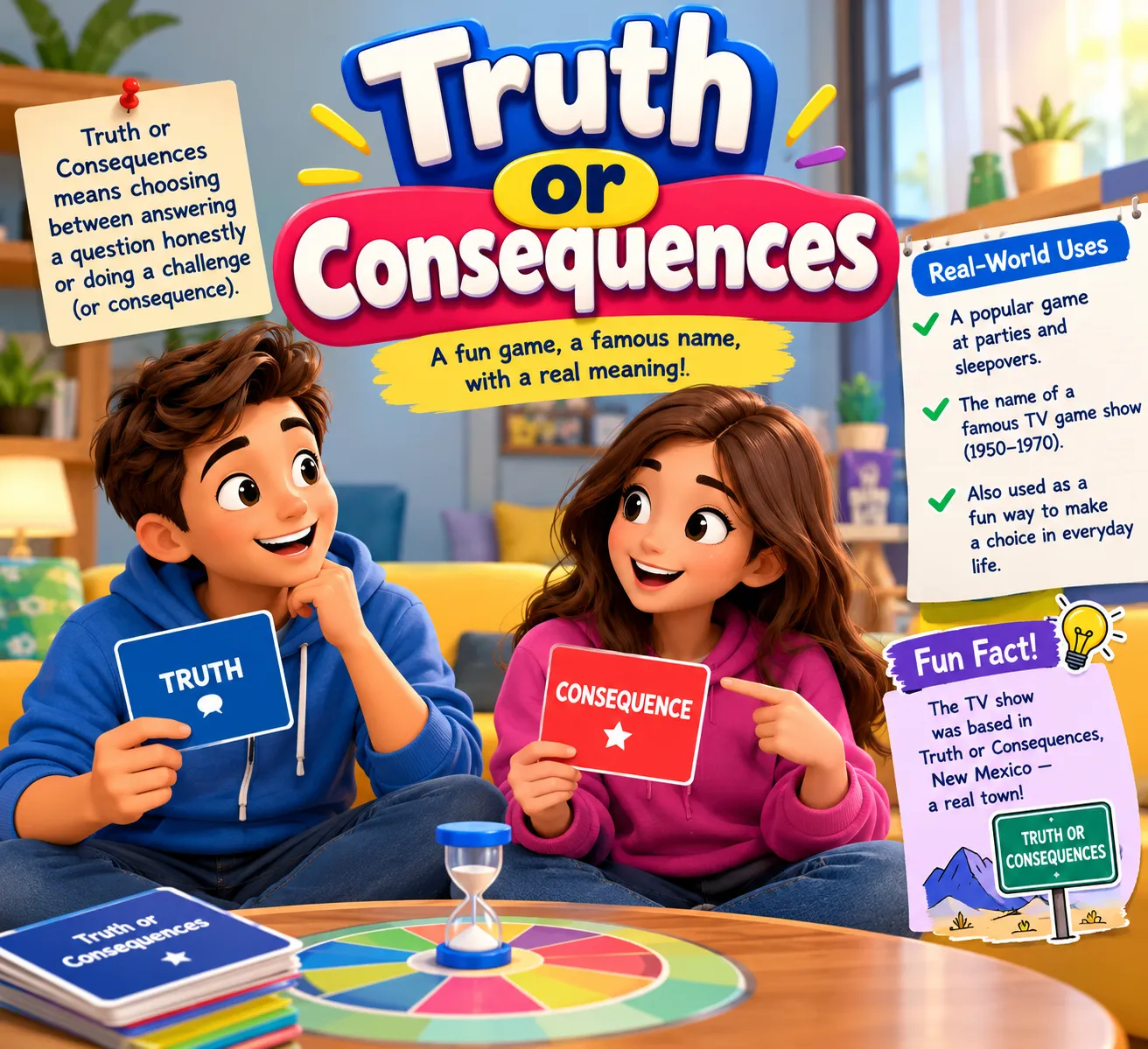
Truth or Consequences means telling the truth or facing the results of your actions. It is also the name of a famous American radio and television game show and a city in New Mexico.
Have you ever had to choose between telling the truth and facing an uncomfortable result? Maybe you made a mistake, kept a secret, or broke a promise. In such moments, the phrase “truth or consequences” can feel very real.
The phrase has a simple message: your choices matter. Being honest may be hard, but hiding the truth can lead to even bigger problems.
However, this phrase has another side that many people do not know. It is also the name of a famous American game show that began on radio in 1940. The show became popular for its funny questions, strange challenges, and surprising moments. It even inspired a town in New Mexico to change its name.
When I looked more closely at this phrase, I found that its meaning depends on the context. It can describe a serious life lesson, a playful challenge, a television program, or a real place.
In this guide, you will learn what truth or consequences means, where it came from, how people use it, and how it differs from similar expressions. You will also discover why this unusual name still attracts attention today.
Truth or Consequences Quick Answer
Truth or consequences is an expression about honesty and the results of your choices. It suggests that you must tell the truth or accept what may happen because of your actions.
For example:
- “You need to tell your parents the truth or face the consequences.”
- “The manager warned the team that there would be consequences for hiding the mistake.”
The phrase can sound serious when someone talks about honesty or responsibility. In a game or entertainment setting, however, it can have a playful meaning.
It is also the official name of a long-running American game show. In that show, contestants answered questions or completed amusing challenges.
The key point: Context tells you whether the phrase refers to a life lesson, a game, a television show, or a place.
The Origin and Background of Truth or Consequences
The phrase became widely known through American entertainment in the 20th century. Its history is closely linked to radio host and producer Ralph Edwards.
The radio show began in 1940
According to ralph edward punctuations Truth or Consequences began as a national radio game show in 1940.
The idea was simple but fun. Contestants had to answer unusual questions within a short time. If they failed, they had to face a consequence. That consequence could involve a silly stunt, an unexpected task, or another entertaining challenge.
The show mixed quiz questions with comedy and audience participation. This helped it stand out from more traditional question-and-answer programs.
The program later moved to television and continued through different broadcasts and hosts. One well-known host was Bob Barker, who later became famous for hosting The Price Is Right.
The
How did a town get this unusual name?
The story becomes even more interesting in New Mexico.
Before 1950, the town now called Truth or Consequences was known as Hot Springs. Ralph Edwards announced that he would broadcast a special anniversary episode from a town that agreed to take the show’s name.
The people of Hot Springs voted to accept the proposal. On March 31, 1950, the town officially became Truth or Consequences.
The next day, the show aired its anniversary broadcast from the newly named town.
The city’s official website explains that this decision became part of the community’s lasting identity. Many people now call the city T or C for short.
Why does the phrase still matter?
The phrase works in several settings because its message is easy to understand.
- In daily life: It reminds people to take responsibility.
- In games: It creates excitement by adding a challenge.
- In entertainment: It refers to the historic radio and television show.
- In geography: It identifies the New Mexico city.
This range of meanings makes the phrase more than just a catchy name.
Truth or Consequences Explained: Key Differences
The same words can carry different meanings in different situations. To understand the phrase, look at how it is being used.
| Term or Use | Meaning | When to Use | Region or Context |
| Truth or consequences | Be honest or face the results | Talking about honesty and responsibility | Everyday English |
| Truth or Consequences game show | An American quiz and stunt show | Discussing radio or television history | American entertainment |
| Truth or Consequences, New Mexico | A city named after the show | Discussing travel, geography, or local history | New Mexico, USA |
| Truth or dare | A party game involving honest answers or challenges | Playing with friends | Social settings |
| Actions have consequences | What you do can lead to results | Giving advice or explaining responsibility | Everyday and formal English |
1. Truth or consequences as a life lesson
In daily speech, the phrase can warn someone that dishonesty or poor choices may have results.
For example, a student might hide a broken classroom item. A teacher could explain that being honest now is better than letting the problem grow.
The phrase is often used to stress accountability, which means accepting responsibility for your actions.
2. Truth or Consequences as a game show
The capitalized name refers to the historic American program created by Ralph Edwards.
The show combined quiz questions with unusual tasks. Contestants who failed to answer correctly had to perform a stunt or take part in another planned activity.
It was not simply a test of knowledge. Its entertainment came from the surprise and humor of what happened next.
3. Truth or Consequences as a place
When the words appear in a travel guide, map, or news story about New Mexico, they may refer to the city.
The city is known for its unusual name and its connection to the historic broadcast. Its name is not just a figure of speech; it is an official place name.
4. Truth or consequences versus truth or dare
These expressions may sound alike, but they are not identical.
Truth or dare is a social game. A player must answer a question honestly or complete a challenge.
Truth or consequences can describe the results of a real choice. It is also the title of the historic game show.
You should use the expression that best fits your meaning.
Which Meaning Should You Use?
Your audience and purpose will help you choose the right interpretation.
For students and beginners
Start with the everyday meaning. The phrase suggests that people should be honest and accept responsibility for what they do.
For example, if a student damages a book, admitting the mistake may help solve the problem.
For writers and bloggers
Explain the context when you first use the phrase. Readers may not know whether you mean honesty, a game show, or the New Mexico city.
If your article is about television history, capitalize the title as Truth or Consequences. If you use the phrase in a general sentence, lowercase may be suitable unless it begins the sentence.
For teachers and parents
Use the phrase to discuss honesty and responsibility, but explain what the consequences will be.
A clear and fair response helps children understand the link between their actions and the results. The goal should be learning, not simply fear of punishment.
For travelers and history fans
Use the full name Truth or Consequences, New Mexico when referring to the city. This avoids confusion with the general expression or the television program.
For global English use
The phrase is understandable in many English-speaking settings. Still, it may not be familiar to everyone as a game-show title.
If you are writing for an international audience, explain its meaning rather than assuming readers know its American entertainment history.
Common Mistakes with Truth or Consequences
People can misunderstand the phrase when they ignore context or confuse it with a similar expression.
Mistake 1: Thinking it only means punishment
Incorrect idea: “Truth or consequences always means you will be punished.”
Better understanding: The phrase can suggest results, responsibility, or a choice. The outcome is not always a punishment.
A consequence can be positive, negative, or simply the natural result of an action.
Mistake 2: Confusing it with truth or dare
Incorrect: “The two expressions mean exactly the same thing.”
Correct: Truth or dare is a specific social game, while truth or consequences has broader uses and is also a historic show title.
The context determines which phrase is appropriate.
Mistake 3: Treating the city as a general expression
Incorrect: “We are visiting truth or consequences next month.”
Better: “We are visiting Truth or Consequences, New Mexico, next month.”
Capitalize the city’s official name. Adding “New Mexico” makes the location clear.
Mistake 4: Using capitals in every sentence
Incorrect: “She Believed In Truth Or Consequences.”
Better: “She believed in truth or consequences.”
Use capital letters when the words form a title or official name, or when normal sentence rules require them. General uses do not always need title capitalization.
Mistake 5: Assuming the phrase is always serious
Incorrect idea: “The phrase can only be used in a serious warning.”
Better understanding: The expression can be serious, playful, or historical. The radio and television show used humor and challenges, while daily speech may use the phrase to discuss responsibility.
Truth or Consequences in Real World Examples
These examples show how the phrase can fit different forms of communication.
1. Professional email
A manager may use the idea when discussing honesty and workplace responsibility.
Example:
“We need an accurate report by Friday. Please share any errors now so we can correct them before they lead to further consequences.”
This example uses the core idea without sounding threatening.
2. News headline or article
A reporter might use the phrase to describe a public issue involving honesty.
Example headline:
Truth or Consequences: The Cost of Hiding Public Information
This headline suggests that a lack of honesty may lead to serious results. It uses the phrase as a rhetorical hook, not as a reference to the television show.
3. Social media post
A short post can use the phrase to share a lesson.
Example:
“Honesty may feel hard for a moment, but a lie can create a bigger problem later. Truth or consequences—your choices matter.”
This version is informal and aims to make readers think.
4. Formal report
In a report, a writer may explain the results of failing to follow a rule.
Example:
“The review found that staff had not reported the error when it first occurred. The case highlights the need for honest reporting and clear accountability procedures.”
In formal writing, a direct explanation is often more precise than using the phrase itself.
Truth or Consequences: Data, Trends, and Usage
Understanding the phrase also means understanding how it appears in media, searches, and everyday language.
Is there reliable search-volume data?
Exact monthly search volume for “truth or consequences” can change over time. It also depends on the country, search engine, and keyword tool.
No verified current monthly search-volume figures are available in the sources used for this article. It would be misleading to invent a number or claim that one country searches for the phrase more often than another.
For accurate figures, tools such as Google Trends can help compare search interest across a selected time period and region. However, Google Trends reports relative interest rather than a direct count of all searches.
What affects search intent?
People searching for this phrase may want different things.
- Informational intent: They want to know what the phrase means.
- Entertainment history: They are looking for details about the radio or television show.
- Geographical intent: They want information about Truth or Consequences, New Mexico.
- Language learning: They want examples or a comparison with “truth or dare.”
This means a useful article should cover more than one definition. It should explain the phrase, its history, and its different contexts.
Why does the phrase remain interesting?
The phrase has a memorable structure. It puts two ideas together: telling the truth and facing what follows.
Its history also gives it cultural value. The original program appeared on radio and television, while the town name created a lasting link between entertainment and a real community.
The city’s official history confirms that the name change took place in 1950 after a public vote connected to the show’s anniversary broadcast.
What about word frequency?
A reliable comparison of how often the phrase appears in books or other writing would require a defined corpus and a search for the exact phrase. General word-frequency figures for “truth” and “consequences” would not prove how common the full expression is.
For that reason, this guide does not claim a specific corpus frequency or ranking without verified data.
The practical lesson is simple: search intent depends on context. Someone looking for the city’s history needs different information from someone learning an English expression.
Truth or Consequences: A Quick Comparison Table
This table adds useful related expressions and shows when each one works best.
| Term or Variant | Meaning | Region or Context | Best Used When |
| Truth or consequences | Honesty and the results of a choice; also a show title | General English and American history | Discussing responsibility or the historic program |
| Truth or dare | Answer honestly or complete a challenge | Social games | Describing a party game |
| Actions have consequences | Choices lead to results | Everyday and formal English | Explaining cause and effect |
| Face the consequences | Accept the results of an action | Everyday English | Discussing accountability |
| Cause and effect | One event produces or influences another | Education, science, and reports | Explaining how events are connected |
| Truth or Consequences, New Mexico | The official name of a city | New Mexico, USA | Writing about travel or local history |
These expressions are related, but they are not interchangeable in every sentence. Choose the one that communicates your intended meaning most clearly.
Frequently Asked Questions
Q: What does truth or consequences mean?
A: It can mean telling the truth or facing the results of your actions. The phrase is also the name of a historic American game show and a city in New Mexico.
Q: Is Truth or Consequences a real game show?
A: Yes. It began as a radio program in 1940 and later appeared on television. Contestants answered questions or took part in amusing challenges.
Q: Why is a city in New Mexico called Truth or Consequences?
A: The city was once called Hot Springs. In 1950, residents voted to change its name after the radio show’s host offered to broadcast an anniversary episode from a town that adopted the show’s name.
Q: Is truth or consequences the same as truth or dare?
A: No. Truth or dare is a social game built around honest answers and challenges. Truth or consequences has a wider meaning and is also associated with a specific American game show.
Q: Can I use truth or consequences in formal writing?
A: Yes, but consider your audience. In a formal report, phrases such as “accountability,” “results,” or “consequences of an action” may be clearer. Use the full phrase when it adds meaning or suits your subject.
Q: Should I capitalize truth or consequences?
A: Use Truth or Consequences when referring to the show or the city. In ordinary sentences, lowercase is usually appropriate unless the phrase begins a sentence or forms part of a title.
Q: Where did the phrase truth or consequences come from?
A: The expression became widely known through Ralph Edwards’s radio game show, which began in 1940. The show’s format paired questions with consequences for contestants who could not answer them.
Q: Is Truth or Consequences a place worth learning about?
A: It is an interesting place for people who enjoy unusual town names and American broadcasting history. Its name reflects a public vote linked to a famous radio and television program.
Conclusion: Remember the Meaning Behind Truth or Consequences
The phrase truth or consequences carries a simple message: honesty matters, and choices can have results. In everyday life, it can remind people to take responsibility and deal with problems openly.
Yet the phrase has a much richer history than its everyday meaning suggests. It became the title of a popular radio show in 1940, moved to television, and inspired the name of a city in New Mexico.
Remember these key points:
- Everyday meaning: Honesty and responsibility are closely linked.
- Entertainment meaning: The phrase names a historic American game show.
- Place name: Truth or Consequences is a real city in New Mexico.
- Related expression: Truth or dare is a different game with a different purpose.
When you see this phrase, look at the context before deciding what it means. That small step will help you understand whether someone is giving advice, discussing television history, or talking about a real place.
Now that you understand Truth or Consequences, share this guide with someone who may be curious about its meaning and surprising history.
Readmore

I’m Daniel sultan, an English language writer and SEO content specialist with experience researching spelling, grammar, vocabulary, and English usage. Through SpellComparison.com, I create clear, accurate, and well-researched guides that help readers understand commonly confused words, spelling differences, and grammar rules with confidence.
Every article I write is based on trusted language references, established style guides, and real-world usage to ensure it is accurate, practical, and easy to understand. My goal is to make learning English simple and reliable by providing fact-checked content, clear explanations, and real-life examples that students, writers, educators, and professionals can trust.










