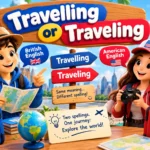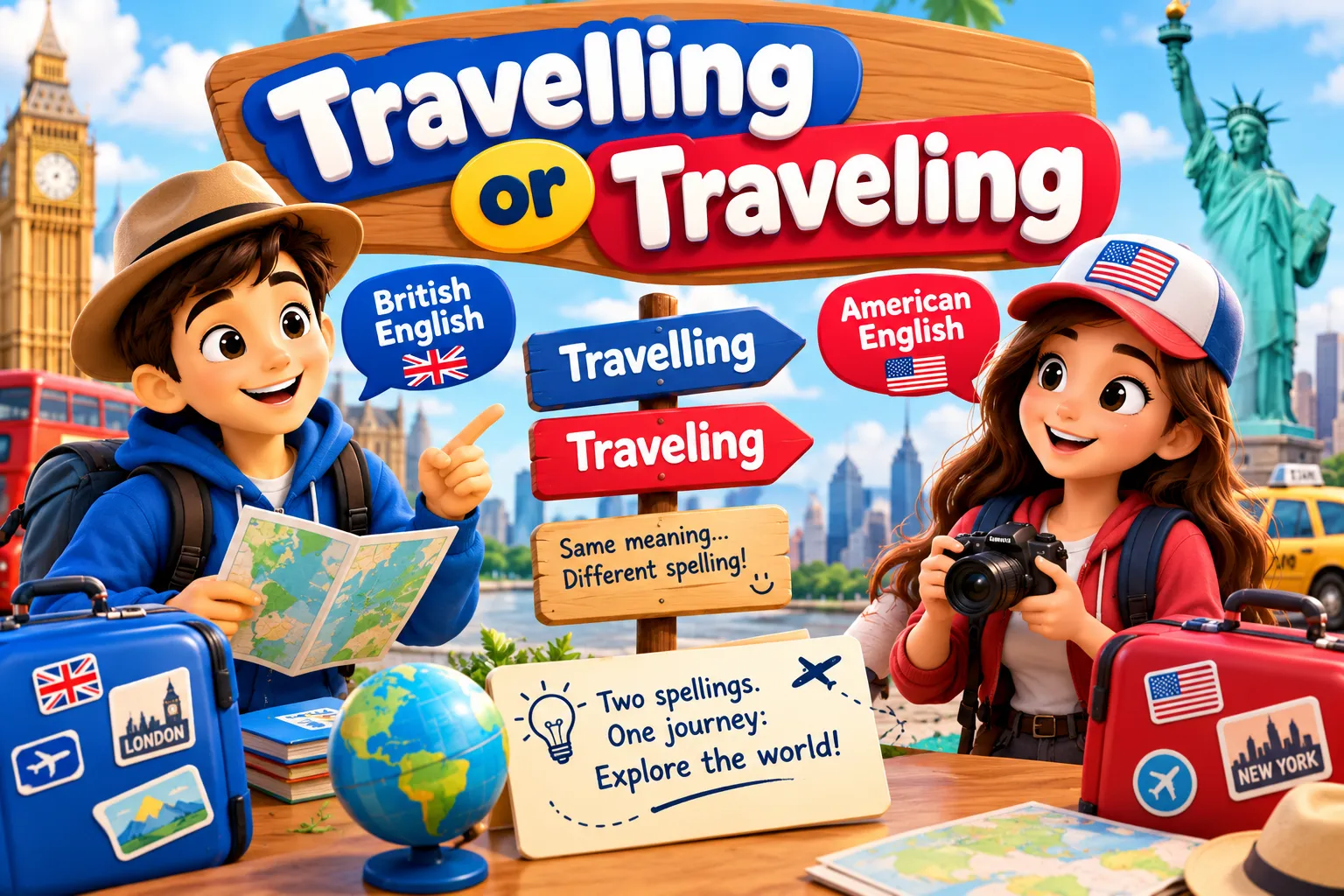
Travelling or traveling are both correct spellings. I learned that travelling is used in British English, while traveling is common in American English.
I remember noticing this difference while writing about a trip. I typed travelling, but my computer suggested traveling instead. At first, I wondered if I had spelled the word incorrectly. After checking the spelling rules, I discovered that both versions were right!
This made me curious about why English uses two spellings for the same word. I also noticed similar differences in words such as travelled and traveled, as well as traveller and traveler.
Since then, I have learned a simple rule: British English often uses a double l, while American English usually uses a single l in these words. Understanding this pattern makes writing much easier.
If you have ever been confused by these spellings, you are not alone. Let’s look at the differences and learn which version to use in your own writing.
In this guide, you will learn the meaning of both spellings, why they differ, how to use them, and which version is best for your writing. You will also find examples, comparison tables, common mistakes, and answers to frequently asked questions.
Travelling or Traveling Quick Answer
Both travelling and traveling describe the act of going from one place to another. They have the same meaning and pronunciation. The difference is regional spelling.
- Travelling: The standard British English spelling.
- Traveling: The standard American English spelling.
According to the cambridge dictionary, travelling is the British form, while traveling is the American form.
Here are two examples:
- British English: “My parents are travelling to London next week.”
- American English: “My parents are traveling to Chicago next week.”
Both sentences are grammatically correct. The spelling changes, but the meaning stays the same.
Quick tip: Choose the spelling that matches your audience. Then use it consistently throughout your writing.
The Origin and Background of Travelling or Traveling
The difference between travelling and traveling comes from the spelling conventions used in British and American English.
The verb travel means to move from one place to another. It can describe a short journey, a long trip, or movement for work.
The oxford dictionary, traces travel to Middle English, where it was a variant of travail and originally had the same sense.
Over time, the word developed its modern meaning of making a journey.
Why Do the Spellings Differ?
British and American English often follow different spelling conventions.
British English usually doubles the final l in words such as travel when adding endings like -ing or -ed.
For example:
- Travel → travelling
- Travel → travelled
- Travel → traveller
American English usually keeps one l in these forms:
- Travel → traveling
- Travel → traveled
- Travel → traveler
The oxford university style guide, lists these forms as examples of British and American spelling differences.
This pattern also appears in other words, such as labelled/labeled and cancelled/canceled.
However, English spelling rules have exceptions. Do not assume that every word ending in l follows exactly the same pattern in every variety of English.
The key lesson is simple: British English usually keeps the double l in travelling, while American English uses one l in traveling.
Travelling or Traveling Explained: Key Differences
The two words have the same meaning, grammatical role, and pronunciation. The main difference is the spelling convention used by the writer.
1. Travelling in British English
Use travelling when following standard British English spelling.
This is a good choice for writing aimed at readers who expect British conventions, including many schools, publishers, and organizations.
Examples:
- We are travelling by train to Manchester.
- She enjoys travelling during the summer holidays.
- The travelling exhibition will visit three cities.
In these examples, travelling describes an action or a person or thing connected with travel.
2. Traveling in American English
Use traveling when following standard American English spelling.
This is the usual choice for US-focused articles, school assignments, business documents, and websites that follow American spelling rules.
Examples:
- He is traveling to Boston for a meeting.
- Traveling alone helped her become more confident.
- The traveling team arrived early.
The meaning is the same as in the British examples. Only the spelling differs.
3. Comparison Table
| Term | Meaning | When to Use | Region or Context |
| Travelling | Going from one place to another | British-style writing | British English |
| Traveling | Going from one place to another | American-style writing | American English |
| Travelled | Past tense or past participle of travel | British-style writing | British English |
| Traveled | Past tense or past participle of travel | American-style writing | American English |
| Traveller | A person who travels | British-style writing | British English |
| Traveler | A person who travels | American-style writing | American English |
Remember: These are spelling variations, not words with different meanings.
Which Version Should You Use?
The best spelling depends on your readers, your school or workplace, and the style guide you follow.
For Students
If your teacher asks you to use British English, write travelling. Use traveling if your assignment follows American English.
If you are unsure, check your textbook or ask your teacher which spelling system to follow.
For Bloggers and SEO Writers
Your audience should guide your choice.
- US audience: Use traveling, traveled, and traveler.
- UK audience: Use travelling, travelled, and traveller.
- International audience: Choose a clear, consistent spelling style that suits your publication.
For SEO content, the spelling may also affect how naturally your article matches a reader’s search. However, do not force both forms into every paragraph. Write for people first and use the appropriate variation naturally.
For Professional Emails and Reports
Follow your company’s writing guide. Some organizations use American English, while others use British English.
If there is no formal guide, choose one style and keep it consistent.
For example, do not write travelling in one paragraph and traveled in the next unless you are quoting a source or discussing spelling differences.
For Writers in Pakistan
British English conventions are widely used in Pakistani education and formal writing. Therefore, travelling is often a suitable choice for school assignments and documents that follow British English.
Still, follow the spelling rules requested by your teacher, employer, or publication.
Common Mistakes with Travelling or Traveling
Even though both forms are correct, writers often make mistakes when using them.
Here are five common errors to avoid.
Mistake 1: Thinking One Spelling Is Always Wrong
Incorrect claim: “Traveling is always a spelling mistake.”
Correction: Both traveling and travelling are correct.
The difference comes from regional spelling conventions. One is standard in American English, while the other is standard in British English.
Mistake 2: Mixing British and American Spellings
Inconsistent: “We are travelling today, and we traveled yesterday.”
Better in British English: “We are travelling today, and we travelled yesterday.”
Better in American English: “We are traveling today, and we traveled yesterday.”
Keeping the same style makes your writing easier to read and more professional.
Mistake 3: Using the Wrong Noun Form
Incorrect for standard British English: “My favorite traveler is visiting.”
Better: “My favourite traveller is visiting.”
The British forms use favourite and traveller. American English normally uses favorite and traveler.
Mistake 4: Changing the Meaning Because of the Extra L
Some learners think the two spellings describe different kinds of travel.
That is not true.
Travelling and traveling have the same meaning. The extra letter does not change the action or the grammar.
Mistake 5: Forgetting the Past-Tense Pattern
British English: “They travelled across the country.”
American English: “They traveled across the country.”
The same regional pattern applies to the past-tense form. Remembering the full group of related words makes spelling easier.
Travelling or Traveling in Real World Examples
The best way to learn a spelling rule is to see it in everyday writing.
Here are four examples from different situations.
1. Professional Email
Hello Team,
I will be travelling to Islamabad next Monday for a client meeting. Please send me the updated schedule before Friday so I can prepare for the trip.
Best regards,
Ayesha
This email uses British English spelling. If the company follows American English, change travelling to traveling.
2. News Headline
British English: Local Students Travelling Abroad for University Studies
American English: Local Students Traveling Abroad for University Studies
Both headlines are correct. A news publication should follow its own spelling style.
3. Social Media Post
New places, fresh memories, and exciting adventures! Travelling gives me a chance to learn about different cultures and see the world in a new way. ✈️🌍
This caption uses British English. For an American audience, use traveling instead.
4. Formal Report
The department plans to review travelling expenses for the next financial year. The review will focus on reducing costs while ensuring that staff can attend essential meetings and training sessions.
This example follows British spelling conventions. In an American-style report, travelling would become traveling.
Travelling or Traveling Data, Trends, and Usage
Spelling differences can affect what people search for online. A person in the United States may search for traveling, while a person using British English may search for travelling.
However, spelling preferences do not tell us the exact number of people who search for each term.
Search Volume Comparison
There is no verified monthly search-volume figure available here for a direct comparison of travelling and traveling. Exact figures would require a keyword research tool, such as Ahrefs or Semrush, with a defined country and date range.
Google Trends can help compare relative search interest over time and across regions. Its values represent normalized interest, not exact search counts. You can explore the terms using google trends.
For accurate SEO research, compare both spellings in your target country and record the selected time period.
Word Frequency in Written English
Google Books’ Ngram viewer lets users compare how often words or phrases appear in books over time.
You can use it to compare travelling and traveling in the general English corpus or choose American and British English corpora separately.
Keep one point in mind: book frequency does not equal current online search volume. It shows patterns in published books, not the number of people searching on Google today.
Without a direct comparison of the selected terms, it would be misleading to claim that one spelling is always more common worldwide.
What Is the Search Intent?
The search intent behind travelling or traveling is mainly informational.
People usually want to know:
- Which spelling is correct?
- Is one form British and the other American?
- Do the words have different meanings?
- Which version should they use in an essay or article?
This makes the topic useful for English-learning websites, grammar guides, and SEO articles.
Why Does This Matter Today?
Many people write for readers in different countries. Students submit assignments online, companies send international emails, and bloggers publish content for global audiences.
A simple spelling choice can help keep that content consistent.
Grammar checkers can also flag a spelling that does not match the selected language setting. If your document uses American English, a checker may suggest traveling. If it uses British English, it may prefer travelling.
The goal is not to avoid one spelling. It is to use the right spelling for your audience.
Travelling or Traveling: A Standalone Comparison Table
This table adds related forms to help you recognize the pattern across different types of writing.
| Term or Variant | Meaning | Region or Context | Best Used When |
| Travelling | The act of going from place to place | British English | Writing for a British-style audience |
| Traveling | The act of going from place to place | American English | Writing for a US audience |
| Travelled | Went from one place to another | British English | Describing a completed journey |
| Traveled | Went from one place to another | American English | Writing in the American past tense |
| Traveller | A person who makes journeys | British English | Describing someone who travels |
| Traveler | A person who makes journeys | American English | Writing for American readers |
| Travel | To go from one place to another | Both varieties | Using the base verb or general noun |
Notice that travel itself has the same spelling in both varieties. The difference appears in certain forms that add endings to the word.
Frequently Asked Questions
Q1: What does travelling or traveling mean?
A: Both words describe going from one place to another. They can refer to holidays, work trips, daily journeys, or movement between places. The meaning does not change with the spelling.
Q2: Is travelling or traveling correct?
A: Both are correct. Travelling is standard in British English, while traveling is standard in American English. Choose the form that matches your preferred spelling style.
Q3: What is the difference between travelling and traveling?
A: The difference is the extra l in the British spelling. British English generally uses travelling, while American English uses traveling. The pronunciation and meaning remain the same.
Q4: Is travelling acceptable in formal writing?
A: Yes. Travelling is suitable for formal writing that follows British English conventions. If your document follows American English, use traveling instead.
Q5: Which is correct: travelled or traveled?
A: Both forms are accepted. Use travelled in standard British English and traveled in standard American English. Apply the same style throughout your document.
Q6: Where does the word travel come from?
A: The Oxford Advanced Learner’s Dictionary traces travel to Middle English, where it was a variant of travail and originally shared its sense. The modern verb is used for going from one place to another.
Q7: Can I use travelling in an SEO article?
A: Yes. Use travelling if your article follows British English, or traveling if it targets American readers. You can mention the alternative spelling when it helps answer a reader’s question, but avoid repeating both forms unnecessarily.
Conclusion: Travelling or Traveling?
The choice between travelling and traveling is easier than it first appears. Both spellings are correct, and both describe the same action. The main difference is the regional spelling convention you follow.
Remember these key points:
- Travelling is the standard British English form.
- Traveling is the standard American English form.
- The same pattern appears in travelled/traveled and traveller/traveler.
- Consistency matters in essays, emails, reports, blogs, and other forms of writing.
If you are writing for a British-style audience, travelling is usually the best choice. For a US audience, choose traveling. If you are unsure, check your organization’s style guide or your teacher’s instructions.
You do not need to memorize two separate meanings because there is only one meaning to learn. Focus on the spelling style that suits your readers, and your writing will look clearer and more professional.
Now you know the difference between travelling and traveling. Bookmark this guide so you can choose the right spelling with confidence whenever you write!
Readmore

I specialize in English grammar, spelling, word choice, and language usage. My content is based on research from grammar references, style guides, dictionaries, and real-world usage to ensure it is accurate and practical.
At Spelling Comparison, I write guides that explain why words are confused, how they are used, and which form is correct in context. I also include proofreading tips, examples, and writing advice readers can apply immediately.
My goal is to publish clear, reliable content that helps readers make better writing decisions. Each guide is written for accuracy, clarity, and usefulness in school, work, business, and everyday communication.