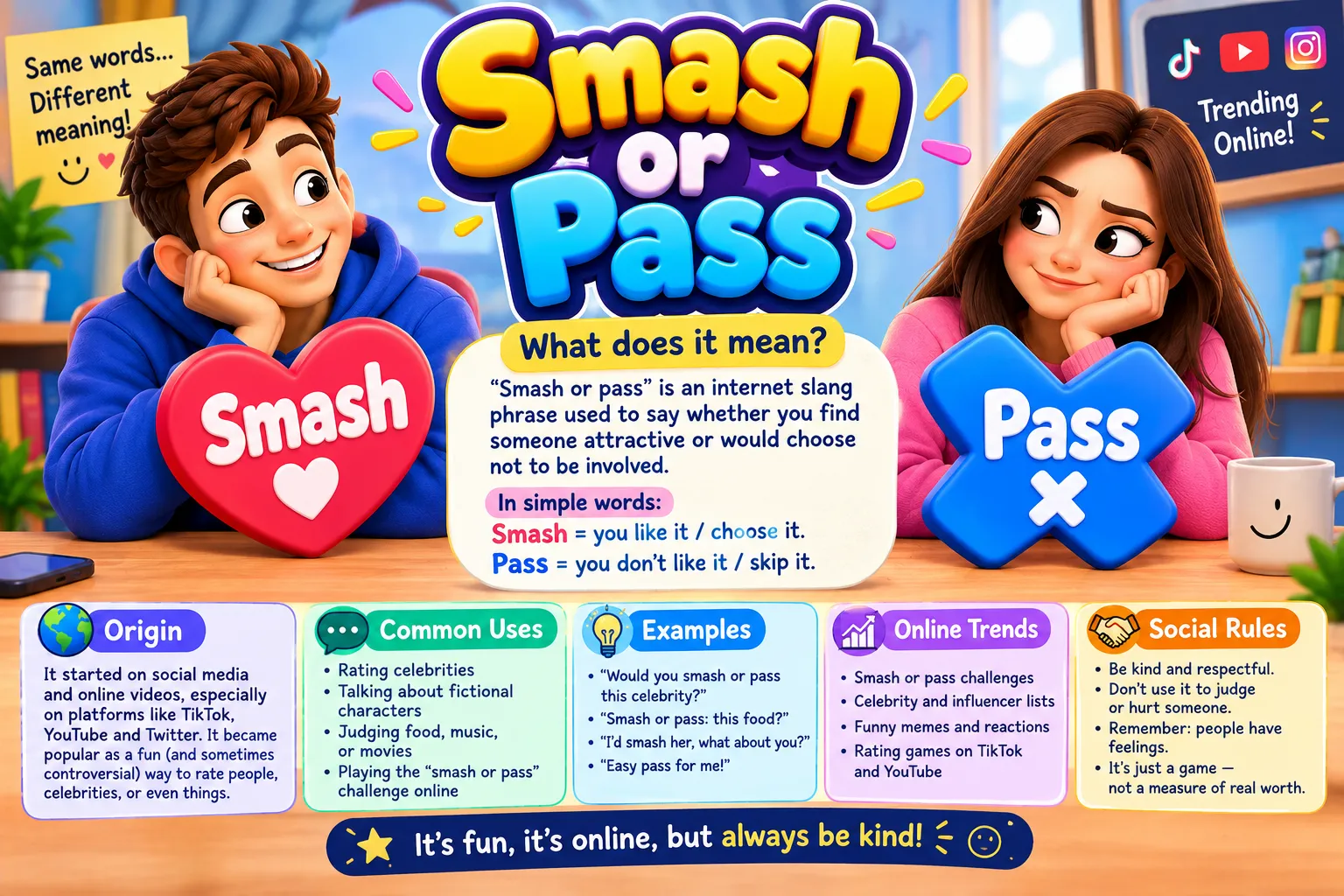
Smash or pass is an informal slang phrase used to choose whether someone finds a person attractive or would be interested in them. It can also be used playfully to show whether someone likes or dislikes a character, food, or other thing.
Have you ever watched a video where someone looks at a picture and quickly says, “Smash or pass”? If you have, you may have wondered what those words mean together.
I first came across the phrase “smash or pass” while watching online videos and scrolling through social media. At first, I thought the words had their usual meanings: breaking something or choosing not to take part. But I soon learned that the phrase is used as a game where people share whether they find someone attractive or would choose to pass.
From my experience, the meaning often depends on the situation. Some people use it for fun when talking about celebrities or fictional characters, while others use it to rate things like food or entertainment. I also learned that the phrase can sound rude if people use it to judge someone’s appearance without considering their feelings.
Understanding this phrase helped me see how internet slang can have meanings that are very different from standard English. In this guide, I’ll share its meaning, background, common uses, and mistakes to avoid so you can understand it and know when it is appropriate to use.
Smash or Pass Quick Answer
Smash or pass is a slang game in which someone chooses between two options. When it refers to a person, smash usually means that the speaker finds them sexually attractive or would be interested in a physical relationship. Pass means the speaker is not interested.
For example:
- Someone shows a celebrity photo and asks, “Smash or pass?”
- Another person replies, “Pass. That character isn’t my type.”
The phrase often appears in videos where people react to photos of celebrities, fictional characters, or other people.
However, the meaning can change with the subject. If a group uses the phrase to rate pizza toppings, smash may mean they love the food, while pass means they would not choose it.
Remember: The phrase is informal slang. Its meaning depends on the subject and the situation.
The Origin and Background of Smash or Pass
The phrase became well known through internet culture. It grew from a simple game: show someone a picture, then ask whether they would choose or reject the person shown.
According to dictionary.com, online discussions using the phrase appeared around 2010. The game gained wider attention during the 2010s, especially through online videos and social media.
The phrase combines two familiar English words, but smash has a special slang meaning here.
Where does “smash” come from?
In everyday English, smash usually means to break something with force.
For example:
- The ball smashed the window.
- The old vase fell and smashed into pieces.
In slang, smash can refer to having sex with someone. This meaning gives the phrase its original, adult meaning.
The word pass has several common meanings. In this game, it means to decline an option or show no interest.
How did the phrase become popular online?
The game was easy to turn into short videos. A creator could show a series of pictures and ask viewers to choose quickly. Other people could then share their answers, disagree, or make jokes.
Online creators helped bring the phrase to a larger audience. Dictionary.com notes that the phrase gained more attention through YouTube personalities in the late 2010s.
The game later spread to different subjects, including fictional characters, food, and entertainment.
Still, its original meaning can be sexual. That is why it is wise to understand the phrase before using it around other people.
Smash or Pass Explained Key Differences
The words smash and pass have different meanings in this expression. Knowing the difference helps you understand the game and avoid using the phrase in the wrong setting.
| Term | Meaning | When to Use | Region/Context |
| Smash | Shows sexual interest when used about a person | In informal slang conversations where the meaning is understood | Internet slang and casual speech |
| Pass | Shows a lack of interest or declines an option | When rejecting a choice in the game | Common in English-speaking online communities |
| Smash or pass | A question that asks someone to choose between the two options | In casual games, memes, and videos | Social media and informal conversation |
| Like or dislike | Shows whether someone enjoys or does not enjoy something | When discussing a song, film, product, or idea | General everyday English |
| Date or pass | Asks whether someone would consider dating a person | When discussing romantic interest | Informal conversation and online games |
What does “smash” mean in the game?
When the subject is a person, smash has a sexual meaning. It expresses a hypothetical interest in having sex with that person.
For example:
“Smash. I find that character attractive.”
The answer is casual and direct. It may also sound crude to some people, so it is not suitable for every conversation.
When the subject is an object or activity, the meaning may be less serious. Someone might use smash to show strong approval of a new song or a food choice.
What does “pass” mean in the game?
In this context, pass means to say no or decline the option.
For example:
“Pass. I would rather watch a different movie.”
When discussing a person, it usually means the speaker is not sexually interested. When discussing food, music, or other things, it may simply mean the person does not like that choice.
Why does context matter?
The phrase can carry different meanings in different settings. A video about fictional characters may use it as a joke, while a conversation about real people can feel personal or disrespectful.
Always consider the subject, the audience, and the setting before using it.
Which Version or Approach Should You Use?
There is no single answer that fits every situation. The best choice depends on who you are talking to and what you want to say.
For friends and casual conversations
You may hear smash or pass among friends who understand the slang. Even then, make sure everyone is comfortable with the topic.
Avoid using the phrase to pressure someone into judging another person. A joke is not harmless if it embarrasses someone.
For students and English learners
If you are learning English, it is useful to understand the phrase when you see it online. However, understanding slang does not mean you need to use it.
Learn the standard meanings of smash and pass first. Then remember that the combined phrase has an informal meaning that may be sexual.
For professional or formal settings
Avoid smash or pass in work emails, school reports, business meetings, and formal writing. The phrase can sound crude or disrespectful.
Use clearer alternatives instead:
- Would you choose this?
- Do you like this option?
- Would you recommend it?
- Are you interested?
These phrases express your meaning without the slang or sexual tone.
For global audiences
People from different age groups and cultures may understand the phrase in different ways. If your audience is broad, choose simple, neutral wording.
Best advice: Understand the slang, but use polite and clear language when the setting calls for it.
Common Mistakes with Smash or Pass
People often misunderstand the phrase because its words have other meanings in standard English. Here are five mistakes to avoid.
1. Thinking “smash” only means breaking something
Mistake: Assuming that smash always refers to breaking an object.
Correction: The word has several meanings. In this slang phrase, it usually refers to sexual interest in a person.
The subject and context help you understand which meaning applies.
2. Thinking “pass” means walking past someone
Mistake: Believing that pass refers only to moving by a person or place.
Correction: In the game, pass means to decline the choice or show no interest.
The word has many meanings in English, so look at how it is used.
3. Using the phrase in formal writing
Mistake: Writing “Smash or pass?” in a business report to ask whether a product is suitable.
Correction: Use “Would you recommend this product?” or “Would you choose this option?”
These alternatives sound more professional and explain the question clearly.
4. Assuming everyone finds the game funny
Mistake: Rating a classmate or coworker without thinking about their feelings.
Correction: Respect people’s privacy and boundaries. Do not use the game to embarrass, pressure, or shame someone.
A person may feel hurt when others judge their appearance in public.
5. Treating every use as sexual
Mistake: Assuming the phrase always refers to a real person’s sexual attractiveness.
Correction: The phrase can also be used in a playful, metaphorical way about food, fictional characters, music, or other choices.
Even so, the original sexual meaning may still be understood. Consider your audience before using it.
Smash or Pass in Real World Examples
These examples show how the phrase may appear in different settings. Some demonstrate the slang itself, while others show how to discuss the trend in a more formal way.
1. Professional email
The phrase itself is usually unsuitable for a professional email. If you need to ask colleagues to choose between two designs, use neutral wording.
Example:
“Hello team, please review the two proposed designs and let me know which option you prefer by Friday.”
This message asks for a choice without using slang.
2. News headline or article
A news article may discuss the phrase as an internet trend.
Example headline:
“Smash or Pass Challenges Raise Questions About Online Privacy”
The headline focuses on the social effects of the trend rather than encouraging people to judge others.
3. Social media post
The phrase often appears in casual posts and short videos.
Example:
“Fictional superhero edition: smash or pass? Share your choice, but keep the comments respectful.”
This example shows how creators may use the phrase while setting a clear rule for respectful discussion.
4. Formal document or report
In a school or research report, explain the phrase rather than using it as a casual question.
Example:
“The report examines how online rating games can affect privacy, peer relationships, and self-esteem.”
This wording is more suitable for formal writing.
5. Everyday conversation
Friends may use the phrase when discussing fictional characters or celebrities.
Example:
“Someone asked me to play smash or pass, but I chose not to join.”
This shows that people can decline to take part in the game.
Smash or Pass Data, Trends & Usage
The phrase is linked to internet slang, social media, and online entertainment. Its popularity has changed over time, but exact search figures require care.
Search volume and online interest
Dictionary.com reports that searches for smash or pass rose in the late 2010s as the phrase became more popular online. The site connects its growth to YouTube personalities and internet discussions.
However, this does not provide a current monthly search-volume figure. Without a verified report from a keyword research tool, it would be misleading to claim that the phrase receives a specific number of searches each month.
You can explore interest over time using google trends. It shows relative search interest for selected terms and regions. Its scores are not the same as exact search counts.
Is “smash or pass” common in written English?
The phrase is informal slang, not a standard expression used in most formal documents. It is more likely to appear in online conversations, memes, video titles, and entertainment content.
A general English corpus may not fully reflect how often people use modern slang in short videos or private chats. For that reason, standard word-frequency data may not tell the whole story.
Why does the topic still matter?
Internet slang can spread quickly across countries and age groups. A phrase may appear in a video long before a learner encounters it in a dictionary or classroom.
Understanding smash or pass can help you interpret online jokes and conversations. It also helps you recognize when slang may be inappropriate.
What is the search intent?
People searching for smash or pass are usually looking for an informational answer. They may want to know:
- What the phrase means.
- How the game works.
- What smash means in slang.
- Whether the phrase is rude or sexual.
- How people use it on social media.
The clearest answer explains both the common meaning and the need for context.
Smash or Pass: A Quick Comparison Table
This table adds related phrases that can help you choose more suitable wording.
| Term/Variant | Meaning | Region/Context | Best Used When |
| Smash or pass | A choice about sexual interest, or a playful yes-or-no rating | Informal internet slang | You are discussing the trend or talking with people who understand the phrase |
| Date or pass | A choice about possible romantic interest | Casual conversation | The topic is dating rather than sexual interest |
| Like or dislike | A choice based on personal preference | General English | You are discussing products, food, music, or entertainment |
| Would you choose it? | Asks whether someone prefers an option | Neutral everyday English | You want a clear question without slang |
| Would you recommend it? | Asks whether someone thinks an option is good enough to suggest to others | Professional and casual settings | You want feedback on a product, service, or experience |
The main difference is tone. Smash or pass is casual and can have a sexual meaning. The other expressions allow you to ask about interest or preference with less risk of causing offense.
Frequently Asked Questions
Q: What does smash or pass mean?
A: It is an informal game or question that asks someone to choose between two options. When used about a person, it usually asks whether the speaker finds them sexually attractive or would be interested in them.
Q: How do you use smash or pass correctly?
A: People often use it as a quick question while showing a picture or discussing a character. The phrase is slang, so it works best in casual settings where everyone understands its meaning.
Q: What is the difference between smash and pass?
A: In this phrase, smash signals sexual interest, while pass signals a lack of interest. When the subject is something like food or music, the words may simply mean strong approval and rejection.
Q: Is smash or pass appropriate for formal writing?
A: Usually, no. It can sound crude or unprofessional, especially when it refers to people. In reports and work messages, use phrases such as “Would you choose this?” or “Do you recommend it?”
Q: Is smash or pass the same as date or pass?
A: Not exactly. Smash or pass usually carries a sexual meaning when it refers to people. Date or pass focuses more on whether someone would consider dating the person.
Q: Where did smash or pass come from?
A: The game became visible in online discussions around 2010 and gained wider attention through internet forums, video creators, and social media. Dictionary.com discusses its early online use and later growth in popularity.
Q: Can smash or pass be used for food or fictional characters?
A: Yes. People sometimes use it playfully to rate meals, fictional characters, or entertainment choices. However, the phrase may still carry its original sexual meaning, so consider your audience.
Q: Is smash or pass rude?
A: It can be. The phrase may feel disrespectful when people use it to judge someone’s body or appearance, especially without their consent. Avoid pressuring others to take part, and respect anyone who does not want to play.
Conclusion
Understanding smash or pass is about more than knowing two slang words. It also means recognizing how context, tone, and audience can change the way a phrase sounds.
The expression usually asks someone to make a quick choice. When it refers to a person, it often has a sexual meaning. When used about food, music, or fictional characters, it may be a playful way to show approval or rejection.
Remember that the phrase is informal. It may be common in online videos and casual chats, but it is rarely a good choice for professional messages or formal writing. Neutral phrases such as “Would you choose this?” or “Do you like this option?” are often clearer and more respectful.
Most of all, think about the people involved. A game should not become a way to embarrass someone, share private photos, or make unwanted comments about their appearance. Respect and consent matter online as much as they do in person.
Now you know what smash or pass means and how people use it. Share this guide with someone who wants to understand internet slang, and remember to choose your words with care.
Readmore

I’m an English language educator and SEO content writer having experience creating clear, accurate, and engaging English learning content. I specialize in spelling differences, grammar, vocabulary, synonyms, commonly confused words, and English usage. My goal is to publish well-researched, easy-to-understand articles that help students, writers, educators, and professionals improve their English with confidence through practical explanations and real-world examples.










