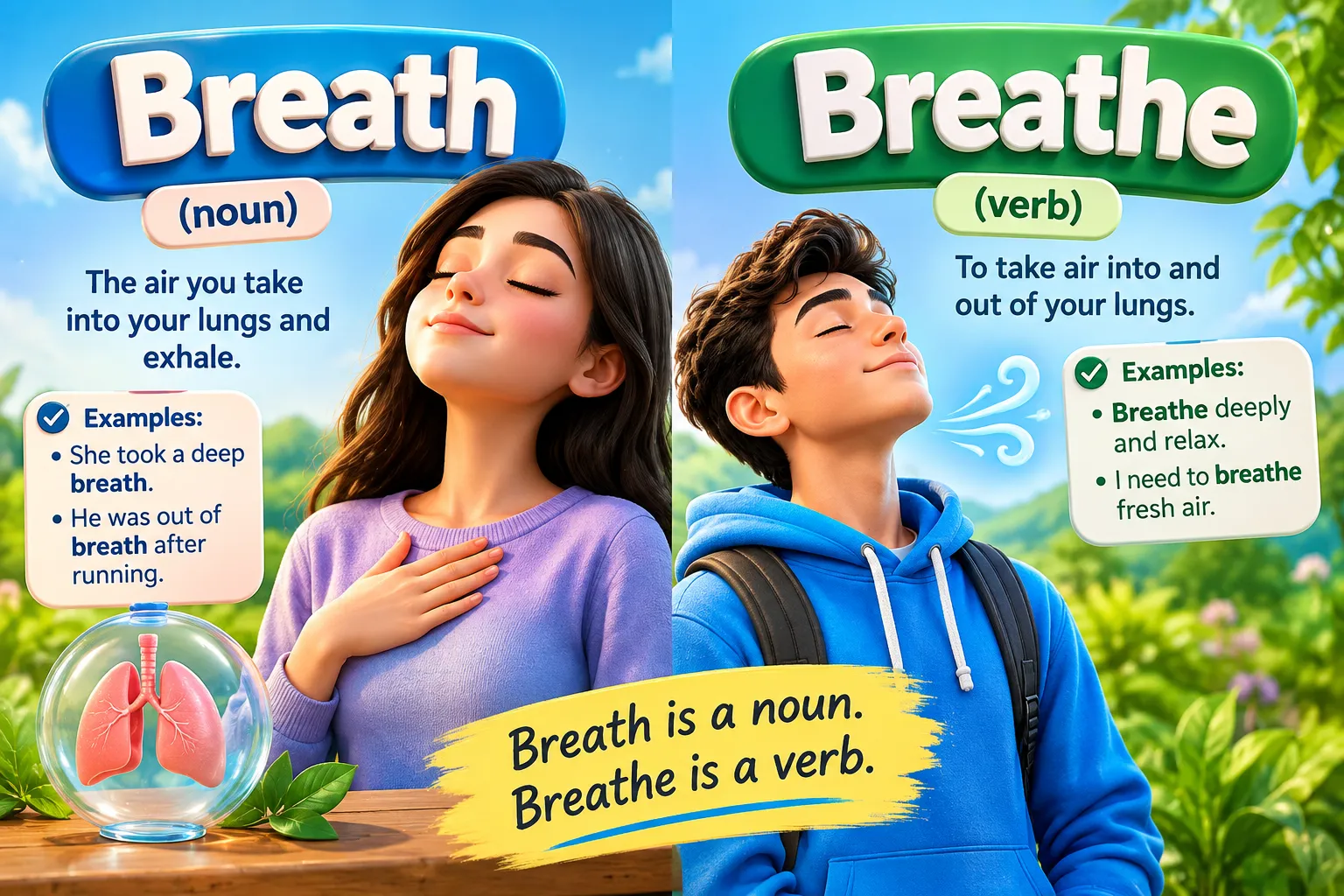
Breath is the air you take in and let out, while breathe is the verb meaning to take air into and release it from your lungs.
I remember helping a student review a short paragraph when I noticed the sentence, “Take a deep breathe.” At first, the mistake was easy to miss because breath and breathe look almost the same. But that extra “e” changes the pronunciation, meaning, and grammatical role of the word.
I have come across this confusion many times in student writing. It is especially common when people are writing quickly because both words are connected to the same idea of taking air in and out of the lungs. The key is that breath is a noun, while breathe is a verb.
For example, “Take a deep breath” is correct because breath names the air you take in. But “Remember to breathe” is correct because breathe describes the action.
Once you know this simple difference, choosing between breath or breathe becomes much easier. In this guide, you will learn their meanings, pronunciation, grammar, origins, common mistakes, examples, and an easy memory trick to help you use the right word every time.
Breath or Breathe Quick Answer
Breath is a noun that means the air you inhale and exhale. Breathe is a verb that means to take air into your lungs and release it.
Examples:
- Take a deep breath.
- Remember to breathe slowly.
A quick memory trick:
Breath = thing
Breathe = action
The Origin / Background of Breath or Breathe
Breath and breathe are closely related words. Both developed from older Germanic language forms connected with breathing and air.
Merriam-Webster lists breath as a noun referring to the air taken into or expelled from the lungs and traces it to Old English brǣth. It also traces breathe to Old English brǣthan.
Their shared history explains why they look so similar today.
English often creates related words that differ in part of speech. Here, breath functions mainly as a noun, while breathe functions as a verb.
The spelling difference also affects pronunciation.
- breath → usually pronounced like “breth”
- breathe → usually pronounced like “breedh”
Cambridge Dictionary gives the same basic distinction between the noun breath and the verb breathe.
Breath or Breathe Explained Key Differences
| Term | Meaning | When to Use | Part of Speech |
| breath | Air taken into or released from the lungs | When naming the air or an instance of breathing | Noun |
| breathe | To take air in and release it | When describing the action | Verb |
| breaths | More than one breath | When referring to several breaths | Plural noun |
| breathing | The act or process of taking in and releasing air | When describing ongoing action | Noun/verb form |
What does “breath” mean?
Breath refers to the air involved in breathing.
She took a deep breath before speaking.
Here, breath is a thing. That makes it a noun.
You can also use it in phrases such as:
- a deep breath
- fresh breath
- bad breath
- hold your breath
- out of breath
What does “breathe” mean?
Breathe describes the action of taking air into and releasing it from the lungs.
Try to breathe slowly.
Here, breathe tells us what someone does. It is a verb.
You can use it in sentences such as:
- Breathe deeply.
- Plants breathe in a different way from animals.
- I can hardly breathe in this crowded room.
Breath vs. Breathe: The Pronunciation Difference
Pronunciation is another useful clue.
Breath
Breath has a short vowel sound.
It sounds roughly like:
breth
Example:
Take a breath.
Breathe
Breathe has a long vowel sound.
It sounds roughly like:
breedh
Example:
Just breathe.
The final e helps distinguish the pronunciation.
A similar spelling pattern appears in other English words, where a final e can affect pronunciation. However, it is best to learn breath and breathe as a pair rather than relying on spelling rules alone.
Which Version Should You Use?
For students
Ask yourself:
Am I naming something or describing an action?
If it is a thing → breath
Take a breath.
If it is an action → breathe
Breathe slowly.
For formal writing
Both words are completely standard in formal English.
Choose the form based on its grammatical role.
The patient took a deep breath.
The patient was told to breathe normally.
For everyday conversation
Both words are extremely common.
You might hear:
“I need to catch my breath.”
or:
“Stop and breathe for a moment.”
For global English learners
Do not depend only on how the words look. Learn their meaning, pronunciation, and part of speech together.
That will prevent most mistakes.
Common Mistakes with Breath or Breathe
1. Mistake: “Take a deep breathe.”
Correct: “Take a deep breath.”
The sentence needs a noun because you are naming what you take.
2. Mistake: “I can’t breath.”
Correct: “I can’t breathe.”
The sentence needs a verb describing the action.
3. Mistake: “Hold your breathe.”
Correct: “Hold your breath.”
You hold a breath, not “breathe.”
4. Mistake: “She took a deep breathe.”
Correct: “She took a deep breath.”
The word after a is a noun here.
5. Mistake: “Remember to breath.”
Correct: “Remember to breathe.”
After to, you need the base form of the verb: breathe.
Breath or Breathe in Real-World Examples
Professional email
Please take a breath and review the document before sending your final response.
News article
The athlete struggled to breathe after completing the difficult race.
Social media post
Take a deep breath, relax, and give yourself another chance.
Formal document
Participants were instructed to breathe normally during the assessment.
Everyday conversation
“Give me a second. I need to catch my breath.”
Each sentence uses the word according to its grammatical role.
Breath or Breathe Data, Trends & Usage
The search intent behind “breath or breathe” is primarily informational. People usually search this pair because they want to check spelling, pronunciation, meaning, or grammar.
Exact monthly search-volume figures vary by country and SEO platform. Google Trends provides relative search interest rather than a fixed universal number of monthly searches, so precise figures should not be presented without a specific data source and timeframe.
Why do people confuse these words?
The main reason is their shared spelling and meaning. Both relate to respiration, but they perform different grammatical jobs.
Compare:
Take a breath.
Breathe deeply.
The first sentence names an action or amount of air. The second tells someone to perform an action.
A useful grammar insight
This pair is an example of how word families can contain related forms with different parts of speech.
Breath → noun
Breathe → verb
Breathing → noun/verb form
Breaths → plural noun
Learning the whole word family can make vocabulary easier.
Breath vs. Breathe: Standalone Comparison Table
| Term/Variant | Meaning | Region/Context | Best Used When |
| breath | One intake or release of air | Standard English | Naming the air or an instance of breathing |
| breathe | Take air in and release it | Standard English | Describing the action |
| breaths | Multiple instances of breathing | Standard English | Talking about several breaths |
| breathing | The process of respiration | General/scientific English | Describing ongoing respiration |
| breathless | Unable to breathe easily or extremely excited | General English | Describing a person or state |
| breathed | Past tense of breathe | Standard English | Describing a previous breathing action |
The Easiest Memory Trick
Here is a simple way to remember the difference:
Breath = noun
Think:
Take a breath.
You can count it:
one breath
two breaths
Breathe = verb
Think:
Breathe slowly.
You perform the action.
Another useful trick is the final E:
Breathe = do the action
The extra e can remind you that breathe is the verb.
Breath or Breathe in Common Expressions
These phrases can help you learn the difference naturally.
Expressions with “breath”
- take a breath
- hold your breath
- catch your breath
- out of breath
- under your breath
- a breath of fresh air
Expressions with “breathe”
- breathe deeply
- breathe slowly
- breathe in
- breathe out
- breathe easily
- breathe new life into something
Notice that breath usually names something, while breathe describes an action.
FAQs About Breath or Breathe
Q: What is the difference between breath and breathe?
A: Breath is a noun for the air you take in or release. Breathe is a verb describing the action of taking in and releasing air.
Q: Is it “take a breath” or “take a breathe”?
A: The correct phrase is “take a breath.” Here, breath is a noun.
Q: Is it “I can’t breathe” or “I can’t breath”?
A: The correct form is “I can’t breathe.” The word describes an action, so you need the verb breathe.
Q: How do you pronounce breath and breathe?
A: Breath generally has the vowel sound in dress, while breathe has a longer vowel sound similar to the one in see. The final consonant sound also differs.
Q: Is breathe a noun?
A: No. Breathe is a verb. The related noun is breath.
Q: Is breath a verb?
A: No. Breath is normally a noun. The corresponding verb is breathe.
Q: What is the plural of breath?
A: The plural is breaths. For example, “She took several slow breaths.”
Q: Is “breathing” related to breath and breathe?
A: Yes. Breathing is the -ing form of breathe and can also function as a noun when referring to the process of respiration.
Conclusion: Breath or Breathe Made Easy
The difference between breath or breathe becomes simple when you focus on grammar.
Breath is the noun. It refers to air or an instance of taking air into or releasing it from the lungs.
Breathe is the verb. It describes the action itself.
Remember:
Take a breath.
Remember to breathe.
The pronunciation can also help. Breath has a shorter vowel sound, while breathe has a longer one.
If you are unsure, look at the sentence. If you need to name something, choose breath. If you need an action, choose breathe.
Once you learn that simple distinction, this common spelling problem becomes much easier. You will also be better prepared for related word pairs where spelling, pronunciation, and grammar work together.
Bookmark this guide so you never have to second-guess “breath” and “breathe” again.
Read More:
Rain or Shine: Meaning, Origin & Easy Examples

I’m an English language educator and content writer with more than 10 years of experience helping learners improve their English skills. I specialize in spelling differences, grammar, vocabulary, synonyms, commonly confused words, and English usage. My goal is to create accurate, easy-to-understand articles that make learning English simple, practical, and enjoyable for students, writers, and professionals around the world.