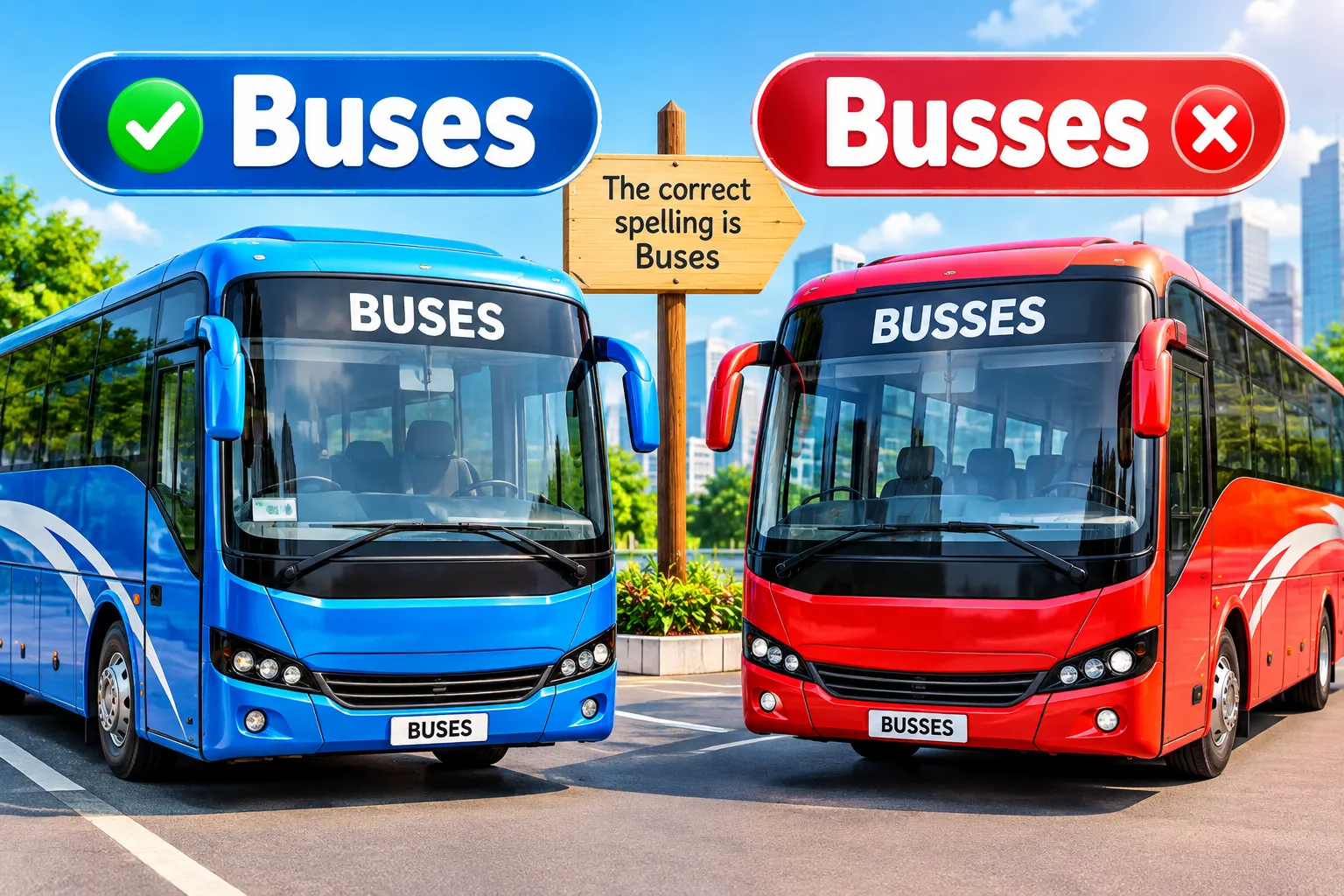
Buses is the standard modern plural of bus when you mean more than one vehicle. Busses is also recorded as a variant, but it is much less common in modern general English.
Have you ever typed buses and stopped to wonder, “Should there be two s letters here?”
I have seen this small spelling question cause surprising hesitation, even in otherwise polished writing. The doubt makes sense. English has words such as classes, kisses, and buses. Then there are buses, which looks as if it should follow the same pattern as kisses.
The problem becomes even more confusing because both spellings appear in dictionaries.
So which one should you use?
For most modern writing, the answer is simple: buses. Cambridge lists buses as the plural of bus, while Merriam-Webster lists buses first and also records busses as an alternative.
But there is more to the story. The double-s form has a real history. It can also connect to the separate word buss, which means a kiss, and to verb forms such as bussed and bussing.
This guide will clear up the difference, explain why the confusion exists, and show you exactly which spelling to choose.
Buses or Busses Quick Answer
If you mean more than one passenger vehicle, use buses.
For example:
- The buses leave at six every morning.
- Several buses stopped outside the station.
Cambridge Dictionary gives buses as the plural of bus. Its US dictionary also notes that busses is used in American English as an alternative spelling.
Merriam-Webster takes a similar approach. It lists the plural as buses, with busses also recorded.
So, if you are writing an essay, email, website, report, or school assignment, buses is the safest choice.
The Origin and Background of Buses
The history of bus helps explain why its plural can feel unusual.
According to the Online Etymology Dictionary, bus appeared in English in 1832 as a shortened form of omnibus, referring to a public passenger vehicle. Omnibus came through French from Latin and meant “for all.”
That history is a good reminder that English words do not always follow neat spelling patterns.
The ending -s can create another problem. English learners often expect a word ending in s to form its plural with -es and therefore produce busses. That spelling does exist, but modern dictionaries generally put buses first for the vehicle noun.
There is also a separate word, buss.
A buss is an old word meaning a kiss. Etymonline dates this noun to the 1560s and also records buss as a verb meaning “to kiss.”
That creates an interesting overlap:
- bus → buses = more than one vehicle
- buss → busses = more than one kiss
- bus → busses = an accepted alternative plural in some dictionaries
Context tells the reader which meaning is intended.
Buses vs. Busses Key Differences
Here is the easiest way to separate the forms:
| Term | Meaning | When to Use | Region/Context |
| buses | More than one bus | Normal modern writing about vehicles | General English |
| busses | Alternative plural of bus | When following a source or style that permits it | Especially recorded in US English |
| busses | More than one buss, or kisses | When buss means “kiss” | Older or literary usage |
| busses | Verb form related to bus or buss | Depends on the verb and meaning | Context-dependent |
Cambridge specifically records busses as a US plural form of bus, while Merriam-Webster lists both forms.
Collins makes another useful distinction. It gives buses as the plural noun form, while busses can appear as a verb form.
Why Does “Busses” Look So Natural?
The spelling pattern is easy to understand.
You already know words such as:
- class → classes
- dress → dresses
- kiss → kisses
- bus → ?
That pattern can make busses feel natural.
But English spelling is full of exceptions and historical choices. A familiar pattern does not always determine the accepted form of every word.
For everyday transport writing, buses is the form to remember.
Which Version Should You Use?
Your best choice depends on what you are writing.
For students
Use buses.
It is clear, familiar, and widely accepted in modern dictionaries. It is also the form you are most likely to see in standard educational material.
For professional writers
Use buses when referring to passenger vehicles.
Consistency matters in professional writing. Unless you are following a particular publication’s style, there is little reason to choose the less common variant.
For international readers
Again, buses is the straightforward choice.
It avoids an unnecessary spelling question and makes the meaning immediately clear.
For historical or literary writing
Busses may be appropriate when you are preserving historical wording or discussing the separate word buss.
In that case, the context matters more than modern spelling preference.
Common Mistakes With Buses and Busses
| Mistake | Correction | Why It Happens |
| The city has 50 busses. | The city has 50 buses. | The writer follows the spelling pattern of words such as kisses. |
| Three bus are waiting. | Three buses are waiting. | The plural ending is missing. |
| The bus’s are late. | The buses are late. | A plural is confused with a possessive form. |
| The buses’ engine is broken. | The bus’s engine is broken. | The writer confuses plural possession with singular possession. |
| Two buss arrived. | Two buses arrived. | The plural form is incomplete. |
A Useful Memory Trick
Think:
One bus → two buses.
The spelling changes only by adding -es.
You do not need to memorize a complicated grammar rule. Just remember that buses is the normal modern plural for the vehicle.
Buses in Real-World Examples
Professional email
Please confirm that the company buses will leave from the main entrance at 7:30 a.m.
News article
Local buses will follow revised routes during the weekend road closure.
Social media post
The buses were packed today, but we still made it home before sunset!
Formal report
The survey found that buses remain an important part of the city’s public transport network.
Notice that each example uses buses because each one refers to more than one passenger vehicle.
Buses or Busses Data, Trends & Usage
Exact monthly search-volume figures for “buses or busses” depend on the SEO platform, country, database, and date. Publicly accessible sources do not provide a stable, universally comparable monthly figure, so it would be misleading to invent one.
There is, however, useful corpus evidence.
A 2014 analysis of the Corpus of Contemporary American English (COCA) reported 5,354 occurrences of “buses” compared with 119 occurrences of “busses” in the dataset examined. That is roughly 45 occurrences of buses for every occurrence of busses in that sample.
Other frequency evidence points in the same direction. Grammarist reports that its comparison of an Ngram graph covering English-language books and magazines from 1800–2019 shows buses occurring much more often than busses in modern usage.
The important lesson is not a single frequency number. It is the broad usage pattern:
- Buses is the dominant modern spelling for the vehicle plural.
- Busses still appears and is recognized by major dictionaries.
- Busses also has separate historical and verb-related uses.
- Search intent for this phrase is primarily informational: readers want to know which spelling is correct.
This matters for students, ESL learners, editors, and online writers because a tiny spelling doubt can slow down otherwise simple writing.
A Standalone Comparison Table
| Term/Variant | Meaning | Region/Context | Best Used When |
| bus | One passenger vehicle | General English | Talking about one vehicle |
| buses | More than one bus | Modern general English | Standard plural in most writing |
| busses | Alternative plural of bus | Recorded especially in US English | A source or style specifically permits it |
| buss | A kiss | Older/literary English | Referring to the separate noun or verb |
| bussed | Past form of bus or buss | Context-dependent | Writing about completed action |
| bussing | Present participle/gerund | UK and US usage varies by sense | Describing an ongoing action |
The distinction between buses and bussed/bussing is especially useful. Merriam-Webster records bused and bussing alongside the alternative bussed and busing, showing that verb spelling can behave differently from the noun plural.
Buses vs. Busses: FAQs
Q: What does “buses” mean?
A: Buses is the plural of bus when bus means a vehicle that carries passengers. Cambridge Dictionary lists buses as the plural form.
Q: How do you use “buses” correctly?
A: Use buses when you are talking about two or more buses. For example, you might write about buses arriving at a station, serving a route, or carrying passengers.
Q: Is “busses” wrong?
A: Not always. Merriam-Webster records busses as an alternative plural of bus, and Cambridge records it as a US form. However, buses is the more straightforward choice for general modern writing.
Q: Which is correct: buses or busses?
A: For ordinary writing about passenger vehicles, choose buses. Busses is a documented variant, so seeing it does not automatically mean the writer has invented a spelling.
Q: Is “buses” acceptable in formal writing?
A: Yes. Buses is standard dictionary-listed English and is suitable for academic, professional, business, and formal writing.
Q: Where does the word “bus” come from?
A: Bus is a shortened form of omnibus, which referred to a public passenger vehicle. Etymonline traces the modern English noun to the early 19th century.
Q: Can “busses” mean something other than buses?
A: Yes. Busses can be the plural of the older word buss, meaning kisses. The verb buss also means to kiss.
Q: Why do some people write “busses”?
A: English spelling patterns make the double-s form look logical, and dictionaries have recorded it as a genuine variant. Historical usage also helped keep the spelling alive.
Final Takeaway: Buses or Busses?
The spelling question looks bigger than it really is.
When you mean more than one passenger vehicle, write buses. That is the form major dictionaries present as the normal plural, and corpus evidence shows it is far more common in modern usage.
Busses is not simply a made-up spelling. It has a documented place in English and can appear as an alternative plural. It also belongs to the separate word buss, meaning a kiss.
For schoolwork, business writing, SEO content, emails, reports, and everyday communication, buses is the practical choice.
The easiest rule is worth keeping:
One bus. Two buses.
Once you remember that, you can stop second-guessing the spelling and focus on what you actually want to say.
Bookmark this guide so you never have to pause over “buses or busses” again.
I kept the usage data cautious rather than inventing current SEO search-volume figures, and used dictionary/corpus evidence where it could be verified.
Read more:
Utmost or Upmost: The Complete Guide to Correct Usage

I’m **Rubab Naaz**, an English language content writer with over 10 years of experience creating educational and SEO-focused articles. I specialize in spelling comparisons, grammar, vocabulary, synonyms, commonly confused words, and English usage. My passion is helping students, writers, and professionals improve their language skills through accurate, well-researched, and easy-to-understand content. Every article I write is designed to make learning English simple, practical, and engaging.