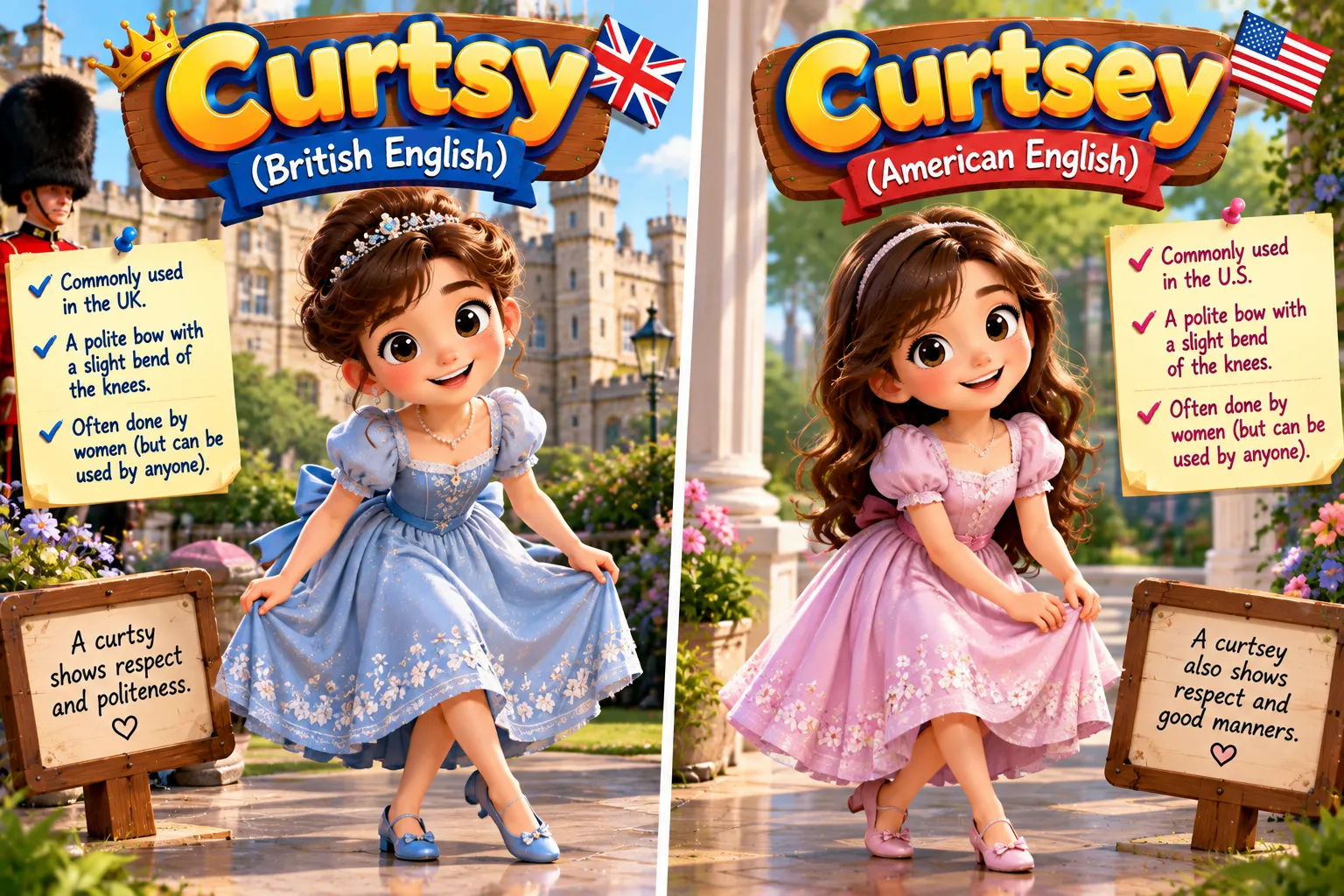
Curtsy and curtsey are both correct spellings for the same respectful gesture of bending the knees and lowering the body.
I have often paused over the spelling of curtsy, especially when curtsey appears in a book or older piece of writing. At first, the extra e can make the two forms look like they might have different meanings, but they do not.
From my experience helping English learners, this is a common spelling doubt. Both curtsy and curtsey are accepted English spellings, and both refer to the same traditional gesture of respect.
What makes the choice confusing is that curtsy is the main form listed by major modern dictionaries, while curtsey is given as an alternative spelling. The pronunciation and basic meaning remain the same.
I have also noticed that learners often become unsure when they see related forms such as curtsied, curtsying, or curtseyed. That is where knowing the spelling pattern becomes useful.
In this guide, I will explain the meaning, pronunciation, history, grammar, spelling forms, common mistakes, and everyday usage of curtsy and curtsey, so you can choose the right form with confidence.
Curtsy or Curtsey Quick Answer
Curtsy and curtsey are two spellings of the same word. Both can be used as a noun or an intransitive verb.
As a noun, the word names the gesture:
The dancer finished with a graceful curtsy.
As a verb, it describes the action:
The performer curtsied before leaving the stage.
You can also use the alternative spelling:
The performer curtseyed before leaving the stage.
The meaning stays the same.
Cambridge Dictionary lists curtsy as a noun and verb and gives curtsey as an alternative spelling. Collins Dictionary does the same. Both dictionaries also show that the word is pronounced essentially the same way in either spelling.
So, if you are wondering “Is it curtsy or curtsey?”, the answer is: both are correct.
The Origin and Background of Curtsy and Curtsey
The history of this word explains why two spellings exist.
According to Etymonline, curtsy developed as a variant of courtesy. The noun appears in English in the 16th century. Its more specific meaning of bending the knee and lowering the body as a gesture of respect developed later in that century.
The connection with courtesy is interesting because both words relate to polite behavior and respect.
Over time, the shorter spelling curtsy became established. The form curtsey also remained in use. Etymonline lists curtsey as an alternative spelling of curtsy.
This is a useful example of how English spelling can change over time. English does not always keep one spelling for every word. Historical spelling, pronunciation, regional habits, and word formation can all affect the forms that survive.
The word is also interesting from a linguistics point of view. Cambridge notes that curtsy is connected historically with courtesy through a sound and form change known as syncope, where sounds are lost within a word.
That history does not mean that curtsy and courtesy are interchangeable today.
- Curtsy = a physical gesture of respect.
- Courtesy = polite behavior or a polite act.
For example:
The guest made a curtsy before the ceremony.
But:
The host showed great courtesy to the visitors.
The two words are related, but their modern meanings are different.
Curtsy vs Curtsey Explained Key Differences and Variations
The easiest way to understand these words is to treat them as variant spellings.
| Term | Meaning | When to Use | Region/Context |
| curtsy | A respectful bending of the knees | General modern writing | Widely used |
| curtsey | Same gesture as curtsy | Alternative spelling | British and historical contexts may show it |
| curtsied | Past form of curtsy | When describing a past action | Modern form |
| curtsying | -ing form of curtsy | For an action in progress | Modern form |
| curtseyed | Past form of curtsey | When keeping the curtsey spelling | Variant form |
| curtseying | -ing form of curtsey | When keeping the curtsey spelling | Variant form |
What does curtsy mean?
As a noun, curtsy refers to the gesture itself.
She gave a small curtsy to the audience.
As a verb, curtsy means to perform that gesture.
The young performer curtsied after the show.
What does curtsey mean?
Curtsey has the same basic meaning.
She gave a polite curtsey.
Or:
The performer curtseyed after receiving the award.
There is no special meaning hidden in the extra e.
Is the pronunciation different?
No. The two spellings have the same standard pronunciation.
Cambridge gives the pronunciation as approximately:
- UK: /ˈkɜːt.si/
- US: /ˈkɝːt.si/
So the extra e in curtsey does not create a different sound.
This makes the pair a good example of variant spellings, not two separate words that happen to sound alike.
Which Version Should You Use?
If you are writing modern English and simply want the most straightforward choice, curtsy is usually the easiest form to use.
For students and English learners
Choose curtsy.
It is the main form shown by major dictionaries such as Cambridge and Collins. It is also easy to connect with common forms such as curtsies, curtsied, and curtsying.
For general online writing
Again, curtsy is a practical choice.
Use it in:
- Blog posts
- Articles
- School assignments
- General emails
- Social media
- Everyday writing
When matching a source or historical style
Curtsey can still be useful.
If you are quoting an older text, editing a historical document, or following a publication that consistently uses curtsey, keeping that spelling may make sense.
For global English
Use curtsy when you have no reason to prefer the alternative.
You do not need to avoid curtsey. It is a valid spelling. However, using one consistent form throughout your document makes your writing cleaner.
Simple rule: If you are unsure, write curtsy.
Common Mistakes with Curtsy and Curtsey
These words cause a few predictable errors.
| Mistake | Correction | Why |
| She curtsey to the queen. | She curtseyed to the queen. | The sentence needs a past-tense verb. |
| They curtsyed after the show. | They curtsied after the show. | The standard past form of curtsy is curtsied. |
| She was curtsy the guest. | She was curtsying to the guest. | The continuous form needs -ing. |
| He showed curtsy. | He showed courtesy. | Courtesy means polite behavior; curtsy is the physical gesture. |
| She made a courtesy before the queen. | She made a curtsy before the queen. | The physical gesture is a curtsy. |
Mistake 1: Mixing spelling systems
You might start with curtsy and then write curtseyed later.
That creates an inconsistent spelling pattern.
If you choose curtsy, use:
- curtsies
- curtsied
- curtsying
If you choose curtsey, use:
- curtseys
- curtseyed
- curtseying
Mistake 2: Confusing curtsy with courtesy
This is one of the more important differences to remember.
Courtesy describes polite behavior.
Curtsy describes a particular physical gesture.
The words are historically connected, but they are not interchangeable in modern English.
Curtsy and Curtsey in Real-World Examples
Seeing both forms in different settings can make the difference easier to remember.
Professional email
Thank you for your kind invitation. I would be honored to attend the ceremony and offer my curtsy during the formal presentation.
Here, curtsy is used as a noun.
News article
The young performers curtsied at the end of the ceremony before leaving the stage.
The past-tense form curtsied describes an action that already happened.
Social media post
What a beautiful performance! The final curtsy was such a lovely way to end the evening.
This casual post uses the noun naturally.
Formal document
Participants were expected to bow or curtsy as part of the traditional ceremony.
Here, the verb appears after to.
Historical writing
The guests entered the royal chamber and curtseyed before taking their seats.
The alternative spelling works well when a writer wants to retain the curtsey form.
Performance setting
After the final note, the dancers stepped forward and curtsied together.
This shows that the word is not limited to royal ceremonies. It can also appear in dance and performance contexts.
Curtsy or Curtsey Data, Trends and Usage
There is a useful lesson in the available language data: dictionary acceptance is clear, but exact modern search-volume figures are harder to verify without a paid SEO database.
Google Trends provides relative search-interest data rather than a simple universal monthly search count. Its results can change with the selected country, time period, category, and search type. Therefore, giving an exact monthly figure for curtsy versus curtsey without a dedicated SEO dataset would be misleading.
Google Books Ngram Viewer is another useful tool. It tracks word frequency in books over time and allows users to compare forms across different English corpora. Collins also provides access to Ngram trend information for curtsey.
The safest conclusions are:
- Curtsy is a standard dictionary form.
- Curtsey is an accepted alternative spelling.
- The two forms have the same core meaning.
- The pronunciation is the same.
- Search interest should not be confused with dictionary correctness.
- Corpus frequency can vary by period and type of English.
- Exact monthly SEO search volume requires a specialist tool such as Ahrefs, Semrush, or Google Keyword Planner.
The search intent behind “curtsy or curtsey” is clearly informational. A person searching the phrase is usually trying to settle a spelling question, understand the difference, or choose the right form for writing.
This matters even more when spell-checkers or AI writing tools flag one version. A spelling checker may prefer one form based on its dictionary or regional settings. That does not automatically make the other spelling wrong.
Standalone Curtsy vs Curtsey Comparison
| Term/Variant | Meaning | Region/Context | Best Used When |
| Curtsy | Respectful knee-bending gesture | General modern English | You want the clearest standard choice |
| Curtsey | Same respectful gesture | Alternative and historical usage | You are matching a source or style |
| Curtsy to | Perform the gesture toward someone | Formal or traditional settings | The person receiving the gesture matters |
| Curtsied | Past form of curtsy | Modern writing | The action happened in the past |
| Curtseyed | Past form of curtsey | Variant spelling | Your text consistently uses curtsey |
| Courtesy | Polite behavior or respect | General English | You mean good manners, not the physical gesture |
One helpful point stands out here: curtsy and curtsey belong in the same spelling family, while courtesy is a related word with a different modern meaning.
FAQs About Curtsy or Curtsey
Q: What does curtsy mean?
A: A curtsy is a traditional gesture of respect made by bending the knees and lowering the body. Cambridge Dictionary lists it as both a noun and a verb.
Q: Is curtsy or curtsey correct?
A: Both are correct. Curtsy is the main form used in major modern dictionaries, while curtsey is listed as an alternative spelling.
Q: Is curtsy acceptable in formal writing?
A: Yes. Curtsy is a standard English word and can be used in formal, academic, historical, and general writing when the context calls for it.
Q: What is the difference between curtsy and courtesy?
A: A curtsy is a physical gesture. Courtesy means polite behavior, kindness, or respect. Although the words are historically related, they are not interchangeable.
Q: How do you spell the past tense of curtsy?
A: The usual past form is curtsied. For example: “The performer curtsied after the final song.”
Q: Can curtsey be used as a verb?
A: Yes. Curtsey works as both a noun and an intransitive verb. For example: “The dancers curtseyed before leaving the stage.”
Q: Where does the word curtsy come from?
A: Etymonline traces curtsy to a variant of courtesy. The word developed its specific sense of a respectful knee-bending gesture during the 16th century.
Final Takeaway: Curtsy or Curtsey?
The spelling question becomes much easier once you know that curtsy and curtsey are not two different meanings. They are alternative spellings for the same basic word.
The form curtsy is the simplest choice for most modern writing. It works as both a noun and a verb, and its common forms include curtsies, curtsied, and curtsying.
Curtsey is also valid. You may see it in British, historical, literary, or source-specific writing. If you use it, keep the spelling consistent with forms such as curtseys, curtseyed, and curtseying.
There is one word you should keep separate: courtesy. It refers to politeness or good manners, not the physical gesture itself.
So the next time you pause over this spelling, you do not need to worry about choosing a “wrong” word. For everyday modern English, curtsy is the easy default.
Bookmark this guide so you never have to second-guess curtsy or curtsey again.
Read More:
GRE or GMAT: The Complete Guide for Students

I’m Daniel sultan, an English language writer and SEO content specialist with experience researching spelling, grammar, vocabulary, and English usage. Through SpellComparison.com, I create clear, accurate, and well-researched guides that help readers understand commonly confused words, spelling differences, and grammar rules with confidence.
Every article I write is based on trusted language references, established style guides, and real-world usage to ensure it is accurate, practical, and easy to understand. My goal is to make learning English simple and reliable by providing fact-checked content, clear explanations, and real-life examples that students, writers, educators, and professionals can trust.










