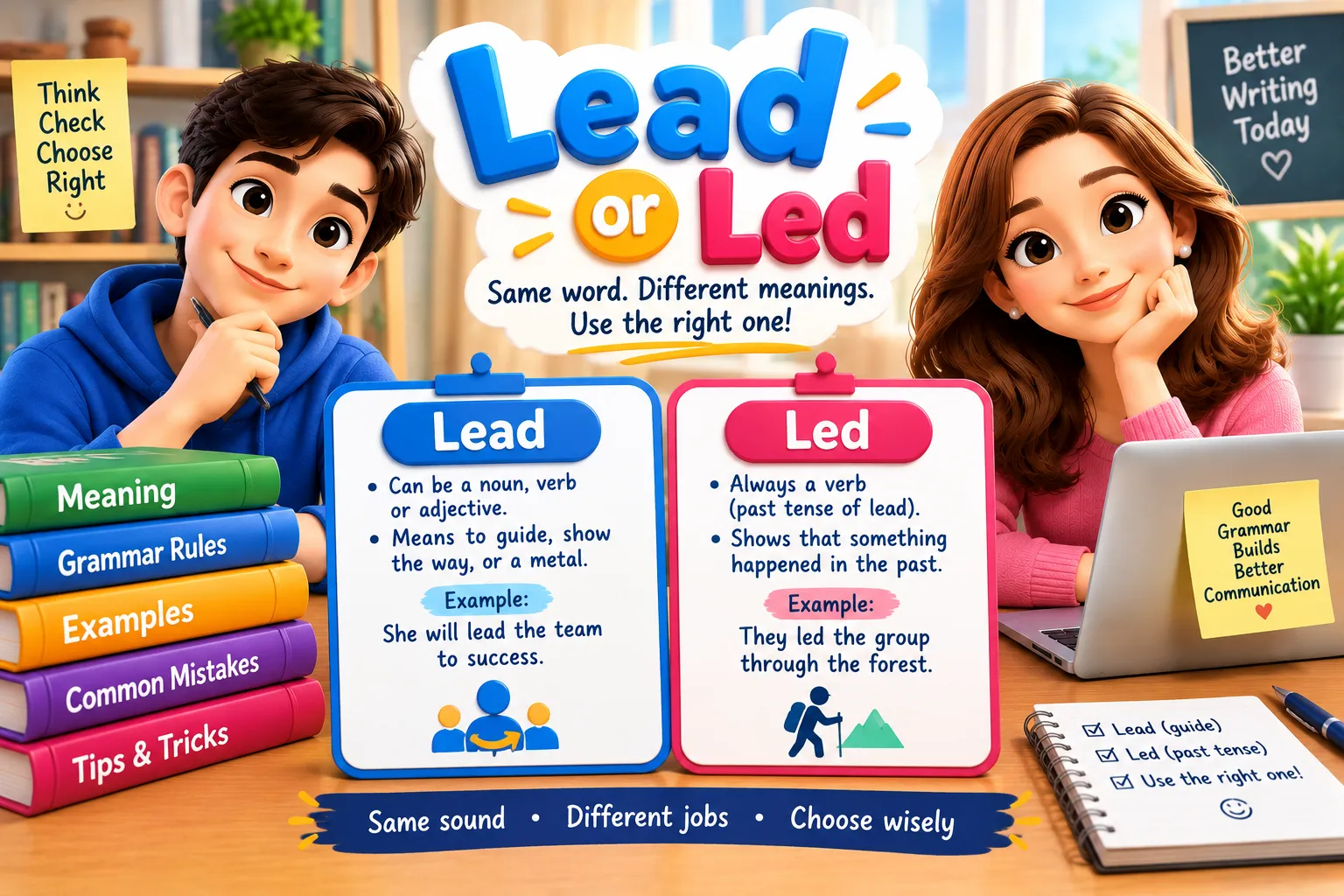
Lead or led depends on the tense of the verb. Lead (pronounced “leed”) is the present form, while led is the past tense and past participle of the verb meaning to guide or direct.
I remember a time when I was writing about a team project and got stuck on a simple question: Should I write lead or led? I wanted to explain that I was in charge of the team last week, but I wasn’t sure which word was correct. After checking the grammar rule, I learned that led is the correct choice for something that happened in the past.
Many English learners face the same confusion because lead and led look almost identical. I also discovered another tricky detail: lead can refer to a heavy metal and is pronounced like led in that context. This makes the difference even more confusing.
The good news is that choosing the right word becomes much easier once you understand the basic rule. In this guide, I’ll share simple explanations, practical examples, and helpful tips to show you when to use lead and when to use led, so you can write with greater confidence.
Lead or Led Quick Answer
Lead is the base form of the verb that means to guide, direct, or be in charge. Led is its past tense and past participle.
Here are two examples:
- Present: “I lead a small team at work.”
- Past: “I led a small team during last year’s project.”
The verb lead is pronounced “leed.” The word led is pronounced “led,” which rhymes with red.
Easy memory trick: If the action already happened, use led. If you are talking about the present or future, use lead.
There is one extra detail to remember. The noun lead, meaning the metal, is also pronounced “led.” Its spelling stays the same, but its meaning and part of speech are different.
The Origin and Background of Lead or Led
The difference between lead and led comes from English verb forms and pronunciation.
Where Does Lead Come From?
The verb lead has roots in Old English. It developed from an older verb meaning to guide or conduct someone along a path.
Over time, its meaning grew. Today, you can lead a person, a team, a meeting, or an activity. You can also lead a life or lead the way in a field.
According to the oxford dictionary, the word’s history can be traced through earlier forms of English. Its long history helps explain why its verb forms do not follow the regular pattern used by many modern verbs.
For example, regular verbs often add -ed to show the past:
- Walk → walked
- Help → helped
- Open → opened
But lead is an irregular verb. Its past form changes to led, not leaded or lead.
Why Is Led the Past Tense?
English has many irregular verbs. Their past forms do not always follow one simple rule.
Consider these examples:
- Go → went
- Teach → taught
- Write → wrote
- Lead → led
The form led is not a spelling mistake. It is the correct past tense and past participle of the verb lead.
According to the cambridge dictionary, led is the past tense and past participle of lead. It is used when describing an action that happened earlier or in perfect-tense structures.
Why Do People Confuse Lead and Led?
There are two main reasons.
First, the words look almost identical. Only one letter changes.
Second, English pronunciation creates a trap. The verb lead sounds like “leed,” but the metal lead sounds like “led.”
This makes lead and led a useful example of a homograph: words that share the same spelling but have different meanings or pronunciations. In this case, the verb lead and the metal lead have different pronunciations.
Lead or Led Explained: Key Differences
Let’s look at how each word works in everyday English.
1. Lead: Meaning and Usage
Lead is the base form of a verb that means to guide, direct, or be in charge.
It is used in the present tense and after helping verbs such as will, can, and should.
Examples:
- I lead the weekly training session.
- She will lead the new research project.
- They want to lead the campaign for cleaner streets.
The word can also appear in other verb forms.
- Leads: He leads the department.
- Leading: She is leading the discussion.
- To lead: We hope to lead the team to success.
Notice that the verb changes to match the sentence, but led remains the past form.
2. Led: Meaning and Usage
Led is the past tense and past participle of the verb lead.
Use it when the action happened in the past or when the sentence requires a past participle.
Examples:
- The coach led the players onto the field.
- Their hard work led to a better result.
- She has led several successful projects.
The last example uses the present perfect tense: has led.
You can also use had led and will have led in other perfect-tense structures.
- He had led the group before joining the new company.
- By June, she will have led the team for two years.
Remember: Do not use lead as the past tense of the verb meaning to guide someone.
Comparison Table: Lead vs. Led
| Term | Meaning | When to Use | Context |
| Lead | Base form of the verb meaning to guide or direct | Present, future, or after a modal verb | Work, education, sports |
| Led | Past tense of the verb lead | When the action happened in the past | Stories, reports, conversations |
| Led | Past participle of lead | With has, have, had, or passive structures | Perfect tenses and passive voice |
| Lead | A heavy metal | When referring to the chemical element | Science, health, materials |
3. Lead as a Noun
The word lead can also be a noun.
It may mean a winning position, an important role, a clue, or a piece of information that helps someone make a discovery.
Examples:
- Our team has a two-point lead.
- The reporter found a new lead in the investigation.
- The actor won the lead role in the film.
In these examples, lead is a noun, not the past tense of a verb.
4. Lead as a Metal
There is another meaning of lead. It refers to a heavy chemical element with the symbol Pb.
This noun is pronounced “led,” just like the past-tense verb.
For example:
- The old pipes contained lead.
- Scientists tested the soil for lead.
This is why pronunciation alone cannot always help you choose the spelling. You must look at the meaning and the role the word plays in the sentence.
Which Version Should You Use?
Choosing between lead and led becomes easier when you look at the time of the action.
For Students
If you are writing a school assignment, first identify when the action happened.
- Present: The captain leads the team.
- Past: The captain led the team yesterday.
- Future: The captain will lead the team tomorrow.
This simple tense check can help you avoid many spelling errors.
For Business Professionals
Use lead when describing a current role or a future responsibility.
For example:
“The marketing director will lead the campaign next month.”
Use led when describing completed work.
For example:
“She led the team through a major software upgrade last year.”
The correct form helps readers understand when the work took place.
For Bloggers and Content Writers
When writing articles, check the tense of the sentence.
If you are describing a past event, use led. If you are giving advice about what someone should do next, use lead after the appropriate helping verb.
For example:
- Past: His research led to a new idea.
- Future: This guide will lead you through the process.
For International English
The basic grammar rule is the same in American and British English.
You do not need to choose a regional spelling convention, as you would with words such as color and colour. Instead, focus on the verb tense and meaning.
Best recommendation: Ask yourself whether you mean to guide someone now or describe an action that already happened. This will usually give you the answer.
Common Mistakes with Lead or Led
Here are five common errors and how to correct them.
Mistake 1: Using Lead for a Past Action
❌ Incorrect: She lead the meeting yesterday.
✅ Correct: She led the meeting yesterday.
Why? The word yesterday shows that the action happened in the past.
Mistake 2: Writing Leed Instead of Lead
❌ Incorrect: He will leed the discussion.
✅ Correct: He will lead the discussion.
Why? Leed is not the correct spelling of the verb. The standard spelling is lead, even though it sounds like “leed.”
Mistake 3: Using Lead After Has or Have
❌ Incorrect: He has lead the department for five years.
✅ Correct: He has led the department for five years.
Why? The present perfect tense uses has or have followed by the past participle. For lead, that form is led.
Mistake 4: Writing Leaded for the Past Tense
❌ Incorrect: The guide leaded us through the museum.
✅ Correct: The guide led us through the museum.
Why? Lead is an irregular verb. Its standard past tense is led, not leaded.
Mistake 5: Confusing the Metal with the Verb
❌ Incorrect: The pipes were made from led.
✅ Correct: The pipes were made from lead.
Why? The metal is spelled lead, even though it is pronounced like led.
Lead or Led in Real World Examples
These examples show how the words appear in different types of writing.
1. Professional Email
Dear Team,
Maria will lead the next phase of the project. She has led similar projects in the past and has the experience needed to guide us through the next steps.
Please contact her if you have any questions.
Best regards,
James
Why it works: Will lead describes a future responsibility, while has led describes previous experience.
2. News Headline
Example: Local Research Team Led Major Effort to Restore Historic Building
The word led tells readers that the team directed an effort that took place in the past.
3. Social Media Post
Great leaders do more than give instructions. They listen, support their teams, and lead by example. Every small step can help you become a stronger leader.
Here, lead is used to describe a general action and principle.
4. Formal Document or Report
Example: The review found that improved communication led to fewer delays during the final stage of the project.
The word led connects a past action or change with its result.
Lead or Led Data, Trends, and Usage
People often search for lead and led because the two spellings are closely related but serve different grammatical roles.
1. Search Volume: Lead vs. Led
Exact monthly search volumes depend on the keyword tool, location, and date range. No verified search-volume figures are available for this article, so it would be misleading to invent numbers.
You can compare these queries using google trends or an SEO tool such as Ahrefs or Semrush:
- Lead or led
- Lead vs. led
- Led meaning
- Lead past tense
- How to use lead and led
These searches have informational intent. People want to learn the correct spelling, meaning, and grammar rule.
The word lead has several meanings, including a verb, a type of metal, and a noun for a winning position. As a result, its total search interest may reflect more than the grammar question alone.
2. Word Frequency in Published Books
Google’s ngram viewersallows users to compare word frequency in published books over time.
You can compare lead and led in different English-language collections. However, the results include different meanings of lead, so they cannot show how often writers confuse the two verb forms.
For a useful comparison, select the appropriate English corpus and review the context of each word.
3. Pronunciation and Grammar
The cambridge dictionary lists led as the past tense and past participle of the verb lead. It also distinguishes the pronunciation of the verb from that of the metal.
This is a good example of why English spelling can be tricky. Two words can look alike but sound different, while two words that sound alike can have different spellings and meanings.
4. Why This Topic Matters
Correct verb tense helps readers understand when an event happened.
This matters in school essays, business reports, news stories, and online content. A sentence with the wrong tense may still be understandable, but it can reduce the quality of your writing.
Grammar checkers can catch some errors. However, they may miss a mistake when the sentence is understandable but the tense is wrong.
Learning the basic rule is often the fastest fix: lead for the base verb, led for the past tense and past participle.
Standalone Comparison Table: Lead, Led, and Related Forms
This table includes related forms to help you use the word correctly in more complex sentences.
| Term/Variant | Meaning | Region/Context | Best Used When |
| Lead | Base verb meaning to guide | All English varieties | You are describing a present or future action |
| Leads | Present-tense form for he, she, or it | All English varieties | The subject is singular and the action is present |
| Leading | The -ing form of the verb | All English varieties | The action is ongoing or the word modifies a noun |
| Led | Past tense and past participle | All English varieties | The action happened earlier or follows a perfect-tense auxiliary |
| Leader | A person who guides or directs others | All English varieties | You are naming the person, not the action |
| Lead (metal) | A heavy chemical element | Science and everyday English | You are referring to the substance |
These forms are related, but they do not all have the same grammatical role. Choosing the correct form depends on the subject, tense, and meaning of the sentence.
Frequently Asked Questions About Lead or Led
Q1: What is the difference between lead and led?
A: Lead is the base form of the verb meaning to guide or direct. Led is the past tense and past participle of that verb.
Q2: Is lead or led correct in a sentence about yesterday?
A: Use led when describing an action that happened yesterday. For example, “Our teacher led the class discussion yesterday.”
Q3: Is led a real word?
A: Yes. Led is the correct past tense and past participle of lead. It is not an informal spelling or a grammar mistake.
Q4: How do you pronounce lead and led?
A: The verb lead is pronounced “leed,” with a long e sound. Led rhymes with “red.” The word lead for the metal is pronounced like led.
Q5: Is it correct to say “has lead”?
A: When you mean the verb “to guide,” the correct form is usually has led. For example, “She has led the group for three years.”
Q6: Where does the word led come from?
A: Led is the irregular past form of the verb lead. Its form comes from the historical development of English, rather than the regular pattern of adding -ed to a verb.
Q7: Can lead be used as a noun?
A: Yes. Lead can mean a winning advantage, a clue, the main role in a performance, or the metal. Its meaning depends on the context in which it appears.
Conclusion: Lead or Led Which One Should You Use?
The difference between lead and led becomes easy once you understand verb tense.
Use lead when you mean to guide, direct, or take charge in the present or future. Use led when that action happened in the past or when you need the past participle. Remember that led also appears after words such as has, have, and had.
There is one extra point worth remembering: lead can also mean a heavy metal, and in that sense, it is pronounced like led. The sentence’s meaning will help you tell the difference.
For everyday writing, you do not need to memorize a long list of rules. Check when the action takes place, identify the role of the word, and choose the form that fits.
If you are ever unsure, read the sentence aloud and look for clues such as yesterday, will, or has. These can help you identify the correct tense.
Now you know how to use lead or led correctly. Bookmark this guide, practise with your own sentences, and share it with someone who wants to improve their English grammar.
Readmore

I’m **Rubab Naaz**, an English language content writer with over 10 years of experience creating educational and SEO-focused articles. I specialize in spelling comparisons, grammar, vocabulary, synonyms, commonly confused words, and English usage. My passion is helping students, writers, and professionals improve their language skills through accurate, well-researched, and easy-to-understand content. Every article I write is designed to make learning English simple, practical, and engaging.










