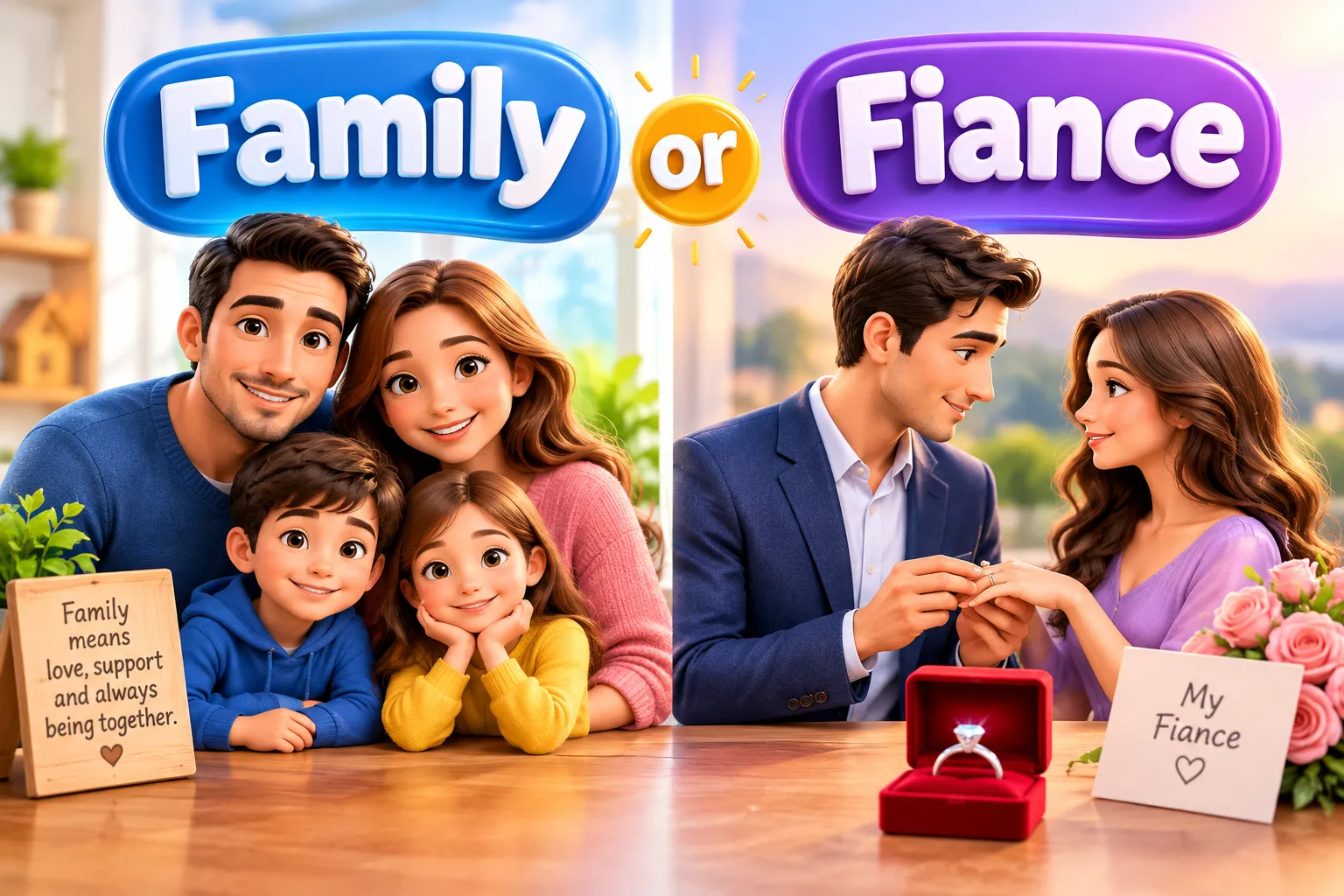
Family or fiance depends on the relationship you mean. Family refers to relatives or people connected as a household, while a fiancé is a man who is engaged to be married.
Have you ever written a sentence about someone you love and stopped because you were unsure whether to say family or fiancé? I have seen this kind of confusion many times when helping English learners improve everyday writing.
The two words may appear in similar conversations about relationships, marriage, and personal life. But they describe very different relationships.
Your family can include your parents, children, brothers, sisters, grandparents, and other relatives. A fiancé, on the other hand, is specifically a man who has formally promised to marry someone. Cambridge Dictionary defines fiancé as the man someone is engaged to marry.
There is also a related word that often causes another spelling problem: fiancée. The extra -e identifies a woman who is engaged to be married.
So, which word should you use? The answer becomes simple once you understand the relationship each word describes.
Family or Fiance Quick Answer
Family and fiancé are not interchangeable.
- Family = people related to you or belonging to your household.
- Fiancé = a man who is engaged to marry someone.
- Fiancée = a woman who is engaged to marry someone.
For example:
- “My family is visiting this weekend.”
- “My fiancé is coming to the wedding.”
- “She introduced her fiancée to her parents.”
Cambridge Dictionary defines family as a group of people related to one another, such as parents and children.
The easiest way to remember the difference is to think about relationship type. Family describes a broader group of relatives or household members. Fiancé describes one specific person connected to an engagement.
The Origin and Background of Family and Fiancé
The two words come from completely different linguistic histories.
The word family entered English in the early 15th century. Etymonline traces it to Latin familia, referring originally to household servants or members of a household. Its meaning later developed to include relatives and the people forming a household.
The history of fiancé is quite different. Etymonline records the English noun fiancé from the 19th century, borrowed from French fiancé, the past participle of fiancer, meaning “to betroth.”
Interestingly, the related feminine form fiancée entered English around the same period. Etymonline traces it to French fiancée, the feminine form of fiancé.
This gives us an interesting lesson in etymology: English has borrowed many relationship words from French and other languages. Their spellings may look unusual, but their meanings are quite precise.
Family vs. Fiancé: Key Differences
Here is the simplest comparison:
| Term | Meaning | When to Use | Region/Context |
| Family | Relatives or people connected as a household | Talking about relatives or close household relationships | General English |
| Fiancé | A man engaged to be married | Talking about a male marriage partner before the wedding | General English |
| Fiancée | A woman engaged to be married | Talking about a female marriage partner before the wedding | General English |
| Partner | Someone in a romantic or domestic relationship | When engagement or gender is not the focus | Very common modern English |
Family
Use family when discussing relatives or a household group.
Examples:
- “My family lives in Lahore.”
- “Her family attended the ceremony.”
- “He spends every Sunday with his family.”
The word can have a broad meaning. Depending on context, it may refer to immediate relatives, extended relatives, or people who form a household.
Fiancé
Use fiancé for a man who is engaged to be married.
Examples:
- “My fiancé works in finance.”
- “Her fiancé bought the wedding rings.”
- “I met Sarah’s fiancé yesterday.”
Cambridge specifically defines fiancé as the man someone is engaged to marry.
Fiancée
Use fiancée for a woman who is engaged to be married.
Examples:
- “His fiancée is planning the ceremony.”
- “John introduced his fiancée to his colleagues.”
- “My fiancée will arrive tomorrow.”
Cambridge Dictionary gives the same gender distinction: fiancée refers to the woman someone is engaged to marry.
Which Word Should You Use?
The right choice depends on what you are describing.
If you mean relatives
Use family.
“I am going to visit my family.”
If you mean an engaged man
Use fiancé.
“My fiancé is helping me choose the venue.”
If you mean an engaged woman
Use fiancée.
“Her fiancée is from Canada.”
If gender is not relevant
In modern English, partner can be useful when you want a gender-neutral term. It can describe a romantic partner without specifically saying whether the person is a fiancé or fiancée.
However, partner does not necessarily mean the person is engaged. That distinction matters.
Common Mistakes With Family or Fiancé
1. Using fiancé for any romantic partner
Incorrect:
“My fiancé and I have been dating for two years.”
This is only correct if the couple is engaged.
Better:
“My boyfriend and I have been dating for two years.”
Or, if they are engaged:
“My fiancé and I have been engaged for two years.”
2. Using family for a romantic partner
Incorrect:
“I am going to dinner with my family,” when you mean only your future husband.
Better:
“I am going to dinner with my fiancé.”
The word family does not normally identify a romantic partner.
3. Confusing fiancé and fiancée
A common spelling mistake is using fiancé for a woman.
Incorrect:
“She introduced her fiancé to her parents.”
If the person is a woman, use:
Correct:
“She introduced her fiancée to her parents.”
4. Assuming fiancé means husband
A fiancé is not yet a husband.
The word describes someone who is engaged to be married. After the marriage takes place, husband is normally the appropriate term.
5. Treating family and fiancé as synonyms
These words describe completely different relationships.
Family is a broad relationship category.
Fiancé is a specific relationship status.
Family or Fiancé in Real World Examples
Professional email
“I will be unavailable on Friday because I need to attend a family event.”
This is appropriate when the event involves relatives or household members.
News-style sentence
“The couple announced their engagement after introducing their families.”
Here, families refers to the relatives of the two people.
Social media post
“So excited to celebrate this new chapter with my fiancé!”
Here, fiancé identifies the man the writer plans to marry.
Formal document
“The applicant listed her immediate family members as emergency contacts.”
The word family is appropriate because the document concerns relatives.
Everyday conversation
“Have you met my fiancé?”
This is a natural way to introduce a man you are engaged to marry.
Family or Fiancé: Data, Trends & Usage
People often search confusing word pairs because they want a quick answer about meaning, spelling, or correct usage. The search intent behind family or fiancé is therefore primarily informational.
However, exact monthly search-volume figures for this exact phrase can vary considerably between SEO platforms. Google, Ahrefs, Semrush, and other tools use different datasets and update schedules. Without a verified current dataset, it would be misleading to present an exact monthly search number as fact.
There is stronger evidence from dictionary usage. Both family and fiancé/fiancée are established English nouns with clearly defined meanings. Cambridge lists family as a noun for a group of related people and distinguishes fiancé and fiancée by gender.
Corpus tools such as Google Ngram can also be useful for comparing written frequency, but frequency alone does not tell you which word is correct in a particular sentence. Context is more important than frequency.
The topic also matters for English learners because relationship vocabulary often crosses between everyday conversation, formal writing, social media, and family announcements.
Standalone Comparison: Family, Fiancé, Fiancée, and Partner
| Term/Variant | Meaning | Region/Context | Best Used When |
| Family | Relatives or household members | General English | Talking about relatives |
| Fiancé | Man engaged to marry | General English | Referring to an engaged man |
| Fiancée | Woman engaged to marry | General English | Referring to an engaged woman |
| Partner | Romantic or domestic companion | Modern, gender-neutral English | Gender or engagement status is not important |
| Spouse | Married partner | Formal and general English | The couple is already married |
Notice the key distinction between fiancé and spouse. An engaged person is not yet your spouse. The relationship status changes after marriage.
FAQ: Family or Fiancé
Q: What does family mean?
A: Family generally means people who are related to one another or who belong to the same household. Cambridge Dictionary includes parents, children, and other relatives within its definition.
Q: What does fiancé mean?
A: Fiancé means a man who is engaged to be married. Cambridge Dictionary gives this specific relationship meaning.
Q: What is the difference between fiancé and fiancée?
A: Fiancé traditionally refers to a man who is engaged to be married, while fiancée refers to a woman. The two forms come from French.
Q: Is fiancé acceptable in formal writing?
A: Yes. Fiancé is a standard English noun and is appropriate in formal, professional, and everyday writing when you mean a man who is engaged to be married.
Q: Is family the same as fiancé?
A: No. Family refers to relatives or household relationships, while fiancé identifies a person who is engaged to marry. They describe different types of relationships.
Q: Where does the word fiancé come from?
A: Fiancé comes into English from French fiancé, related to fiancer, meaning “to betroth.” Etymonline records the English noun from the 19th century.
Q: Can I call my fiancé my partner?
A: Yes. Partner can be used as a broader, gender-neutral relationship term. However, it does not necessarily show that the person is engaged, so fiancé is more specific when engagement matters.
Q: Is a fiancé the same as a husband?
A: No. A fiancé is someone you are engaged to marry. A husband is a man you are already married to.
Conclusion: Family or Fiancé?
The difference between family and fiancé becomes easy once you focus on the relationship being described.
Family is a broad word for relatives or people connected through a household or family relationship. Fiancé is much more specific: it traditionally means a man who is engaged to be married. Fiancée is the corresponding traditional feminine form. Cambridge Dictionary supports these distinctions in its definitions.
The spelling also gives you a useful clue. The accent in fiancé and fiancée reflects their French origin, while family has a much older history connected with the Latin word familia.
When writing, ask yourself one simple question: Am I talking about relatives, or am I talking about someone I am engaged to marry? That answer will usually tell you which word belongs in your sentence.
Bookmark this guide so you never have to second-guess family, fiancé, or fiancée again.
Read More:
Catalog or Catalogue: The Easy Spelling Guide

I’m **Rubab Naaz**, an English language content writer with over 10 years of experience creating educational and SEO-focused articles. I specialize in spelling comparisons, grammar, vocabulary, synonyms, commonly confused words, and English usage. My passion is helping students, writers, and professionals improve their language skills through accurate, well-researched, and easy-to-understand content. Every article I write is designed to make learning English simple, practical, and engaging.