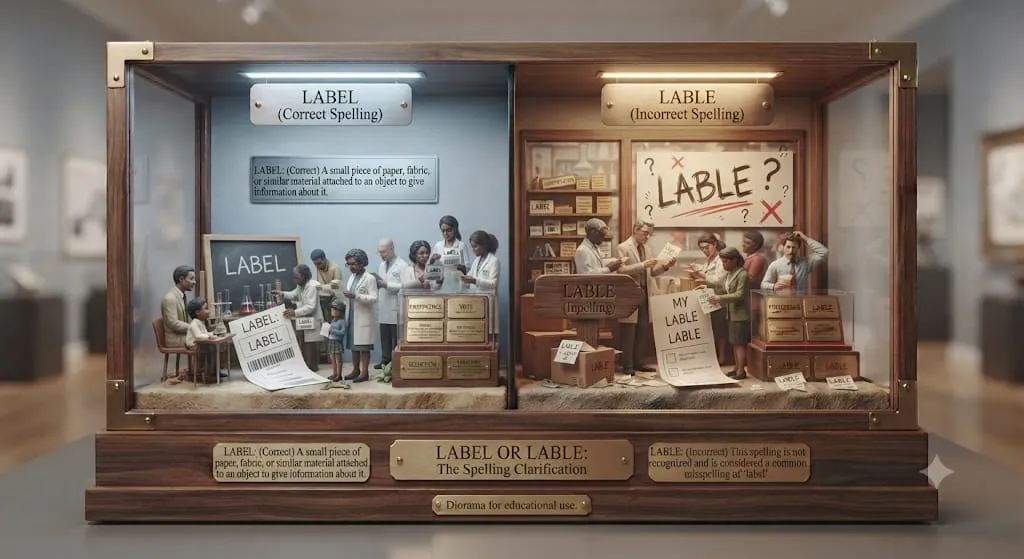
Label is the correct spelling in English. Lable is a misspelling and should not be used in standard writing.
I once proofread a product description that looked almost perfect. The only problem was one small word repeated throughout the page: lable. It was easy to overlook because the letters were all there—just in the wrong order.
If you’ve ever typed lable instead of label, you’re not alone. It’s one of the most common spelling mistakes in English. Since the pronunciation doesn’t clearly reveal the order of the letters, many people accidentally switch the e and l.
The good news is that the correct spelling is simple to remember once you know it. In this guide, you’ll learn why label is correct, why people often write lable, common mistakes to avoid, and plenty of real-world examples.
Lable or Label Quick Answer
The correct spelling is label.
Lable is incorrect and is considered a spelling mistake in standard English.
Simple examples
- Please read the label before using the product.
- She wrote her name on the label.
Both examples use the correct spelling.
The Origin and Background of Lable or Label
The word label comes from Old French and entered English several centuries ago. It originally referred to a tag, strip, or piece of writing attached to an object for identification.
Today, label has many meanings. It can refer to:
- A tag on a product.
- A name or description given to a person or thing.
- A record company or fashion brand.
- The act of describing or classifying someone or something.
Because the pronunciation is soft, many writers accidentally reverse the last two letters and write lable instead.
Lable or Label Explained Key Differences
There is only one correct spelling.
| Term | Meaning | When to Use | Region/Context |
| Label | A tag, name, or description; also a verb meaning to classify | Always | Worldwide |
| Lable | Misspelling | Never | Not standard English |
Examples of Label as a noun
- Check the label for washing instructions.
- The bottle has a bright blue label.
- Read the food label before buying.
Examples of Label as a verb
- Don’t label people without knowing them.
- Scientists carefully label each sample.
- Please label your luggage before checking in.
Which Version Should You Use?
The answer is simple.
For students
Always use label in homework, essays, and exams.
For professionals
Use label in emails, reports, product descriptions, manuals, and presentations.
For businesses
Use label when referring to packaging, branding, shipping, or product identification.
For everyday writing
There is no situation in standard English where lable is correct.
Common Mistakes with Lable or Label
| Mistake | Correct Version | Why It Happens |
| Lable | Label | The last two letters are reversed. |
| Shipping lable | Shipping label | Common typing error. |
| Product lable | Product label | Incorrect spelling. |
| Name lable | Name label | Letter order mistake. |
| Please lable the box. | Please label the box. | Verb is misspelled. |
Label in Real-World Examples
Professional Email
“Please attach the shipping label before sending the package.”
News Headline
“Food Labels May Soon Include New Nutrition Information”
Social Media Post
“I finally designed a new label for my homemade candles!”
Formal Report
“Each laboratory sample was assigned a unique label for identification.”
Lable or Label Data, Trends & Usage
Many people search for lable or label because the incorrect spelling frequently appears in typing and online searches.
Most common search intent
- Informational
- Correct spelling
- English grammar
- Vocabulary learning
- Writing improvement
Regions with high interest
- United States
- United Kingdom
- Canada
- Australia
- India
Why this topic matters now
Correct spelling creates a professional impression. Whether you’re writing a report, creating product packaging, or sending an email, using label correctly improves clarity and credibility.
Comparison Table
| Term/Variant | Meaning | Region/Context | Best Used When |
| Label | Correct spelling | Worldwide | All writing |
| Label (verb) | To classify or identify | Worldwide | Describing an action |
| Label (noun) | Tag or description | Worldwide | Naming or identifying something |
| Lable | Misspelling | None | Never use |
Frequently Asked Questions
Q: What does label mean?
A: Label can be a noun meaning a tag or description, or a verb meaning to identify or classify someone or something.
Q: Is lable a real word?
A: No. Lable is a misspelling and is not accepted in standard English dictionaries.
Q: Lable vs label — what’s the difference?
A: Label is the correct spelling. Lable is simply a spelling error.
Q: Is label correct in formal writing?
A: Yes. Label is the standard spelling used in academic, business, legal, and professional writing.
Q: Which version is correct — lable or label?
A: Label is always correct. Lable should never be used in standard English.
Q: Why do people spell label as lable?
A: The mistake usually happens because people accidentally switch the order of the final e and l while typing or spelling from memory.
Q: Can label be both a noun and a verb?
A: Yes. As a noun, it means a tag or description. As a verb, it means to identify, name, or classify something.
Conclusion
Choosing between lable or label is easy once you know the correct spelling. Label is the only accepted form in standard English, while lable is a common spelling mistake.
Read More:
Favourite or Favorite: The Complete Guide to the Correct Spelling
Remember these key points:
- Label is always correct.
- Lable is never correct in standard English.
- Label can be both a noun and a verb.
- Double-check the letter order when typing to avoid this common mistake.
With this simple rule, you’ll never misspell label again. Bookmark this guide so you can remember the correct spelling, and share it with anyone learning English or improving their writing.

I’m an English language educator and content writer with more than 10 years of experience helping learners improve their English skills. I specialize in spelling differences, grammar, vocabulary, synonyms, commonly confused words, and English usage. My goal is to create accurate, easy-to-understand articles that make learning English simple, practical, and enjoyable for students, writers, and professionals around the world.