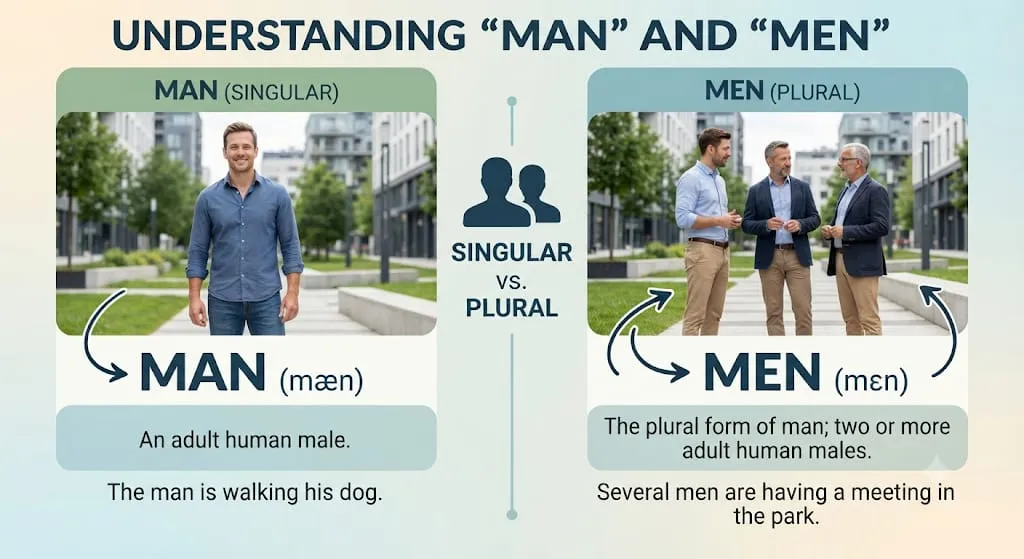
Man is the singular form, meaning one adult male person. Men is the plural form, meaning two or more adult male people.
I once edited a travel brochure that proudly announced, “Five brave man climbed the mountain.” The story was inspiring, but one small grammar mistake stood out. Since the sentence referred to more than one person, the correct word was men.
Many English learners struggle with man and men because they don’t follow the usual rule of simply adding -s to form the plural. Instead, the vowel changes, making them an example of an irregular plural noun.
The good news is that the rule is easy to remember. Once you know when to use man and when to use men, you’ll avoid one of the most common English grammar mistakes.
In this guide, you’ll learn the difference between man and men, where these words come from, common mistakes to avoid, and plenty of real-world examples.
Men or Man Quick Answer
Use man when referring to one adult male.
Use men when referring to two or more adult males.
Simple examples
- One man was waiting outside.
- Three men were talking in the park.
The Origin and Background of Men or Man
The word man comes from Old English and has been part of the language for over a thousand years.
Unlike most English nouns, man forms its plural by changing the vowel instead of adding -s.
- Man → Men
- Woman → Women
This irregular pattern developed naturally over centuries and remains standard in modern English.
Men or Man Explained Key Differences
The difference is based on number.
| Term | Meaning | When to Use | Region/Context |
| Man | One adult male | Singular | Worldwide |
| Men | Two or more adult males | Plural | Worldwide |
Examples of Man
- The man smiled politely.
- A young man asked for directions.
- That man is my neighbor.
Examples of Men
- The men finished the project.
- Several men volunteered.
- The men waited outside the building.
Which Version Should You Use?
The choice depends on how many people you’re talking about.
For students
- One person → man
- More than one → men
For professionals
Use the correct form in reports, emails, presentations, and articles.
Examples:
- One man applied.
- Five men were interviewed.
For everyday writing
Simply ask yourself:
Am I talking about one person or more than one?
- One → man
- Two or more → men
Common Mistakes with Men or Man
| Mistake | Correct Version | Why It Happens |
| Three man | Three men | Plural noun required. |
| One men | One man | Singular noun required. |
| Many man work here. | Many men work here. | Incorrect plural. |
| Every men should vote. | Every man should vote. | “Every” takes a singular noun. |
| Those man are friendly. | Those men are friendly. | Plural subject needed. |
Men or Man in Real-World Examples
Professional Email
“One man has accepted the job offer.”
News Headline
“Two Men Rescue Family From Flooded Home”
Social Media Post
“The men on our team did an amazing job today!”
Formal Report
“Each man completed the required safety training before beginning work.”
Men or Man Data, Trends & Usage
Many learners search for men or man because irregular plurals are harder to remember than regular nouns.
Most common search intent
- Informational
- English grammar
- Correct usage
- Vocabulary learning
- Homework help
Regions with high interest
- United States
- United Kingdom
- Canada
- Australia
- India
Why this topic matters now
Using the correct singular and plural forms improves both spoken and written English. It also helps you communicate clearly in school, work, and everyday conversations.
Comparison Table
| Term/Variant | Meaning | Region/Context | Best Used When |
| Man | One adult male | Worldwide | Singular noun |
| Men | More than one adult male | Worldwide | Plural noun |
| Man’s | Belonging to one man | Worldwide | Singular possessive |
| Men’s | Belonging to multiple men | Worldwide | Plural possessive |
Frequently Asked Questions
Q: What does man mean?
A: Man refers to one adult male person. It is the singular form.
Q: What does men mean?
A: Men is the plural of man and refers to two or more adult male people.
Q: Men vs man what’s the difference?
A: Man is singular, while men is plural.
Q: Is men correct in formal writing?
A: Yes. Men is the standard plural form used in academic, professional, legal, and everyday writing.
Q: Which version is correct men or man?
A: Use man for one person and men for two or more people.
Q: Why doesn’t man become mans?
A: Man is an irregular noun. Instead of adding -s, it changes its vowel to form the plural: man → men.
Q: What other words follow the same pattern?
A: The best-known example is woman → women. Like man, it changes the vowel instead of adding -s.
Conclusion
Choosing between men or man is simple once you remember the rule. Man refers to one adult male, while men refers to two or more. Because man is an irregular noun, its plural changes the vowel instead of adding -s.
Keep these key points in mind:
- Man = one adult male.
- Men = two or more adult males.
- Man is singular.
- Men is the only correct plural form.
With this rule, you’ll confidently use man and men in conversations, essays, emails, and professional writing. Bookmark this guide so you never confuse “man” and “men” again, and share it with anyone learning English grammar.
Men or man explained with meanings, plural rules, correct usage, examples, grammar tips, and common mistakes .
Read More:
Calfs or Calves: The Complete Guide to the Correct Plural

I’m an English language educator and SEO content writer having experience creating clear, accurate, and engaging English learning content. I specialize in spelling differences, grammar, vocabulary, synonyms, commonly confused words, and English usage. My goal is to publish well-researched, easy-to-understand articles that help students, writers, educators, and professionals improve their English with confidence through practical explanations and real-world examples.