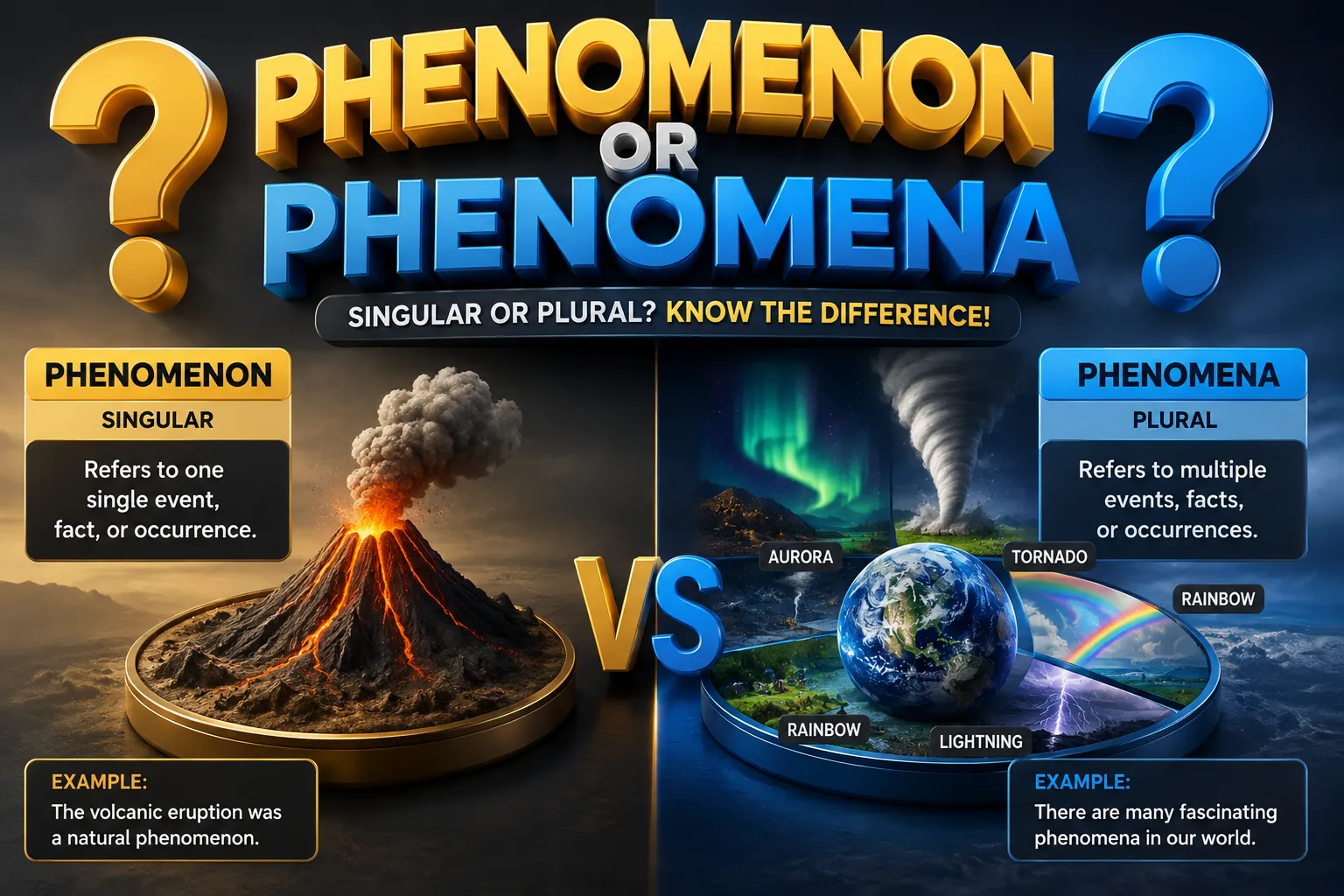
Quick Answer: Phenomenon is the singular form, meaning one fact, event, or occurrence. Phenomena is the plural form and refers to two or more facts, events, or occurrences.
The first time I edited a university student’s research paper, I noticed a sentence that read, “Global warming is one of the most important phenomena.” At first glance, nothing seemed wrong. But later in the same paper, the student wrote, “This phenomenon are affecting millions of people.” The meaning was clear, but the grammar wasn’t. The student had accidentally mixed the singular and plural forms.
This is a common mistake because phenomenon and phenomena look similar and are closely related. Many English learners—and even native speakers—aren’t sure when to use each one. Since these words often appear in science, education, journalism, and academic writing, using the correct form is important.
Fortunately, the rule is simple. Once you understand which word is singular and which is plural, you’ll be able to use them confidently in essays, reports, presentations, and everyday conversations.
In this guide, you’ll learn the meanings, origins, grammar rules, practical examples, and easy memory tricks that make phenomenon and phenomena impossible to confuse.
Phenomenon or Phenomena Quick Answer
Although the words look alike, they have different grammatical roles.
- Phenomenon = one event, fact, or occurrence.
- Phenomena = more than one event, fact, or occurrence.
Examples
✅ The Northern Lights are a beautiful natural phenomenon.
✅ Earthquakes and volcanoes are natural phenomena.
A simple way to remember the difference is to think about number. If you’re talking about one, use phenomenon. If you’re talking about many, use phenomena.
The Origin of Phenomenon and Phenomena
The word phenomenon comes from the Ancient Greek word phainomenon, meaning something that appears or something observed.
According to Merriam-Webster, the word entered English through Latin and has long been used in philosophy, science, and everyday language to describe observable events.
The plural phenomena follows the original Greek grammar rather than the regular English plural pattern. Instead of adding -s, the ending changes from -on to -a.
This pattern appears in several other English words borrowed from Greek.
Examples include:
| Singular | Plural |
| Criterion | Criteria |
| Bacterium | Bacteria |
| Datum | Data (in many contexts) |
| Phenomenon | Phenomena |
According to the Cambridge Dictionary, both phenomenon and phenomena remain common in modern English, especially in academic, scientific, and professional writing.
Phenomenon vs. Phenomena Explained
The easiest way to choose the correct word is to ask yourself:
Am I talking about one thing or more than one?
If the answer is one, choose phenomenon.
If the answer is more than one, choose phenomena.
| Word | Meaning | Number | Example |
| Phenomenon | A remarkable event or observable fact | Singular | A rainbow is a natural phenomenon. |
| Phenomena | Multiple remarkable events or observable facts | Plural | Rainbows and eclipses are natural phenomena. |
Example 1
The solar eclipse is a fascinating phenomenon.
Only one event is being discussed.
Example 2
Solar eclipses and lunar eclipses are fascinating phenomena.
More than one event is mentioned.
Example 3
The internet has become a global phenomenon.
One broad occurrence.
Example 4
Social media trends are modern cultural phenomena.
Several trends are being discussed.
Which Version Should You Use?
For Students
When writing essays or exam answers:
- Use phenomenon for one example.
- Use phenomena for multiple examples.
For Academic Writing
Scientific papers frequently use both words.
Examples:
- This phenomenon requires further investigation.
- These phenomena occur under extreme temperatures.
For Journalists
Choose the word that matches the number of events.
Example:
The unusual weather phenomenon surprised meteorologists.
Example:
Several unusual weather phenomena were recorded this year.
For Everyday English
Although phenomenon often sounds formal, it is perfectly correct in normal conversation.
Example:
The popularity of the new app is a real phenomenon.
Common Mistakes
| Mistake | Correct Version | Why |
| This phenomena is interesting. | This phenomenon is interesting. | Singular subject. |
| Many natural phenomenon exist. | Many natural phenomena exist. | Plural noun needed. |
| These phenomenon are unusual. | These phenomena are unusual. | “These” requires plural. |
| One strange phenomena appeared. | One strange phenomenon appeared. | One = singular. |
Easy Memory Trick
Remember this pattern:
One → phenomenon
Many → phenomena
Another trick:
Words ending in -a are often plural in Greek-derived English words.
Examples:
- criteria
- bacteria
- media (in some contexts)
- phenomena
Quick Practice
Choose the correct word.
- A rainbow is a natural ________.
- Tornadoes and hurricanes are weather ________.
- Scientists studied the unusual ________.
- These strange ________ puzzled researchers.
- The success of the movie became a global ________.
Answers
- phenomenon
- phenomena
- phenomenon
- phenomena
- phenomenon
Phenomenon or Phenomena in Real World Examples
Seeing these words in context is the easiest way to remember the difference. Notice that phenomenon always refers to one event, while phenomena refers to more than one.
Professional Email
Subject: Research Findings
Dear Team,
The unusual phenomenon observed during yesterday’s experiment requires additional testing. Please review the data before tomorrow’s meeting.
News Headline
Rare Weather Phenomenon Lights Up the Night Sky
Social Media Post
The Northern Lights were the most beautiful natural phenomenon I’ve ever seen! ✨🌌
Scientific Report
Researchers documented several unusual phenomena during the volcanic eruption.
Everyday Conversation
A: Have you ever seen a solar eclipse?
B: Yes, it’s an amazing natural phenomenon.
Phenomenon or Phenomena Data, Trends & Usage
These words are frequently searched because many people are unsure which form is singular and which is plural.
Approximate Monthly Search Volume
| Keyword | Approximate Monthly Searches |
| phenomenon | 300,000+ |
| phenomena | 150,000+ |
| phenomenon vs phenomena | 15,000+ |
| phenomenon or phenomena | 6,000+ |
| phenomenon meaning | 20,000+ |
Approximate figures are based on general trends from SEO platforms such as Google Trends, Ahrefs, and Semrush. Actual search volumes vary over time.
Search Intent
The keyword “phenomenon or phenomena” is primarily:
- ✅ Informational
- ✅ Educational
- ✅ Grammar and vocabulary
- ✅ Academic writing
Most users want to understand the grammatical difference and learn which word fits a sentence correctly.
Google Books Ngram Viewer
Published books consistently show that phenomenon appears more frequently than phenomena because writers often discuss a single event. However, phenomena is very common in scientific journals, research papers, and educational textbooks where multiple observations are described.
Regional Usage
Unlike many spelling differences (such as analyse vs. analyze), phenomenon and phenomena are used the same way in:
- American English
- British English
- Canadian English
- Australian English
The only difference is number, not region.
Why This Topic Matters
As scientific news, technology, and educational content become more popular online, writers increasingly use these terms. Choosing the correct form improves clarity and makes your writing appear more professional.
Standalone Comparison Table
| Word | Part of Speech | Meaning | Best Used When |
| Phenomenon | Singular noun | One observable event or fact | Referring to one occurrence |
| Phenomena | Plural noun | Multiple observable events or facts | Referring to two or more occurrences |
| Phenomenal | Adjective | Extraordinary or remarkable | Describing something impressive |
Example:
- The rainbow is a natural phenomenon.
- Rainbows and eclipses are natural phenomena.
- The athlete gave a phenomenal performance.
Frequently Asked Questions
Q1. What is the difference between phenomenon and phenomena?
Phenomenon is singular and refers to one observable event. Phenomena is plural and refers to two or more observable events.
Q2. Is phenomena singular or plural?
Phenomena is always plural.
Example:
- These phenomena are difficult to explain.
Q3. Can I say “a phenomena”?
No.
Since phenomena is plural, you should say:
✅ a phenomenon
❌ a phenomena
Q4. Is phenomenon used only in science?
No.
Although it’s common in scientific writing, phenomenon is also used in business, sports, entertainment, culture, and everyday conversation.
Example:
The singer became a worldwide phenomenon.
Q5. Why doesn’t the plural end in -s?
Because phenomenon comes from Ancient Greek. Its original plural ending -a has been preserved in modern English.
Q6. Is “phenomenons” correct?
No.
The correct plural is phenomena.
Q7. How can I remember the difference?
Use this simple memory trick:
- One = phenomenon
- Many = phenomena
If you’re talking about multiple events, always choose phenomena.
Key Takeaways
- Phenomenon is the singular form.
- Phenomena is the plural form.
- Both words have the same meaning but refer to different numbers.
- The rule is the same in American and British English.
- Remember: one phenomenon, many phenomena.
Conclusion
The difference between phenomenon and phenomena is simple once you understand the grammar. Phenomenon refers to one remarkable event, observation, or occurrence, while phenomena refers to two or more. Since these words come from Ancient Greek, they follow a special plural pattern that differs from most English nouns.
Whether you’re writing an academic paper, preparing a presentation, publishing a blog post, or simply improving your English, choosing the correct form helps your writing sound accurate and polished.
Whenever you’re unsure, ask yourself one question: Am I talking about one thing or several? The answer will immediately tell you whether to use phenomenon or phenomena.
Now you know exactly when to use each word. Bookmark this guide for future reference, practice with your own examples, and share it with anyone who wants to improve their English grammar.
Read More:
Echos or Echoes: Which Spelling Is Correct?

I specialize in English grammar, spelling, word choice, and language usage. My content is based on research from grammar references, style guides, dictionaries, and real-world usage to ensure it is accurate and practical.
At Spelling Comparison, I write guides that explain why words are confused, how they are used, and which form is correct in context. I also include proofreading tips, examples, and writing advice readers can apply immediately.
My goal is to publish clear, reliable content that helps readers make better writing decisions. Each guide is written for accuracy, clarity, and usefulness in school, work, business, and everyday communication.