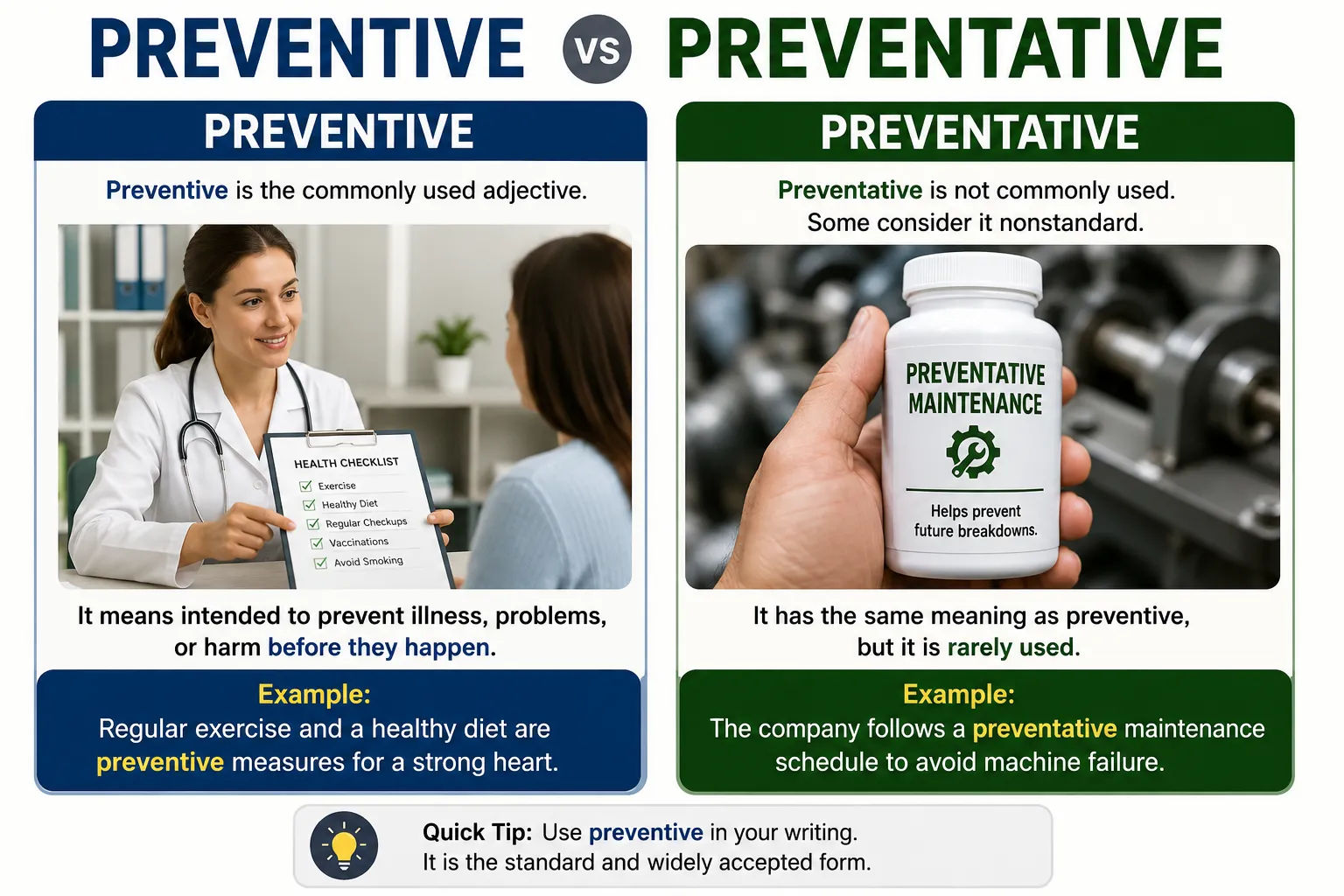
Quick Answer: Preventive and preventative are both correct. Preventive is more common and is usually preferred in formal writing, while preventative is a common variant that appears in everyday English and some publications.
A single extra syllable can make English spelling look more confusing than it really is. That is exactly why many writers pause when they see preventive and preventative used side by side. Both forms appear in real writing, and both are understood, but one is generally more common in formal English.
Many people wonder whether preventive or preventative is correct because the two words are so similar in meaning and pronunciation. Since English often allows more than one accepted form, it is easy to see why this word causes confusion.
The good news is that both spellings are standard. Once you know which version is more common in formal writing and which one appears as a variant, you can use the word confidently in reports, articles, emails, medical writing, and everyday communication.
In this guide, you’ll learn the difference between preventive and preventative, where the word comes from, how to use it correctly, common mistakes to avoid, and real-world examples.
Preventive or Preventative – Quick Answer
Both preventive and preventative are correct.
- Preventive is more common and is usually preferred in formal writing
- Preventative is also correct and is often used in everyday English and some publications
Simple examples
- The doctor recommended preventive care.
- The doctor recommended preventative care.
- The company introduced preventive measures.
- The company introduced preventative measures.
Both sentences are correct, but the first pair is more typical in formal writing.
The Origin and Background of Preventive or Preventative
The word preventive comes from the verb prevent, meaning to stop something from happening before it starts.
The form preventive is the older and more established spelling. Over time, the variant preventative developed by analogy with other English words ending in -ative. Both forms entered common use, and both are now accepted in modern English.
In many style guides, preventive is preferred because it is shorter and more traditional. Preventative is still widely understood and used, especially in speech and in some fields such as health, safety, and business.
The word can refer to something intended to stop a problem before it happens:
- Preventive care
- Preventive measures
- Preventive maintenance
- Preventative action
Examples:
- The clinic offers preventive screenings.
- The team took preventative steps to reduce risk.
- Regular inspections are a form of preventive maintenance.
Preventive or Preventative Explained Key Differences
The difference is mainly about usage preference, not meaning.
| Term | Meaning | When to Use | Region/Context |
| Preventive | Intended to stop something from happening | Standard and more common spelling | Worldwide, especially formal writing |
| Preventative | Intended to stop something from happening | Also correct, but less common | Worldwide, often in everyday or specialized usage |
Examples of Preventive
- The hospital offers preventive care.
- The company adopted preventive measures.
- Regular exercise can be preventive medicine.
Examples of Preventative
- The hospital offers preventative care.
- The company adopted preventative measures.
- Regular exercise can be preventative medicine.
Which Version Should You Use?
The answer depends on your audience and writing style.
For students
If your teacher or textbook uses formal English, preventive is usually the safer choice. If you see preventative in reading materials, it is still acceptable.
For professionals
Match the spelling to your workplace, publication, or audience.
- Formal reports → preventive
- Everyday writing → preventive or preventative
- Medical and technical writing → often preventive
For everyday writing
Use whichever spelling feels natural for your region or style. Both are correct, but preventive is usually the more polished choice.
For international readers
If you’re writing for a global audience, preventive is often the safest option because it is more widely preferred in formal English.
Common Mistakes with Preventive or Preventative
| Mistake | Correct Version | Why It Happens |
| Using preventative is wrong | Preventative is correct | Some people assume only one form exists |
| Using preventive is wrong | Preventive is correct | The shorter form is sometimes overlooked |
| Mixing preventive and preventative in the same document | Choose one spelling and stay consistent | Style inconsistency |
| Thinking the words have different meanings | Both mean the same thing | They are spelling variants |
| Assuming preventative is always informal | Preventative is acceptable in standard English | Usage varies by style guide |
Preventive or Preventative in Real-World Examples
Professional Email
“We recommend preventive maintenance before the next inspection.”
News Headline
“City Launches Preventive Health Program for Residents”
Social Media Post
“I finally booked my annual preventative checkup today!”
Formal Report
“The organization introduced preventive measures to reduce workplace accidents.”
Preventive or Preventative Data, Trends & Usage
Many people search for preventive or preventative because English allows more than one accepted spelling for the same idea.
Most common search intent
- Informational
- Spelling help
- English usage
- Regional differences
- Vocabulary clarification
- Writing improvement
Regions with high interest
- United States
- United Kingdom
- Canada
- Australia
- India
Why this topic matters now
Clear writing matters in healthcare, business, education, safety, and online communication. Using the preferred spelling for your audience helps your writing look polished and professional, while staying consistent prevents confusion.
Comparison Table
| Term/Variant | Meaning | Region/Context | Best Used When |
| Preventive | Intended to stop something before it happens | Worldwide | Writing for formal, academic, or professional audiences |
| Preventative | Intended to stop something before it happens | Worldwide | Writing where the variant is preferred or already established |
| Preventive care | Care meant to prevent illness | Medical and health contexts | Health writing, clinics, insurance, and public health |
| Preventative care | Care meant to prevent illness | Medical and health contexts | Same meaning, but less common in formal style |
Frequently Asked Questions
Q: What does preventive mean?
A: Preventive means intended to stop something from happening before it starts. It is the more common spelling.
Q: What does preventative mean?
A: Preventative has the same meaning as preventive. It is a correct variant spelling.
Q: Preventive vs preventative what’s the difference?
A: The meaning is the same. The difference is mainly in usage preference: preventive is more common, while preventative is also accepted.
Q: Is preventative correct in formal writing?
A: Yes. Preventative is correct, though many style guides prefer preventive in formal writing.
Q: Is preventive more common than preventative?
A: Yes. Preventive is generally more common in edited, academic, and professional English.
Q: Which version is correct preventive or preventative?
A: Both are correct. The best choice depends on your audience and the style of English you are using.
Q: Can I use preventive and preventative interchangeably?
A: Yes, but it is best to stay consistent within one piece of writing and match the style you are using.
Q: Why do some people spell preventive as preventative?
A: Because both forms have been used in English for a long time, and preventative developed as a common variant.
Q: Is preventive the older spelling?
A: Yes. Preventive is generally considered the older and more established form.
Q: Which spelling is better for SEO?
A: It depends on your audience. If you are targeting readers who prefer formal English, preventive may be the better choice. If your audience commonly uses preventative, that spelling may also be useful.
Conclusion
Choosing between preventive or preventative is simple once you know the rule. Both spellings are correct, but preventive is more common and is usually preferred in formal writing.
Remember these key points:
- Preventive is correct.
- Preventative is correct.
- Use preventive for formal, academic, and professional writing.
- Use preventative when that spelling fits your audience or style.
- Stay consistent with the style of your document.
With this simple rule, you’ll never second-guess the spelling again. Bookmark this guide so you always remember the difference between “preventive” and “preventative,” and share it with anyone learning English spelling or improving their writing.
Read More:
Verbiage or Verbage: The Complete Guide to the Correct Spelling

I’m **Rubab Naaz**, an English language content writer with over 10 years of experience creating educational and SEO-focused articles. I specialize in spelling comparisons, grammar, vocabulary, synonyms, commonly confused words, and English usage. My passion is helping students, writers, and professionals improve their language skills through accurate, well-researched, and easy-to-understand content. Every article I write is designed to make learning English simple, practical, and engaging.