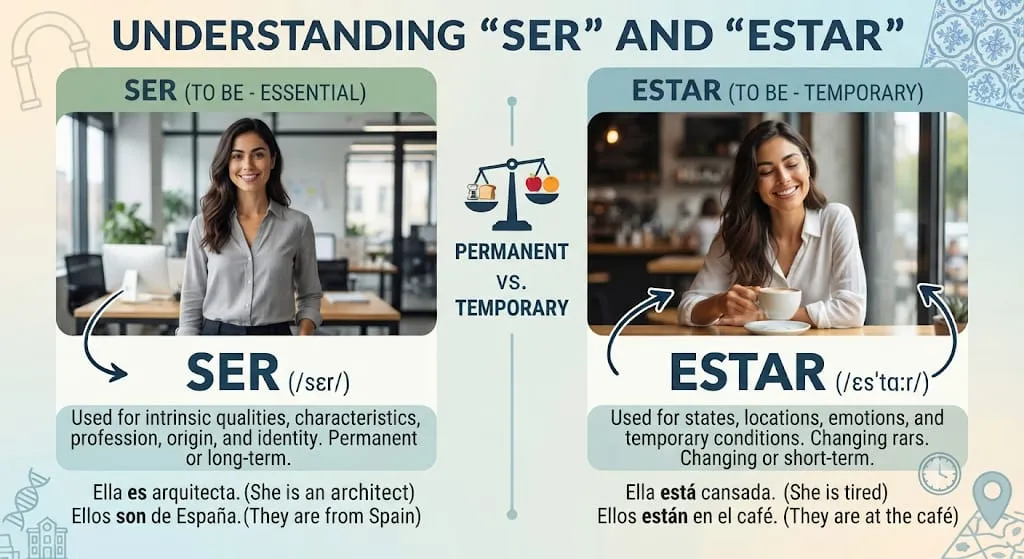
Ser and estar both mean "to be" in Spanish, but they are used differently. Ser describes permanent qualities, identity, and origin, while estar describes temporary conditions, locations, and changing states.
When I first started learning Spanish, one of my biggest mistakes was using ser and estar interchangeably. I knew they both meant “to be,” so I assumed either one would work. Then I told a Spanish-speaking friend, “Soy cansado,” thinking I was saying, “I’m tired.” He smiled and explained that the correct phrase was “Estoy cansado.” That small mistake completely changed how I understood Spanish.
If you’re learning Spanish, you’ve probably faced the same confusion. Unlike English, Spanish has two verbs for “to be,” and choosing the wrong one can change the meaning of your sentence.
The good news is that the difference follows clear patterns. Once you learn when to use ser and when to use estar, speaking and writing become much easier.
In this guide, you’ll discover the key differences, easy memory tips, real-life examples, common mistakes, and practical advice to help you use ser and estar with confidence.
Ser or Estar Quick Answer
Use ser for identity, origin, characteristics, time, dates, and professions.
Use estar for location, emotions, physical conditions, and temporary situations.
Simple examples
- Ella es doctora. (She is a doctor.)
- Ella está cansada. (She is tired.)
The Origin and Background of Ser or Estar
Spanish inherited both ser and estar from Latin.
Over hundreds of years, each verb developed its own purpose.
- Ser became the verb for things that define what something is.
- Estar became the verb for things that describe how something is right now or where it is.
This distinction is one of the first major grammar topics every Spanish learner studies.
Ser or Estar Explained Key Differences
Think of it this way:
- Ser = Permanent or defining information
- Estar = Temporary condition or location
| Term | Meaning | When to Use | Context |
| Ser | To be | Identity, origin, profession, time, dates, characteristics | Permanent or defining |
| Estar | To be | Location, feelings, health, temporary conditions | Temporary or changing |
Use Ser for
- Identity
- Nationality
- Profession
- Personality
- Time
- Date
- Relationships
- Material
Examples:
- Soy estudiante.
- Él es mexicano.
- Hoy es lunes.
- La mesa es de madera.
Use Estar for
- Location
- Feelings
- Emotions
- Health
- Temporary conditions
- Progressive tenses
Examples:
- Estoy feliz.
- Estamos en casa.
- El café está caliente.
- Está lloviendo.
Which Version Should You Use?
The correct choice depends on what you’re describing.
For beginners
Ask yourself:
Does this describe what something IS?
Use ser.
If it describes how something FEELS or WHERE it IS
Use estar.
For everyday conversations
Use ser when talking about identity.
Use estar when talking about mood or location.
For exams
Remember the common memory aids:
Ser → DOCTOR
- Description
- Occupation
- Characteristic
- Time
- Origin
- Relationship
Estar → PLACE
- Position
- Location
- Action (present progressive)
- Condition
- Emotion
Common Mistakes with Ser or Estar
| Mistake | Correct Version | Why It Happens |
| Soy cansado. | Estoy cansado. | Tired is a temporary condition. |
| La escuela está grande. | La escuela es grande. | Size is a characteristic. |
| Madrid es aquí. | Madrid está aquí. | Location requires estar. |
| Estoy profesor. | Soy profesor. | Profession uses ser. |
| La comida es fría. (when it became cold) | La comida está fría. | Temperature is usually temporary. |
Ser or Estar in Real-World Examples
Professional Email
“Actualmente estoy disponible para una reunión el martes.”
(I am currently available for a meeting on Tuesday.)
News Headline
“El presidente está en Madrid para una conferencia.”
Social Media Post
“¡Hoy estoy muy feliz porque terminé mi examen!”
Formal Report
“El edificio es uno de los más antiguos de la ciudad.”
Ser or Estar Data, Trends & Usage
Ser or estar is one of the most searched Spanish grammar topics because every learner encounters it early.
Most common search intent
- Informational
- Spanish grammar
- Language learning
- Homework help
- Exam preparation
Regions with high interest
- United States
- Spain
- Mexico
- Latin America
- English-speaking countries learning Spanish
Why this topic matters now
Spanish is one of the world’s most widely spoken languages. Mastering ser and estar helps learners communicate naturally from the very beginning.
Comparison Table
| Term/Variant | Meaning | Context | Best Used When |
| Ser | To be | Identity | Talking about permanent qualities |
| Ser | To be | Profession | Saying what someone does |
| Estar | To be | Location | Saying where someone or something is |
| Estar | To be | Condition | Talking about feelings or temporary states |
Frequently Asked Questions
Q: What do ser and estar mean?
A: Both verbs mean “to be” in Spanish. The difference is that ser describes permanent or defining qualities, while estar describes temporary conditions and locations.
Q: How do you use ser correctly?
A: Use ser for identity, nationality, profession, relationships, characteristics, dates, and time.
Q: Ser vs estar — what’s the difference?
A: Ser tells what something is, while estar tells how something is or where it is.
Q: Is ser used in formal Spanish?
A: Yes. Both ser and estar are essential in formal and informal Spanish.
Q: Which version is correct — ser or estar?
A: It depends on the meaning. Use ser for permanent qualities and estar for temporary conditions and locations.
Q: Why are there two words for “to be” in Spanish?
A: Spanish developed two separate verbs from Latin. Each expresses a different type of state or quality, making communication more precise.
Q: Can the same adjective be used with both ser and estar?
A: Yes. Some adjectives change meaning depending on the verb. For example, es aburrido means “he is boring,” while está aburrido means “he is bored.”
Conclusion
Learning ser or estar may seem challenging at first, but the basic rule is simple. Use ser for identity, origin, profession, and lasting characteristics. Use estar for location, emotions, health, and temporary conditions.
Remember these key points:
- Ser describes what something is.
- Estar describes how something is or where it is.
- Think DOCTOR for ser.
- Think PLACE for estar.
- Practice with everyday sentences to build confidence.
Once you master this difference, your Spanish will sound much more natural. Bookmark this guide so you never second-guess “ser” and “estar” again, and share it with anyone learning Spanish.
Read More:
Ya’ll or Y’all: The Complete Guide to the Correct Spelling

I specialize in English grammar, spelling, word choice, and language usage. My content is based on research from grammar references, style guides, dictionaries, and real-world usage to ensure it is accurate and practical.
At Spelling Comparison, I write guides that explain why words are confused, how they are used, and which form is correct in context. I also include proofreading tips, examples, and writing advice readers can apply immediately.
My goal is to publish clear, reliable content that helps readers make better writing decisions. Each guide is written for accuracy, clarity, and usefulness in school, work, business, and everyday communication.