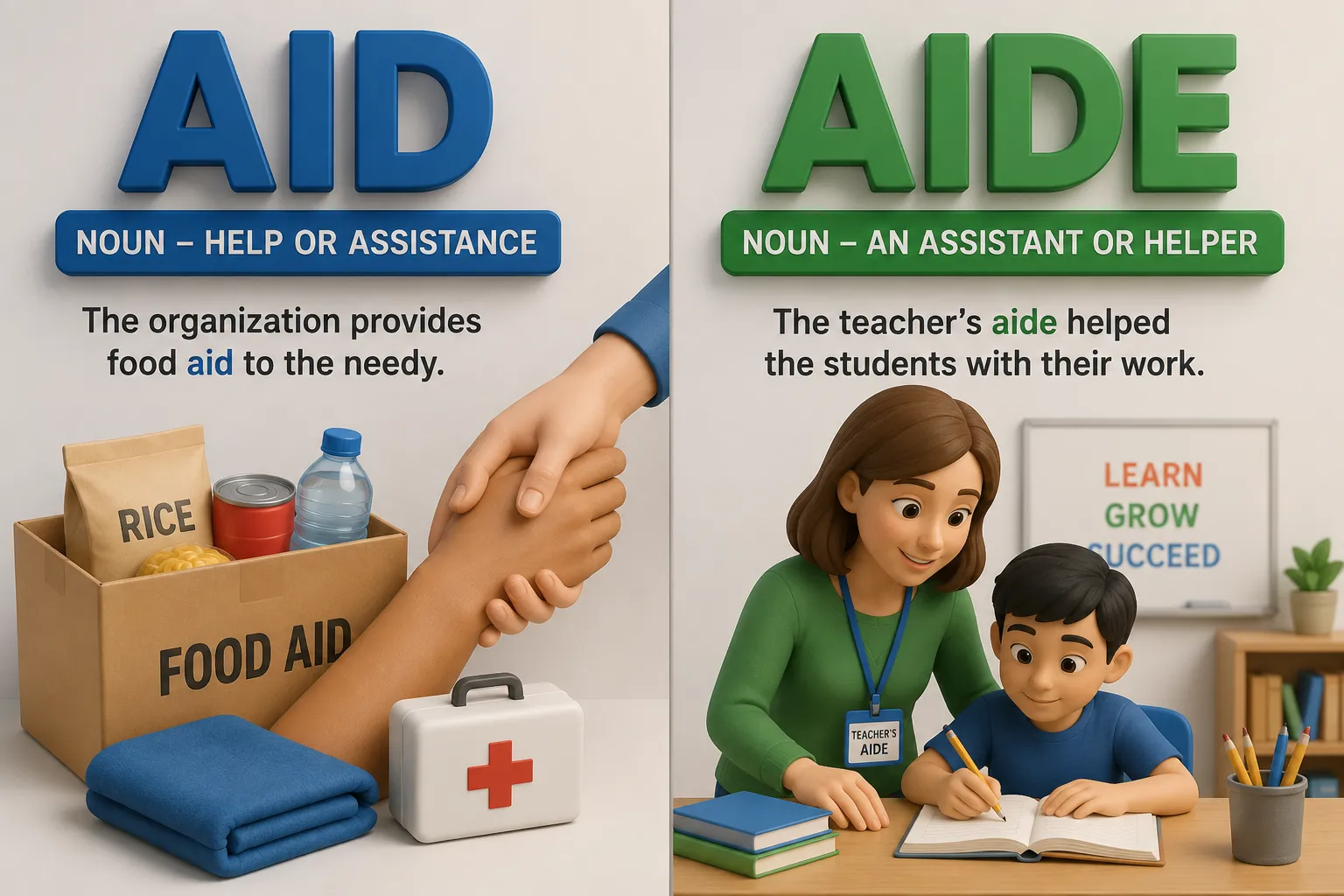
Aid is usually a noun or verb that means help or support. Aide is always a noun that means a person who helps someone, especially in a professional or official role.
I still remember proofreading a report where someone wrote, “The president thanked his aid for years of service.” At first glance, nothing seemed wrong. But the sentence actually referred to a trusted assistant, not help itself. One missing letter completely changed the meaning.
If you’ve ever paused before writing aid or aide, you’re not alone. The two words sound exactly alike, but they have different meanings and uses. That’s why many students, writers, and professionals mix them up.
The good news is that the difference is simple once you know one easy rule. In this guide, you’ll learn what each word means, where it came from, when to use it, common mistakes to avoid, and plenty of real-world examples. By the end, you’ll never have to guess between aid and aide again.
Aid or Aide Quick Answer
Aid means help, assistance, or support. It can be a noun or a verb.
Aide means a person who gives help, especially an assistant to an important person or organization. It is always a noun.
Simple examples
- The charity sent aid after the storm.
- The senator’s aide organized the meeting.
The Origin and Background of Aid or Aide
The word aid comes from the Old French word aide, meaning help or assistance. It has been used in English for hundreds of years as both a noun and a verb.
The word aide entered English later from French. It specifically came to mean a helper or assistant, especially in military, government, and political settings.
Read More:
Possum or Opossum: The Complete Guide to the Real Difference
Because both words share the same origin and pronunciation, they are easy to confuse. Their meanings, however, have become clearly different over time.
Aid or Aide Explained Key Differences
The easiest way to remember the difference is this:
- Aid = Help
- Aide = Helper
| Term | Meaning | When to Use | Region/Context |
| Aid | Help or assistance; to help | General writing, education, news | Worldwide |
| Aide | A person who assists someone | Government, business, healthcare, military | Worldwide |
Examples of Aid
- The country received emergency aid.
- Good notes can aid your memory.
- Financial aid helped pay for college.
Examples of Aide
- The governor’s aide answered reporters’ questions.
- A classroom aide helped the teacher.
- The nurse’s aide cared for patients.
Which Version Should You Use?
Choose the word based on what you mean.
For students
Use aid when talking about help, support, or assistance.
Example:
- Financial aid
- Study aid
For professionals
Use aide when referring to someone’s assistant.
Examples:
- Executive aide
- Legislative aide
- Teacher’s aide
For general writing
Ask yourself one question:
Are you talking about help or a helper?
- Help → Aid
- Helper → Aide
Common Mistakes with Aid or Aide
| Mistake | Correct Version | Why It Happens |
| The president thanked his aid. | The president thanked his aide. | Refers to a person, not help. |
| Disaster aide arrived quickly. | Disaster aid arrived quickly. | The sentence means assistance. |
| Financial aide package | Financial aid package | Aid means funding or support. |
| Teacher aid helped students. | Teacher aide helped students. | A person is being described. |
| Aid organized the meeting. | The aide organized the meeting. | The organizer is a person. |
Aid or Aide in Real-World Examples
Professional Email
“Our administrative aide will schedule your appointment later today.”
News Headline
“International aid reaches flood victims after severe storms.”
Social Media Post
“Big thanks to my teaching aide for making today run so smoothly!”
Formal Report
“The organization provided medical aid to more than 5,000 people.”
Aid or Aide Data, Trends & Usage
Many people search for aid or aide because the words sound identical but have different meanings.
Most common search intent
- Informational
- Grammar help
- Correct word choice
- Writing improvement
- English learning
Regions with high interest
- United States
- Canada
- United Kingdom
- Australia
- India
Why this topic matters now
Clear writing builds trust. Whether you’re writing a school paper, a business email, or a news story, choosing aid or aide correctly helps readers understand your message immediately.
Comparison Table
| Term/Variant | Meaning | Region/Context | Best Used When |
| Aid | Help, support, or assistance | General English | Talking about help or helping |
| Aid (verb) | To help | General English | Describing an action |
| Aide | Assistant or helper | Government, healthcare, education, business | Referring to a person |
| Financial aid | Money for education | Schools and universities | Discussing education funding |
Frequently Asked Questions
Q: What does aid mean?
A: Aid means help, support, or assistance. It can also be used as a verb meaning “to help.”
Q: What does aide mean?
A: Aide is a person who assists someone, often in a professional, political, educational, or healthcare role.
Q: Aid vs aide — what’s the difference?
A: Aid refers to help itself, while aide refers to the person providing that help.
Q: Is aid acceptable in formal writing?
A: Yes. Aid is the correct word for assistance in academic, business, legal, and professional writing.
Q: Which version is correct aid or aide?
A: Both are correct. Use aid for help and aide for a helper or assistant.
Q: Where does the word aide come from?
A: It comes from French and originally meant a helper or assistant. English later adopted it with the same meaning.
Q: Can aid be used as a verb?
A: Yes. For example, “Exercise can aid recovery.” In this sentence, aid means “to help.”
Conclusion
Understanding aid or aide is easier than it first seems. The key is remembering that aid means help, while aide means the person who helps. That one extra “e” makes all the difference.
Keep these simple tips in mind:
- Use aid for assistance or support.
- Use aid as a verb when you mean “to help.”
- Use aide only for a person who serves as an assistant.
- When in doubt, ask yourself whether you’re talking about help or a helper.
With this simple rule, you’ll make the right choice every time. Bookmark this guide so you never confuse “aid” and “aide” again, and share it with anyone who wants to improve their English writing.
Meta Description: Aid or aide explained with meanings, differences, examples, correct usage, common mistakes, and simple tips for choosing the right word every time.

I’m Daniel sultan, an English language writer and SEO content specialist with experience researching spelling, grammar, vocabulary, and English usage. Through SpellComparison.com, I create clear, accurate, and well-researched guides that help readers understand commonly confused words, spelling differences, and grammar rules with confidence.
Every article I write is based on trusted language references, established style guides, and real-world usage to ensure it is accurate, practical, and easy to understand. My goal is to make learning English simple and reliable by providing fact-checked content, clear explanations, and real-life examples that students, writers, educators, and professionals can trust.