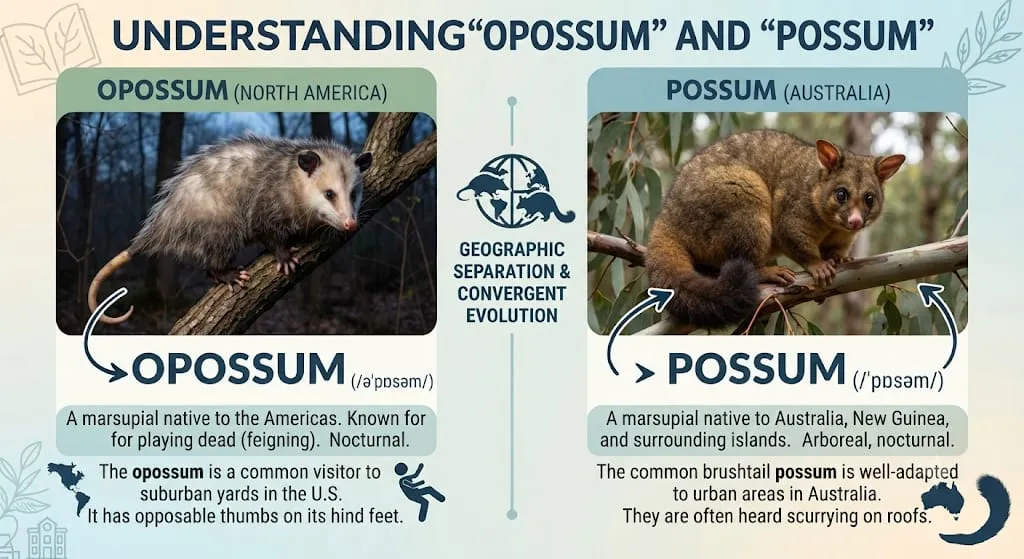
Possum or opossum both refer to marsupials, but they are not the same animal. Opossums live in North and South America, while possums are different marsupials native to Australia, New Guinea, and nearby islands.
The first time I heard someone say, “A possum was in my backyard,” I pictured the gray animal I had seen in American wildlife photos. Later, while reading about Australian animals, I found pictures of cute, fluffy creatures that looked nothing like it. That was the moment I realized many people use possum and opossum as if they mean the same thing.
You may have asked yourself the same question. Is there really a difference? Are they just two spellings of one word? Or does each name describe a different animal?
The confusion is common because people in the United States often shorten opossum to possum in everyday speech. At the same time, Australia has its own animals officially called possums.
In this guide, I’ll explain the difference in simple words. You’ll learn where each animal lives, why the names are confusing, when to use each term, and how to avoid common mistakes.
Possum or Opossum Quick Answer
The opossum is a marsupial found in North and South America. The possum is a different marsupial that lives mainly in Australia and nearby regions.
Simple examples
- An opossum may wander into a backyard in Texas or Florida.
- A possum might climb a eucalyptus tree in Sydney.
Although Americans often say “possum” when talking about an opossum, the animals are different.
The Origin and Background of Possum or Opossum
The word opossum comes from an Algonquian Native American language. It was later adopted into English during the early colonial period.
Over time, many Americans began dropping the first “o” in casual speech. Saying possum became easier and faster. Eventually, the shorter version became common in conversation.
Meanwhile, early European settlers in Australia noticed tree-dwelling marsupials that reminded them of the American opossum. They started calling these animals possums, even though they belonged to different species.
That simple naming choice created confusion that still exists today.
Possum or Opossum Explained Key Differences
Although they belong to the same larger group of marsupials, these animals are quite different.
| Term | Meaning | When to Use | Region/Context |
| Opossum | American marsupial | Scientific and formal writing | North and South America |
| Possum | Australian marsupial | Official animal name | Australia and New Guinea |
| Possum (US) | Informal nickname for opossum | Casual American speech | United States |
Appearance
Opossums
- Gray fur
- Long pointed face
- Hairless tail
- Sharp teeth
- White face
Possums
- Thick fluffy fur
- Large round eyes
- Bushy or furry tail
- Smaller face
- Softer appearance
Behavior
Opossums
- Often active at night
- Eat insects, fruit, and small animals
- Famous for “playing dead”
Possums
- Spend much of their time in trees
- Eat leaves, flowers, and fruit
- Rarely play dead
Which Version Should You Use?
Choosing the right word depends on your audience.
For students
Use opossum when writing about the American animal. Teachers usually expect the correct biological name.
For wildlife writers
Use the official animal name for the correct region.
- America → opossum
- Australia → possum
For casual conversations in the United States
Most people understand possum as a shortened form of opossum.
For international readers
Use the full word opossum when discussing the American species. Use possum only for the Australian animal. This avoids confusion.
Common Mistakes with Possum or Opossum
Here are mistakes people often make.
| Mistake | Correct Version | Why It Happens |
| Australian opossum | Australian possum | Australia has possums, not opossums |
| American possum in scientific writing | American opossum | Opossum is the official name |
| Thinking both animals are identical | They are different species | The similar names cause confusion |
| Using the words interchangeably worldwide | Match the correct region | Different countries use different names |
| Assuming possums play dead | Only American opossums are famous for this behavior | Popular wildlife stories create confusion |
Possum or Opossum in Real-World Examples
Professional Email
“Wildlife officers safely relocated an opossum from the office parking lot this morning.”
News Headline
“Opossum Rescued After Becoming Trapped Inside Family Garage”
Social Media Post
“Look at this adorable possum sleeping in a tree during my trip to Australia!”
Formal Report
“The survey identified several opossums living within the protected woodland area.”
Possum or Opossum Data, Trends & Usage
Search interest usually comes from people asking one simple question:
“What’s the difference between possum and opossum?”
Most common search intent
- Informational
- Animal identification
- Wildlife education
- Correct spelling
- Regional language differences
Regions with high interest
- United States
- Australia
- Canada
- United Kingdom
- New Zealand
Why this topic matters now
Wildlife videos spread quickly on social media. People often see these animals online before learning their real names. That makes correct identification more valuable than ever.
Comparison Table
| Term/Variant | Meaning | Region/Context | Best Used When |
| Opossum | American marsupial | North America | Scientific writing and education |
| Possum | Australian marsupial | Australia | Referring to native Australian wildlife |
| Possum (informal) | Short name for opossum | United States | Casual conversations |
| Opossum species | More than 100 American marsupials | Biology | Formal discussions |
Frequently Asked Questions
Q: What does possum or opossum mean?
A: The words refer to marsupials, but not the same ones. Opossums live in the Americas, while possums live mainly in Australia.
Q: How do you use opossum correctly?
A: Use opossum whenever you mean the American animal, especially in school papers, books, scientific writing, and news articles.
Q: Possum vs opossum — what’s the difference?
A: They belong to different groups of marsupials. They live on different continents and have different appearances and behaviors.
Q: Is opossum acceptable in formal writing?
A: Yes. It is the preferred and scientifically correct term for the American species.
Q: Which version is correct — possum or opossum?
A: Both are correct, but only in the right context. Use opossum for the American animal and possum for the Australian one.
Q: Where does the word opossum come from?
A: It comes from an Algonquian Native American language. English speakers later adopted the word.
Q: Can possum be used in everyday conversation?
A: Yes. In the United States, many people casually say possum instead of opossum. In Australia, possum is the official name of the native animal.
Conclusion
The difference between possum or opossum is much simpler once you know where each animal lives. Opossums belong to the Americas. Possums are native to Australia and nearby regions. While Americans often shorten opossum to possum in casual speech, the two names are not always interchangeable.
Remember these key points:
- Opossum is the official American animal.
- Possum is the official Australian animal.
- Use the correct name based on the location and your audience.
- Formal writing should use the scientifically correct term.
Knowing this small difference helps you write more clearly and speak with confidence. Whether you’re studying wildlife, writing an article, or simply answering a friend’s question, you’ll now know exactly which word to choose.
Bookmark this guide so you never second-guess “possum or opossum” again, and share it with anyone who has ever wondered if they’re the same animal.
Read More:
Anyway or Anyways: Which One Should You Use?

I’m an English language educator and content writer with more than 10 years of experience helping learners improve their English skills. I specialize in spelling differences, grammar, vocabulary, synonyms, commonly confused words, and English usage. My goal is to create accurate, easy-to-understand articles that make learning English simple, practical, and enjoyable for students, writers, and professionals around the world.