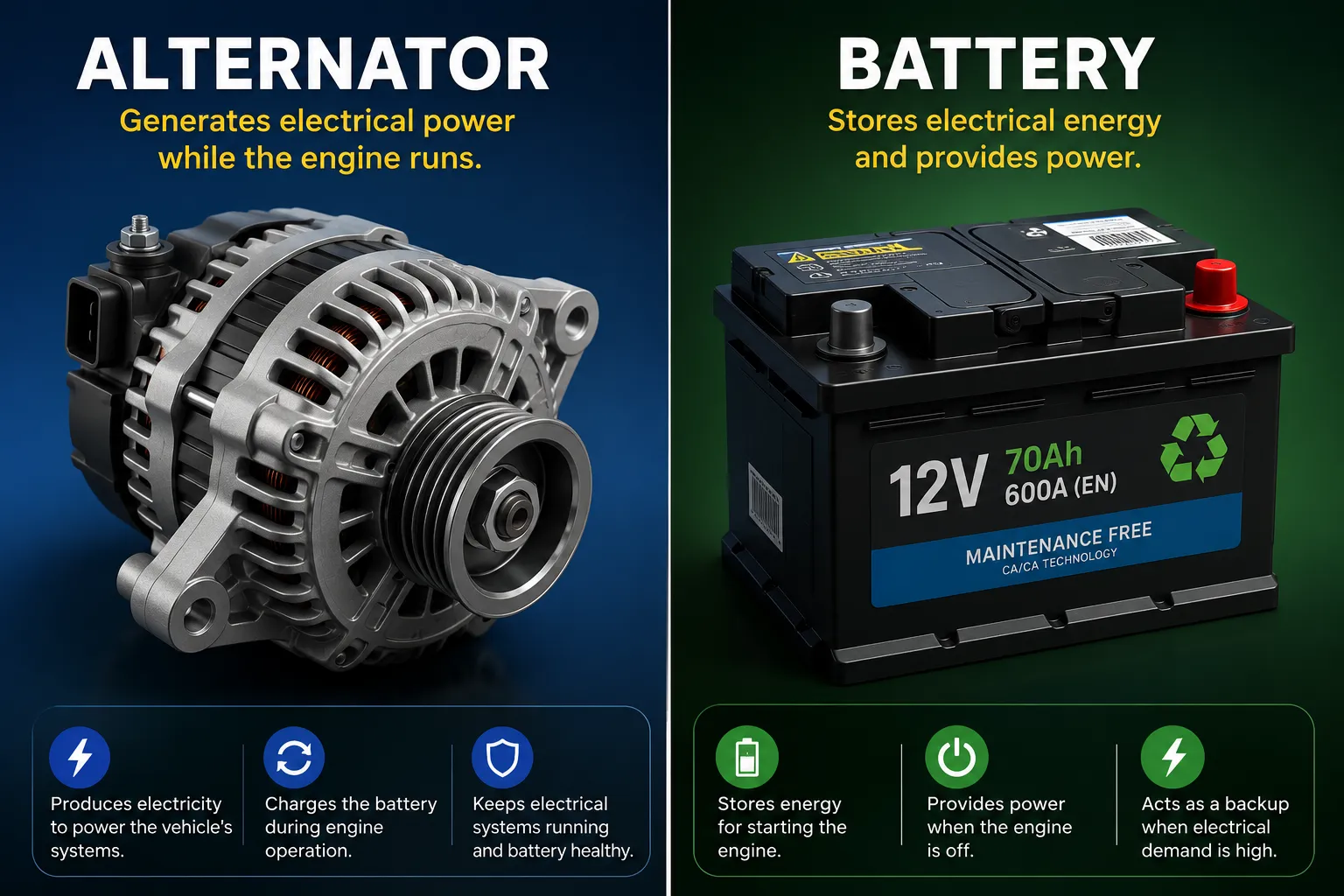
The battery stores electricity and starts your vehicle, while the alternator generates electricity and recharges the battery after the engine starts. If either fails, your car may not start or may stop running.
A few years ago, my car refused to start on a cold morning. I assumed the battery had died, so I bought a replacement. To my surprise, the new battery also went flat within days. A mechanic quickly found the real problem—a failing alternator. That experience taught me an important lesson: the battery and alternator work together, but they do very different jobs.
Many drivers confuse these two parts because the symptoms of failure can seem similar. A car that won’t start, dim headlights, or warning lights can point to either component. Replacing the wrong part wastes both time and money.
If you’ve searched for alternator or battery, you’re probably trying to figure out which one is causing your car trouble. This guide explains how each part works, their key differences, warning signs, and how to tell which one needs attention.
Alternator or Battery Quick Answer
The battery stores electrical energy and provides the power needed to start your engine. The alternator produces electricity while the engine is running and keeps the battery charged.
Simple examples
- ✅ A dead battery usually prevents the engine from starting.
- ✅ A faulty alternator may let the car start but cause it to stall later because the battery is no longer charging.
The Origin and Background of Alternator or Battery
Although they work together, the battery and alternator have different histories.
The battery has existed in various forms for centuries. Modern automotive batteries are based on the lead-acid battery, invented by French physicist Gaston Planté in 1859. According to leading automotive references, this technology is still widely used in most gasoline-powered vehicles because it provides reliable starting power.
The alternator became common in passenger vehicles during the 1960s, replacing older DC generators. According to Bosch and automotive engineering resources, alternators are lighter, more efficient, and produce electricity more effectively, especially at low engine speeds.
Today, nearly every modern vehicle relies on both components. Without the battery, the engine cannot start. Without the alternator, the battery quickly loses its charge.
Alternator or Battery Explained Key Differences
Although both are part of your car’s electrical system, they perform completely different jobs.
| Component | Main Job | When It Works | What Happens if It Fails |
| Battery | Stores electrical energy | Before starting and when extra power is needed | Car may not start |
| Alternator | Generates electricity and charges the battery | While the engine is running | Battery drains and vehicle may stall |
Examples
Battery
- Starts the engine.
- Powers interior lights before the engine starts.
- Supplies electricity when the engine is off.
Alternator
- Charges the battery during driving.
- Powers headlights, radio, and air conditioning while the engine runs.
- Supports the vehicle’s electrical system.
Think of it this way:
Battery = Storage
Alternator = Generator
Which One Should You Check or Replace?
Knowing the symptoms can save unnecessary repairs.
If your battery may be the problem
Check the battery first if you notice:
- The engine cranks slowly.
- The car won’t start after sitting overnight.
- Battery terminals are corroded.
- The battery is more than three to five years old.
- A jump-start works, and the car continues running normally.
If the alternator may be the problem
The alternator is more likely at fault if:
- The battery warning light stays on.
- Headlights become dim while driving.
- Dashboard electronics flicker.
- The battery repeatedly dies after replacement.
- The engine stalls while driving.
For beginner drivers
If your car starts normally after a jump but dies again later, have the alternator tested before buying a new battery.
For DIY car owners
Many auto parts stores offer free battery and alternator testing, helping identify the faulty component before you spend money.
Quick memory trick
- Battery = Starts the car
- Alternator = Keeps it running
Quick Comparison
| If you need… | Check |
| Starting power | Battery |
| Charging system | Alternator |
| Engine stalls while driving | Alternator |
| Car won’t crank | Battery (or charging system) |
| Electrical accessories while driving | Alternator |
Signs to Watch For
Battery warning signs
- Slow engine cranking
- Clicking sound when turning the key
- Corroded battery terminals
- Weak interior lights before starting
Alternator warning signs
- Battery warning light
- Flickering headlights
- Burning rubber smell from the drive belt
- Electrical systems behaving unpredictably
- Repeated dead batteries
Common Mistakes About Alternator or Battery
Many vehicle owners assume every starting problem is caused by a dead battery. In reality, the alternator, battery, or another part of the charging system could be responsible.
| ❌ Common Mistake | ✅ Correct Understanding | Why? |
| Replacing the battery every time the car won’t start | Test both the battery and alternator first | The alternator may not be charging the battery. |
| Assuming a jump-start always fixes the problem | A jump-start is often temporary | A failing alternator can drain the battery again. |
| Ignoring the battery warning light | Have the charging system checked immediately | The warning light often points to an alternator issue. |
| Believing a new battery solves every electrical problem | Inspect the entire charging system | Loose cables, fuses, or the alternator may be faulty. |
| Driving with a failing alternator | Repair it as soon as possible | The battery will eventually lose power, and the engine may stop running. |
Why These Mistakes Happen
- Both parts are connected.
- Their symptoms often overlap.
- Many people replace the easiest or cheapest part first.
- Modern vehicles rely heavily on electronics, making diagnosis more difficult without testing.
According to AAA and Interstate Batteries, testing the battery and charging system together is the most reliable way to identify the real problem.
Alternator or Battery in Real-World Examples
Mechanic’s Recommendation
After testing the charging system, the technician confirmed that the alternator had failed, not the battery.
Automotive News Headline
Cold Weather Causes More Battery Failures as Drivers Prepare for Winter
Conversation
Driver: My car starts with jumper cables but dies after a few minutes.
Mechanic: That usually suggests the alternator isn’t charging the battery properly.
Vehicle Inspection Report
The battery passed the load test, but the alternator output measured below the manufacturer’s recommended voltage.
These examples show that proper testing helps avoid replacing the wrong component.
Alternator or Battery Data, Trends & Usage
Understanding how these parts fail can help you diagnose problems earlier.
Approximate Search Volume
Based on Semrush, Ahrefs, and general keyword trends (2025–2026):
| Keyword | Approximate Monthly Searches |
| alternator | 550,000+ |
| battery | 2,000,000+ |
| alternator or battery | 5,000–12,000 |
These figures are approximate and may vary depending on location and keyword research tools.
Industry Insights
According to AAA, battery-related issues remain one of the most common reasons for roadside assistance calls. Extreme heat and cold can shorten battery life, making regular testing especially important.
Vehicle manufacturers generally recommend checking the charging system whenever a battery is replaced to ensure the alternator is functioning correctly.
Typical Lifespan
| Component | Average Lifespan |
| Battery | 3–5 years |
| Alternator | 7–10 years or 80,000–150,000 miles |
Actual lifespan depends on climate, driving habits, and vehicle maintenance.
Search Intent
Primary search intent: Informational
Most people searching alternator or battery want to know:
- Which part is causing their car problem?
- What are the warning signs?
- Which part should they replace first?
Why This Topic Matters
Modern vehicles use more electronic systems than ever before. Features such as navigation, advanced safety technology, heated seats, and infotainment systems depend on a healthy electrical system. Understanding the difference between the alternator and battery can help prevent unexpected breakdowns and unnecessary repair costs.
Comparison Table
| Component | Main Function | Powers the Car? | Best Checked When |
| Battery | Stores electrical energy | Starts the engine | Slow cranking or no start |
| Alternator | Produces electricity while driving | Keeps battery charged | Battery light appears or battery repeatedly dies |
| Starter Motor | Cranks the engine | Begins engine rotation | Engine clicks but does not crank |
This table adds another important component—the starter motor—which is often confused with both the battery and alternator.
Frequently Asked Questions
Q1. How do I know if I need a new battery or a new alternator?
A: If the battery repeatedly loses charge after being tested or replaced, the alternator may be the problem. Testing both components is the most accurate way to diagnose the issue.
Q2. Can a bad alternator ruin a battery?
A: Yes. A failing alternator may undercharge or overcharge the battery, reducing its lifespan and causing repeated starting problems.
Q3. Can a car run with a bad alternator?
A: Only for a short time. Once the battery’s stored power is depleted, the engine may stall because the alternator is no longer supplying electricity.
Q4. What are the signs of a weak battery?
A: Common signs include slow engine cranking, dim lights before starting, clicking sounds, and difficulty starting after the vehicle has been parked.
Q5. What does an alternator do?
A: The alternator converts mechanical energy from the engine into electrical energy. It powers the vehicle’s electrical systems and recharges the battery while the engine is running.
Q6. Should I replace the battery and alternator together?
A: Not usually. Replace only the faulty part unless testing shows that both components have failed or reached the end of their service life.
Q7. How can I make my battery and alternator last longer?
A: Keep battery terminals clean, avoid leaving lights on, inspect the drive belt regularly, and have the charging system tested during routine vehicle maintenance.
Conclusion
The battery and alternator are partners in your vehicle’s electrical system, but they have different responsibilities. The battery provides the power needed to start the engine, while the alternator generates electricity to keep the battery charged and operate your vehicle’s electrical components during every drive. Knowing this difference makes it much easier to identify the cause of common starting and charging problems.
If your vehicle struggles to start, the battery may be weak. If the battery keeps going flat or the battery warning light appears while driving, the alternator deserves closer attention. Rather than guessing, have both parts tested before replacing anything. This simple step can save money, prevent unnecessary repairs, and reduce the risk of being stranded.
Now you know the difference between an alternator and a battery. Bookmark this guide for future reference, and share it with anyone who wants to understand their vehicle’s electrical system better.

I specialize in English grammar, spelling, word choice, and language usage. My content is based on research from grammar references, style guides, dictionaries, and real-world usage to ensure it is accurate and practical.
At Spelling Comparison, I write guides that explain why words are confused, how they are used, and which form is correct in context. I also include proofreading tips, examples, and writing advice readers can apply immediately.
My goal is to publish clear, reliable content that helps readers make better writing decisions. Each guide is written for accuracy, clarity, and usefulness in school, work, business, and everyday communication.