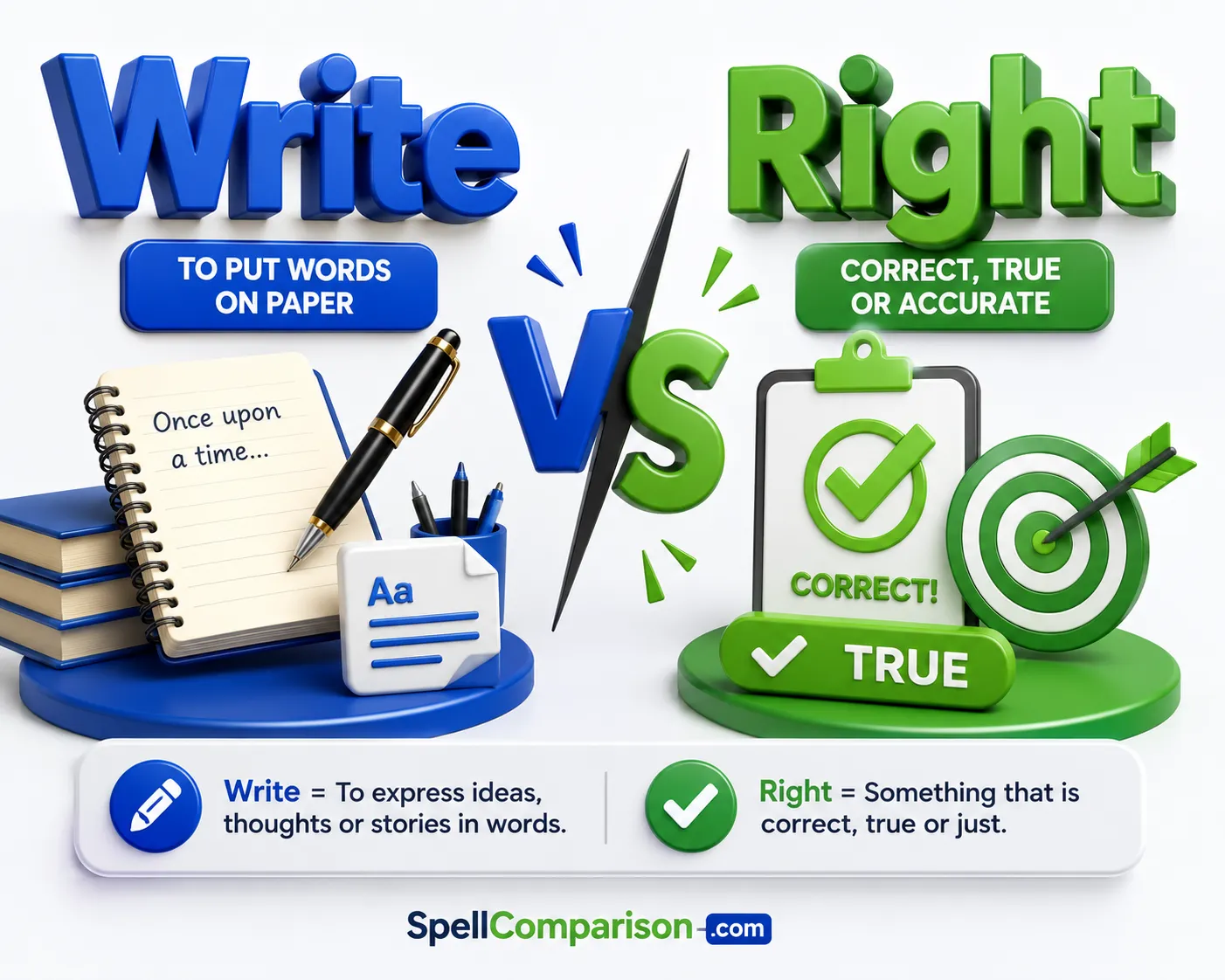
Write means to create words, letters, or text, while right means correct, proper, or the opposite of left. They sound the same but have different meanings and uses. Choosing the correct word makes your writing clear and accurate.
One of the first spelling mistakes I noticed while editing student essays was the sentence, “Please right your name at the top of the page.” The sentence sounded perfectly fine when read aloud, but something looked wrong. The student had used right instead of write because both words sound exactly alike. That tiny mistake completely changed the meaning of the sentence.
If you’ve ever hesitated before typing write or right, you’re not alone. These words are homophones—words that share the same pronunciation but have different spellings and meanings. They confuse English learners, students, and even native speakers because your ears cannot tell them apart.
Fortunately, the difference is simple once you understand how each word works. In this guide, you’ll learn the meanings of write and right, their origins, grammar, real-world examples, common mistakes, and practical tips for remembering the correct word every time.
Write or Right Quick Answer
Although write and right sound identical, they have completely different meanings.
- Write is a verb. It means to create words using a pen, keyboard, or another tool.
- Right can be an adjective, noun, adverb, or verb. It usually means correct, proper, lawful, or the opposite of left.
Examples
- ✅ Please write your address on the form.
- ✅ Your answer is right.
A simple rule is:
Write = Words
Right = Correct
The Origin and Background of Write or Right
The words write and right developed from different roots, even though they are pronounced the same today.
According to Etymonline, write comes from the Old English word writan, meaning to score, carve, draw, or write. Long before paper became common, people carved symbols into wood, stone, or wax tablets. Over time, the meaning expanded to include writing with ink, pencils, and eventually keyboards.
The word right comes from the Old English word riht, meaning straight, just, lawful, or correct. According to Merriam-Webster, the word gradually developed additional meanings, including the direction opposite left and the idea of fairness or legal entitlement.
The pronunciation of both words became similar over centuries because of changes in English speech. Today they are classic homophones, which means they sound alike but differ in spelling and meaning.
According to the Cambridge Dictionary, write functions mainly as a verb, while right serves multiple grammatical roles depending on the sentence.
Write or Right Explained Key Differences
The biggest difference is their purpose.
| Word | Meaning | Part of Speech | When to Use |
| Write | To create letters, words, or text | Verb | Writing books, emails, notes, messages |
| Right | Correct, proper, opposite of left, legal entitlement | Adjective, noun, adverb, verb | Directions, correctness, rights, approval |
Examples with Write
- Please write your full name.
- She likes to write short stories.
- I’ll write you an email tonight.
- Students should write clearly during the exam.
Examples with Right
- You chose the right answer.
- Turn right at the traffic light.
- Everyone has the right to express an opinion.
- That’s exactly right.
Notice that write always involves producing words, while right has several meanings unrelated to writing.
Which Word Should You Use?
The easiest way to choose is to ask yourself one question:
Are you talking about putting words on paper or a screen?
If yes, choose write.
Example:
Please write your phone number here.
Are you talking about something correct?
Choose right.
Example:
You made the right decision.
Are you giving directions?
Use right.
Example:
Turn right after the bridge.
Are you talking about legal or moral freedom?
Again, choose right.
Example:
Every child has the right to education.
Quick Comparison
| If you mean… | Use |
| Create words | Write |
| Send a letter | Write |
| Correct answer | Right |
| Opposite of left | Right |
| Legal freedom | Right |
Easy Memory Tricks
These simple tricks help many learners remember the difference.
Write
The word write contains wri, just like writer, writing, and written.
If the sentence involves words, choose write.
Right
Think of the phrase:
The right answer is correct.
Both right and correct describe accuracy.
Common Situations
Use write when you:
- Write an email
- Write a book
- Write a message
- Write your homework
- Write a report
Use right when you:
- Give directions
- Describe something correct
- Talk about legal rights
- Approve a decision
- Explain that someone is correct
Common Mistakes with Write or Right
Because write and right are homophones, they sound exactly the same. Spell checkers may not catch the mistake because both words are correctly spelled. The key is choosing the word that matches your meaning.
| ❌ Incorrect | ✅ Correct | Why? |
| Please right your name here. | Please write your name here. | You’re creating words. |
| You always write answers. | You always give right answers. | The sentence describes correctness. |
| Turn write at the next street. | Turn right at the next street. | It refers to a direction. |
| She has the write to vote. | She has the right to vote. | It refers to a legal entitlement. |
| I’ll right you tomorrow. | I’ll write to you tomorrow. | It means sending a message or letter. |
Why These Mistakes Happen
- The words have the same pronunciation.
- English spelling doesn’t always match pronunciation.
- Learners often write the word they hear instead of the word they mean.
- Grammar checkers cannot always identify the error because both are valid English words.
Tip: Ask yourself whether you’re talking about words or correctness.
Write or Right in Real-World Examples
Professional Email
Please write your employee ID on the application form. Make sure all information is right before submitting it.
News Headline
Local Author Writes Award-Winning Children’s Novel
Social Media Post
Finally finished writing my first blog post! It feels great to know I made the right decision to start.
Formal Report
Employees must write incident reports within 24 hours. Managers should verify that all information is right before approval.
These examples show that write relates to creating text, while right refers to accuracy, direction, or fairness.
Write or Right Data, Trends & Usage
Approximate Search Volume
Based on Semrush, Ahrefs, and general keyword trends (2025–2026):
| Keyword | Approximate Monthly Searches |
| write | 1,000,000+ |
| right | 2,000,000+ |
| write or right | 5,000–10,000 |
These numbers are approximate and may differ depending on the keyword research tool and country.
Word Frequency
According to Google Books Ngram Viewer, both write and right are among the most frequently used words in English. However, right appears more often because it has several meanings, including correct, direction, and legal entitlement.
Regional Interest
Google Trends shows consistent interest in write or right in:
- United States
- United Kingdom
- Canada
- Australia
- India
Most searches come from students, English learners, teachers, and professional writers.
Search Intent
Primary search intent: Informational
Users generally want to know:
- Which word is correct?
- What is the difference?
- How do I remember which one to use?
Why This Topic Matters
As emails, online learning, and AI writing tools become more common, using the correct homophone is increasingly important. A small mistake like confusing write and right can make your writing appear less polished and may even change the meaning of your sentence.
Comparison Table
| Word | Meaning | Part of Speech | Best Used When |
| Write | Create written words | Verb | Writing emails, books, essays, notes |
| Right | Correct; opposite of left; legal entitlement | Adjective, noun, adverb, verb | Accuracy, directions, rights |
| Written | Past participle of write | Adjective/Verb | Referring to completed writing |
This table introduces written, a related form that often appears alongside write.
Frequently Asked Questions
Q1. What is the difference between write and right?
A: Write means to produce words or text, while right usually means correct, proper, or the opposite of left. Although they sound the same, they have different meanings and grammatical functions.
Q2. Is it write or right an email?
A: The correct phrase is write an email because you are creating written text.
Example:
I’ll write an email this afternoon.
Q3. When should I use right?
A: Use right when talking about something correct, a direction, or a legal or moral entitlement.
Example:
You gave the right answer.
Q4. Are write and right homophones?
A: Yes. According to major English dictionaries, they are homophones words that share the same pronunciation but have different spellings and meanings.
Q5. Is write always a verb?
A: In standard English, write is primarily used as a verb. Its related forms include writes, writing, wrote, and written.
Q6. Where do write and right come from?
A: According to Etymonline, write comes from the Old English writan, meaning “to carve or write,” while right comes from riht, meaning “correct” or “just.”
Q7. How can I remember the difference between write and right?
A: Think of writer, writing, and written. They all begin with wri. If your sentence involves creating words, choose write. If it involves correctness or direction, choose right.
Conclusion
Although write and right sound identical, they perform very different roles in English. Write is the word you need whenever you’re creating text, whether you’re writing an email, a story, or a report. Right, on the other hand, describes something that is correct, points to a direction, or refers to a legal or moral entitlement.
The easiest way to avoid confusion is to focus on the meaning of your sentence rather than its pronunciation. If you’re putting words on paper or a screen, use write. If you’re talking about accuracy, directions, or fairness, choose right. This simple habit will help you communicate more clearly and avoid one of the most common homophone mistakes in English.
Now you know exactly when to use write and right. Bookmark this guide for quick reference, and share it with anyone who wants to improve their English with confidence.
Read More:
Tweek or Tweak: The Complete Guide to the Correct Spelling

I’m **Rubab Naaz**, an English language content writer with over 10 years of experience creating educational and SEO-focused articles. I specialize in spelling comparisons, grammar, vocabulary, synonyms, commonly confused words, and English usage. My passion is helping students, writers, and professionals improve their language skills through accurate, well-researched, and easy-to-understand content. Every article I write is designed to make learning English simple, practical, and engaging.