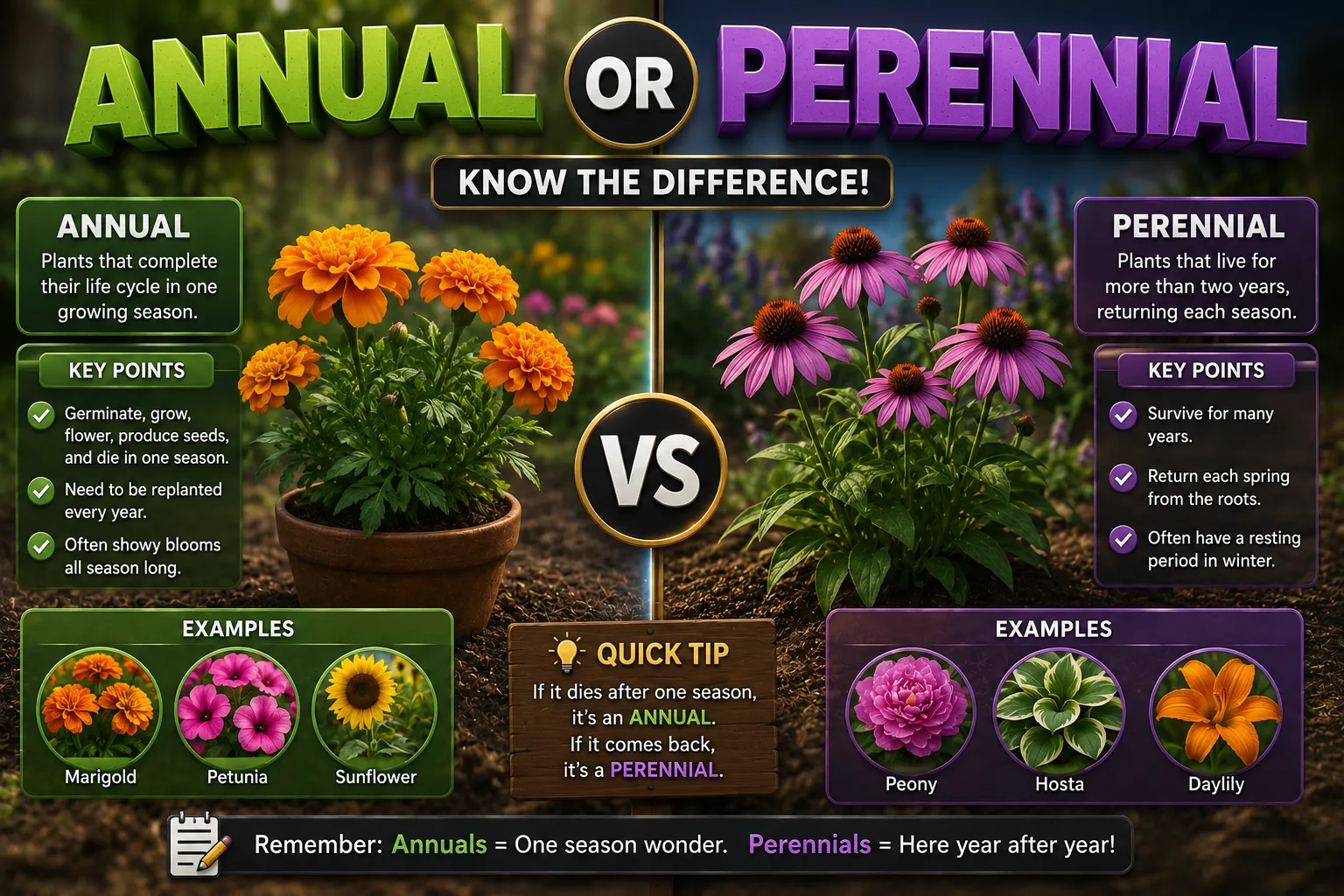
An annual plant completes its entire life cycle in one growing season, while a perennial plant lives for more than two years and usually grows back every season. If you’re choosing plants for your garden, annuals provide quick color, while perennials offer long-term value with less replanting.
The first flower bed I planted looked beautiful in spring. Bright marigolds, petunias, and zinnias filled the garden with color. But by the end of autumn, everything had disappeared. I thought I had done something wrong. The truth was much simpler—I had planted annuals, not perennials.
Many beginners make the same mistake. Garden centers are full of colorful labels, but terms like annual and perennial can feel confusing if you’re new to gardening. Even experienced gardeners sometimes pause before buying a plant because they aren’t sure how long it will last.
Understanding the difference saves both time and money. It also helps you create a garden that looks beautiful throughout the year. Whether you’re planting flowers, vegetables, herbs, or ornamental grasses, knowing which plants return every year and which need replacing makes planning much easier.
In this guide, you’ll learn what annual and perennial mean, where these terms come from, how they differ, when to choose each one, and the common mistakes gardeners make.
Annual or Perennial Quick Answer
An annual plant grows, flowers, produces seeds, and dies within one growing season. A perennial plant survives for several years and usually returns each spring from its roots or crown.
According to the Royal Horticultural Society (RHS), annuals complete their life cycle in one year, while perennials continue growing for many years under suitable conditions. The University of Minnesota Extension gives the same distinction in its gardening guides.
Examples
- Sunflowers are commonly grown as annuals.
- Lavender is a perennial in many climates.
The Origin and Background of Annual or Perennial
The words have deep roots in Latin.
The word annual comes from the Latin word annus, meaning year. According to Merriam-Webster, it has referred to something occurring once each year or lasting for one year since Middle English.
Perennial comes from the Latin perennis, meaning lasting through the years. According to the Oxford English Dictionary, the word entered English in the late Middle Ages to describe things that endure continuously or return year after year.
These botanical terms became standard as scientists developed modern plant classification. Today, gardeners, landscapers, botanists, and farmers use them worldwide.
Understanding their origin makes the meaning easier to remember:
- Annual = one year
- Perennial = many years
Annual or Perennial Explained Key Differences
The biggest difference is the plant’s life cycle.
Annuals complete everything in one season. Perennials continue growing over multiple years.
| Term | Meaning | When to Use | Typical Examples |
| Annual | Lives one growing season | Seasonal displays, fast color | Petunia, Marigold, Zinnia |
| Perennial | Lives several years | Long-term gardens | Peony, Daylily, Lavender |
Annual Example
The gardener planted colorful annuals to brighten the front yard during summer.
Perennial Example
The perennial flowers returned without being replanted after winter.
Notice that the meaning changes completely depending on which word you choose.
Annual vs. Perennial: Key Characteristics
Annual Plants
Annual plants:
- Complete their life cycle in one season.
- Grow quickly.
- Produce many flowers.
- Usually bloom for a long period.
- Need replanting every year.
Popular annuals include:
- Marigolds
- Petunias
- Cosmos
- Zinnias
- Impatiens
Advantages
- Bright seasonal color.
- Easy to change garden designs.
- Excellent for containers.
- Long flowering season.
Disadvantages
- Must be replanted yearly.
- Higher long-term cost.
- More maintenance.
Perennial Plants
Perennials survive for many years.
Their leaves may disappear during winter, but the roots remain alive. New growth appears when conditions become favorable.
Common perennials include:
- Lavender
- Coneflower
- Hosta
- Black-eyed Susan
- Peony
Advantages
- Return every year.
- Lower long-term cost.
- Less planting work.
- Strong root systems.
Disadvantages
- Often bloom for shorter periods.
- Some take several years to mature.
- Initial cost may be higher.
Which Should You Choose?
Your choice depends on your gardening goals.
For beginners
Choose annuals if you want fast results and colorful flowers during your first season.
For homeowners
Choose perennials if you want a garden that improves each year with less replanting.
For landscape designers
Mix both annuals and perennials for continuous color and long-lasting structure.
For vegetable gardeners
Many vegetables like tomatoes, cucumbers, and beans are grown as annuals, while crops such as asparagus and rhubarb are perennials.
Best overall advice
A balanced garden usually contains both annuals and perennials. Annuals fill empty spaces with vibrant blooms, while perennials provide a dependable foundation that returns year after year.
Common Mistakes with Annual or Perennial
Many gardeners confuse these terms, especially when buying plants for the first time. Here are the most common mistakes and how to avoid them.
| Mistake | Correct | Why It Happens |
| Thinking all flowers come back every year | Many flowers are annuals | Plant labels are often overlooked. |
| Assuming perennial means “flowers all year” | Perennials usually bloom for only part of the season | People confuse lifespan with flowering time. |
| Buying annuals for a permanent garden | Choose perennials for long-term planting | Annuals die after one growing season. |
| Ignoring climate zones | Check your local hardiness zone | A perennial in one region may act as an annual in another. |
| Removing dormant perennials | Wait until spring before digging them up | Many perennials lose their leaves during winter but remain alive underground. |
Tips to Remember
- Annual = One season
- Perennial = Many seasons
- Read the plant tag before buying.
- Check whether the plant suits your local climate.
Annual or Perennial in Real-World Examples
Professional Email
Subject: Plant Selection for the Community Garden
We recommend planting perennials along the borders for long-term structure and using colorful annuals in the center beds to provide seasonal blooms.
News Headline
City Park Adds Native Perennials to Reduce Water Use and Maintenance Costs
Social Media Post
My garden finally has the perfect mix of bright annuals and hardy perennials. Color this year and beauty for years to come! 🌸🌿
Formal Report
The landscape design includes perennial shrubs to minimize replacement costs, while annual flowering plants provide seasonal visual interest during peak visitor months.
Annual or Perennial Data, Trends & Usage
Understanding search trends helps explain why this topic remains popular among gardeners and students.
Search Intent
Primary Intent: Informational
Most readers want to know:
- What is the difference?
- Which plants come back every year?
- Which should I plant?
- Which option saves money?
Approximate Search Volume
Based on Google Trends, Semrush, and Ahrefs (2025–2026 estimates):
| Keyword | Approximate Monthly Searches |
| annual vs perennial | 40,000–60,000 |
| annual or perennial | 8,000–15,000 |
| perennial meaning | 20,000–35,000 |
| annual plants | 15,000–30,000 |
These figures are approximate and vary over time.
Google Trends Insights
Google Trends consistently shows strong seasonal interest during:
- March
- April
- May
Interest peaks during spring because gardeners begin planning flower beds and vegetable gardens.
Countries with high search interest include:
- United States
- Canada
- United Kingdom
- Australia
- New Zealand
Corpus Frequency
General English corpora, including Google Books Ngram Viewer, show that both annual and perennial have appeared consistently in gardening, agriculture, and botanical publications for decades. The word annual appears more frequently overall because it is also used in phrases like annual report, annual meeting, and annual event.
Why This Topic Matters Today
Home gardening has grown significantly in recent years. More people are creating backyard gardens, growing food at home, and improving outdoor spaces. As a result, searches about annual vs. perennial continue to rise each planting season.
Comparison Table
| Term/Variant | Meaning | Region/Context | Best Used When |
| Annual | Lives for one growing season | Worldwide | Seasonal flowers and vegetables |
| Perennial | Lives for multiple years | Worldwide | Long-term gardens and landscapes |
| Biennial | Completes its life cycle in two years | Botanical and gardening contexts | Plants such as foxglove, parsley, and carrots grown for seed |
Tip: Many beginners forget about biennials, which complete their life cycle over two growing seasons, making them different from both annuals and perennials.
Frequently Asked Questions
Q: What does annual or perennial mean?
An annual completes its life cycle in one growing season. A perennial survives for several years and usually grows back each season. This distinction is recognized by organizations such as the Royal Horticultural Society (RHS).
Q: How do you know if a plant is annual or perennial?
Check the plant label, seed packet, or a trusted gardening guide. Most nurseries clearly identify whether a plant is annual, perennial, or biennial.
Q: Annual vs. perennial what’s the main difference?
The key difference is lifespan. Annuals live for one season, while perennials continue growing for many years under suitable conditions.
Q: Are perennials better than annuals?
Neither is universally better. Perennials save time because they return each year, while annuals provide longer flowering periods and greater flexibility in garden design.
Q: Can an annual become a perennial?
No. A plant’s life cycle is determined by its biology. However, climate can affect how a plant behaves. For example, some tropical perennials are grown as annuals in colder regions because they cannot survive freezing temperatures.
Q: Where do the words annual and perennial come from?
Annual comes from the Latin annus (“year”), while perennial comes from perennis (“lasting through the years”), according to Merriam-Webster and the Oxford English Dictionary.
Q: Can annual and perennial plants grow together?
Yes. In fact, many professional landscape designers combine both types. Perennials provide structure, while annuals add bright seasonal color and fill gaps between established plants.
Conclusion
Understanding the difference between annual and perennial makes gardening much easier. Annuals offer fast growth, vibrant flowers, and flexibility, but they need to be replanted each year. Perennials require more patience at first, yet they reward gardeners by returning season after season with less effort.
A successful garden often includes both. Annuals keep your beds colorful throughout the growing season, while perennials create a lasting framework that becomes stronger over time. Knowing your local climate and reading plant labels carefully will help you choose the right plants for your space.
Whether you’re planting your first flower bed or redesigning an established landscape, this simple knowledge will help you make smarter decisions and enjoy better results.
Now you know exactly when to choose annuals or perennials. Bookmark this guide for your next trip to the garden center, and share it with anyone who wants to grow a healthier, more beautiful garden.
Read More:
Hoofs or Hooves: The Complete Guide to Correct Usage

I specialize in English grammar, spelling, word choice, and language usage. My content is based on research from grammar references, style guides, dictionaries, and real-world usage to ensure it is accurate and practical.
At Spelling Comparison, I write guides that explain why words are confused, how they are used, and which form is correct in context. I also include proofreading tips, examples, and writing advice readers can apply immediately.
My goal is to publish clear, reliable content that helps readers make better writing decisions. Each guide is written for accuracy, clarity, and usefulness in school, work, business, and everyday communication.