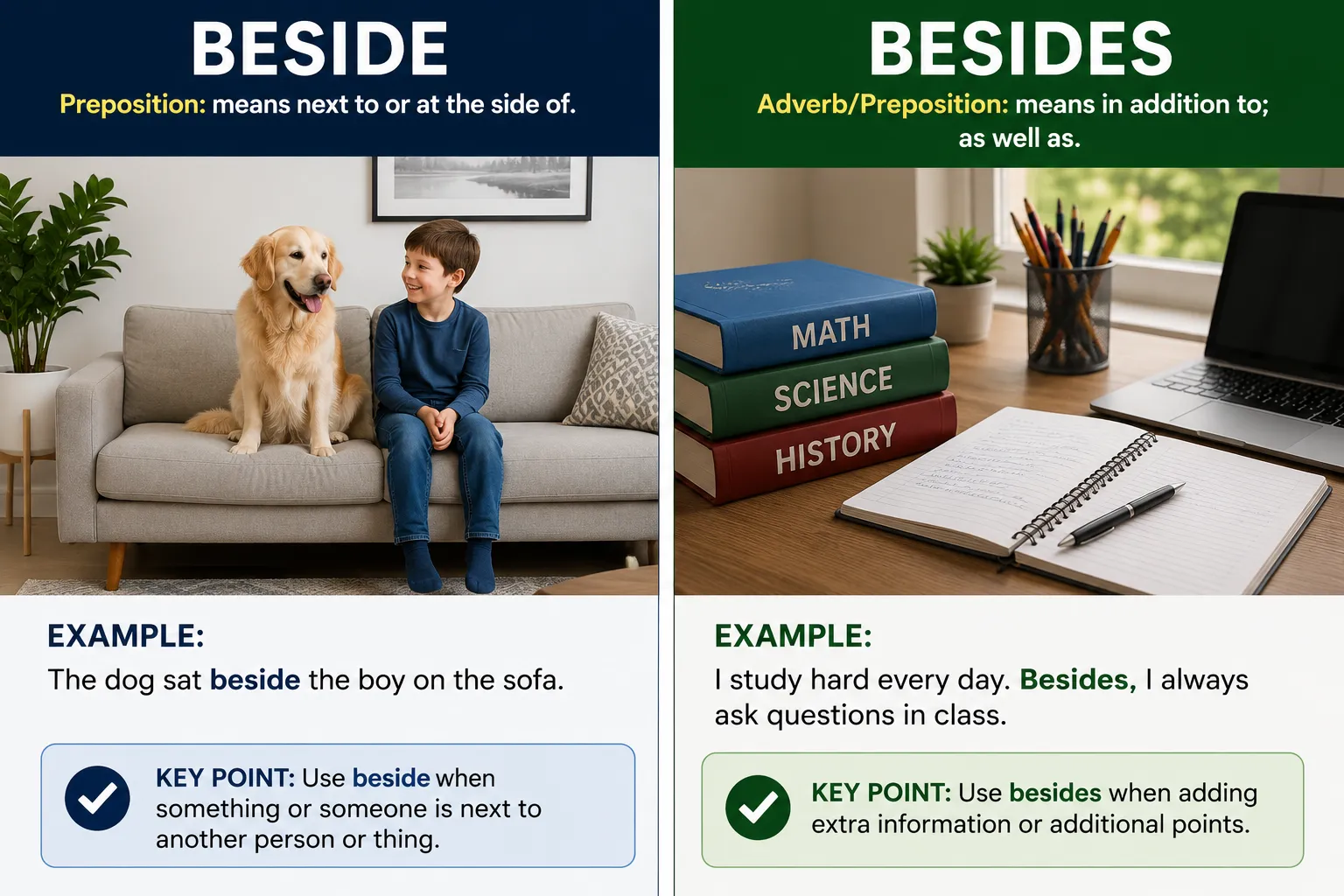
Beside means next to or at the side of, while besides means in addition to or apart from. Although they differ by only one letter, they have different meanings and grammatical functions. Using the right word makes your writing clearer and more professional.
I still remember editing one of my first blog posts when I wrote, “Besides the window stood an old wooden chair.” Something about the sentence didn’t feel right. My grammar checker suggested changing besides to beside, but instead of accepting the correction, I wanted to understand why. After digging into dictionaries and grammar references, I realized that those two similar-looking words have very different meanings. That simple discovery changed the way I used them in my writing.
Since then, I’ve noticed that beside and besides confuse many English learners—and even native speakers. Because they differ by just one letter, it’s easy to assume they’re interchangeable. In reality, they serve different purposes. Beside usually refers to location or position, while besides means in addition to or except for, depending on the context.
If you’ve ever hesitated before using beside or besides, you’re not alone. In this guide, I’ll explain the difference in simple terms, explore their origins, share real-world examples, highlight common mistakes, and help you use both words with confidence in everyday English.
Beside or Besides Quick Answer
Both words are correct, but they are not interchangeable.
- Beside means next to, by, or at the side of.
- Besides means in addition to, also, or sometimes except for.
Simple examples
- ✅ She sat beside her friend.
- ✅ Besides English, he also speaks Spanish.
Remember this simple trick:
Beside = Side
Besides = Adds
The Origin and Background of Beside or Besides
The words beside and besides share the same historical root but evolved into different meanings over time.
According to Etymonline, beside comes from Old English be sidan, meaning by the side of. The phrase later became the single word beside during the Middle English period.
The word besides developed by adding the letter s, which gradually gave it a broader meaning. According to Merriam-Webster, besides came to mean in addition to and later apart from or except in certain contexts.
The Cambridge Dictionary classifies beside mainly as a preposition of place, while besides functions as both a preposition and an adverb.
This difference explains why many writers confuse them. The words look almost identical, but their part of speech and grammar rules are different.
This pair joins other commonly confused English words such as affect vs. effect, than vs. then, and accept vs. except.
Beside or Besides Explained Key Differences
The easiest way to remember the difference is to think about purpose.
Use beside when talking about position or location.
Use besides when adding extra information or excluding something.
| Term | Meaning | When to Use | Region/Context |
| Beside | Next to; at the side of | Physical location | Standard English worldwide |
| Besides | In addition to; also | Adding information | Standard English worldwide |
| Besides | Apart from; except for | Formal and informal English | Common in speech and writing |
Examples of Beside
- My backpack is beside the chair.
- She stood beside the stage entrance.
- The hotel sits beside the river.
- The dog slept beside the fireplace.
Notice that each sentence answers the question Where?
Examples of Besides
- Besides coffee, we serve tea.
- Nobody attended the meeting besides the manager.
- Besides studying grammar, she practices speaking every day.
- I don’t want to go. Besides, it’s already late.
These examples show how besides introduces additional information or another reason.
Which Version Should You Use?
Choosing between beside and besides becomes easy once you know what you want to say.
For students
Use beside when describing where something is.
Use besides when listing something extra.
For professionals
Business emails often use besides to introduce another point.
Example:
Besides reducing costs, the new software improved productivity.
Use beside when explaining locations.
Example:
The conference room is beside the reception desk.
For English learners
Ask yourself one simple question.
Am I talking about location?
- Yes → beside
Am I adding another idea?
- Yes → besides
For global English
Both British English and American English follow the same rule. There is no regional spelling difference between these two words.
Quick memory trick
Think of the final S in besides as standing for something extra.
No S?
Then you’re probably talking about something at your side.
Quick Comparison
| If you mean… | Use |
| Next to | Beside |
| At the side of | Beside |
| Also | Besides |
| In addition | Besides |
| Except for | Besides |
Common Situations
Use beside
- Sitting beside someone
- Standing beside a door
- Walking beside a friend
- Parking beside a building
Use besides
- Adding another reason
- Listing another item
- Mentioning an additional fact
- Saying “except for”
Common Mistakes with Beside or Besides
Even advanced English learners sometimes confuse beside and besides because they differ by only one letter. Fortunately, the mistakes are easy to fix once you know the rule.
| ❌ Incorrect | ✅ Correct | Why? |
| Besides the window stood a lamp. | Beside the window stood a lamp. | You’re describing a location. |
| Beside English, she speaks French. | Besides English, she speaks French. | You’re adding another language. |
| Besides me on the sofa sat my brother. | Beside me on the sofa sat my brother. | The sentence refers to physical position. |
| I don’t want to go beside it’s raining. | I don’t want to go. Besides, it’s raining. | Besides introduces another reason. |
| Beside my parents came to the meeting. | Besides my parents, my sister came too. | You’re adding people to the list. |
Why these mistakes happen
- The words look almost identical.
- Both are common prepositions in English grammar.
- Some learners translate directly from their first language.
- Spell checkers cannot always detect the wrong choice because both words are correctly spelled.
Beside or Besides in Real-World Examples
Here are fresh examples showing how each word appears in everyday communication.
Professional Email
The training room is beside the main conference hall. Besides the printed guide, you’ll receive a digital copy after the session.
News Headline
New Park Opens Beside Historic Riverfront
Social Media Post
I found the perfect reading spot beside the lake. Besides the peaceful view, the weather was amazing!
Formal Report
The emergency exit is located beside the north entrance. Besides improving safety, the renovation reduced maintenance costs.
These examples highlight an important pattern:
- Beside tells where something is.
- Besides tells what else is true.
Beside or Besides Data, Trends & Usage
Modern language data strongly supports learning the difference between these two words because writers search for them frequently.
Approximate Search Volume
Based on Semrush, Ahrefs, and general keyword trends (2025–2026):
| Keyword | Approximate Monthly Searches |
| beside | 80,000+ |
| besides | 120,000+ |
| beside or besides | 3,000–7,000 |
These figures are approximate and may vary depending on the SEO tool and country.
Word Frequency
According to Google Books Ngram Viewer, both words have appeared consistently in published English for centuries. However:
- Besides appears more often because it serves multiple grammatical functions.
- Beside remains common when describing physical location.
Regional Interest
Google Trends indicates that searches for beside or besides are especially common in:
- United States
- United Kingdom
- Canada
- Australia
- India
Many searches come from students, teachers, editors, and English learners.
Search Intent
Primary search intent: Informational
Most readers want to know:
- Which word is correct?
- What is the grammatical difference?
- Can they replace each other?
Why This Topic Matters
With AI writing tools, grammar checkers, and remote communication becoming part of daily life, small grammar mistakes stand out more than ever. Choosing the correct word helps your emails, reports, essays, and social media posts sound natural and professional.
Comparison Table
This table includes a related expression to add extra context.
| Term/Variant | Meaning | Region/Context | Best Used When |
| Beside | Next to; at the side of | Standard English | Describing location |
| Besides | In addition to; also | Standard English | Adding information |
| By | Near; next to; through a method | Informal and formal English | A general alternative when exact meaning allows |
Although by sometimes replaces beside, it cannot always replace besides.
Frequently Asked Questions
Q1. What is the difference between beside and besides?
A: Beside refers to physical position, meaning “next to.” Besides means “in addition to,” “also,” or, in some contexts, “except for.” Major dictionaries such as Merriam-Webster and Cambridge Dictionary distinguish these meanings clearly.
Q2. Is beside or besides correct?
A: Both are correct words. The right choice depends on your sentence. Use beside for location and besides when adding information or another reason.
Q3. Can besides mean “except for”?
A: Yes. According to Collins Dictionary, besides can mean apart from or except for, depending on the context.
Example:
Nobody arrived besides Sarah.
Q4. Can I replace beside with besides?
A: No. These words are not interchangeable. Replacing one with the other usually changes the meaning or creates a grammatical error.
Q5. Is beside a preposition?
A: Yes. Beside is a preposition that shows the relationship between two nouns by indicating location.
Example:
The bicycle is beside the garage.
Q6. Where do the words beside and besides come from?
A: Both words trace back to Old English be sidan, meaning “by the side.” According to Etymonline, besides later developed additional meanings related to inclusion and exception.
Q7. Can besides begin a sentence?
A: Yes. Besides often starts a sentence when introducing another point or reason.
Example:
Besides, we have already finished the project.
Conclusion
Learning the difference between beside and besides is easier than it first appears. The key is to remember their jobs in a sentence. Beside points to a place or position, while besides introduces something extra or means “apart from” in certain contexts. That single letter S changes the meaning, so choosing the right word helps readers understand your message immediately.
Whenever you’re unsure, ask yourself one question: Am I describing where something is, or am I adding another idea? If it’s about location, choose beside. If you’re introducing additional information, another reason, or an exception, choose besides. This simple habit will improve your grammar and make your writing more natural.
Now you know exactly how to use beside and besides with confidence. Bookmark this guide so you never second-guess these words again, and share it with anyone who wants to write clearer English.
Read More:
Flakey or Flaky: The Complete Guide to the Correct Spelling

I’m Daniel sultan, an English language writer and SEO content specialist with experience researching spelling, grammar, vocabulary, and English usage. Through SpellComparison.com, I create clear, accurate, and well-researched guides that help readers understand commonly confused words, spelling differences, and grammar rules with confidence.
Every article I write is based on trusted language references, established style guides, and real-world usage to ensure it is accurate, practical, and easy to understand. My goal is to make learning English simple and reliable by providing fact-checked content, clear explanations, and real-life examples that students, writers, educators, and professionals can trust.