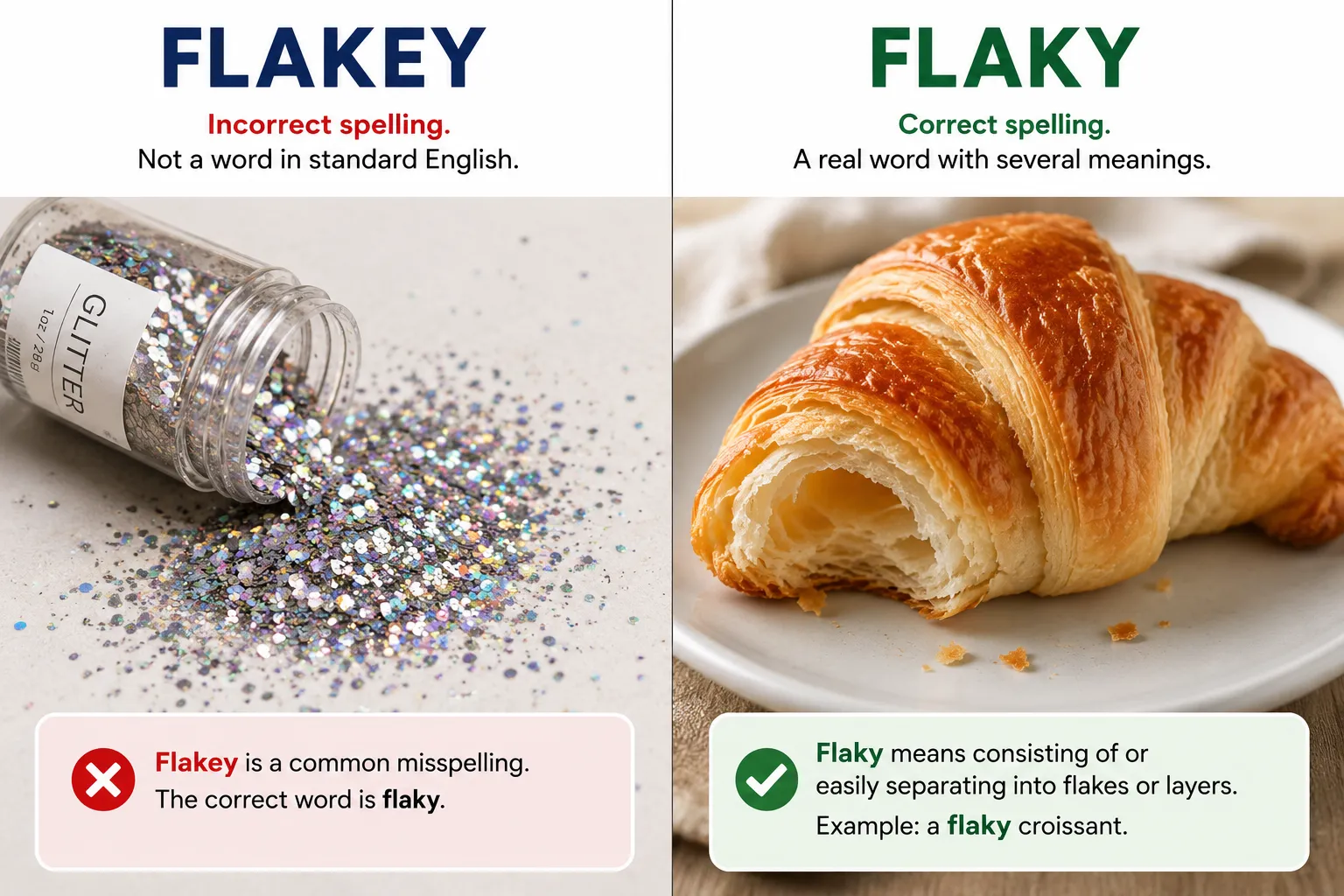
Flaky is the standard and preferred spelling in modern English for describing something that breaks into flakes or a person who is unreliable. Flakey is an accepted variant, but it is much less common and is generally avoided in formal writing.
I still remember proofreading one of my earliest grammar articles when I stopped at the word flakey. It didn’t look quite right, but I had seen it online so many times that I hesitated to change it. Before making the edit, I checked several trusted dictionaries and language references. That’s when I discovered something interesting: both flakey and flaky exist, but flaky is the standard spelling used in modern English, while flakey is simply a much less common variant.
That experience reminded me how easily repeated online usage can make an uncommon spelling seem correct. It’s a mistake many English learners, writers, bloggers, and even native speakers make because both versions appear in search results, social media posts, and older publications. As a result, it’s not always obvious which spelling belongs in professional writing, school assignments, or everyday communication.
If you’ve ever wondered whether to write flakey or flaky, this guide has the answer. You’ll learn which spelling is correct, why both forms exist, where the words came from, how major dictionaries treat them, and which version you should confidently use in every situation. By the end, you’ll never have to second-guess this spelling again.
Flakey or Flaky Quick Answer
Both flakey and flaky describe something that forms flakes or someone who is unreliable. However, flaky is the standard spelling recognized by major dictionaries and style guides.
Examples
- ✅ The pie has a flaky crust.
- ✅ He’s talented but sometimes flaky about deadlines.
Although you may occasionally see flakey, especially in informal writing or older publications, flaky is the safer and more professional choice.
The Origin and Background of Flakey or Flaky
The adjective flaky comes from the noun flake, which has roots in Old English and later Middle English. According to Etymonline, flake originally referred to a small flat piece that breaks away from a larger object. Over time, English speakers added the suffix -y, creating flaky, meaning “covered with flakes” or “breaking into flakes.”
According to Merriam-Webster, the figurative meaning developed later. By the mid-20th century, flaky also described someone who behaves unpredictably or fails to keep promises.
So where did flakey come from?
Language experts generally consider flakey an alternative spelling that emerged naturally because English often forms adjectives by adding -ey to nouns. Even so, dictionaries such as Cambridge Dictionary and Collins Dictionary overwhelmingly list flaky as the preferred form.
This is a common pattern in English linguistics, where two spellings coexist for a time before one becomes dominant.
Flakey or Flaky Explained Key Differences
The meanings are almost identical.
The difference lies mainly in frequency and acceptance.
| Term | Meaning | When to Use | Region/Context |
| Flaky | Covered in flakes; unreliable or inconsistent | Everyday writing, business, education | Preferred worldwide |
| Flakey | Same meaning as flaky | Informal writing or personal preference | Rare alternative spelling |
Example of Flaky
- The pastry stayed flaky after baking.
- Her internet connection became flaky during the meeting.
- The old paint turned flaky over the winter.
Example of Flakey
- Some blogs still spell the word flakey.
- You might see flakey in informal online discussions.
While both versions communicate the same idea, choosing flaky avoids confusion and looks more polished.
Which Version Should You Use?
Your audience matters.
For students
Choose flaky because teachers, dictionaries, and grammar checkers recognize it as the standard spelling.
For professional writers
Always use flaky in reports, emails, articles, and business documents.
For bloggers and casual writers
You can use flakey, but readers may view it as a spelling mistake because it is much less common.
For global English
If your audience includes readers from different countries, flaky is the safest and clearest option.
Recommendation: Use flaky almost every time.
Common Mistakes with Flakey or Flaky
Here are mistakes many learners make.
| Mistake | Correct Form | Why |
| The crust is flakey. | The crust is flaky. | Standard spelling |
| She’s very flakey at work. | She’s very flaky at work. | Preferred in professional English |
| Spell check changed flaky. | Keep flaky. | Most tools recognize it |
| Assuming both are equally common | Flaky is much more common | Modern usage favors flaky |
Why the confusion happens
- Both spellings appear on the internet.
- Some older books used flakey.
- English spelling is not always perfectly predictable.
- Search engines often show both versions together.
Flakey or Flaky in Real-World Examples
Professional Email
The supplier has become flaky with delivery dates, so we’re reviewing other options.
News Headline
Flaky Weather Delays Weekend Flights Across the Region
Social Media Post
Finally baked bread with a perfectly flaky crust. Worth every minute!
Formal Report
Several systems showed flaky network performance during peak operating hours.
Notice that the adjective works naturally in many different contexts.
Flakey or Flaky Data, Trends & Usage
Language data shows a clear winner.
Approximate Search Volume
Based on Semrush, Ahrefs, and general keyword trend patterns (2025–2026):
| Search Query | Approximate Monthly Searches |
| flaky | 150,000+ |
| flakey | 8,000–15,000 |
These numbers are approximate and may vary by country and keyword tool.
Corpus Frequency
According to Google Books Ngram Viewer, flaky appears far more often than flakey in published books over recent decades. The gap has continued to widen, showing growing preference for flaky.
Regional Interest
Google Trends data suggests searches for flakey or flaky are common in:
- United States
- United Kingdom
- Canada
- Australia
Many searches come from ESL learners, editors, and content writers trying to confirm the correct spelling.
Search Intent
Primary search intent: Informational
Readers usually want to know:
- Which spelling is correct?
- Are both acceptable?
- Which version should they use?
Why This Matters Today
AI writing assistants, spell checkers, and remote work have made polished writing more important than ever. Using the standard spelling helps your writing appear more professional and trustworthy.
Comparison Table
| Term/Variant | Meaning | Region/Context | Best Used When |
| Flaky | Standard adjective for flakes or unreliability | International English | Nearly all writing |
| Flakey | Alternative spelling | Informal or personal writing | Rarely needed |
| Flake | Noun meaning a small thin piece | Universal | When referring to the object itself |
Frequently Asked Questions
Q: What does flakey or flaky mean?
A: Both words describe something that breaks into small flakes or someone who is unreliable. According to Merriam-Webster, flaky is the preferred modern spelling.
Q: Which spelling is correct flakey or flaky?
A: Flaky is the standard spelling accepted by major dictionaries, including Cambridge Dictionary and Collins Dictionary. Flakey is an uncommon variant.
Q: Can I use flakey in formal writing?
A: You can, but it is not recommended. Most editors and style guides favor flaky, making it the better choice for academic and professional documents.
Q: Why do some people spell it flakey?
A: English sometimes allows alternative spellings to develop over time. Flakey likely appeared through natural spelling variation, but flaky became the dominant form.
Q: Is flaky an adjective?
A: Yes. It functions as an adjective that describes texture, behavior, or reliability. It comes from the noun flake, with the suffix -y added.
Q: Where does the word flaky come from?
A: According to Etymonline, it developed from the noun flake, whose roots trace back to Old English. The figurative meaning describing unreliable people became popular in the twentieth century.
Q: Can flaky describe food and people?
A: Yes. You can describe a pastry as flaky because it has thin layers. You can also describe a person as flaky if they often cancel plans or fail to follow through.
Conclusion
Choosing between flakey and flaky is easier once you know how modern English uses the word. While both spellings can express the same idea, flaky has become the clear standard in dictionaries, published writing, and everyday communication. It works whether you’re talking about a buttery pastry, peeling paint, unstable technology, or someone who struggles to keep commitments.
Remember these key points: flaky is the preferred spelling, flakey is a rare variant, trusted dictionaries support flaky, and using the standard form helps your writing look more polished and professional. Paying attention to small spelling choices like this improves clarity and builds confidence in your English.
Now you know exactly when to use flaky. Bookmark this guide so you never second-guess flakey or flaky again, and share it with anyone who loves learning better English.
Read More:
Skate or Die: The Complete Meaning & Origin Guide

I’m an English language educator and content writer with more than 10 years of experience helping learners improve their English skills. I specialize in spelling differences, grammar, vocabulary, synonyms, commonly confused words, and English usage. My goal is to create accurate, easy-to-understand articles that make learning English simple, practical, and enjoyable for students, writers, and professionals around the world.