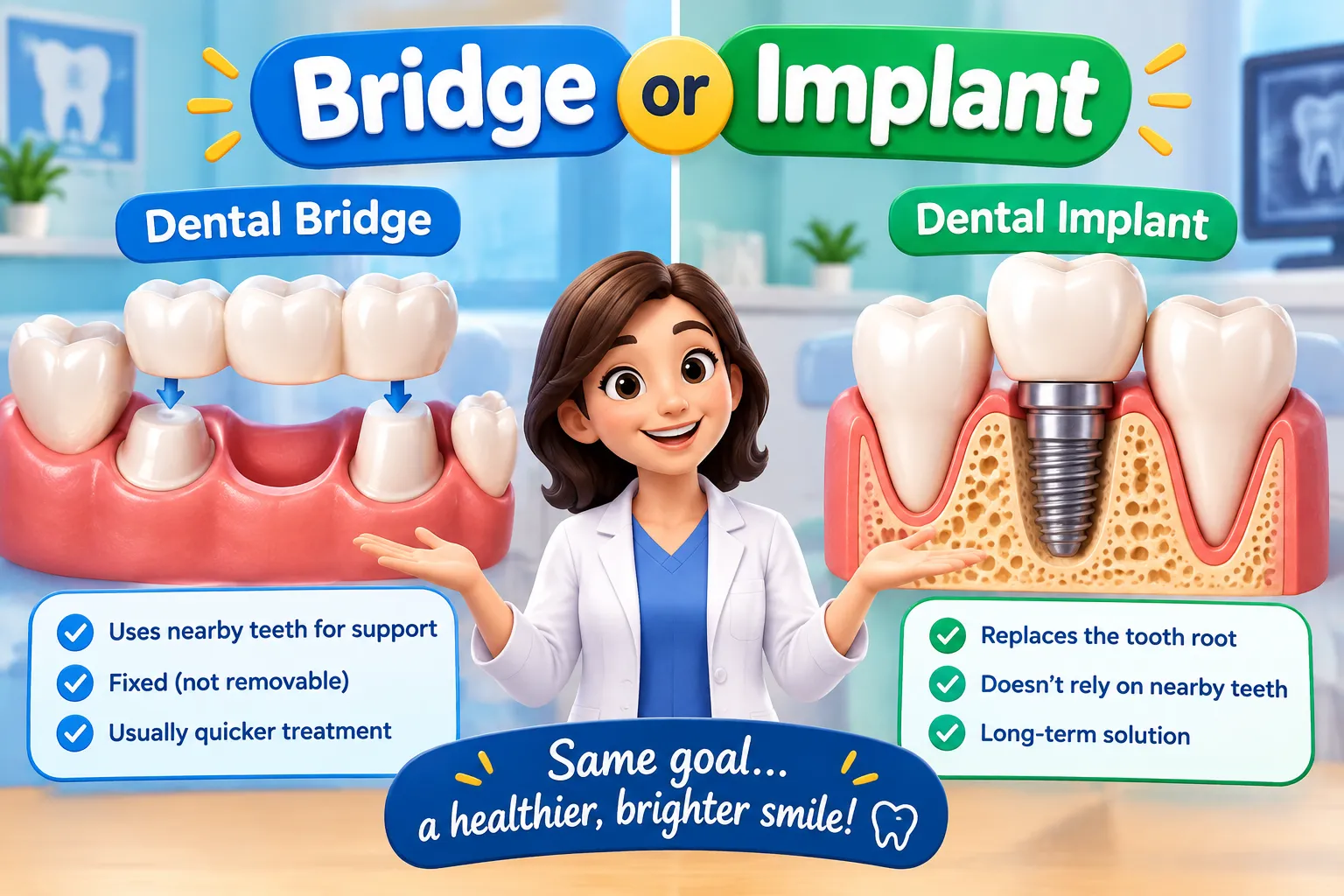
Bridge or implant refers to two different ways to replace a missing tooth: a bridge uses nearby teeth for support, while an implant uses a dental implant placed in the jaw.
Losing a tooth can turn a simple question into a confusing one: Should you get a bridge or an implant? I have seen how easily dental terms can blur together, especially when both options are described as ways to “replace a missing tooth.” Yet they work in very different ways.
A bridge is like a small structure that fills the gap left by a missing tooth. It usually uses nearby teeth for support. An implant takes a different route. It uses a small artificial tooth root placed in the jaw, with a crown attached above it.
The choice is not only about appearance. Your jawbone, nearby teeth, oral health, treatment time, budget, and long-term goals can all matter.
This guide breaks down bridge or implant in simple English. You will learn what each term means, how they differ, common mistakes, real-world examples, and what dental sources say about these tooth-replacement options.
Bridge or Implant Quick Answer
A dental bridge replaces a missing tooth by connecting an artificial tooth to supporting teeth or implants. A dental implant replaces the tooth root and can support a crown, bridge, or other dental restoration.
For example:
- A person with one missing tooth may consider an implant and crown.
- Someone who cannot or does not want an implant may discuss a fixed dental bridge with a dentist.
The key difference is simple: a bridge fills the gap with support from another structure, while an implant is anchored in the jaw.
The American Dental Association describes dental implants as devices used to replace missing teeth and support dental restorations.
The Origin / Background of Bridge or Implant
The words bridge and implant are not two spellings of the same word. They are separate dental terms.
The word bridge has a long history in English. Its basic sense relates to a structure that crosses a gap. Dentistry uses the same idea: a dental bridge spans the space created by one or more missing teeth.
Implant comes from the idea of putting something firmly into another material or place. In dentistry, the term describes a device placed in the jaw to provide support for a replacement tooth.
This is a useful example of how semantic meaning develops. A familiar word can gain a specialized meaning in a professional field.
In dental language, you may also see terms such as:
- Dental crown
- Dental implant
- Fixed bridge
- Implant-supported bridge
- Abutment
- Prosthesis
- Tooth replacement
So, when someone searches for bridge or implant, they are usually not asking about grammar or spelling. They want to understand which tooth-replacement method fits their situation.
The National Institute of Dental and Craniofacial Research explains that dental implants can replace missing teeth and are designed to function as artificial tooth roots.
Bridge or Implant Explained Key Differences
The biggest difference is how the replacement tooth is supported.
A traditional bridge normally uses neighboring teeth as support. An implant is placed into the jaw and can support a crown without relying on neighboring natural teeth in the same way.
| Term | Meaning | When to Use | Region/Context |
| Dental bridge | A fixed restoration that replaces missing teeth | When surrounding teeth can provide support | Common dental treatment |
| Dental implant | An artificial tooth root used to support a restoration | When implant treatment is suitable | Modern restorative dentistry |
| Implant-supported bridge | A bridge supported by dental implants | When several teeth are missing | Implant dentistry |
| Dental crown | A cap placed over a tooth or implant restoration | To restore or cover a damaged tooth or implant | General dentistry |
How a Dental Bridge Works
A traditional bridge can use the teeth next to the gap as abutments.
The replacement tooth sits between the supporting structures. The result is a fixed restoration rather than a removable denture.
A bridge may be discussed when:
- The nearby teeth are suitable for support.
- You want a fixed replacement.
- An implant is not suitable or is not your preferred option.
- Your dentist believes the restoration fits your oral condition.
How a Dental Implant Works
An implant is different because it replaces the role of a tooth root.
A dental professional places the implant into the jawbone. After healing, a connector called an abutment can support a crown or another restoration.
The process usually involves several stages. The exact plan depends on your mouth, bone, general dental condition, and treatment needs.
The American Academy of Implant Dentistry explains that implants can be used to replace a single tooth or support other dental restorations.
Which Version / Approach Should You Use?
There is no single choice that works for everyone.
Your dentist may look at several factors before suggesting a treatment.
If you have healthy supporting teeth
A bridge may be one option worth discussing. Your dentist can check whether the nearby teeth can safely support the restoration.
If you want to replace the missing tooth without using nearby teeth as bridge supports
An implant may be an option. It is designed to sit in the jaw and support a replacement tooth.
If several teeth are missing
An implant-supported bridge may be discussed. This is different from a traditional bridge because implants provide the support.
If you have bone or gum concerns
Your dentist may need to assess those issues before recommending treatment. Implant treatment can require enough suitable bone for placement.
If cost and treatment time matter
Ask your dentist for a complete treatment estimate rather than comparing only the initial price.
The total cost can depend on examinations, imaging, surgery, restoration, follow-up care, and any additional treatment required.
The right choice depends on your dental condition, not just the name of the treatment.
Common Mistakes with Bridge or Implant
People often mix up these two treatments. Here are some common mistakes.
| Common Mistake | Better Understanding |
| “A bridge and an implant are the same.” | They use different support systems. |
| “An implant is just a crown.” | The implant is the artificial root; the crown is the visible replacement tooth. |
| “Every missing tooth needs an implant.” | Treatment depends on the individual case. |
| “A bridge always means removable teeth.” | A fixed dental bridge is designed to stay in place. |
| “The cheapest option is always the best.” | Initial price does not show the full treatment picture. |
Another common mistake is assuming that an implant is automatically possible.
A dentist may need to check your jawbone, gums, remaining teeth, and oral health first.
Bridge or Implant in Real World Examples
Seeing the terms in context can make the difference much easier to understand.
Professional Email
“Could you please explain whether a bridge or implant would be suitable for replacing my missing tooth?”
News Article
“The patient was offered several tooth-replacement options, including a dental bridge and an implant.”
Social Media Post
“I had no idea there was such a difference between a dental bridge and an implant until I spoke with my dentist.”
Formal Dental Report
“The examination identified a missing tooth and recommended further assessment before selecting a definitive restorative treatment.”
Notice how bridge and implant refer to treatment options, not interchangeable names.
Bridge or Implant Data, Trends & Usage
Unlike spelling questions, bridge or implant is mainly a health-information search. People often use the phrase when comparing treatment options after losing a tooth.
Exact monthly search volumes can change by country, language, device, and keyword tool. Google Trends can also show relative search interest rather than absolute search counts. Therefore, search-volume figures should not be treated as fixed facts.
For this topic, the most useful data comes from established dental sources rather than simply counting searches.
The American Dental Association provides consumer information about dental implants, while the National Institute of Dental and Craniofacial Research provides research-based information about oral health and dental implants.
Search intent
The phrase bridge or implant has mainly informational intent.
A reader may be asking:
- What is a bridge?
- What is an implant?
- How are they different?
- Which one might fit my situation?
- What should I ask my dentist?
Search interest can also lead to commercial intent when readers begin researching dentists, clinics, treatment costs, or appointments.
Why the topic matters
Missing teeth are not only a cosmetic concern. They can affect chewing and other parts of oral function.
That is why readers often need more than a simple definition. They need a clear comparison that helps them prepare for a discussion with a dental professional.
Bridge or Implant: A Second Comparison
Here is another way to compare the options, including an important third option.
| Term/Variant | Meaning | Region/Context | Best Used When |
| Traditional bridge | Fixed replacement supported by neighboring teeth | Restorative dentistry | Nearby teeth can provide support |
| Dental implant | Artificial root supporting a restoration | Implant dentistry | Implant treatment is clinically appropriate |
| Implant-supported bridge | Bridge held by implants | Multiple missing teeth | Several missing teeth need replacement |
| Removable partial denture | Removable appliance replacing missing teeth | Prosthetic dentistry | A removable option is being considered |
These treatments are not simply interchangeable products.
Your dentist may consider your bite, gum health, bone condition, remaining teeth, medical history, and treatment goals before choosing a plan.
Bridge or Implant: Questions to Ask Your Dentist
If you are deciding between these treatments, take a few clear questions to your appointment.
- Why do you recommend this option for my mouth?
- Are my neighboring teeth healthy enough for a bridge?
- Do I have enough bone for an implant?
- Will I need additional treatment first?
- How long will the complete treatment take?
- What will the total cost include?
- What happens if I choose not to replace the tooth now?
These questions can help you understand the reasoning behind your treatment plan.
FAQ: Bridge or Implant
Q: What does “bridge or implant” mean?
A: It refers to two different ways of replacing a missing tooth. A bridge uses supporting structures to hold a replacement tooth, while an implant is placed in the jaw to support a restoration.
Q: Is a dental bridge the same as an implant?
A: No. A traditional bridge and a dental implant have different designs and procedures. An implant acts as an artificial tooth root, while a traditional bridge generally relies on supporting teeth.
Q: Which lasts longer, a bridge or implant?
A: Longevity varies by the treatment, oral hygiene, bite, materials, and individual health. A dentist can give you a more useful estimate after examining your mouth.
Q: Can an implant replace one missing tooth?
A: Yes. A single dental implant can support a crown for a missing tooth when implant treatment is appropriate. The American Academy of Implant Dentistry recognizes single-tooth replacement as one use of dental implants.
Q: Is a bridge acceptable in modern dentistry?
A: Yes. Dental bridges remain an established method for replacing missing teeth. Your dentist can determine whether one is appropriate for your particular situation.
Q: Does every dental implant need a crown?
A: Not every implant is used in exactly the same way. Implants can support crowns, bridges, dentures, and other restorations depending on the treatment plan.
Q: Can I choose an implant without seeing a dentist?
A: No treatment should be selected from a general comparison alone. A dental examination is needed to determine whether an implant, bridge, or another option is suitable.
Conclusion
The choice between a bridge or implant comes down to more than appearance or price.
A traditional bridge fills the space left by a missing tooth and generally uses nearby teeth for support. A dental implant takes a different approach by providing an artificial root in the jaw. An implant-supported bridge is another option when several teeth are missing.
Your oral health also matters. So do your bone condition, gum health, neighboring teeth, budget, treatment goals, and willingness to undergo different procedures.
The most useful step is to ask your dentist why one option fits your specific case. A general comparison can help you understand your choices, but it cannot replace a personal dental assessment.
Now you know the key difference between a bridge or implant. Use this guide to prepare better questions for your next dental appointment, and save it so you can review your options with confidence.
Readmore

I am an English language specialist with over 10 years of experience writing about grammar, spelling differences, and language usage. Dedicated to helping writers communicate with confidence, my detailed guides break down complex rules into clear, real-world advice. At Spelling Comparison, my focus is on providing actionable proofreading tips and vocabulary deep-dives to ensure your writing is always accurate, clear, and impactful.