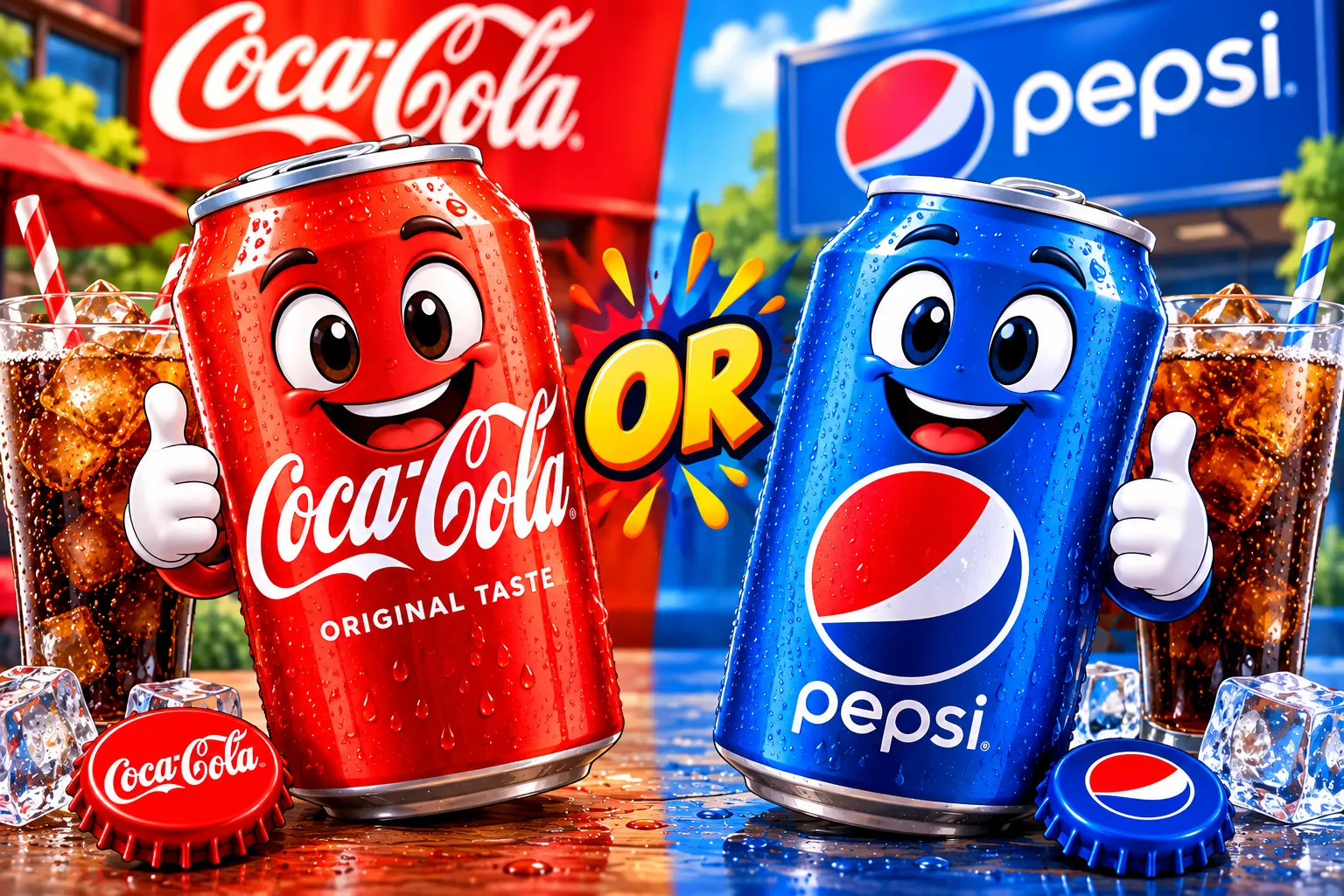
Coke and Pepsi are two classic cola soft drinks, but they differ in flavor profile, sweetness, caffeine, ingredients, and brand history. Your choice mainly depends on the taste and product features you prefer.
I still remember the first time I was asked a simple question at a meal: “Coke or Pepsi?” It sounded easy, but I paused. Both drinks looked almost the same in the glass, yet regular fans can often tell them apart after only one sip.
That small choice comes up at restaurants, parties, fast-food counters, and family meals. It also leads to many online searches. People want to know which drink is sweeter, which has more caffeine, how their ingredients differ, and why their tastes are so different.
The confusion makes sense. Coke and Pepsi are both cola drinks, and both contain carbonated water, sweeteners, caramel color, acids, flavorings, and caffeine in their regular U.S. versions. Yet their recipes and flavor descriptions are not identical.
In this guide, I’ll break down Coke or Pepsi in simple terms. We’ll look at their history, ingredients, nutrition, caffeine, taste profiles, common mistakes, real-world usage, and current market data.
Coke or Pepsi Quick Answer
Coke usually refers to Coca-Cola, while Pepsi refers to Pepsi-Cola. Both are carbonated cola soft drinks, but they have different recipes and flavor profiles.
Coca-Cola describes its regular product as having its classic, crisp taste. Pepsi describes its cola as bold, sweet, and citrus-forward.
For example:
- You might order a Coke with a burger at a restaurant.
- You might ask for a Pepsi when you prefer its particular flavor.
The key point is simple: Coke and Pepsi are separate branded cola products, not two spellings for the same drink.
The Origin and Background of Coke and Pepsi
Coke and Pepsi have long histories, but Coca-Cola came first.
According to The Coca-Cola Company, Dr. John Pemberton created Coca-Cola in Atlanta in 1886. The first glass was served at Jacobs’ Pharmacy on May 8, 1886.
Pepsi followed later. According to PepsiCo, pharmacist Caleb Bradham created a drink called Brad’s Drink in 1893. It was renamed Pepsi-Cola on August 28, 1898.
That gives the two brands different starting points:
| Brand | Early History | Origin |
| Coca-Cola | Created by John Pemberton | Atlanta, Georgia |
| Pepsi | Created by Caleb Bradham as Brad’s Drink | New Bern, North Carolina |
The two brands later became major competitors in the soft-drink market. Their rivalry is often called the Cola Wars.
One reason the comparison remains interesting is that both companies have continued changing their product ranges. Today, consumers can find regular, diet, zero-sugar, caffeine-free, and flavored versions of both brands.
Coke or Pepsi Explained: Key Differences
The biggest differences appear in taste, sweetness, caffeine, nutrition, and ingredients.
1. Taste
Taste is the hardest difference to measure because it is personal.
Coca-Cola describes its classic drink as having a crisp and refreshing taste. Pepsi describes its regular cola as bold, with citrus-forward notes and lively carbonation.
Some people experience Coke as having a sharper cola character. Others find Pepsi sweeter or more citrus-like.
Your own taste buds matter here.
2. Sugar
In the United States, a 12-ounce can of regular Coke contains 39 grams of sugar.
A 12-ounce can of regular Pepsi contains 41 grams of sugar.
That means the difference is small, but Pepsi has slightly more sugar in the standard U.S. serving.
3. Calories
A 12-ounce serving of regular Coke contains 140 calories.
A 12-ounce serving of regular Pepsi contains 150 calories.
The exact values can vary by country, package size, and formulation, so always check the local label.
4. Caffeine
Caffeine is another measurable difference.
Coca-Cola states that a 12-ounce can contains 34 mg of caffeine.
Pepsi states that a 12-ounce can contains 38 mg of caffeine in the United States.
So, in a standard U.S. 12-ounce serving, Pepsi contains slightly more caffeine.
Comparison Table
| Term | Meaning | When to Use | Region/Context |
| Coke | Coca-Cola | When referring to the Coca-Cola brand or drink | Widely used, especially in informal speech |
| Pepsi | Pepsi-Cola | When referring to the Pepsi brand or drink | Widely used internationally |
| Coca-Cola | Full brand name | Formal writing, product descriptions, business writing | Global |
| Pepsi-Cola | Full Pepsi name | Formal or historical references | Global |
Which Should You Choose: Coke or Pepsi?
There is no universal taste choice that works for everyone. A better approach is to match the drink to what you care about.
If you prefer a classic cola profile
Try Coke and see whether its flavor works better for you.
If you prefer a sweeter, citrus-forward profile
Pepsi may appeal to your taste because the brand describes its regular cola with bold sweetness and citrus-forward flavor notes.
If caffeine matters
Compare the labels of the exact products you are buying. In the current U.S. regular versions, Pepsi has 38 mg of caffeine per 12-ounce serving, while Coke has 34 mg.
If sugar matters
The standard U.S. versions are close. Coke has 39 g of sugar per 12 ounces, while Pepsi has 41 g.
If you want no sugar
Both brands offer zero-sugar alternatives. Coke has Coca-Cola Zero Sugar, while Pepsi offers Pepsi Zero Sugar.
The best comparison is therefore not simply “Which is better?” It is “Which features matter most to me?”
Common Mistakes With Coke or Pepsi
People often make mistakes when comparing or naming these drinks.
| Mistake | Correction | Why It Matters |
| Calling Pepsi “Coke” | Say Pepsi | They are separate brands |
| Assuming Coke and Coca-Cola are different drinks | Coke is commonly used as a short name for Coca-Cola | “Coke” is an established brand term |
| Assuming all Coke has the same nutrition | Check the exact product | Zero Sugar and regular Coke differ |
| Assuming all Pepsi has the same recipe | Check the product label | Pepsi has several varieties |
| Comparing different serving sizes | Use the same serving size | Nutrition numbers depend on portion size |
Another common mistake is comparing a regular Coke with a zero-sugar Pepsi and then treating the result as a simple brand comparison.
For a fair comparison, use the same product type and serving size.
Coke or Pepsi in Real-World Examples
Professional Email
Please confirm whether the meeting order should include Coke, Pepsi, or both.
News Headline
Coke and Pepsi Continue to Compete for Space in the U.S. Soda Market
Social Media Post
Cold Coke or Pepsi with dinner? I honestly change my mind every time.
Formal Report
The analysis compares the nutritional information and product characteristics of regular Coca-Cola and Pepsi in the United States.
These examples show how the names work naturally in everyday, professional, and formal contexts.
Coke or Pepsi Data, Trends & Usage
The Coke-versus-Pepsi debate is more than a taste question. Both brands remain major names in the global soft-drink industry.
Current U.S. nutrition data
For a standard 12-ounce U.S. serving:
| Measure | Coke | Pepsi |
| Calories | 140 | 150 |
| Sugar | 39 g | 41 g |
| Caffeine | 34 mg | 38 mg |
| Fat | 0 g | 0 g |
These figures come from the current U.S. product information provided by Coca-Cola and Pepsi.
U.S. market data
Recent U.S. data reported by the Atlanta Journal-Constitution, citing Beverage Digest, shows that Coca-Cola Classic held an 18.5% share of U.S. carbonated soda sales volume in 2025. Pepsi returned to the No. 3 position among U.S. soda brands in that report.
This is brand-level U.S. sales-volume data, not a worldwide measurement and not a direct measure of taste preference.
Search interest
Exact monthly search-volume figures for phrases such as “Coke or Pepsi” can change by country, platform, and date. Google Trends also reports normalized search interest rather than absolute search counts.
For that reason, it is safer to describe this topic as a comparison and informational search intent rather than claim a fixed worldwide monthly search volume.
People commonly search for Coke and Pepsi to compare:
- Taste
- Sugar
- Calories
- Caffeine
- Ingredients
- History
- Brand popularity
- Zero-sugar options
This also explains why the topic remains useful for consumers: product formulas, packaging, and available versions can change over time.
Coke or Pepsi: Standalone Comparison Table
| Term/Variant | Meaning | Region/Context | Best Used When |
| Coke | Common short name for Coca-Cola | Everyday English | Ordering or casually discussing Coca-Cola |
| Coca-Cola | Full Coca-Cola brand name | Formal and global contexts | Reports, articles, product descriptions |
| Pepsi | Common name for Pepsi-Cola | Everyday and global contexts | Ordering or discussing Pepsi |
| Pepsi-Cola | Full/historical brand form | Formal or historical contexts | Brand history and older references |
| Coke Zero Sugar | Zero-sugar Coca-Cola product | Product-specific | Comparing no-sugar Coke options |
| Pepsi Zero Sugar | Zero-sugar Pepsi product | Product-specific | Comparing no-sugar Pepsi options |
This distinction matters because Coke vs. Pepsi is not always a comparison between identical product types. A regular cola, diet cola, and zero-sugar cola have different nutritional profiles.
Frequently Asked Questions
Q: What does Coke mean?
A: Coke commonly refers to Coca-Cola, the carbonated cola brand created in Atlanta in 1886. In everyday speech, “Coke” is often used as the shorter brand name.
Q: How is Pepsi different from Coke?
A: Pepsi and Coca-Cola are separate cola brands with different recipes and flavor profiles. Their standard U.S. versions also have slightly different sugar, calorie, and caffeine amounts.
Q: Which has more caffeine, Coke or Pepsi?
A: In the current U.S. regular versions, Pepsi has slightly more caffeine per 12-ounce serving: 38 mg compared with 34 mg in Coke.
Q: Which has more sugar, Coke or Pepsi?
A: A 12-ounce U.S. serving of regular Pepsi contains 41 grams of sugar, while regular Coke contains 39 grams.
Q: Are Coke and Pepsi the same type of drink?
A: Yes, both are cola-style carbonated soft drinks. They are different branded products with their own recipes and flavor characteristics.
Q: Where did Coke come from?
A: Coca-Cola began in Atlanta, Georgia, in 1886. The Coca-Cola Company credits pharmacist Dr. John Pemberton with creating the original syrup.
Q: Where did Pepsi come from?
A: Pepsi began in New Bern, North Carolina. Caleb Bradham first created a drink called Brad’s Drink in 1893 and renamed it Pepsi-Cola in 1898.
Q: Can I compare Coke and Pepsi by nutrition?
A: Yes. Comparing equal serving sizes is the clearest method. You can check calories, sugar, caffeine, sodium, and ingredients on the current product labels.
Conclusion
The Coke or Pepsi question looks simple, but there is more to the comparison than taste.
Coca-Cola began in 1886, while Pepsi’s history reaches back to 1893, with the Pepsi-Cola name adopted in 1898. Both became major cola brands and developed large product families.
Their standard U.S. versions also have measurable differences. A 12-ounce Coke has 140 calories, 39 grams of sugar, and 34 mg of caffeine. A 12-ounce Pepsi has 150 calories, 41 grams of sugar, and 38 mg of caffeine.
Taste is different. Coca-Cola describes its classic drink as crisp and refreshing, while Pepsi highlights bold sweetness, lively carbonation, and citrus-forward notes. Your personal preference can therefore matter more than any simple comparison.
When choosing between them, compare the exact products, serving sizes, sugar levels, caffeine, and ingredients rather than relying only on the brand name.
Now that you know the key differences, you can make your next Coke or Pepsi choice with a much clearer idea of what is in your glass.
Bookmark this guide so you can quickly compare Coke and Pepsi whenever the question comes up.
Read More:
Bridge or Implant: The Complete Guide to Choosing

I’m an English language educator and content writer with more than 10 years of experience helping learners improve their English skills. I specialize in spelling differences, grammar, vocabulary, synonyms, commonly confused words, and English usage. My goal is to create accurate, easy-to-understand articles that make learning English simple, practical, and enjoyable for students, writers, and professionals around the world.










