Quick Answer: Calf is the correct singular noun for a young cow, elephant, whale, and many other animals, while calves is its correct plural form. Calve is a verb that means to give birth to a calf or for a glacier to break off chunks of ice.
I once reviewed a farming article that proudly announced, “The cow gave birth to a healthy calf last night.” A few paragraphs later, the writer changed it to, “The cow will calf in early spring.” That sentence immediately caught my attention because it should have been calve, not calf. The mistake was small, but it completely changed the grammar.
If you’ve searched for calve or calf, you’re probably wondering which word is correct. The confusion is understandable because the two words look almost identical and are closely related. However, they have different jobs in English. One is mainly a noun, while the other is a verb.
In this guide, you’ll learn the meanings of calve and calf, their origins, key differences, correct usage, common mistakes, and practical examples. By the end, you’ll know exactly when to use each word with confidence.
Calve or Calf Quick Answer
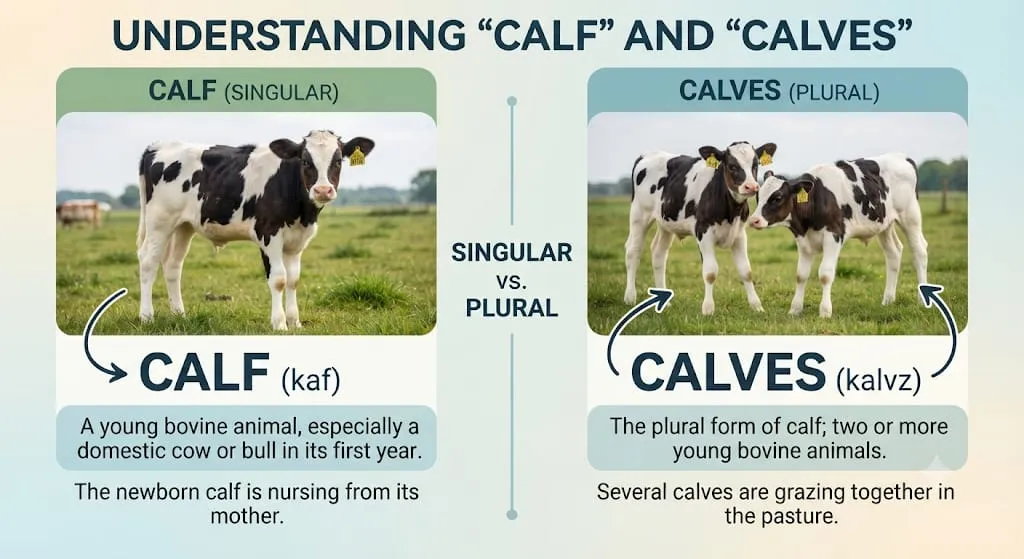
Calf is a noun that usually refers to a young animal, such as a baby cow or elephant. It can also mean the muscular back part of your lower leg.
Calve is a verb. It means to give birth to a calf or to break off large pieces of ice from a glacier.
Examples
- The calf followed its mother across the field.
- The cow will calve next month.
- Scientists watched the glacier calve into the sea.
The Origin and Background of Calve and Calf
According to Merriam-Webster, Oxford English Dictionary, and Etymonline, the word calf comes from the Old English word cealf, meaning a young bovine animal. Similar words appear in several Germanic languages, showing that the term has been used for centuries.
The verb calve developed later from the noun calf. It originally described the act of a cow giving birth to a calf. Over time, scientists also adopted the word to describe glaciers breaking off large blocks of ice that become icebergs.
Today, calf functions primarily as a noun, while calve functions as a verb. Although they share the same root, their grammatical roles are different.
Calve or Calf Explained: Key Differences
The biggest difference is part of speech.
| Term | Part of Speech | Meaning | When to Use |
| Calf | Noun | A young animal or the back of the lower leg | Talking about animals or anatomy |
| Calve | Verb | To give birth to a calf or for ice to break away | Talking about birth or glaciers |
Examples
Calf
- The calf stayed close to its mother.
- My calf hurts after yesterday’s hike.
Calve
- Dairy cows usually calve once each year.
- The glacier began to calve after temperatures increased.
Different Meanings of Calf
The word calf has more than one meaning.
1. A Young Animal
A calf can refer to the baby of several large mammals, including:
- Cow
- Buffalo
- Elephant
- Whale
- Dolphin
- Giraffe
- Moose
Example
- The elephant calf stayed beside its mother.
2. The Back of the Lower Leg
In human anatomy, the calf is the muscular area between the knee and the ankle.
Example
- Stretch your calf muscles before running.
Different Meanings of Calve
1. To Give Birth
Farmers commonly use calve when talking about cattle.
Example
- The heifer will calve in early May.
2. Glacier Ice Breaking Away
According to the U.S. Geological Survey (USGS) and the National Snow and Ice Data Center (NSIDC), glaciers calve when large pieces of ice separate and fall into the ocean or a lake.
Example
- Researchers observed the glacier calve several icebergs.
Which Version Should You Use?
For students
Use calf when naming the animal or the leg muscle.
For farmers
Use calve when describing an animal giving birth.
For wildlife writers
Use calf for baby whales, elephants, giraffes, and similar animals.
For science writing
Use calve when discussing glaciers breaking apart.
Simple Rule
- Name = Calf
- Action = Calve
Common Mistakes with Calve or Calf
| Mistake | Correct |
| The cow will calf tomorrow. | The cow will calve tomorrow. |
| The calve followed its mother. | The calf followed its mother. |
| My calve hurts after exercise. | My calf hurts after exercise. |
| The glacier lost a calf of ice. | The glacier calved a large iceberg. |
| Three calfs were born. | Three calves were born. |
Why These Mistakes Happen
- The words differ by only one letter.
- Many learners confuse nouns and verbs.
- The irregular plural calves surprises many English learners.
Calve or Calf in Real-World Examples
Professional Email
The veterinarian confirmed that the cow is expected to calve next week.
News Headline
Rare blue whale calf spotted off the Pacific coast.
Social Media Post
We welcomed our first calf of the season this morning!
Scientific Report
Satellite images show the glacier continued to calve throughout the summer.
Farm Record
Every newborn calf received a health examination within 24 hours.
Calve or Calf Data, Trends & Usage
Approximate Monthly Search Volume
Based on Semrush, Ahrefs, and general keyword trends (2025–2026):
| Keyword | Approximate Monthly Searches |
| calf | 500,000+* |
| calve | 15,000+ |
| calf meaning | 40,000+ |
| calve or calf | 1,000–3,000 |
*Includes searches related to anatomy, animals, fitness, and sports injuries.
Google Trends
Google Trends shows that calf is searched much more frequently than calve, mainly because it has multiple meanings in anatomy and zoology.
Corpus Frequency
According to Google Ngram Viewer, calf appears far more often than calve in published books due to its wider range of meanings.
Search Intent
- Primary Intent: Informational
- Secondary Intent: Grammar and vocabulary
- Related Intent: Farming, anatomy, wildlife, and glaciology
Why This Topic Matters
Interest in this topic continues as agriculture, wildlife documentaries, and climate change discussions introduce readers to both calf and calve in different contexts.
Comparison Table
| Term | Part of Speech | Meaning | Context | Best Used When |
| Calf | Noun | Young animal | Farming, wildlife | Naming a baby animal |
| Calf | Noun | Lower leg muscle | Anatomy, fitness | Referring to the leg |
| Calve | Verb | Give birth | Agriculture | Describing birth |
| Calve | Verb | Ice breaking away | Geography, climate science | Discussing glaciers |
Frequently Asked Questions
Q: What does calf mean?
A: Calf usually refers to a young cow or another young large mammal. It also means the muscular back part of the lower leg, according to Merriam-Webster.
Q: What does calve mean?
A: Calve is a verb meaning to give birth to a calf or for a glacier to release large pieces of ice.
Q: Is calve the plural of calf?
A: No. The plural of calf is calves, not calve.
Q: Which is correct: calve or calf?
A: Both are correct, but they serve different purposes. Use calf as a noun and calve as a verb.
Q: Can calve be used for animals other than cows?
A: Yes. While it most commonly refers to cattle, calve can also describe other animals that produce calves, such as whales and elephants.
Q: Why do glaciers calve?
A: According to the National Snow and Ice Data Center, glaciers calve when stress, melting, and gravity cause large blocks of ice to break away into water.
Q: Can calf refer to a person’s body?
A: Yes. In anatomy, the calf is the large muscle at the back of the lower leg, commonly discussed in sports and fitness.
Conclusion
Although calve and calf are closely related, they have different meanings and grammatical roles. Calf is a noun that refers to a young animal or the back of the lower leg, while calve is a verb meaning to give birth to a calf or for a glacier to break off pieces of ice. Remembering this simple distinction will help you avoid one of the most common vocabulary mistakes in farming, wildlife, anatomy, and environmental writing.
A helpful memory trick is this: if you’re naming something, use “calf.” If you’re describing an action, use “calve.” Keeping this rule in mind will make your writing clearer and more accurate.
Now that you understand the difference between calve and calf, you can use both words with confidence. Bookmark this guide for future reference, and share it with anyone who has ever wondered which word is correct.
Read More:
Molding or Moulding? Which Spelling Is Correct?

I’m **Rubab Naaz**, an English language content writer with over 10 years of experience creating educational and SEO-focused articles. I specialize in spelling comparisons, grammar, vocabulary, synonyms, commonly confused words, and English usage. My passion is helping students, writers, and professionals improve their language skills through accurate, well-researched, and easy-to-understand content. Every article I write is designed to make learning English simple, practical, and engaging.