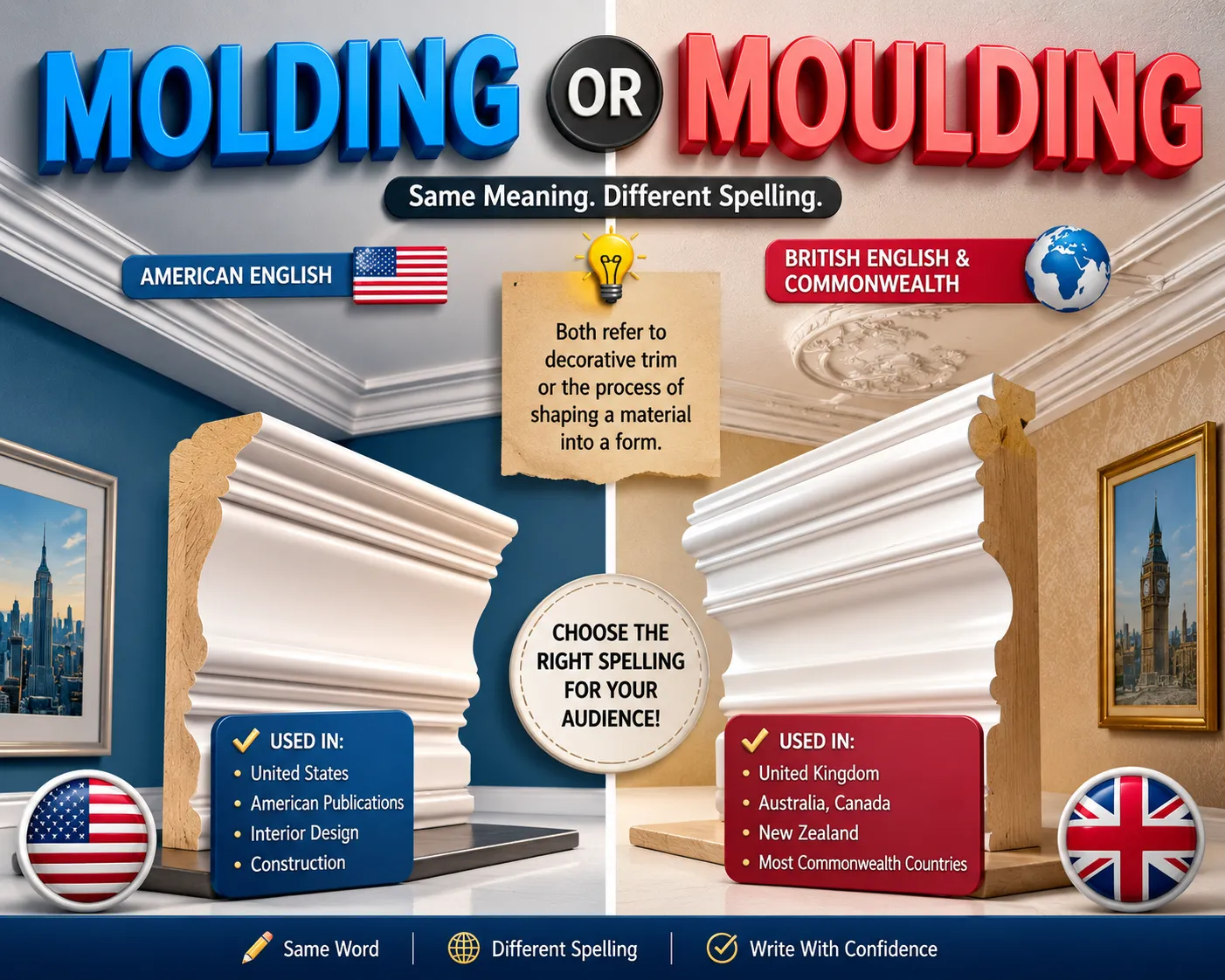
Molding and moulding mean the same thing. Molding is the standard spelling in American English, while moulding is preferred in British English, Australian English, Canadian English (often), and most other Commonwealth varieties. Use the spelling that matches your audience or the regional English standard you’re following.
A few years ago, I was proofreading a home improvement article about installing decorative wall trim. The writer used “molding” in one paragraph and “moulding” in the next. Neither spelling was incorrect, but switching between them made the article feel inconsistent. That small editing job reminded me that choosing the right regional spelling is just as important as using the correct word.
If you’ve searched for molding or moulding, you’re likely wondering which spelling is correct. Maybe you’re writing about interior design, woodworking, architecture, manufacturing, or even grammar. Since both spellings appear online, it’s easy to become confused.
The good news is that there isn’t a right-versus-wrong answer. The choice depends on whether you’re writing in American English or British English. This guide explains the differences, meanings, origins, usage, common mistakes, examples, and practical tips so you can write with confidence.
Molding or Moulding Quick Answer
Both molding and moulding are correct spellings.
- Molding → American English
- Moulding → British English and most Commonwealth English
Both can refer to:
- Decorative trim around walls, ceilings, doors, or windows
- The process of shaping a material into a particular form
Examples
- We installed new molding around the living room ceiling. (US English)
- The carpenter repaired the wooden moulding in the hallway. (UK English)
The Origin and Background of Molding and Moulding
The words molding and moulding come from mold/mould, which trace back to the Old English word molde, meaning earth, soil, or shape. According to Etymonline, the word gradually developed additional meanings related to forming objects and creating decorative shapes.
Over time, the verb to mold (or to mould) came to mean to shape or form something. The noun molding/moulding later described both:
- Decorative architectural trim
- The process or result of shaping materials such as wood, plastic, plaster, or metal
According to Merriam-Webster and the Oxford English Dictionary, the spelling difference is purely regional.
The distinction became more noticeable after Noah Webster promoted simplified spellings in American English during the early 19th century. American publications gradually adopted molding, while Britain retained moulding.
Molding or Moulding Explained: Key Differences
The only real difference is spelling.
| Term | Meaning | When to Use | Region |
| Molding | Decorative trim or shaping process | American English | United States |
| Moulding | Decorative trim or shaping process | British English | UK, Australia, New Zealand, most Commonwealth countries |
Examples
Molding
- The kitchen features elegant crown molding.
- Plastic molding reduces manufacturing costs.
Moulding
- Victorian homes often have decorative ceiling moulding.
- The factory specializes in injection moulding.
Different Meanings of Molding/Moulding
Although the spelling changes by region, the word has several meanings.
1. Decorative Trim
The strips of wood, plaster, or plastic installed along walls, ceilings, windows, and doors.
Example
- White crown molding adds elegance to the room.
2. Manufacturing Process
The process of shaping materials using a mold.
Example
- Injection moulding is widely used to produce plastic products.
3. Artistic or Creative Shaping
The act of forming clay, wax, plaster, or similar materials.
Example
- The students practiced clay molding during art class.
Which Version Should You Use?
For American readers
Use molding.
For British readers
Use moulding.
For Australian and New Zealand audiences
Use moulding.
For architects and builders
Follow the spelling required by your client, publication, or regional building standards.
For international websites
Choose one spelling style and remain consistent throughout the page.
Common Mistakes with Molding or Moulding
| Mistake | Correct |
| Mixing molding and moulding in one document | Choose one regional spelling and use it consistently |
| Thinking they describe different products | They describe the same thing |
| Using moulding in American style guides | Prefer molding |
| Assuming molding is incorrect | It is standard American English |
| Confusing molding with mold (fungus) | Context determines the meaning |
Why These Mistakes Happen
- Writers combine sources from different countries.
- Spell-check software changes words based on language settings.
- Construction and manufacturing industries publish materials in multiple English varieties.
Molding or Moulding in Real-World Examples
Professional Email
The contractor will replace the damaged molding around the conference room windows.
News Headline
Historic theater restores original Victorian moulding during renovation.
Social Media Post
Just finished painting the crown molding. The room looks completely different!
Construction Report
Decorative moulding throughout the entrance hall remains in excellent condition.
Manufacturing Manual
Proper injection molding reduces waste and improves product quality.
Molding or Moulding Data, Trends & Usage
Approximate Monthly Search Volume
Based on Semrush, Ahrefs, and general keyword data (2025–2026):
| Keyword | Approximate Monthly Searches |
| molding | 400,000+ |
| moulding | 90,000+ |
| molding vs moulding | 2,000–5,000 |
| molding or moulding | 1,000–3,000 |
Google Trends
Google Trends shows:
- Molding dominates searches in the United States.
- Moulding receives stronger search interest in the United Kingdom, Australia, Ireland, and New Zealand.
Corpus Frequency
According to Google Ngram Viewer, molding is far more common in American books, while moulding appears more frequently in British publications.
Search Intent
- Primary Intent: Informational
- Secondary Intent: Home improvement
- Related Intent: Manufacturing, architecture, woodworking
Why This Topic Matters
As international businesses publish content for global audiences, using the appropriate regional spelling improves professionalism, consistency, and SEO performance.
Comparison Table
| Variant | Meaning | Region/Context | Best Used When |
| Molding | Decorative trim or shaping process | American English | US construction, manufacturing, interior design |
| Moulding | Decorative trim or shaping process | British English | UK and Commonwealth publications |
| Crown Molding | Decorative ceiling trim | Mainly American English | Home renovation |
| Crown Moulding | Decorative ceiling trim | Mainly British English | Commonwealth home improvement |
Frequently Asked Questions
Q: What does molding mean?
A: Molding refers to decorative trim used in buildings or the process of shaping materials into a desired form. Merriam-Webster recognizes both meanings.
Q: Is moulding the same as molding?
A: Yes. The meanings are identical. The only difference is the regional spelling used in different varieties of English.
Q: Which spelling is correct: molding or moulding?
A: Both are correct. Use molding in American English and moulding in British and most Commonwealth English.
Q: Is molding acceptable in formal writing?
A: Yes. It is the standard spelling in American academic, technical, business, and construction writing.
Q: Why does British English use moulding?
A: British English retained the traditional spelling, while American English adopted simplified spellings influenced by Noah Webster.
Q: Does molding only refer to decorative trim?
A: No. It can also describe manufacturing methods, artistic shaping, and industrial production processes.
Q: Should I use both spellings in one article?
A: No. Select the spelling that matches your target audience and use it consistently from beginning to end.
Conclusion
Choosing between molding and moulding is straightforward once you know your audience. Both words have the same meanings and refer to decorative trim, manufacturing processes, or the act of shaping materials. The only difference lies in regional spelling. Molding is the standard form in American English, while moulding remains the preferred spelling in British English and most Commonwealth countries.
Whether you’re writing about architecture, woodworking, interior design, plastic manufacturing, or home renovation, using the correct regional spelling makes your content look polished and professional. Consistency is just as important as correctness, so avoid switching between the two forms in the same document.
Now that you understand the difference between molding and moulding, you can confidently choose the right spelling for any audience. Bookmark this guide so you never second-guess “molding or moulding” again, and share it with anyone writing for an international audience.
Read More:
Mold or Mould? Which Spelling Is Correct? The Complete Guide

I’m **Rubab Naaz**, an English language content writer with over 10 years of experience creating educational and SEO-focused articles. I specialize in spelling comparisons, grammar, vocabulary, synonyms, commonly confused words, and English usage. My passion is helping students, writers, and professionals improve their language skills through accurate, well-researched, and easy-to-understand content. Every article I write is designed to make learning English simple, practical, and engaging.