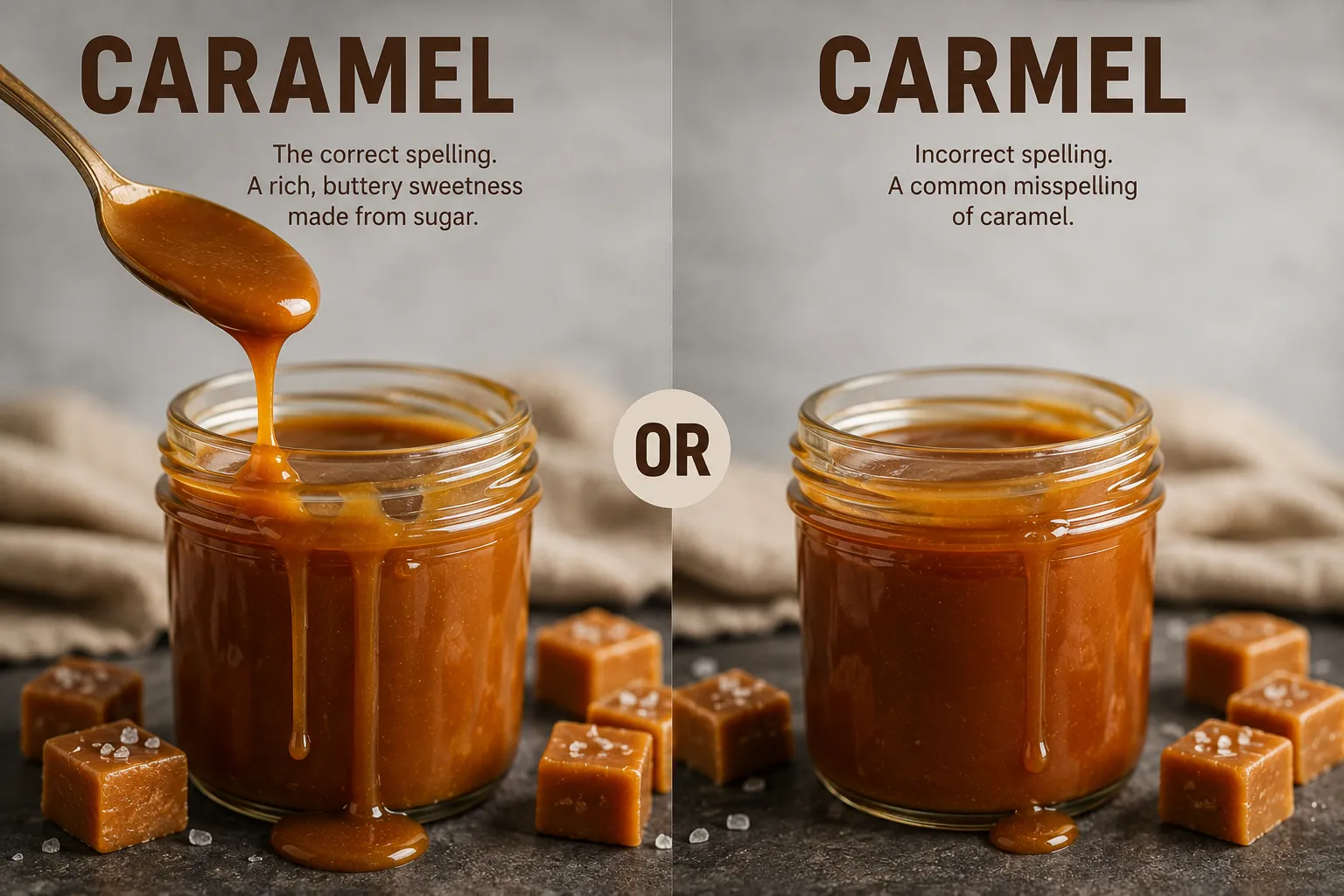
Caramel is the correct English spelling for the sweet made by heating sugar. Carmel is usually a place name or a personal name, although some people pronounce caramel as “carmel” in everyday speech.
A few years ago, I was proofreading a food blog when I spotted a recipe titled “Homemade Carmel Sauce.” At first, I thought it referred to a special regional recipe. Then I realized it was simply a spelling mistake. That small typo changed the meaning completely. It also reminded me how easily even experienced writers can confuse these two words.
If you’ve ever wondered whether to write caramel or carmel, you’re not alone. Many English learners, home bakers, bloggers, and even native speakers mix them up because they often sound alike in casual speech. Add regional accents into the mix, and the confusion grows even more.
The good news is that the answer is simple once you understand the difference. In this guide, you’ll learn what each word means, why people confuse them, when each spelling is correct, and how to avoid common mistakes with confidence.
Caramel or Carmel Quick Answer
Caramel refers to the golden-brown candy or flavor made by heating sugar until it browns. It is the standard spelling recognized by dictionaries such as Merriam-Webster, Cambridge Dictionary, and Oxford Languages.
Examples:
- I ordered a caramel latte before work.
- The cake is topped with warm caramel sauce.
Meanwhile, Carmel usually refers to a proper noun, such as a person’s name or a place.
Example:
- She spent the weekend in Carmel-by-the-Sea.
The Origin and Background of Caramel or Carmel
The word caramel has a long history. According to Merriam-Webster and Etymonline, it entered English through French caramel, which likely came from Spanish caramelo. Linguists believe the word has even older Latin roots connected with sugar cane.
As sugar became more common across Europe, the word spread into many languages. Today, caramel is both a noun and an adjective. It can describe candy, desserts, coffee drinks, colors, and flavors.
So where does carmel come from?
Unlike caramel, Carmel is generally a proper noun. It appears in names such as:
- Mount Carmel
- Carmel-by-the-Sea
- Carmel, Indiana
- Personal names like Carmel
The confusion mainly happens because many English speakers pronounce caramel with two syllables (“CAR-mel”) instead of three (“CARE-uh-mel”). Pronunciation varies by region, but the spelling remains caramel.
Caramel or Carmel Explained: Key Differences
Although these words look similar, they serve different purposes.
| Term | Meaning | When to Use | Region/Context |
| Caramel | Sweet made from heated sugar | Food, drinks, desserts, colors | Standard English worldwide |
| Carmel | Place name or personal name | Geographic names or people | Proper nouns |
| Caramelized | Cooked until browned with sugar | Cooking and recipes | Culinary writing |
Examples
Caramel
- The cookies have a rich caramel flavor.
- Add caramel syrup to your coffee.
Carmel
- They visited Carmel, California, during summer.
- Carmel is her middle name.
Which Version Should You Use?
The correct choice depends on what you mean.
For students
Use caramel whenever you’re talking about food, candy, desserts, drinks, or colors.
For writers and bloggers
Always spell the sweet ingredient as caramel. Spell-checkers may not catch Carmel because it is also a valid word.
For travelers
Use Carmel only when referring to a location or someone’s name.
For global readers
Choose caramel unless you’re intentionally writing about a place called Carmel.
Simple rule: If you can eat it, write caramel. If you can visit it, write Carmel.
Common Mistakes with Caramel or Carmel
Here are mistakes people often make.
| Mistake | Correct |
| I love carmel popcorn. | I love caramel popcorn. |
| The recipe needs carmel sauce. | The recipe needs caramel sauce. |
| We drove to caramel, California. | We drove to Carmel, California. |
| She bought carmel candy. | She bought caramel candy. |
| Caramel-by-the-Sea is beautiful. | Carmel-by-the-Sea is beautiful. |
Why these mistakes happen
- Many people spell words the way they pronounce them.
- Some accents drop the middle vowel in caramel.
- Autocorrect may not flag Carmel because it is a legitimate proper noun.
Caramel or Carmel in Real-World Examples
Professional Email
Please bring the caramel cupcakes for tomorrow’s office celebration.
News Headline
Local bakery launches new caramel cheesecake collection.
Social Media Post
Just tried a sea salt caramel milkshake. Absolutely worth the wait!
Formal Report
Consumer demand for caramel-flavored beverages increased during the holiday season.
Travel Brochure
Visitors can enjoy breathtaking coastal views in Carmel-by-the-Sea, California.
Caramel or Carmel: Data, Trends & Usage
Understanding how these words appear online can help explain the confusion.
Approximate Search Volume
Based on Semrush, Ahrefs, and general keyword trend patterns (2025–2026):
| Keyword | Approximate Monthly Searches |
| caramel | 600,000+ |
| caramel sauce | 150,000+ |
| caramel recipe | 110,000+ |
| caramel or carmel | 1,000–3,000 |
Google Trends
Google Trends consistently shows that searches for caramel greatly exceed searches for carmel when users are looking for food. Interest in Carmel spikes mainly around travel destinations such as California and Indiana.
Corpus Frequency
According to Google Ngram Viewer, caramel appears far more frequently than carmel in published books because it is the standard dictionary spelling for the confection.
Search Intent
- Primary intent: Informational
- Secondary intent: Educational
- Related intent: Recipe searches and spelling verification
Why This Topic Matters
AI writing tools, voice typing, and speech recognition often mirror pronunciation rather than spelling. That makes it easier than ever to accidentally type Carmel instead of caramel, especially for ESL learners.
Comparison Table
| Term/Variant | Meaning | Region/Context | Best Used When |
| Caramel | Heated sugar, candy, flavor | Standard English | Talking about food |
| Carmel | Place or personal name | Proper noun | Referring to locations or people |
| Caramelized | Cooked until brown | Culinary writing | Describing cooking methods |
| Burnt Sugar | Dark cooked sugar | Cooking | Describing flavor rather than the ingredient |
Frequently Asked Questions
Q: What does caramel mean?
A: Caramel is sugar heated until it browns, creating a rich flavor and golden color. According to Merriam-Webster, it also refers to the candy or flavor made from this process.
Q: How do you use caramel correctly?
A: Use caramel whenever you are writing about desserts, candy, sauces, coffee drinks, or flavors. It is the accepted spelling in formal and informal writing.
Q: Caramel vs. Carmel what’s the difference?
A: Caramel is food. Carmel is generally a place name or personal name. They may sound alike in some accents, but they have different meanings.
Q: Is caramel acceptable in formal writing?
A: Yes. Dictionaries including Cambridge Dictionary and Oxford Languages recognize caramel as the standard spelling for the confection and flavor.
Q: Which spelling is correct: caramel or carmel?
A: For candy, desserts, and food products, caramel is correct. Use Carmel only when referring to a specific name or location.
Q: Where does the word caramel come from?
A: According to Etymonline, the word entered English from French and has earlier roots connected with Spanish and Latin terms related to sugar.
Q: Can caramel be used outside food writing?
A: Yes. The word also describes colors, such as caramel brown, and appears in fashion, interior design, cosmetics, and product descriptions.
Conclusion
Choosing between caramel and Carmel becomes easy once you know what each word represents. Caramel is the standard spelling for the sweet ingredient, candy, flavor, and color found in recipes and everyday English. Carmel, on the other hand, belongs mainly to names of people and places. Although many speakers pronounce caramel with only two syllables, pronunciation does not change the correct spelling.
Remember one simple trick: if you’re talking about something delicious, write “caramel.” If you’re talking about a town or a person’s name, write “Carmel.” Keeping this distinction in mind will help you avoid one of the most common spelling mistakes in English.
The next time you write a recipe, menu, blog post, or email, you’ll know exactly which word belongs there. Bookmark this guide so you never second-guess “caramel or Carmel” again, and share it with someone who has made this mistake before.
Read More:
Yarra or Drakka: Which Choice Is Better?

I’m **Rubab Naaz**, an English language content writer with over 10 years of experience creating educational and SEO-focused articles. I specialize in spelling comparisons, grammar, vocabulary, synonyms, commonly confused words, and English usage. My passion is helping students, writers, and professionals improve their language skills through accurate, well-researched, and easy-to-understand content. Every article I write is designed to make learning English simple, practical, and engaging.