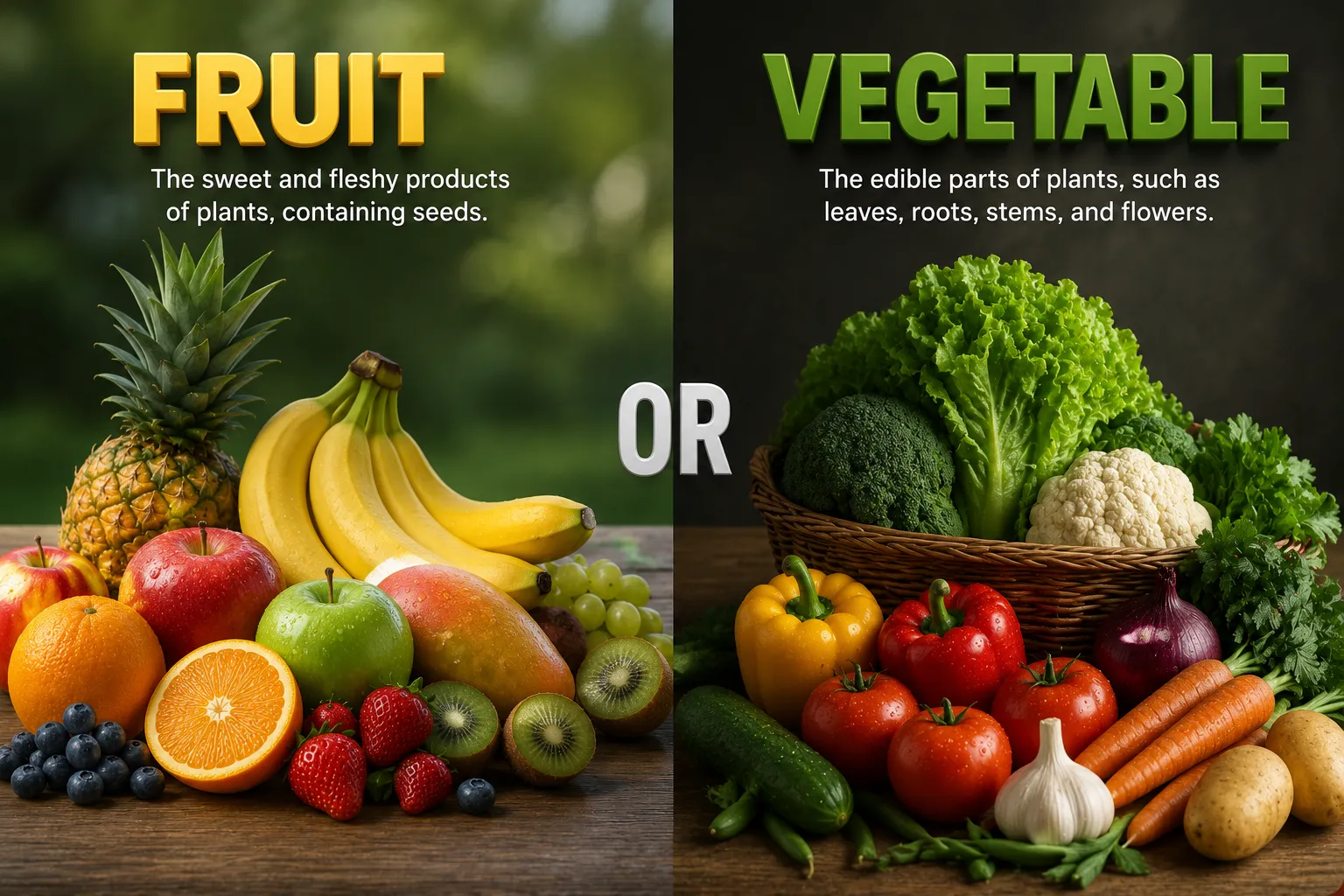
A fruit develops from the flower of a plant and contains seeds, while a vegetable is any other edible part of the plant, such as the roots, stems, leaves, or bulbs. Scientifically, tomatoes, cucumbers, and pumpkins are fruits, but they are often treated as vegetables in cooking.
Growing up, I was convinced that tomatoes were vegetables because everyone in my family used them in salads, sandwiches, and savory dishes. Then, during a biology class, my teacher explained that tomatoes are actually fruits because they grow from a flower and contain seeds. That simple lesson changed the way I looked at many foods. Suddenly, cucumbers, peppers, pumpkins, and even avocados belonged to a different category than I had always believed.
If you’ve ever wondered whether a tomato is a fruit or a vegetable, you’re not alone. Millions of people search this question every year because science and cooking don’t always use the same definitions. A food can be a fruit in botany but a vegetable in the kitchen.
In this guide, you’ll discover the scientific and culinary differences between fruits and vegetables, learn how each is classified, explore common misconceptions, and find practical examples that make the topic easy to understand.
Fruit or Vegetable Quick Answer
The difference depends on context.
- Botanically, a fruit develops from a flower and contains seeds.
- Culinarily, a vegetable is any edible plant part mainly used in savory dishes.
Examples
- ✅ Apple → Fruit
- ✅ Carrot → Vegetable
- ✅ Tomato → Botanically a fruit, culinarily a vegetable
- ✅ Cucumber → Botanically a fruit, commonly used as a vegetable
The scientific definition focuses on plant biology, while cooking focuses on flavor and use.
The Origin and Background of Fruit or Vegetable
The words fruit and vegetable have long histories, but they did not always have the meanings we use today.
According to Etymonline, the word fruit comes from the Latin fructus, meaning produce, enjoyment, or harvest. Over time, English adopted the word to describe the seed-bearing structures produced by flowering plants.
The word vegetable comes from the Medieval Latin vegetabilis, meaning growing or flourishing. According to Merriam-Webster, it later came to describe edible plant parts such as roots, stems, leaves, bulbs, and tubers.
Modern botany defines a fruit based on plant reproduction. A fruit develops from the ovary of a flower and usually contains seeds. Vegetables, however, are not a botanical category. Instead, they are a culinary term covering edible plant parts that are not classified as fruits in everyday cooking.
According to the Encyclopædia Britannica and the United States Department of Agriculture (USDA), this distinction explains why foods like tomatoes and peppers can be both fruits and vegetables depending on the context.
Fruit or Vegetable Explained Key Differences
The easiest way to tell the difference is to ask one question:
Does it develop from the flower and contain seeds?
If yes, it is a fruit from a botanical perspective.
If not, it is usually considered a vegetable.
| Food | Botanical Classification | Culinary Classification | Why? |
| Apple | Fruit | Fruit | Develops from a flower with seeds |
| Banana | Fruit | Fruit | Seed-bearing structure |
| Tomato | Fruit | Vegetable | Used mainly in savory dishes |
| Cucumber | Fruit | Vegetable | Contains seeds from the flower |
| Pumpkin | Fruit | Vegetable | Develops from the flower |
| Carrot | Vegetable | Vegetable | It is a root |
| Potato | Vegetable | Vegetable | It is a tuber |
| Lettuce | Vegetable | Vegetable | It is a leaf |
| Celery | Vegetable | Vegetable | It is a stem |
Examples of Fruits
- Apples
- Oranges
- Mangoes
- Grapes
- Peaches
- Tomatoes
- Cucumbers
- Eggplants
- Peppers
- Avocados
Examples of Vegetables
- Carrots
- Potatoes
- Broccoli
- Spinach
- Onions
- Garlic
- Cabbage
- Celery
- Lettuce
- Radishes
Notice that several foods commonly called vegetables are actually fruits in scientific terms.
Scientific Definition vs. Culinary Definition
One reason people become confused is that science and cooking use different systems.
Botanical Definition
In botany, fruits are part of a plant’s reproductive system.
They:
- Develop from flowers.
- Protect seeds.
- Help plants reproduce.
Examples include:
- Tomatoes
- Peppers
- Pumpkins
- Cucumbers
- Zucchini
Culinary Definition
Chefs classify foods according to flavor and use rather than plant biology.
Generally:
- Sweet foods are called fruits.
- Savory foods are treated as vegetables.
This practical approach explains why tomatoes appear in salads instead of fruit desserts.
Which Classification Should You Use?
The answer depends on your audience.
For students
Use the botanical definition in science classes.
Example:
A tomato is a fruit because it develops from the flower and contains seeds.
For cooks
Use the culinary definition when preparing recipes.
Example:
Chop the tomatoes with the other vegetables.
For gardeners
Understanding the botanical definition helps identify how plants grow and reproduce.
For everyday conversation
Most people will understand tomatoes, cucumbers, and peppers as vegetables because that’s how they are commonly used in cooking.
Both meanings are acceptable when the context is clear.
Quick Comparison
| If you’re talking about… | Use |
| Plant biology | Botanical definition |
| Cooking | Culinary definition |
| Seeds and flowers | Fruit |
| Roots, stems, and leaves | Vegetable |
| Recipes | Culinary classification |
Easy Memory Trick
Remember this simple rule:
🌼 Flower + Seeds = Fruit
🌿 Roots, Leaves, Stems, or Bulbs = Vegetable
This trick works for almost every common example.
Common Mistakes About Fruit or Vegetable
Many people assume that sweet foods are fruits and savory foods are vegetables. While this rule often works in the kitchen, it does not always match the scientific definition.
| ❌ Common Mistake | ✅ Correct Understanding | Why? |
| Tomatoes are vegetables. | Botanically, tomatoes are fruits. | They develop from flowers and contain seeds. |
| Cucumbers are vegetables. | Botanically, cucumbers are fruits. | They grow from the flower of the plant. |
| Every fruit is sweet. | Not all fruits are sweet. | Avocados, olives, and tomatoes are fruits. |
| Every vegetable grows underground. | Many vegetables grow above ground. | Lettuce, broccoli, and spinach are examples. |
| Fruits and vegetables are opposite scientific categories. | “Vegetable” is mainly a culinary term. | Botany classifies fruits differently. |
Why These Mistakes Happen
- Science and cooking use different definitions.
- Schools often teach simplified examples.
- Grocery stores group foods by culinary use.
- Everyday language focuses on flavor instead of plant biology.
According to the Encyclopædia Britannica and the USDA, understanding the context helps explain why one food can be called both a fruit and a vegetable.
Fruit or Vegetable in Real-World Examples
Professional Email
Please include at least two servings of fruit and three servings of vegetables in tomorrow’s lunch menu.
News Headline
Nutrition Experts Encourage Eating More Fruits and Vegetables Every Day
Social Media Post
I just learned that tomatoes are actually fruits! Science can be surprising. 🍅
School Science Report
Botanically, the tomato is classified as a fruit because it develops from the flower and contains seeds.
Each example shows how the correct term depends on the context.
Fruit or Vegetable Data, Trends & Usage
Approximate Search Volume
Based on Semrush, Ahrefs, and general keyword trends (2025–2026):
| Keyword | Approximate Monthly Searches |
| fruit | 800,000+ |
| vegetable | 700,000+ |
| fruit or vegetable | 20,000–40,000 |
These figures are approximate and vary by country and keyword tool.
Search Interest
According to Google Trends, searches for “fruit or vegetable” increase during:
- School science projects
- Nutrition awareness campaigns
- Healthy eating challenges
- Gardening seasons
The most searched questions include:
- Is a tomato a fruit or vegetable?
- Is an avocado a fruit?
- Is a cucumber a fruit?
- Is corn a vegetable?
Word Usage
Reference sources such as Encyclopædia Britannica and educational textbooks consistently distinguish between botanical and culinary classifications. This dual approach explains why many everyday foods have two accepted descriptions depending on the context.
Search Intent
Primary Search Intent: Informational
Most readers want to learn:
- What is the difference between a fruit and a vegetable?
- Why are tomatoes considered fruits?
- Which foods are commonly misclassified?
- Which definition is correct?
Why This Topic Matters
Understanding the difference improves your knowledge of botany, nutrition, and English vocabulary. It also helps students, gardeners, cooks, and health-conscious readers communicate more accurately.
Standalone Comparison Table
| Food | Botanical Category | Culinary Category | Best Described As |
| Tomato | Fruit | Vegetable | Both, depending on context |
| Cucumber | Fruit | Vegetable | Both |
| Avocado | Fruit | Fruit | Fruit |
| Pumpkin | Fruit | Vegetable | Both |
| Carrot | Root Vegetable | Vegetable | Vegetable |
| Potato | Tuber | Vegetable | Vegetable |
| Broccoli | Flower | Vegetable | Vegetable |
| Apple | Fruit | Fruit | Fruit |
This table highlights foods that often cause confusion and shows how scientific and culinary classifications can differ.
Frequently Asked Questions
Q1. What is the main difference between a fruit and a vegetable?
A: A fruit develops from the flower of a plant and usually contains seeds. A vegetable is an edible part of the plant such as the root, stem, leaf, or bulb.
Q2. Is a tomato a fruit or a vegetable?
A: Botanically, a tomato is a fruit because it grows from the flower and contains seeds. In cooking, it is commonly treated as a vegetable because of its savory flavor.
Q3. Why is a cucumber considered a fruit?
A: According to botanical classification, cucumbers develop from flowers and contain seeds, making them fruits even though they are commonly used as vegetables.
Q4. Are vegetables a scientific category?
A: No. In botany, “vegetable” is not an official scientific classification. It is mainly a culinary term used for edible plant parts.
Q5. Can a food be both a fruit and a vegetable?
A: Yes. Foods like tomatoes, pumpkins, peppers, and cucumbers are botanical fruits but culinary vegetables because of how they are prepared and eaten.
Q6. Which classification should students use?
A: For science classes, use the botanical definition. For cooking or recipes, follow the culinary definition.
Q7. Why does this topic confuse so many people?
A: Everyday language focuses on taste and cooking, while botany focuses on how plants grow and reproduce. These different systems lead to different classifications.
Conclusion
The debate over fruit or vegetable is not about one definition being right and the other being wrong. Instead, it is about understanding context. In botany, fruits grow from flowers and contain seeds, while vegetables include other edible parts of the plant, such as roots, stems, leaves, and bulbs. In the kitchen, however, foods are grouped by flavor and how they are used in recipes.
This is why tomatoes, cucumbers, peppers, and pumpkins can be called fruits by scientists and vegetables by chefs. Once you know the difference between the botanical and culinary definitions, the confusion disappears.
Whether you’re studying biology, planning healthy meals, or simply satisfying your curiosity, knowing how fruits and vegetables are classified helps you understand plants more clearly. Bookmark this guide for future reference, and share it with anyone who’s ever wondered whether a tomato is really a fruit or a vegetable.
Read More:
Caramel or Carmel: The Complete Guide to the Correct Usage

I specialize in English grammar, spelling, word choice, and language usage. My content is based on research from grammar references, style guides, dictionaries, and real-world usage to ensure it is accurate and practical.
At Spelling Comparison, I write guides that explain why words are confused, how they are used, and which form is correct in context. I also include proofreading tips, examples, and writing advice readers can apply immediately.
My goal is to publish clear, reliable content that helps readers make better writing decisions. Each guide is written for accuracy, clarity, and usefulness in school, work, business, and everyday communication.