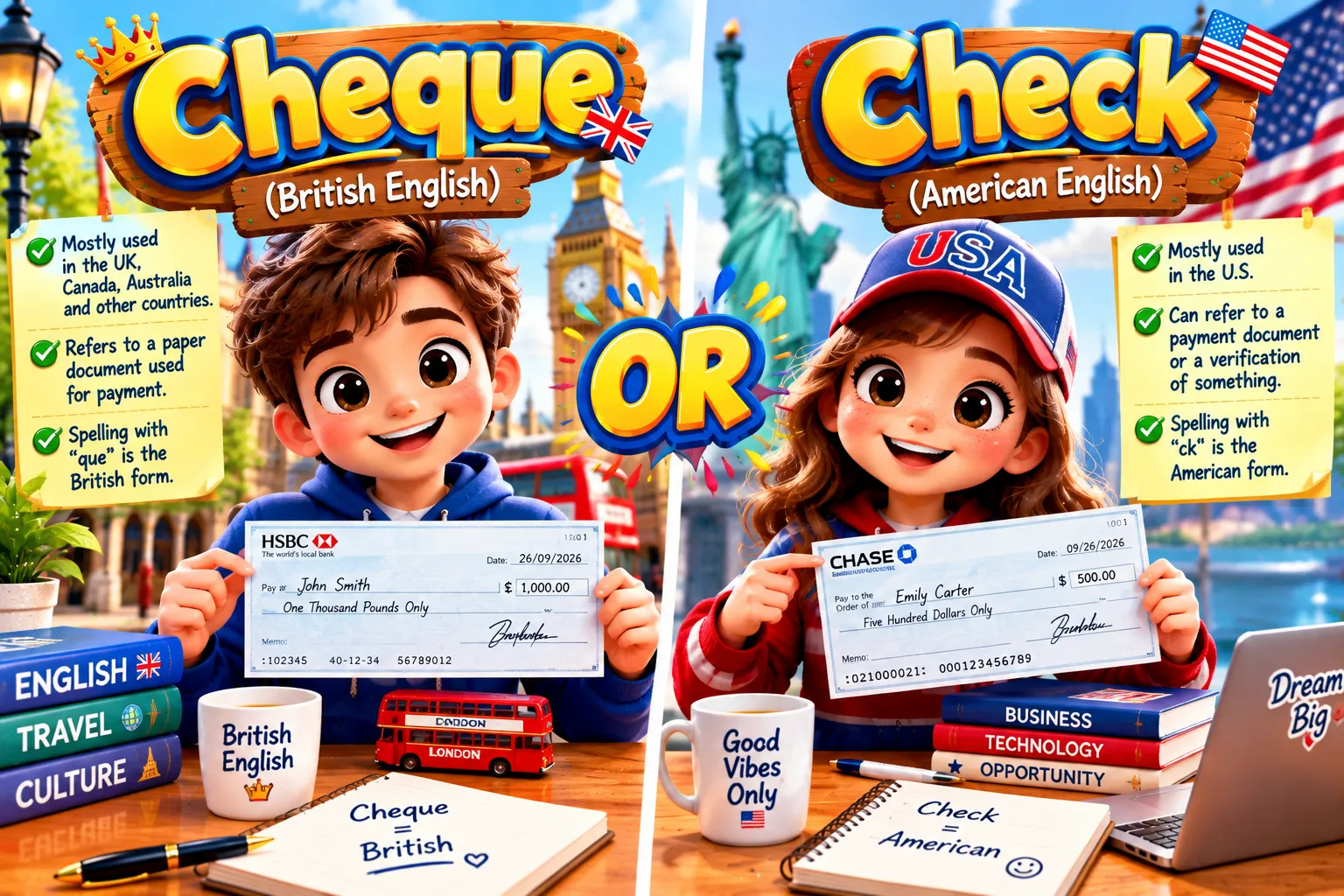
Cheque and check are two spellings for the same banking term. Cheque is standard in British English, while check is standard in American English.
I remember pausing over this word when writing about bank payments. I knew exactly what I meant, but the spelling still made me stop: cheque or check? The difference looks small, yet it can make your writing feel clearly British or American.
The confusion becomes even greater because check has many other meanings. You can check your email, check your work, check a box, or ask for the check at a restaurant. Cheque, however, is mainly used for the banking meaning in British English.
This is why the two words can feel both identical and different at the same time. They have the same pronunciation when they mean a bank payment, but their spelling depends on the variety of English you use.
If you are writing an email, article, assignment, business document, or financial message, choosing the right form matters. The simple rule is to match your spelling to your audience and keep it consistent.
Let’s break down the difference so you can use cheque or check with confidence.
Cheque or Check Quick Answer
When you mean a written payment order from a bank, cheque and check have the same meaning.
- Cheque is the usual British English spelling.
- Check is the usual American English spelling.
- Check also has several other meanings that have nothing to do with banking.
For example:
- British English: I sent the payment by cheque.
- American English: I sent the payment by check.
Cambridge Dictionary lists cheque as the UK form and check as the US form for this banking sense.
The pronunciation is also the same: /tʃek/. So this is mainly a spelling and regional usage difference, not a pronunciation difference.
The Origin and Background of Cheque and Check
The history of these words is more interesting than the spelling difference suggests.
The broader word check has a long history connected with chess. Etymonline traces the word to Old French eschequier, related to chess, and ultimately through Medieval Latin and Arabic to Persian shah, meaning “king.”
Over time, the idea of checking or stopping developed from the chess sense. The word gained meanings related to restraint, examination, verification, and control.
The financial meaning came later. Etymonline dates the sense of a written order for money drawn on a bank to 1798 and notes that it was often spelled cheque. The spelling was probably influenced by exchequer, a word connected with government finance.
Oxford Learner’s Dictionaries gives cheque as a British English form and check as the US form. Oxford also traces cheque to the early 18th century as a variant of check in a financial sense.
This history explains why the two forms are so closely related. They are not two completely different words. They are regional spelling forms for the same financial term.
Cheque vs. Check Explained Key Differences
The easiest way to remember the difference is to think about English variety.
| Term | Meaning | When to Use | Region/Context |
| Cheque | A written bank payment | When following British spelling | UK and other varieties using British English |
| Check | A written bank payment | When following American spelling | US English |
| Check | To examine or verify something | When used as a verb | All major varieties of English |
| Check | A restaurant bill | Common in North American English | Mainly US/Canada |
| Check | A ✓ mark | Especially common in North American English | US and other contexts |
Cambridge Dictionary confirms that cheque is the UK form of the banking word, while check is the US form.
Cheque
Use cheque when you are following British English spelling.
Examples:
- The company paid the refund by cheque.
- Please make the cheque payable to the school.
- She deposited the cheque at her bank.
Check
Use check for the same banking meaning in American English.
Examples:
- The company mailed the refund by check.
- He signed the check before leaving.
- The bank received the check yesterday.
Check Has Other Meanings
This is where the word gets interesting.
Check can also mean:
- to examine something
- to verify information
- to control something
- to mark an item
- a restaurant bill in North American English
- a pattern of squares
- a move in chess
Oxford Learner’s Dictionaries lists these different meanings separately. It also notes that British English usually uses bill rather than check for a restaurant payment and tick rather than check for the ✓ mark.
For example:
Please check your spelling before submitting the report.
Here, check is a verb. It has nothing to do with a bank payment.
Which Version Should You Use?
There is no single spelling that fits every English-speaking audience. Your best choice depends on the variety of English you are using.
For British English
Use cheque when writing in British English.
This is suitable for:
- UK schoolwork
- British business writing
- UK publications
- Documents following British spelling
For American English
Use check for the banking meaning.
This is the normal choice in:
- US business writing
- American newspapers
- US financial documents
- American schoolwork
For International or Global Writing
Choose one spelling based on your site’s or organization’s style guide.
The key is consistency. Do not switch randomly between British and American spelling in the same piece.
For example, if your article uses colour, centre, and organise, cheque may fit the same British style. If you use color, center, and organize, check is likely the better match for American style.
A language-style guide from the University of Canberra also recommends choosing an established dictionary standard and maintaining consistency throughout a text.
Common Mistakes with Cheque or Check
1. Treating cheque as an American spelling
Wrong assumption: Cheque is the American version.
Better: Check is the standard American spelling for the banking term.
Cambridge and Oxford both identify cheque as British and check as American.
2. Using cheque for every meaning of check
Not every use of check becomes cheque in British English.
For example:
- Check your answer. ✅
- Cheque your answer. ❌
Here, check is a verb meaning “examine or verify.”
3. Mixing regional styles
A piece of writing can look inconsistent when it switches between British and American spelling.
If you choose cheque, also consider whether the rest of your article follows British spelling.
4. Confusing check with a restaurant bill
In American English, check can mean the bill at a restaurant.
In British English, bill is normally used for this meaning.
5. Assuming the pronunciation changes
The banking forms cheque and check are pronounced the same way.
The difference is mainly in spelling and regional convention.
Cheque or Check in Real-World Examples
Professional Email
British English: Please confirm when the cheque has been received.
American English: Please confirm when the check has been received.
News Headline
British style: Charity Receives Large Cheque From Local Business
American style: Charity Receives Large Check From Local Business
Social Media Post
British style: My first salary cheque finally arrived! 🎉
American style: My first salary check finally arrived! 🎉
Formal Document
British style: Payment must be made by cheque within 14 days.
American style: Payment must be made by check within 14 days.
These examples show that the meaning stays the same. The spelling changes with the English variety.
Cheque or Check Data, Trends & Usage
The most useful data point here is not an exact monthly search number. Search-volume figures for cheque and check vary by country, search engine, date, and SEO platform. Public Google Trends data can show relative interest, but it does not provide the same fixed monthly-volume figure as commercial tools such as Ahrefs or Semrush.
The linguistic evidence is much clearer.
Cheque is strongly associated with British English, while check is the American spelling for the same banking term. Oxford and Cambridge both make this regional distinction.
There is also an important search-intent issue. Someone searching check may not be asking about banking at all. They could be looking for the verb check, a restaurant check, a check mark, or another meaning. That makes cheque vs. check a useful clarification topic for English learners.
The word check also appears in many compounds and phrases, including checklist, check-in, checkout, and spell-check. Etymonline records these different developments from the older senses of check.
Search Intent
The main intent behind cheque or check is informational.
Readers usually want to know:
- Which spelling is correct?
- Is cheque British or American?
- Is check also correct?
- Do the words mean the same thing?
- Which form should I use in formal writing?
For English learners, writers, editors, and international businesses, understanding this difference helps avoid accidental style changes.
Cheque or Check Standalone Comparison
| Term/Variant | Meaning | Region/Context | Best Used When |
| Cheque | Bank payment document | British English | Writing for a British-English audience |
| Check | Bank payment document | American English | Writing for an American-English audience |
| Check | Restaurant bill | North American English | Asking for the bill in a US-style context |
| Bill | Amount owed for a meal or service | British English and general use | Asking for payment details at a restaurant |
| Check mark | ✓ symbol | Especially North American English | Talking about a marked or selected item |
| Tick | ✓ symbol | Especially British English | Referring to the mark used to show selection |
This table highlights an important point: cheque is not simply the British spelling of every meaning of check. It specifically represents the financial noun.
FAQ: Cheque or Check
Q: What does cheque mean?
A: Cheque is a written payment document linked to a bank account. It is the standard British English spelling of the banking term.
Q: Is cheque or check correct?
A: Both are correct for the banking meaning. Cheque is standard in British English, while check is standard in American English.
Q: What is the difference between cheque and check?
A: When referring to a bank payment, the two words have the same meaning. The main difference is regional spelling. Check also has many additional meanings that cheque does not share.
Q: Is cheque acceptable in formal writing?
A: Yes. Cheque is a standard formal spelling in British English. Oxford lists it as the British form of the banking term.
Q: Can I use check in British English?
A: Yes, but the banking noun is normally written cheque in British English. The word check is still used in British English for meanings such as examining or verifying something.
Q: Where does the word cheque come from?
A: The financial sense developed from check and is associated with the idea of checking or verifying financial amounts. Etymonline dates the banking sense to the late 18th century, while Oxford gives cheque as an early-18th-century financial variant.
Q: Are cheque and check pronounced the same way?
A: Yes. When they mean the bank payment, both are pronounced /tʃek/. The difference is in spelling and regional usage.
Conclusion
Choosing between cheque or check is much easier once you identify your English variety.
For British English, use cheque when you mean a written bank payment. For American English, use check. Both forms refer to the same basic financial instrument, so neither spelling is a mistake when it matches the appropriate regional style.
The bigger challenge is remembering that check has many other meanings. It can be a verb meaning “examine,” a noun meaning a restaurant bill in North American English, a ✓ mark, or part of words such as checklist and check-in.
Your safest approach is simple: match the spelling to your audience and stay consistent throughout your writing. If the rest of your text follows British English, cheque will usually fit. If you are writing in American English, choose check for the banking sense.
Once you understand that regional difference, this spelling pair becomes much easier to handle.
Bookmark this guide and share it with another English learner who keeps mixing up cheque and check.
Meta Description
Cheque or check explained meaning, spelling, differences, regional usage, examples, and easy tips for choosing the correct form in English confidently.

I’m an English language educator and SEO content writer having experience creating clear, accurate, and engaging English learning content. I specialize in spelling differences, grammar, vocabulary, synonyms, commonly confused words, and English usage. My goal is to publish well-researched, easy-to-understand articles that help students, writers, educators, and professionals improve their English with confidence through practical explanations and real-world examples.










