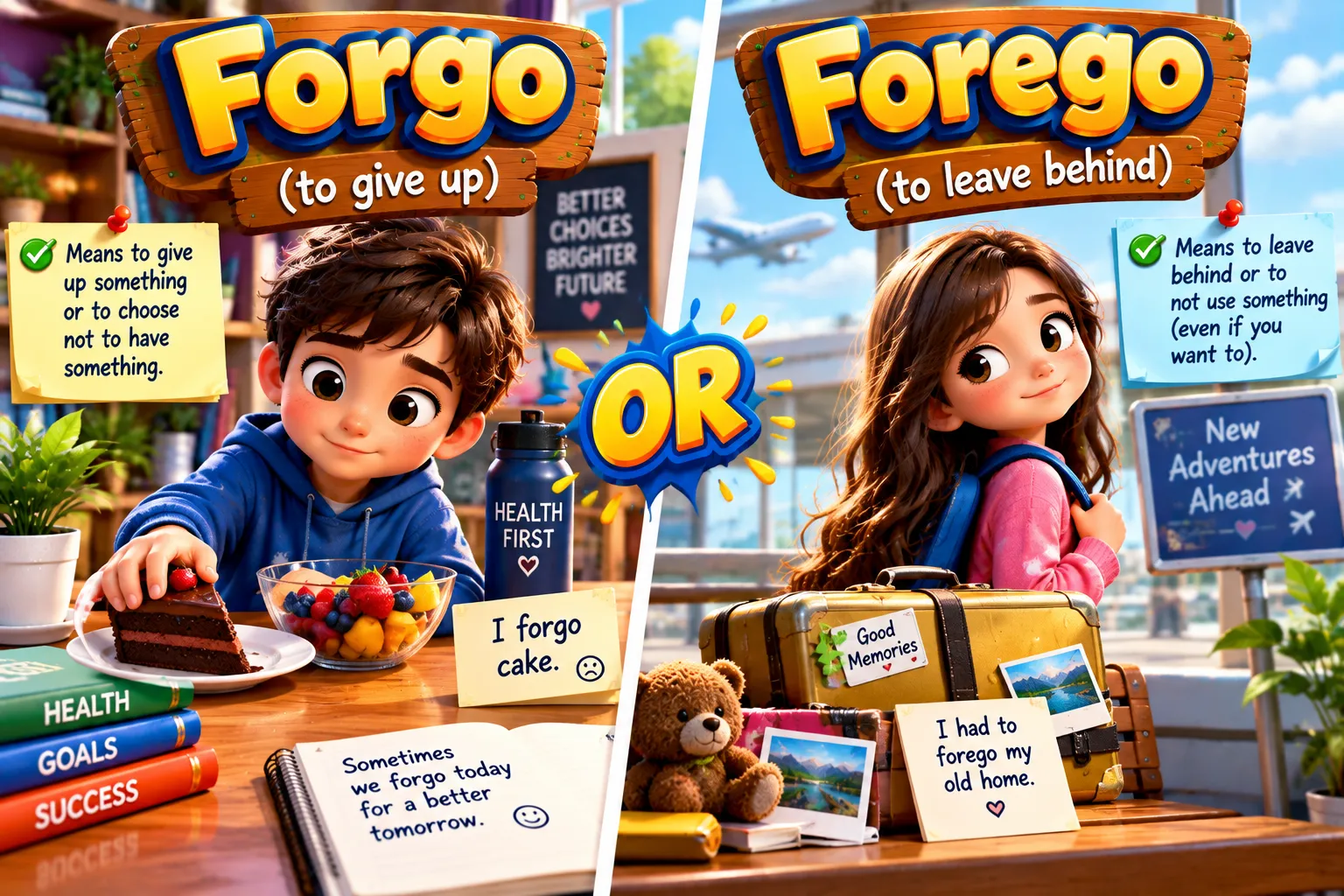
Forgo means to give up, skip, or do without something, while forego can mean the same thing in modern English but also has the older sense “to go before” or “precede.”
I have often seen writers pause over forgo and forego, especially when a sentence means “give up” or “do without.” The extra e looks small, but it can make you wonder whether it changes the meaning.
The confusion gets worse because modern dictionaries do not always treat the two spellings as completely separate. Cambridge lists forego as another spelling of forgo in the sense of giving something up. At the same time, forego has a distinct historical meaning: to go before.
That means the choice is not always as simple as “one is right and the other is wrong.”
If you are writing an email, school assignment, article, or formal report, there is a useful rule that makes the choice much easier: use forgo when you mean “give up,” and reserve forego for the “go before” sense when that distinction matters.
Let’s break it down with simple examples, word history, common mistakes, and practical rules.
Forgo or Forego Quick Answer
When you mean to give up, skip, or do without something, forgo is the clearest spelling.
- Forgo = give up or do without
- Forego = can also mean give up, but traditionally means go before or precede
For example:
I decided to forgo dessert after dinner.
Here, the person chooses not to have dessert.
Now consider:
The introduction foregoes the main discussion.
Here, forego can carry the older sense of coming before something.
Cambridge defines forgo as deciding not to have or do something, while its entry for forego also gives “to forgo” as a meaning.
So, if your intended meaning is “give up,” choose forgo in most modern writing.
The Origin and Background of Forgo and Forego
The two words look almost identical because their histories are closely tied to the verb go, but their prefixes developed different meanings.
According to Etymonline, forego comes from Old English foregan, meaning “to go before.” It is built from fore- + go. The prefix fore carries the idea of something being before or in front.
Forgo has a different historical path. Etymonline traces it to Old English forgan, with senses connected to refraining from something, leaving something undone, or passing something by.
That difference explains the traditional distinction:
- forgo → give up or refrain from
- forego → go before or precede
Over time, however, English usage blurred the line. Modern dictionaries such as Cambridge recognize forego as an alternative spelling of forgo when the meaning is “give up.”
This is a good example of how etymology and modern usage do not always line up perfectly.
Forgo Explained Key Differences and Variations
The safest way to remember the words is to focus on the meaning you want.
| Term | Meaning | When to Use | Region/Context |
| forgo | Give up or do without | When you choose not to have or do something | Modern formal English |
| forego | Give up or do without | Accepted as an alternative spelling in some dictionaries | Modern English |
| forego | Go before or precede | When something comes earlier in time or order | Traditional/literary use |
1. Forgo = give up
Use forgo when someone decides not to take, use, enjoy, or do something.
We chose to forgo the expensive upgrade.
The meaning is close to skip, give up, avoid, or do without.
Cambridge also gives examples of forgo meaning to give up something desirable or enjoyable.
2. Forego = give up
You may also see forego used with this meaning.
The family decided to forego the trip this year.
This spelling is recognized by dictionaries. Cambridge’s learner dictionary calls forego another spelling of forgo.
Still, forgo is usually the simpler choice if you want to make the meaning immediately clear.
3. Forego = come before
This is the special meaning worth remembering.
A short briefing will forego the main presentation.
Here, the briefing comes before the presentation.
The related word foregoing is especially useful in formal writing. Cambridge defines foregoing as referring to something that was just mentioned or described.
For example:
The foregoing discussion explains the main problem.
Here, foregoing means previously mentioned, not “given up.”
Which Version Should You Use?
For most learners, students, and general writers, this simple approach works well:
For beginners and students
Use forgo when you mean give up or do without.
It is easier to remember and avoids unnecessary confusion.
For professional writers
Use forgo for the “give up” meaning unless your style guide or house style prefers forego.
This keeps your meaning clear.
For formal or traditional writing
Use forego when you specifically mean precede or come before.
The related forms foregoing and foregone can also appear in formal language, especially in phrases such as foregone conclusion.
For global English
When your audience includes English learners from different regions, forgo is a useful choice for the “give up” meaning because the spelling makes the distinction easier to see.
Common Mistakes with Forgo and Forego
1. Using forego when you mean precede
Mistake:
The introduction forgoes the main chapter.
Better:
The introduction foregoes the main chapter.
If the meaning is “comes before,” forego preserves the traditional distinction.
2. Assuming forego is always wrong
Mistake:
“Forego” is never a correct word.
Correction:
Forego is a real English word. Modern dictionaries also recognize it as another spelling of forgo when it means “give up.”
3. Writing forgoed
Mistake:
She forgoed the opportunity.
Correct:
She forwent the opportunity.
The verb forgo has the irregular past tense forwent and past participle forgone. Cambridge lists these forms explicitly.
4. Writing foregoed
Mistake:
They foregoed the meeting.
Better:
They forewent the meeting.
The traditional inflection uses forewent and foregone, not foregoed. Cambridge lists these forms for forego as well.
5. Confusing foregoing with forgoing
The two forms can have different meanings.
- forgoing = giving something up
- foregoing = mentioned earlier or preceding
For example:
Forgoing coffee helped her sleep better.
But:
The foregoing paragraph explains the rule.
That small e can matter.
Forgo or Forego in Real-World Examples
Here are fresh examples from different types of writing.
Professional email
To keep the project within budget, we may need to forgo some optional features.
News article
Several retailers chose to forgo extended opening hours during the holiday period.
Social media post
I decided to forgo my usual takeout and cook at home tonight.
Formal report
The foregoing analysis identifies three factors that may affect the final result.
Notice the difference. The first three examples involve giving something up. The last uses foregoing to mean something already discussed.
Forgo or Forego Data, Trends & Usage
There is a useful lesson in the available corpus evidence: these forms have not always followed the neat distinction that modern grammar guides suggest.
Collins links both forgo and forego to Google Books Ngram Viewer data, showing that their historical usage can be studied across published books.
A British National Corpus analysis discussed in an Ohio State University linguistics dissertation also examined forego and forgo as variant forms and found that speakers show uncertainty around their verb forms, especially the past tense.
There is also evidence that the spelling distinction has shifted over time. A discussion published by The Independent noted that Google Books Ngram data showed forego historically appearing more often than forgo, while forgo became more common later.
So it would be misleading to claim that one spelling has always dominated English.
What about search volume?
Reliable public sources do not provide a stable, universally verifiable monthly search-volume figure for forgo vs. forego without access to a live SEO platform such as Semrush or Ahrefs. I therefore would not present an invented monthly number as fact.
The stronger takeaway is linguistic rather than numerical: people search for the pair because dictionaries recognize overlap in their modern usage, while forego also has a distinct traditional sense.
The search intent is therefore mainly informational. Readers usually want to know which spelling fits a sentence, what each word means, and whether the two forms are interchangeable.
Forgo vs. Forego: Standalone Comparison Table
| Term/Variant | Meaning | Region/Context | Best Used When |
| forgo | Give up; do without | Modern English | You mean “skip” or “give up” |
| forego | Give up; do without | Modern dictionary usage | Your chosen style accepts the variant |
| forego | Go before; precede | Traditional/literary | Something comes before another thing |
| forwent | Past tense of forgo | Modern English | You need the past tense of “give up” |
| forgone | Past participle of forgo | Modern English | Used with have, has, or had |
| foregoing | Previously mentioned; preceding | Formal writing | Referring to earlier text |
Forgo or Forego: A Simple Memory Trick
Try this:
FORGO = FORGET THE THING / GIVE IT UP
Think:
I will forgo the cake.
You are choosing not to have it.
For forego, focus on fore, which often relates to something being before or in front.
The foregoing section comes before the current section.
This trick is not a complete explanation of English etymology, but it is a useful memory aid.
FAQ: Forgo or Forego
Q: What does “forgo” mean?
A: Forgo means to give up, skip, or do without something. Cambridge defines it as deciding not to have or do something, even when you want it.
Q: What does “forego” mean?
A: Forego has two important uses. Modern dictionaries recognize it as another spelling of forgo, meaning “give up,” while its traditional meaning is “go before” or “precede.”
Q: Is “forgo” or “forego” correct?
A: Both can be correct, depending on the meaning and context. For give up, forgo is the clearest modern choice; forego is also accepted by dictionaries in that sense.
Q: Is “forgo” formal English?
A: Yes. Cambridge labels forgo as formal and gives examples of its use in serious and professional contexts.
Q: What is the past tense of “forgo”?
A: The past tense is forwent. The past participle is forgone, as in “She had forgone the opportunity.”
Q: What is the difference between “forego” and “foregoing”?
A: Forego is a verb. Foregoing is commonly an adjective or noun referring to something that came earlier or was just mentioned.
Q: Does “foregone conclusion” come from “forego”?
A: Yes. The expression contains the past participle foregone. Etymonline traces the older verb forego to the sense “to go before” and discusses the history of foregone conclusion.
Conclusion
The choice between forgo and forego becomes much easier once you focus on meaning.
Use forgo when you mean give up, skip, or do without something. For example, you might forgo dessert, a purchase, or an opportunity. Modern dictionaries also recognize forego as an alternative spelling with this meaning.
Use forego when you want the traditional sense of going before or preceding something. This distinction also helps explain words such as foregoing and the phrase foregone conclusion.
One more point matters: do not write forgoed when you need the past tense. The correct form is forwent, with forgone as the past participle.
If you want the simplest rule for everyday writing, remember: forgo = give up. That choice will keep most of your sentences clear and easy to understand.
Bookmark this guide so you never second-guess “forgo” and “forego” again.
Read More:
Cheque or Check: The Correct Spelling Explained

I specialize in English grammar, spelling, word choice, and language usage. My content is based on research from grammar references, style guides, dictionaries, and real-world usage to ensure it is accurate and practical.
At Spelling Comparison, I write guides that explain why words are confused, how they are used, and which form is correct in context. I also include proofreading tips, examples, and writing advice readers can apply immediately.
My goal is to publish clear, reliable content that helps readers make better writing decisions. Each guide is written for accuracy, clarity, and usefulness in school, work, business, and everyday communication.










