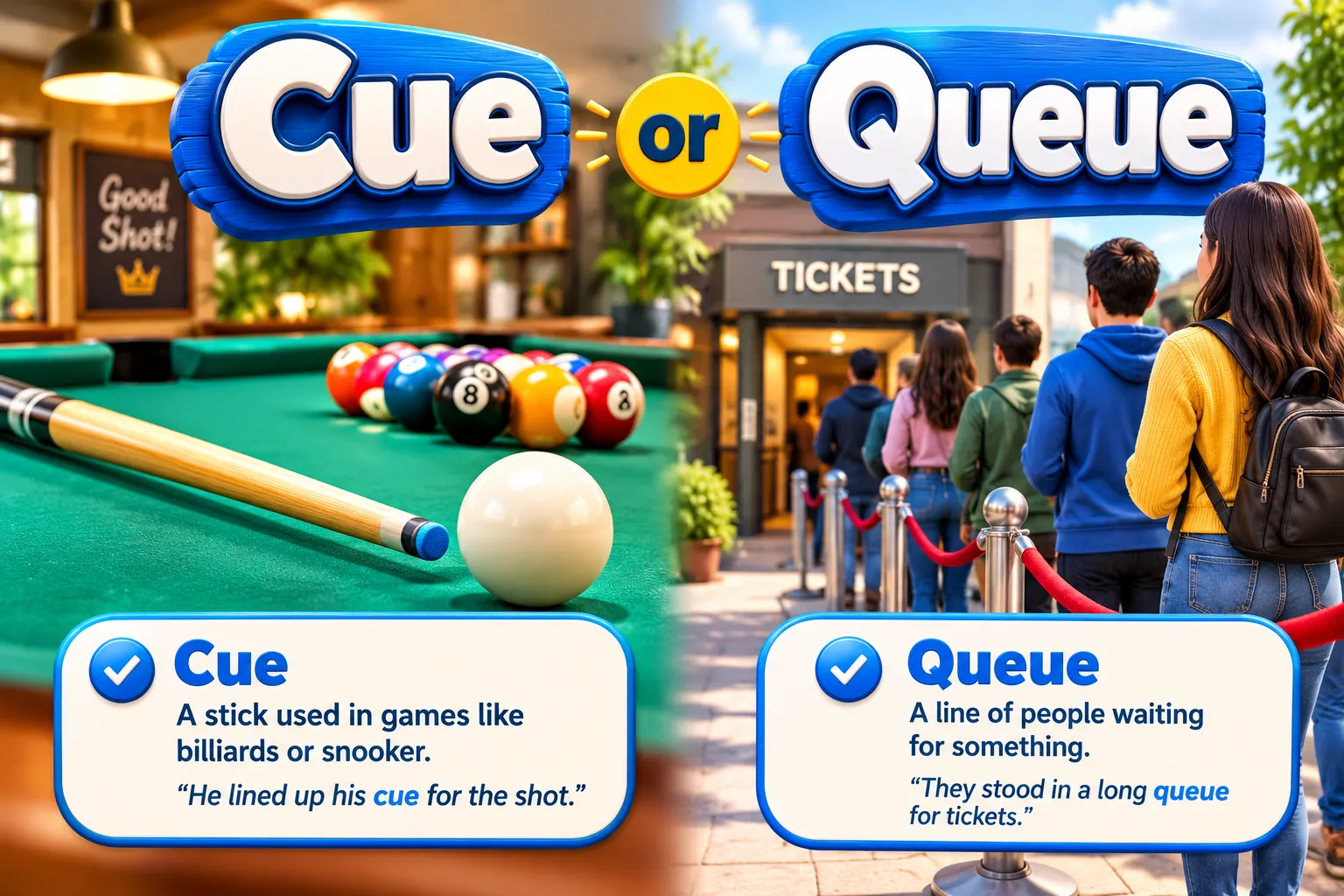
Cue means a signal, hint, or prompt, while queue means a line of people or things waiting their turn. Both are pronounced /kjuː/, but they have different meanings and spellings.
Have you ever written “cue” when you meant a line of people? Or typed “queue” when you simply meant a signal?
You are not alone. Cue and queue are classic English homophones. They sound the same, but their meanings are completely different. Cambridge defines a homophone as a word that sounds like another word but has a different spelling or meaning.
I have seen this mix-up often in student writing, emails, and everyday messages. The problem becomes even easier to understand when you say the words aloud. There is no sound clue to help you choose the spelling.
The good news is that the difference is simple once you connect each word with an idea.
Cue is about a signal or prompt. Queue is about waiting in line. Queue is also used in computing for tasks waiting to be processed.
In this guide, you will learn the meaning, history, correct usage, common mistakes, and easy memory tricks for cue or queue.
Cue or Queue Quick Answer
Use cue when you mean a signal, sign, hint, or prompt.
For example:
- The director gave the actor a cue to begin.
- Her smile was a cue that everything was fine.
Use queue when you mean a line of people or things waiting.
For example:
- We joined the queue outside the theater.
- There was a long queue at the ticket counter.
Cambridge also lists queue as a computing term for a series of data, files, calls, or other tasks waiting to be handled.
A quick memory trick:
Cue = signal.
Queue = line.
The Origin and Background of Cue and Queue
The two words have different histories, even though they now sound exactly alike.
Where does “cue” come from?
The history of cue is not completely certain.
Etymonline dates the theatrical noun to the 1550s. It describes cue as words at the end of a speech that signaled another actor to respond. One historical theory connects the spelling with the letter Q, which was used in some stage texts.
The meaning later expanded beyond theater.
Today, a cue can be any signal that tells someone what to do or what is about to happen. Cambridge gives examples involving theater, film, conversation, and everyday behavior.
The word also has another meaning. A cue is the long stick used to hit balls in games such as pool, billiards, and snooker.
Where does “queue” come from?
Queue has a different origin.
Etymonline traces the noun to French queue, meaning “tail,” from older French forms and ultimately Latin cauda. The idea of a “tail” later developed into the idea of people or things arranged one after another.
This history makes the modern meaning easier to picture.
Imagine people standing one behind another. The line stretches out like a tail.
Today, queue is especially common in British English. American English usually uses line for the same situation. Cambridge labels queue as mainly British and notes that Americans usually say line.
Cue or Queue Explained: Key Differences
The easiest way to choose the right word is to focus on the job the word is doing.
| Term | Meaning | When to Use | Region/Context |
|---|---|---|---|
| cue | A signal, sign, hint, or prompt | When something tells you to act or speak | General English |
| queue | A line of people or things waiting | When people or tasks are waiting their turn | Mainly British English |
| line | A row of people or things | Common alternative to “queue” | Especially American English |
| cue | A stick used in billiards or pool | When discussing cue sports | Sports context |
How to use “cue”
Cue can be a noun or a verb.
As a noun:
The change in music was her cue to enter the stage.
As a verb:
The producer cued the presenter to begin.
Cambridge defines the verb cue as giving someone a signal to do something.
You will also see useful expressions such as:
- on cue
- take your cue from someone
- cue someone in
- cue something up
For example:
Right on cue, the lights went out.
How to use “queue”
Queue can also be a noun or a verb.
As a noun:
A long queue formed outside the museum.
As a verb:
Visitors began to queue before the doors opened.
Cambridge explains that queue as a verb means to wait in a line. In American English, line up is more common.
Which Word Should You Use?
Your choice depends on the meaning and, sometimes, the type of English you are writing.
For students
Use cue when you mean a signal or hint.
Use queue when you mean a waiting line.
A simple test is to replace the word with signal or line.
- If signal works → cue
- If line works → queue
For British English
Queue is the normal word for a line of people waiting.
For example:
We waited in the queue for twenty minutes.
For American English
Line is usually more natural than queue when talking about people waiting.
For example:
We stood in line for tickets.
However, queue is still widely used in technical and computing contexts.
For professional and academic writing
Choose the word based on meaning, not pronunciation.
A report might say:
The software places incoming requests in a queue.
Another report might say:
The warning sound served as a cue for the operator.
Both are correct because they describe different ideas.
Common Mistakes With Cue and Queue
These words are easy to confuse because they sound alike.
| Common Mistake | Correct Version | Why? |
|---|---|---|
| Please join the cue. | Please join the queue. | You are joining a line. |
| That was my queue to leave. | That was my cue to leave. | The event was a signal. |
| The actor missed his queue. | The actor missed his cue. | An actor responds to a signal. |
| We waited in the cue. | We waited in the queue. | A waiting line is a queue. |
| The teacher gave me a queue to answer. | The teacher gave me a cue to answer. | The teacher gave a signal. |
Why do these errors happen?
The main reason is pronunciation.
Cue and queue are both pronounced /kjuː/ in standard British and American dictionary pronunciations. Cambridge gives the same pronunciation for both words.
When you hear the word, you cannot tell which spelling the speaker means.
You have to use context.
Cue or Queue in Real-World Examples
Professional email
Please wait for my cue before sharing the presentation with the client.
Here, cue means a signal.
News-style article
Long queues formed outside the stadium before the gates opened.
Here, queues means lines of people.
Social media post
Take that as your cue to finally book the trip you’ve been planning!
Here, cue means a sign or reason to act.
Formal report
All incoming requests are placed in a queue before they are processed by the system.
Here, queue has a computing meaning.
Entertainment
The host gave the singer a cue to begin the performance.
Again, cue means a signal.
Cue or Queue Data, Trends & Usage
People search for “cue or queue” because pronunciation does not reveal the spelling. Both words sound the same, yet they appear in very different contexts.
Search intent
The search intent behind “cue or queue” is mainly informational.
People usually want to know:
- Which spelling is correct?
- What does each word mean?
- Is it cue or queue in a particular sentence?
- How are the words pronounced?
- Why do they sound the same?
Search-volume data
Exact monthly search volumes vary by SEO platform, country, language, and date. Public dictionary pages do not provide reliable monthly keyword-volume figures, so it would be misleading to present an invented number as fact.
Tools such as Google Trends, Ahrefs, and Semrush can provide estimates, but those figures should be labeled as third-party estimates, not exact counts.
Corpus and dictionary evidence
Dictionary and corpus examples show that both words have several established uses.
Cue appears in contexts involving signals, theater, music, behavior, and cue sports. Cambridge also provides corpus examples involving visual, acoustic, and emotional cues.
Queue appears in everyday waiting situations and in computing. Cambridge includes examples involving ticket lines, traffic, companies waiting for opportunities, and computer processing.
Regional difference
One useful regional distinction is especially clear:
British English:
I am waiting in the queue.
American English:
I am waiting in the line.
Cambridge explicitly identifies queue as mainly British in this everyday sense and gives line as the usual American equivalent.
Why this matters today
The distinction is useful in more than schoolwork.
Modern writing often mixes British and American English. It also includes technical language, where queue has a specific computing meaning. At the same time, cue remains common in entertainment, communication, psychology, and everyday speech.
Knowing the difference helps you avoid errors that spell-checkers may not catch because both words are correctly spelled.
Cue vs. Queue: A Simple Comparison
| Term/Variant | Meaning | Region/Context | Best Used When |
|---|---|---|---|
| cue | Signal or prompt | General English | Someone receives a sign to act |
| queue | Waiting line | Mainly British English | People or things wait their turn |
| line | Waiting row | Mainly American English | Referring to people waiting |
| cue | Billiards stick | Pool, billiards, snooker | Talking about cue sports |
| queue | Waiting list of tasks | Computing and technology | Data or jobs await processing |
This table highlights an important point: cue and queue are not alternative spellings of the same word. They are separate words that happen to share a pronunciation.
Easy Ways to Remember Cue and Queue
If you often mix them up, try these memory tricks.
1. Cue = clue
Both cue and clue can relate to an idea that gives you information.
The teacher’s gesture was a cue.
Think:
Cue → clue → signal
2. Queue has a long line of letters
Look at the spelling:
Q-U-E-U-E
It has several letters after the Q, almost like a long line following the first person.
Think:
Queue → people waiting in line
3. Replace the word
When you are unsure, substitute another word.
If you can say signal, use cue.
If you can say line, use queue.
This works better than trying to remember the spelling alone.
FAQs About Cue or Queue
Q: What does “cue” mean?
A: Cue usually means a signal, sign, hint, or prompt that tells someone to act or speak. It is also the name of the stick used in games such as pool and snooker.
Q: What does “queue” mean?
A: Queue means a line of people or things waiting for something. In computing, it can also mean a group of tasks or data waiting to be processed.
Q: Are cue and queue pronounced the same?
A: Yes. Standard British and American pronunciations give both words as /kjuː/. Their different meanings and spellings make them homophones.
Q: What is the difference between cue and queue?
A: Cue is generally a signal or prompt. Queue is a waiting line or, in computing, a series of tasks waiting to be handled.
Q: Is “queue” British or American English?
A: Queue is especially common in British English for a waiting line. American English normally uses line or line up in everyday situations.
Q: Can “cue” be used as a verb?
A: Yes. To cue someone means to give them a signal to begin or do something. For example, a director can cue an actor to enter.
Q: Can “queue” be used as a verb?
A: Yes. In British English, people can queue or queue up when they wait in a line. In computing, a system can also queue tasks for later processing.
Q: Is “cue” the same as “clue”?
A: Not exactly. A clue is information that helps you discover or understand something. A cue is often a signal that prompts an action, though the two ideas can overlap in some contexts.
Q: How can I remember cue and queue?
A: Think cue = signal and queue = line. Another useful trick is to connect cue with clue, since both can point you toward an action or idea.
Conclusion
Choosing between cue or queue becomes easy once you focus on meaning instead of sound.
Use cue when you are talking about a signal, prompt, hint, or theatrical instruction. The word can also refer to the stick used in billiards and related sports.
Use queue when you mean a line of people or things waiting. In technology, a queue can also hold tasks, files, calls, or data until they are processed.
The two words are pronounced alike, which explains why they cause so many spelling mistakes. Their histories are also different. Cue developed in English around theatrical signaling, while queue came through French from a word meaning “tail.”
When you are stuck, use one simple test:
Can I replace it with “signal”? Use cue.
Can I replace it with “line”? Use queue.
That small trick can save you from one of the most common homophone mistakes in English.
Bookmark this guide and use it the next time you are unsure whether to write “cue” or “queue.”
Read More:
Unphased or Unfazed: The Complete Spelling Guide

I’m an English language educator and content writer with more than 10 years of experience helping learners improve their English skills. I specialize in spelling differences, grammar, vocabulary, synonyms, commonly confused words, and English usage. My goal is to create accurate, easy-to-understand articles that make learning English simple, practical, and enjoyable for students, writers, and professionals around the world.