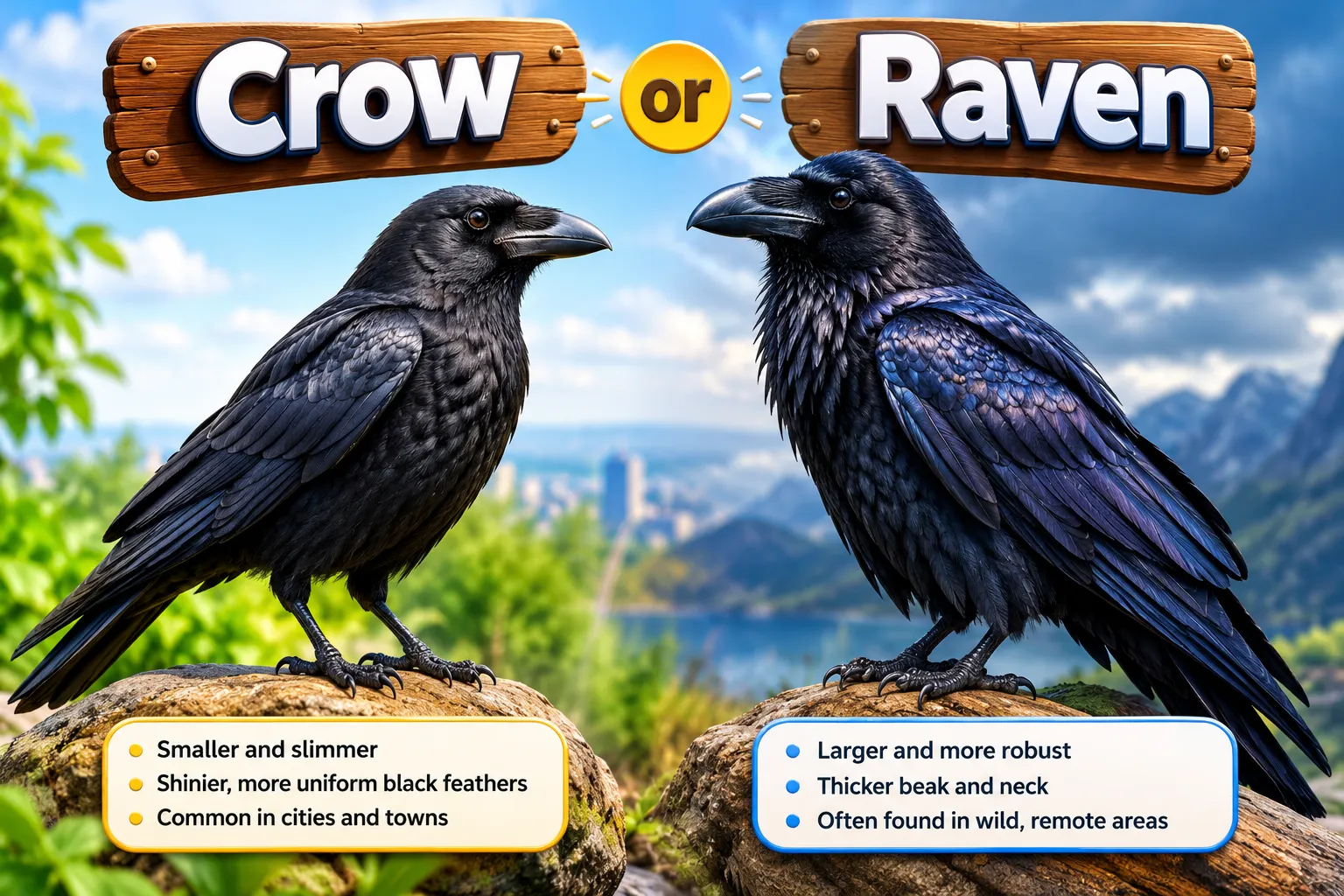
Crow or raven refers to two closely related black birds in the corvidae family, but a raven is generally larger, heavier-billed, and has a more wedge-shaped tail than a crow.
I was looking up at a black bird one day and wondering, “Is that a crow or a raven?” From the ground, it was difficult to tell. The bird was high in the sky, and all I could really see was its dark shape moving across the clouds. For a moment, I assumed it was a crow, but then I noticed its size and flight pattern and started to wonder if it might actually be a raven.
If you have ever had the same experience, you are not alone. Crows and ravens can look remarkably similar at first glance. Both are black, intelligent birds, and both belong to the Corvidae family. They can also live near people, making it easy to confuse one for the other.
The confusion becomes even greater when a bird is flying high above you. You may not be able to see its bill, throat feathers, or body size clearly. In that situation, its overall shape, tail, wing movement, and flight style can provide useful clues.
The good news is that you do not need to be an expert birdwatcher to tell a crow from a raven. A few simple features can make identification much easier.
In this guide, you will learn how crows and ravens differ in size, tail shape, bill, voice, behavior, habitat, and scientific classification. You will also see common identification mistakes, practical examples, and a quick comparison table to help you identify one the next time you spot a black bird.
Crow or Raven Quick Answer
A crow and a raven are not the same bird, although both belong to the genus Corvus and the wider crow family, Corvidae. The exact species matters because there are many different crows and ravens around the world.
The easiest rule is simple:
- Crow: usually smaller, with a shorter bill and rounded or squared tail.
- Raven: usually larger, with a heavier bill, shaggy throat, and wedge-shaped tail.
- Crow sound: commonly a strong caw.
- Raven sound: often a deeper croak.
For example, if you see a small black bird repeatedly calling “caw,” it may be a crow. If you see a much larger black bird soaring with a diamond-like tail, a raven is a stronger possibility.
The Origin and Background of Crow or Raven
The words crow and raven have very old roots in English.
According to the Online Etymology Dictionary, crow comes from Old English crawe. The word is thought to imitate the bird’s cry. Similar sound-based bird names appear in several Germanic languages.
Raven has a different history. It comes from late Old English forms such as ræfen and hræfn, ultimately connected with Proto-Germanic khrabanaz. The word also has related forms in languages such as Old Norse, Dutch, and German.
This is a useful lesson in etymology. Bird names are often shaped by sound, appearance, or very old cultural associations.
The two words also developed different meanings outside bird names. For example, crow can be a verb meaning to boast or express triumph. Raven also exists as an old verb meaning to prey upon or devour greedily.
So, while crow and raven are sometimes used loosely in everyday speech, they are not interchangeable when you are identifying a bird.
Crow or Raven Explained: Key Differences
The fastest way to identify these birds is to look at several features together.
| Term | Meaning | When to Use | Region/Context |
| Crow | A bird belonging to the crow group within Corvus | When identifying a crow species | Worldwide, depending on species |
| Raven | A larger type of Corvus bird | When identifying a raven species | Europe, Asia, North America, and other regions |
| American Crow | Corvus brachyrhynchos | For the common North American crow | Much of North America |
| Common Raven | Corvus corax | For the large raven species | Much of the Northern Hemisphere |
Cornell University’s Bird Academy notes that American Crows are generally about 20 inches long, while Common Ravens are around 27 inches. Their bills, tails, wings, and flight styles also differ.
1. Size
Size is one of your best clues.
An American Crow is noticeably smaller than a Common Raven. Cornell lists American Crow body length at roughly 40–53 cm, while Common Ravens measure about 56–69 cm.
If the bird looks surprisingly large, consider raven.
2. Bill
Look at the beak.
A crow has a relatively moderate bill. A raven has a much heavier and longer bill.
The raven’s bill can look almost oversized compared with its head. That strong shape is particularly useful when the bird is standing nearby.
3. Tail
The tail is extremely useful when the bird is flying.
A crow generally has a rounded or squared tail.
A raven has a wedge-shaped or diamond-like tail.
If you can see the tail clearly against the sky, this clue can be easier than judging size.
4. Throat feathers
A raven often has long, shaggy feathers around its throat.
These feathers can give its neck a rough or ruffled appearance. Cornell describes these elongated throat feathers as hackles.
A crow usually looks smoother around the throat.
5. Voice
Sound can solve the mystery.
American Crows are known for their familiar cawing calls. Common Ravens often produce a deeper, throatier croak.
Do not depend on one sound alone, though. Both groups have varied vocal repertoires.
Which Version Should You Use?
If you are talking about a real bird, choose the more specific name you can support.
- For a small black bird: “crow” may be appropriate if the species fits.
- For a large bird with a heavy bill: “raven” may be more accurate.
- For North American bird identification: consider the exact species, such as American Crow or Common Raven.
- For general writing: use crow or raven only when you know which group you mean.
- For formal reports: use the common name and, when needed, the scientific name.
This matters because crow is a broad everyday label. It does not always identify one exact species.
Cambridge Dictionary gives crow as a noun for a large black bird with a loud cry, while the scientific world uses more precise species names.
Common Mistakes With Crow or Raven
Mistake 1: “All black birds are crows.”
Correction: Black color alone does not identify the bird.
Many corvids have mostly black plumage. Size, tail shape, bill, voice, and location provide better clues.
Mistake 2: “A raven is just a male crow.”
Correction: A raven is not the male form of a crow.
They are different birds, although they are closely related.
Mistake 3: Looking only at size
Correction: Use several clues together.
A distant bird can look larger or smaller depending on its distance and angle. Tail shape and voice can help confirm your guess.
Mistake 4: “Caw means crow every time.”
Correction: Calls vary among species.
Cornell’s bird experts explain that crows and ravens have several different sounds. Their calls are more varied than the simple “caw versus croak” rule suggests.
Mistake 5: Confusing a raven with another large corvid
Correction: Check the bird’s location and species.
There are multiple crow and raven species. For example, the Chihuahuan Raven is smaller than the Common Raven and occurs in dry areas of the southwestern United States and northern Mexico.
Crow or Raven in Real-World Examples
Professional email
“I attached the wildlife survey notes from yesterday, including our observation of a possible Common Raven.”
News headline
Large Raven Spotted Near Mountain Wildlife Reserve
Social media post
“I finally learned how to tell a raven from a crow. The tail shape gave it away!”
Formal report
“The survey recorded several American Crows feeding in an open agricultural area.”
These examples show why precise bird names matter. In casual conversation, people may say “black bird” or simply “crow.” In scientific or professional writing, a more exact identification is better.
Crow or Raven Data, Trends & Usage
There is a major limitation with keyword data here: “crow” is a broad search term, so search-volume figures can include meanings and topics unrelated to the bird.
One third-party keyword database currently estimates roughly 673,000 monthly searches for “crow”, but that figure is from an Etsy-focused dataset rather than Google Search. It should therefore not be treated as a reliable measure of general Google search volume.
For that reason, this article does not present an invented “crow vs. raven” Google search-volume number.
What does the available evidence show?
- Search intent: Mainly informational when the query contains phrases such as “crow or raven,” “crow vs raven,” or “difference between crow and raven.”
- Topic interest: Strongly connected with bird identification, wildlife education, nature, photography, and general curiosity.
- Corpus evidence: Google Ngram Viewer can compare the written frequency of words such as crow and raven, but raw frequency does not tell us how often people mean the birds. Both words also have other literary and figurative uses.
- Regional variation: The species you are likely to encounter depends heavily on geography. Cornell notes that Common Ravens occupy much of the Northern Hemisphere, while American Crows are widespread across much of North America.
The key SEO insight is that “crow or raven” has clear comparison intent. A reader using this phrase usually wants a fast identification method, not a long history of ornithology.
Crow vs Raven: Standalone Comparison Table
| Term Variant | Meaning | Region Context | Best Used When |
| American Crow | Common North American crow species | Much of North America | You are identifying Corvus brachyrhynchos |
| Common Raven | Large raven species | Much of Northern Hemisphere | You are identifying Corvus corax |
| Chihuahuan Raven | Medium-sized raven | Southwestern U.S. and northern Mexico | You are in dry desert or grassland habitat |
| Carrion Crow | A crow species | Europe and parts of Asia | Identifying Corvus corone |
| Corvid | Member of the crow family | Global scientific context | Discussing crows, ravens, jays, and relatives collectively |
The word corvid is especially useful because it describes the wider bird family rather than one specific species.
FAQs About Crow or Raven
Q: What is the main difference between a crow and a raven?
A: A raven is generally larger and has a heavier bill and wedge-shaped tail. A crow is usually smaller, with a more rounded or squared tail.
Q: Which is bigger, a crow or a raven?
A: The Common Raven is considerably larger than the American Crow. Cornell lists Common Ravens at about 56–69 cm long compared with about 40–53 cm for American Crows.
Q: Can you tell a raven from a crow by its tail?
A: Often, yes. A raven’s tail usually forms a wedge or diamond shape in flight, while a crow’s tail tends to look rounded or squared.
Q: Do crows and ravens make the same sound?
A: No. American Crows commonly produce strong caws, while Common Ravens often make deeper, throaty calls. Both birds can produce many other sounds as well.
Q: Are crows and ravens the same species?
A: No. They are different birds, although both belong to the genus Corvus. The exact species depends on the bird and its location.
Q: Where does the word “crow” come from?
A: Crow comes from Old English crawe and is thought to imitate the bird’s cry. Related forms appear in several Germanic languages.
Q: Where does the word “raven” come from?
A: Raven comes from Old English forms such as ræfen and hræfn, with deeper roots in Proto-Germanic. Related words occur in several older Germanic languages.
Q: Can I call every large black bird a raven?
A: No. Black color and large size are not enough for reliable identification. Check the bill, tail, voice, habitat, and other field marks before deciding.
Conclusion: Crow or Raven?
The next time you see a black bird overhead, do not rely on color alone. Size, tail shape, bill shape, throat feathers, voice, and habitat give you a much better answer.
Remember the simplest clues:
- A crow is generally smaller.
- A raven is generally larger.
- Ravens have a heavier bill and shaggy throat.
- A raven’s flying tail often forms a wedge or diamond shape.
- Crows usually have a more rounded or squared tail.
- Their voices can also help, with crows commonly giving strong caws and ravens producing deeper calls.
There is one final lesson worth keeping in mind: not every crow-like bird is the same species. Geography matters. If you want a confident identification, combine several clues rather than trusting one feature.
Now you have a simple field guide in your head. The next time a black bird catches your eye, look at its tail, listen to its voice, and check its size. Bookmark this guide so you can identify your next crow or raven with confidence.
Read More:
Buses or Busses: The Easy Spelling Guide

I specialize in English grammar, spelling, word choice, and language usage. My content is based on research from grammar references, style guides, dictionaries, and real-world usage to ensure it is accurate and practical.
At Spelling Comparison, I write guides that explain why words are confused, how they are used, and which form is correct in context. I also include proofreading tips, examples, and writing advice readers can apply immediately.
My goal is to publish clear, reliable content that helps readers make better writing decisions. Each guide is written for accuracy, clarity, and usefulness in school, work, business, and everyday communication.