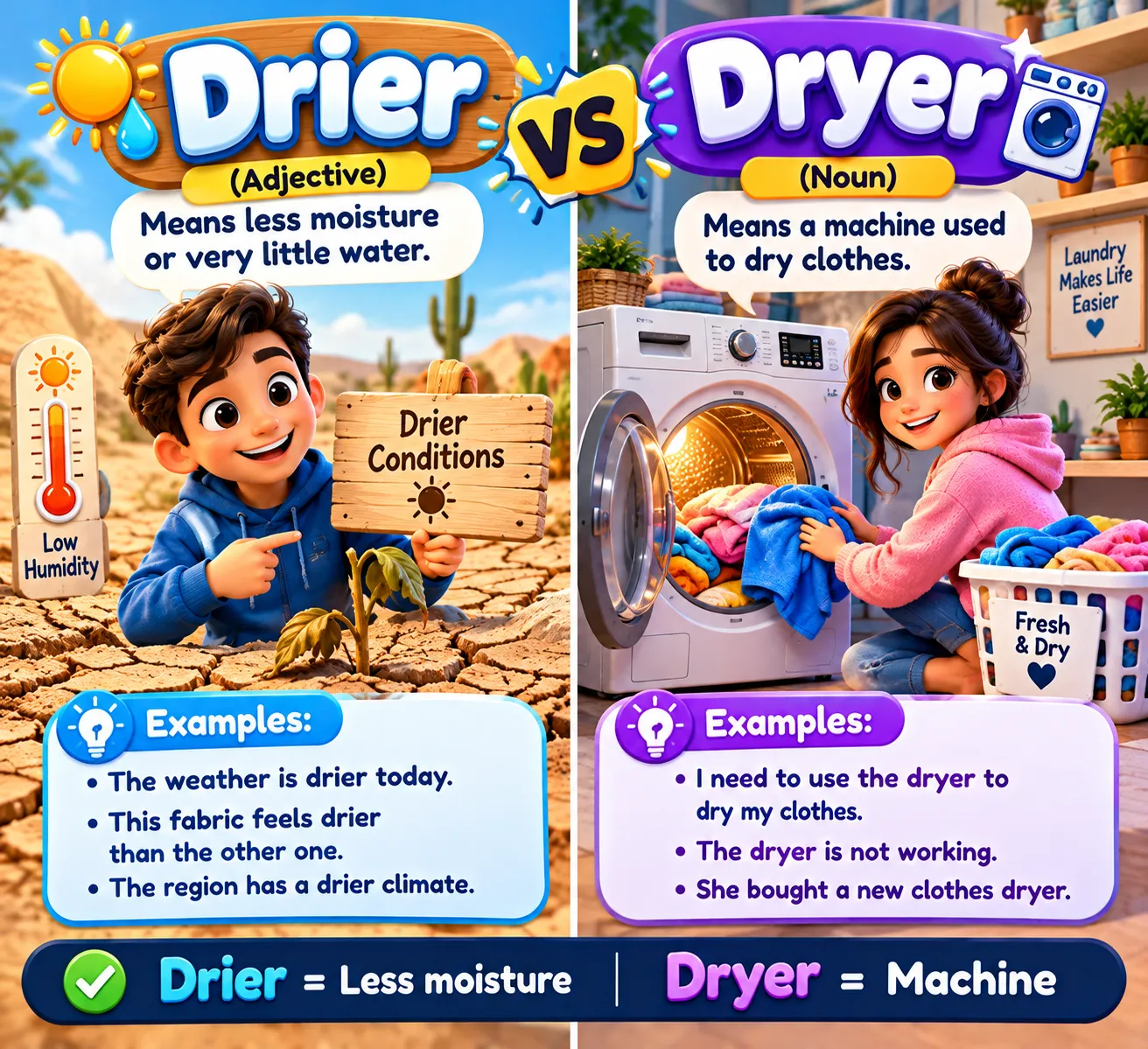
Drier means more dry, while dryer usually refers to a machine that removes moisture, such as a clothes dryer or hair dryer.
I have often come across confusion between drier and dryer in everyday writing. Have you ever paused while writing about the weather or laundry because you were unsure which word to use? You are not alone. These two words sound alike and both come from the word dry, but they usually have different meanings.
I use drier when comparing how dry two things are. For example, a desert may be drier than a forest. On the other hand, I use dryer when referring to a machine that removes moisture, such as a clothes dryer.
Once I understood this simple difference, choosing the correct word became much easier. The rule is straightforward: drier usually describes something that is more dry, while dryer usually refers to a device that dries things.
In this guide, I will explain the meanings, origins, grammar rules, and common mistakes associated with drier and dryer. I will also share simple examples, comparison tables, and practical tips to help you use both words correctly in emails, reports, and everyday conversations.
Drier or Dryer: Quick Answer
Use drier when you mean more dry. It is the comparative form of the adjective dry.
- The weather is drier this week than it was last week.
- The towel became drier after hanging in the sun.
Use dryer when you mean a machine or device that dries something.
- I put my wet clothes in the dryer.
- She bought a new hair dryer.
There is one useful detail: drier can also be a noun for a person, substance, or device that helps something dry. Some dictionaries list it as a variant of dryer. However, dryer is the clearest choice for a household machine, while drier is the usual spelling when comparing dryness.
The Origin and Background of Drier and Dryer
Both words come from the English word dry. The main difference comes from how each spelling is used.
According to the Online Etymology Dictionary, dry comes from Old English drygan, a verb meaning to make something dry or remove moisture. Its history shows how English words can change form while keeping a link to their original meaning.
The ending -er often helps form words that describe a person or thing that performs an action. For example:
- Teach → teacher
- Bake → baker
- Dry → dryer
In drier, however, the ending has a different grammatical role. It marks a comparison, just as tall becomes taller and cold becomes colder.
The noun drier has a long history, too. It has been used for a person or thing that dries something. It can also refer to a substance that helps materials such as paint dry. The spelling dryer is now familiar in the names of household appliances.
This history helps explain why the two forms can overlap. They are related words, and dictionaries recognize that drier can sometimes be a noun. Still, modern writing is easier to follow when you use drier for comparison and dryer for equipment.
Drier or Dryer Explained: Key Differences
The main difference is the word’s role in the sentence.
1. Drier: The Comparative Form of Dry
Drier is an adjective. It describes something that has less moisture than something else.
You can often test it by replacing drier with more dry. If the sentence still makes sense, drier is likely the word you need.
Examples:
- This year’s summer has been drier than last year’s.
- My skin feels drier after spending time in the sun.
- The paint needs a drier place to set.
In the third example, drier describes the place. It does not name a tool or machine.
2. Dryer: A Machine or Device
Dryer is usually a noun. It names something that removes moisture from an object or material.
Common examples include:
- Clothes dryer: A machine that dries clothes.
- Hair dryer: A device that blows warm or cool air to dry hair.
- Hand dryer: A device used to dry hands.
- Food dryer: Equipment used to remove moisture from food.
For example, “The dryer is making a strange noise” uses dryer as the name of a machine.
Oxford Learner’s Dictionaries defines a dryer as a machine used for drying something and lists related terms such as hairdryer, spin dryer, and tumble dryer.
Comparison Table: Drier vs. Dryer
| Term | Meaning | When to Use | Region/Context |
| Drier | More dry; having less moisture | Comparing weather, skin, soil, or other things | Standard English |
| Dryer | A machine or device that dries something | Talking about clothes, hair, hands, or food equipment | Standard English |
| Drier as a noun | A person, substance, or thing that helps something dry | Technical contexts, such as paint and printing | Accepted but less common for household machines |
| Drying | The process of removing moisture | Describing an action or process | Standard English |
| Dried | Already made dry or having lost moisture | Describing food, clothes, paint, or other materials | Standard English |
Remember the quick test: if you are comparing how dry something is, choose drier. If you are naming a machine, choose dryer.
Which Version Should You Use?
The best choice depends on what you want to say.
For Students and English Learners
Use drier when comparing two things.
- Correct: The soil is drier near the road.
- Less suitable for this meaning: The soil is dryer near the road.
The second sentence is not the clearest standard choice for a comparison. Use drier to make your meaning easy to understand.
For Emails and Everyday Writing
Use dryer when you mean an appliance.
- Recommended: The clothes dryer needs to be repaired.
- Less common: The clothes drier needs to be repaired.
Although drier can be a noun in some dictionaries, clothes dryer is the familiar spelling for the machine.
For Reports and Formal Documents
Be clear and consistent. If you are writing about climate, farming, or soil, use drier for comparisons. If you are writing about equipment, use dryer.
For example:
- The region has become drier over the past decade.
- The factory installed a new industrial dryer.
For Global English
Follow the same basic rule in British and American English. Both forms are recognized, but their usual roles differ. If you mean a machine, dryer is the safest and clearest choice.
Common Mistakes with Drier and Dryer
These errors are easy to make because the words sound alike. A quick check of meaning can help you avoid them.
Mistake 1: Using Dryer for a Comparison
Incorrect: The air is dryer today than yesterday.
Better: The air is drier today than yesterday.
Why? The sentence compares the moisture in the air. The comparative adjective drier fits that meaning.
Mistake 2: Using Drier for a Household Appliance
Less clear: I need to buy a new drier for my clothes.
Better: I need to buy a new dryer for my clothes.
Why? Dryer is the familiar spelling for a machine that removes moisture from clothes.
Mistake 3: Thinking One Spelling Is Always Wrong
Incorrect idea: Drier is never a noun.
Correct understanding: Drier can also be a noun. Some dictionaries list it as a variant of dryer or as a term for a substance that speeds up drying.
Why does this matter? English spelling can allow more than one form, even when one form is more common for a particular use.
Mistake 4: Confusing Drier with Dried
Incorrect: The clothes are drier after I washed them.
Better, if you mean they have lost moisture: The clothes are drier after I left them outside.
Better, if you mean they are no longer wet: The clothes have dried in the sun.
Why? Drier compares levels of dryness. Dried describes a completed change or a resulting state.
Mistake 5: Choosing by Sound Alone
Incorrect approach: Pick whichever spelling looks right.
Better approach: Ask what the word does in the sentence.
- Is it comparing two things? Use drier.
- Is it naming a machine? Use dryer.
This meaning-based check is more reliable than pronunciation because the two words are often pronounced alike.
Drier or Dryer in Real-World Examples
Here are examples showing how each spelling works in different types of writing.
1. Professional Email
Subject: Update on Storage Conditions
“Please move the paper supplies to a drier room to protect them from moisture.”
Here, drier describes the room. It means the room has less moisture than the current one.
2. News Headline
“Farmers Prepare for a Drier Season After Low Rainfall”
The word drier compares the expected season with a wetter one. It does not refer to a piece of equipment.
3. Social Media Post
“Rainy day laundry tip: Clean the lint filter before using your dryer!”
In this post, dryer names the appliance used to dry clothes.
4. Formal Report
“The facility added an industrial dryer to reduce moisture in the raw materials before packaging.”
The word dryer refers to equipment used in a work process.
5. Everyday Conversation
“My hair feels drier in winter, so I use less heat when styling it.”
This example compares the condition of the hair with its condition at another time.
6. Product Description
“This compact dryer is designed for small laundry rooms and apartments.”
The word identifies the product as a machine.
Drier or Dryer: Data, Trends, and Usage
Understanding these words is useful because both spellings are valid, but their meanings are not always interchangeable.
Search Intent
People searching for drier or dryer are usually looking for an answer to a spelling or grammar question. Their likely questions include:
- Which spelling is correct?
- Is drier a real word?
- Is it a clothes dryer or clothes drier?
- How do I use drier in a sentence?
This is mainly informational search intent. Readers want a clear rule and examples rather than a product to buy.
Word Frequency and Search Trends
Google Books Ngram Viewer lets readers compare how often words appear in books over time. Its data can help explore the use of driers and dryers, but it measures published book usage, not monthly search volume.
There is no verified monthly search-volume figure or current regional ranking available in the sources used for this guide. For that reason, exact numbers would be misleading. Tools such as Google Trends, Ahrefs, and Semrush can help researchers investigate search interest, but their results depend on the date, region, and settings selected.
Why the Difference Still Matters
Spelling checkers may accept both words because both exist in English. They may not know whether you mean a comparison or a machine. That is why context matters, even when you use a grammar tool.
For students, writers, and people learning English, the practical lesson is simple: check the meaning, not just the spelling.
Quick Comparison Table: Drier, Dryer, and Related Words
| Term/Variant | Meaning | Region/Context | Best Used When |
| Drier | More dry | British and American English | Comparing moisture levels |
| Dryer | A machine or device that dries | British and American English | Naming clothes, hair, or industrial equipment |
| Dried | Made dry or no longer wet | General English | Describing a result or completed process |
| Drying | Losing or removing moisture | General English | Describing an action in progress |
| Dry | Free from moisture; not wet | General English | Describing a condition or quality |
This table adds one helpful distinction: dried and drying describe other forms of the same word. They cannot always replace drier or dryer.
Frequently Asked Questions
Q: What is the main difference between drier and dryer?
A: Drier is usually the comparative form of dry. Dryer is usually a noun for equipment that removes moisture, such as a hair dryer.
Q: Is drier a real word?
A: Yes. Drier is a standard English word. It is the usual comparative form of dry, and dictionaries also recognize it as a noun in certain contexts.
Q: Is it a clothes drier or a clothes dryer?
A: Clothes dryer is the clearest and most familiar choice for the machine. Some dictionaries accept drier as a noun variant, but dryer avoids confusion.
Q: Is drier correct in formal writing?
A: Yes. Use drier when comparing levels of dryness in formal writing. For example, a report might describe one region as drier than another.
Q: How do you remember drier or dryer?
A: Link drier to comparisons, such as drier weather. Link dryer to devices, such as a hair dryer. Checking the word’s role in the sentence is the easiest method.
Q: Do drier and dryer sound the same?
A: In many accents, they sound the same or very similar. Because pronunciation may not help, use the sentence’s meaning to choose the right spelling.
Q: Can dryer mean more dry?
A: Dryer is mainly used as a noun for a machine or device. Although dictionaries may recognize it as a variant spelling of the comparative, drier is the clearer choice when you mean “more dry.”
Conclusion: Choose Drier or Dryer with Confidence
The difference between drier and dryer becomes easy once you focus on meaning. Both words are linked to dry, but they usually serve different purposes in modern English.
Use drier when comparing things. You might describe a dry season as drier than the one before it, or say that one towel is drier than another. Use dryer when naming a machine or device that removes moisture. A clothes dryer and a hair dryer are common examples.
Also remember that drier can sometimes be used as a noun. That does not make the words fully interchangeable in every sentence. For clear everyday writing, the comparison-versus-machine rule is a reliable guide.
When you proofread, ask yourself one question: Am I describing how dry something is, or naming something that dries it? That small check can prevent the most common mistake.
Now you know how to use drier and dryer. Bookmark this guide, share it with another English learner, and use the rule in your next piece of writing.
Read More:
Siblings or Dating: How to Tell the Difference

I’m **Rubab Naaz**, an English language content writer with over 10 years of experience creating educational and SEO-focused articles. I specialize in spelling comparisons, grammar, vocabulary, synonyms, commonly confused words, and English usage. My passion is helping students, writers, and professionals improve their language skills through accurate, well-researched, and easy-to-understand content. Every article I write is designed to make learning English simple, practical, and engaging.










