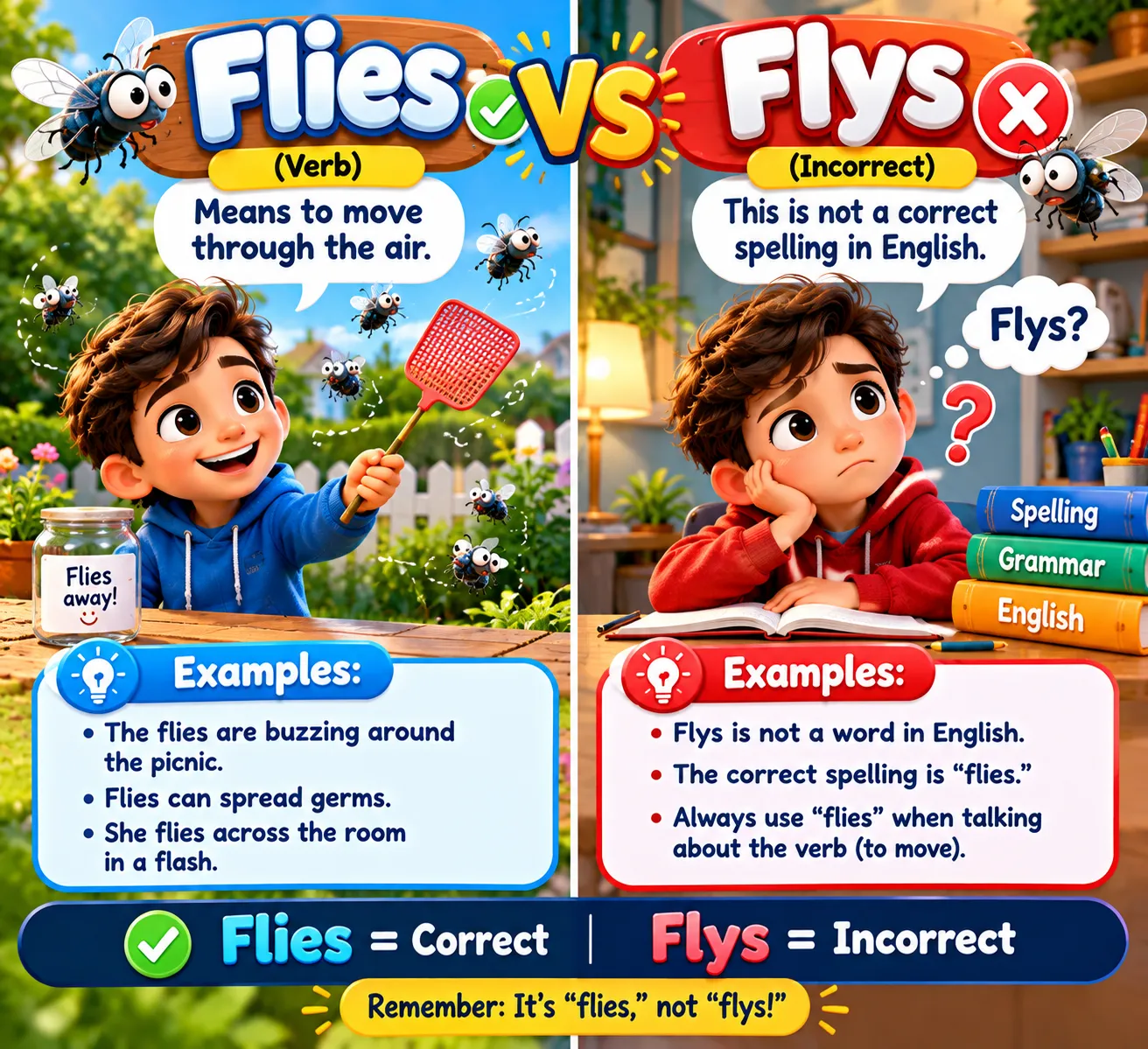
Flies is the correct plural of fly and the third-person singular form of the verb fly. Flys is generally a misspelling in standard English, although it may appear in specialized names or unusual contexts.
I have often seen people pause when writing the word fly. Should they write flies or flys? This small spelling choice can cause confusion in schoolwork, emails, social media posts, and everyday messages.
At first, the rule may seem tricky. Many English words form their plurals by adding -s. For example, book becomes books, and car becomes cars. So, it may seem natural to write flys. However, English has a spelling rule that changes the ending of many words that end in a consonant followed by y.
I use flies when talking about more than one flying insect. I also use it when describing what someone or something does, as in “The bird flies over the trees.” In both cases, flies follows a standard English spelling rule.
The good news is that you do not need to memorize a long list of words. Once you understand how -y changes to -ies, the difference becomes much easier to remember. In this guide, I will explain the meanings, grammar rules, word history, common mistakes, and practical examples to help you write with confidence.
Flies or Flys Quick Answer
In standard English, flies is the correct spelling when you mean several insects or describe an action performed by one person, animal, or thing.
Here are two new examples:
- The gardener noticed flies near the ripe fruit.
- My sister flies to Karachi for work.
The spelling flys is usually incorrect in these situations. If you are writing an essay, article, school assignment, or business email, choose flies.
The Origin and Background of Flies
The word fly has a long history in the English language. Understanding its origin helps explain why its modern spelling looks the way it does.
According to Etymonline, the noun fly comes from Old English flēoge, a word for a flying insect. The verb fly comes from the Old English word flēogan, meaning to move through the air.
Over time, English spelling and grammar changed. The plural form of fly developed into flies, following the spelling pattern that changes the final y to i before adding -es.
This pattern is not unique to fly. It also appears in words such as baby, city, and story.
The Cambridge Dictionary explains this general spelling rule in its English spelling guide. When a word ends in a consonant followed by y, the y normally changes to i before a suitable suffix is added.
This history also explains why flys may look reasonable at first. Many English words form plurals by adding only -s. However, the final letters of a word affect which spelling rule applies.
Flies Explained: Key Differences and Meanings
The word flies has two main grammatical uses. It can be a plural noun or a verb. The sentence tells you which meaning applies.
1. Flies as a plural noun
A noun names a person, place, thing, or animal. When flies is a noun, it means more than one fly.
Examples:
- Two flies landed on the window.
- The farmer keeps the stable clean to control flies.
- Several flies gathered around the fruit bowl.
The singular form is fly. The plural form is flies.
| Singular | Plural |
| One fly | Two flies |
| A baby | Several babies |
| One city | Many cities |
| One story | Several stories |
2. Flies as a verb
A verb describes an action or state. Flies is the present-tense form of fly used with a singular third-person subject, such as he, she, it, or a person’s name.
Examples:
- The eagle flies above the hills.
- Sarah flies home every December.
- This small insect flies toward the light.
Compare these forms:
| Subject | Correct verb | Example |
| I | fly | I fly to work. |
| You | fly | You fly often. |
| We | fly | We fly together. |
| They | fly | They fly at night. |
| He | flies | He flies every week. |
| She | flies | She flies with her family. |
| It | flies | It flies across the room. |
The key point is that the verb changes according to its subject. You use flies with he, she, or it, but you use fly with I, you, we, and they.
3. The spelling rule: Change Y to IES
Here is an easy rule to remember:
When a word ends in a consonant followed by Y, change Y to I and add ES to form many regular plurals and third-person singular verbs.
Examples:
- Fly → flies
- Try → tries
- Cry → cries
- Carry → carries
- Reply → replies
- Study → studies
There is one useful contrast. When a word ends in a vowel followed by y, you usually keep the y and add s.
For example:
- Boy → boys
- Toy → toys
- Day → days
- Play → plays
This is why the final letters matter. In fly, the letter before y is a consonant, l. In boy, the letter before y is a vowel, o.
Which Version Should You Use?
For almost all standard English writing, choose flies rather than flys.
- For students: Use flies in homework, exams, and grammar exercises.
- For professional writers: Use flies in reports, articles, emails, and other formal documents.
- For English learners: Remember the consonant-plus-y rule. It also helps with words such as carry and study.
- For social media users: Use flies when writing about insects or something moving through the air.
- For global English: Use flies in both British and American English. This spelling does not change between these varieties.
Could flys ever appear in writing? Yes, it may appear as a deliberately chosen brand name, username, or stylized label. A proper name can use unusual spelling. That does not make flys the standard plural of fly.
If you see flys in an ordinary sentence, check whether the writer meant flies.
Common Mistakes with Flies or Flys
Even experienced writers can make spelling mistakes when a word looks familiar. These are the most common errors to watch for.
Mistake 1: Adding only -s
Incorrect: The flys are near the window.
Correct: The flies are near the window.
Why? Fly ends in a consonant followed by y. Change the y to i and add -es.
Mistake 2: Using flies with the wrong subject
Incorrect: They flies across the field.
Correct: They fly across the field.
Why? The subject they takes the base form fly. The form flies is used with a singular third-person subject.
Mistake 3: Confusing flies with flew
Incorrect: Yesterday, the bird flies away.
Correct: Yesterday, the bird flew away.
Why? Flew is the simple past tense of fly. Use it for an action that happened in the past.
Mistake 4: Using flys in formal writing
Incorrect: The report explains how flys spread around food.
Correct: The report explains how flies gather around food.
Why? Flys is not the standard plural spelling. Use flies in schoolwork, professional documents, and published content.
Mistake 5: Changing the y when you should not
Incorrect: The boys watched the fl ies near the toys.
Correct: The boys watched the flies near the toys.
A related error is writing boies instead of boys. Words ending in a vowel followed by y usually keep the y when forming plurals.
Flies or Flys in Real-World Examples
Seeing a word in different situations makes its correct use easier to remember. Here are four fresh examples.
1. Professional email
Hello Team,
I noticed several flies near the staff kitchen this morning. Could we please arrange a cleaning check and review the current pest control measures?
Thank you for your help.
Best regards
2. News headline
Heavy Rain Drives Flies Indoors Across Local Homes
Here, flies is a plural noun because the headline refers to several insects.
3. Social media post
Summer tip: Keep food covered and clean up spills quickly. Small steps can help keep flies away from your kitchen! 🪰
4. Formal report
The report states that the aircraft flies over the test area twice each day.
In this sentence, flies is a verb. The singular subject aircraft takes the third-person singular verb form.
Flies or Flys Data, Trends, and Usage
When comparing spelling variants, it is useful to separate established grammar rules from online search trends.
What do dictionaries tell us?
The standard spelling is well established. The Cambridge Dictionary provides guidance on the consonant plus y rule, while Etymonline documents the historical development of fly. These sources support using flies in standard English.
What about search volume?
Google Trends can compare search interest, but it does not provide exact monthly search counts. Its search tips also explain that spelling variants are treated as separate search terms.
I have not verified exact monthly search volumes for flies and flys, so I will not give invented figures or percentages. Tools such as Semrush and Ahrefs may provide keyword-volume estimates, but those figures should be checked directly and dated before publication.
| Usage factor | What we can establish |
| Search intent | Mainly informational |
| Main question | Which spelling is correct? |
| Standard spelling | Flies |
| Common error | Flys |
| Regional variation | Flies is standard in British and American English |
| Practical value | Helps improve grammar, spelling, and proofreading |
The main lesson is simple: a spelling guide should rely on established grammar rules rather than unsupported search statistics. Correct spelling also helps readers understand your writing, whether they are reading a school assignment, an email, or a website article.
Standalone Comparison Table: Fly, Flies, Flys, Flew, and Flown
These related forms can look similar, but each has a different role.
| Term/Variant | Meaning | Region/Context | Best Used When |
| Fly | Singular insect or base verb | British and American English | Referring to one insect or using the verb with I, you, we, or they |
| Flies | Plural noun or present-tense verb | Standard English | Referring to multiple insects or an action by he, she, or it |
| Flys | Nonstandard spelling in ordinary usage | Rare names or stylized labels | Only when reproducing an intentional name or label |
| Flew | Simple past tense of fly | Standard English | Describing an action completed in the past |
| Flown | Past participle of fly | Standard English | Using forms such as “has flown” or “had flown” |
| Flying | Present participle or gerund | Standard English | Describing an action in progress or an activity |
Remember that flies, flew, flown, and flying are not interchangeable. Choose the form that fits both the meaning and the tense of your sentence.
Frequently Asked Questions
Q1: Is it flies or flys?
A: Flies is the correct spelling in standard English when referring to more than one fly or describing what a singular subject does. Flys is generally a spelling error in these contexts.
Q2: Why does fly change to flies?
A: The word ends in a consonant followed by y. Under the usual English spelling rule, the y changes to i before -es is added.
Q3: Is flies a noun or a verb?
A: It can be either. As a noun, it refers to several insects. As a verb, it describes an action performed by a singular third-person subject, such as a bird or a pilot.
Q4: Can I use flys in formal writing?
A: Avoid flys when you mean the plural of fly or the present-tense verb form. It may appear in a proper name or brand, but standard grammar calls for flies.
Q5: What is the difference between fly and flies?
A: Fly can refer to one insect or serve as a base verb. Flies refers to multiple insects or is the verb form used with a singular third-person subject.
Q6: What is the past tense of fly?
A: The usual simple past tense is flew. For example, “The plane flew through the clouds.” The past participle is flown, as in “The plane has flown this route before.”
Q7: Does British English use flies or flys?
A: British English uses flies, just as American English does. There is no standard regional spelling difference for this word.
Conclusion: Choose Flies with Confidence
The difference between flies and flys becomes easy once you understand the spelling rule. In standard English, flies is the correct form for both the plural of the insect fly and the present-tense verb used with he, she, or it.
Keep these three points in mind:
- Change the final y to i and add -es when the consonant plus y rule applies.
- Use fly with subjects such as I, you, we, and they.
- Use flew for the simple past and flown with helping verbs such as has or had.
You do not need to memorize every spelling in English. Learning a few useful patterns can help you avoid many common mistakes. The same consonant-plus-y rule applies to words such as tries, carries, and studies.
Whenever you are unsure, check the word’s role in the sentence and apply the rule. Bookmark this guide for your next writing task, and share it with someone who wants to improve their English spelling.
Read More:
Drier or Dryer: Easy Spelling and Usage Guide

I’m Daniel sultan, an English language writer and SEO content specialist with experience researching spelling, grammar, vocabulary, and English usage. Through SpellComparison.com, I create clear, accurate, and well-researched guides that help readers understand commonly confused words, spelling differences, and grammar rules with confidence.
Every article I write is based on trusted language references, established style guides, and real-world usage to ensure it is accurate, practical, and easy to understand. My goal is to make learning English simple and reliable by providing fact-checked content, clear explanations, and real-life examples that students, writers, educators, and professionals can trust.