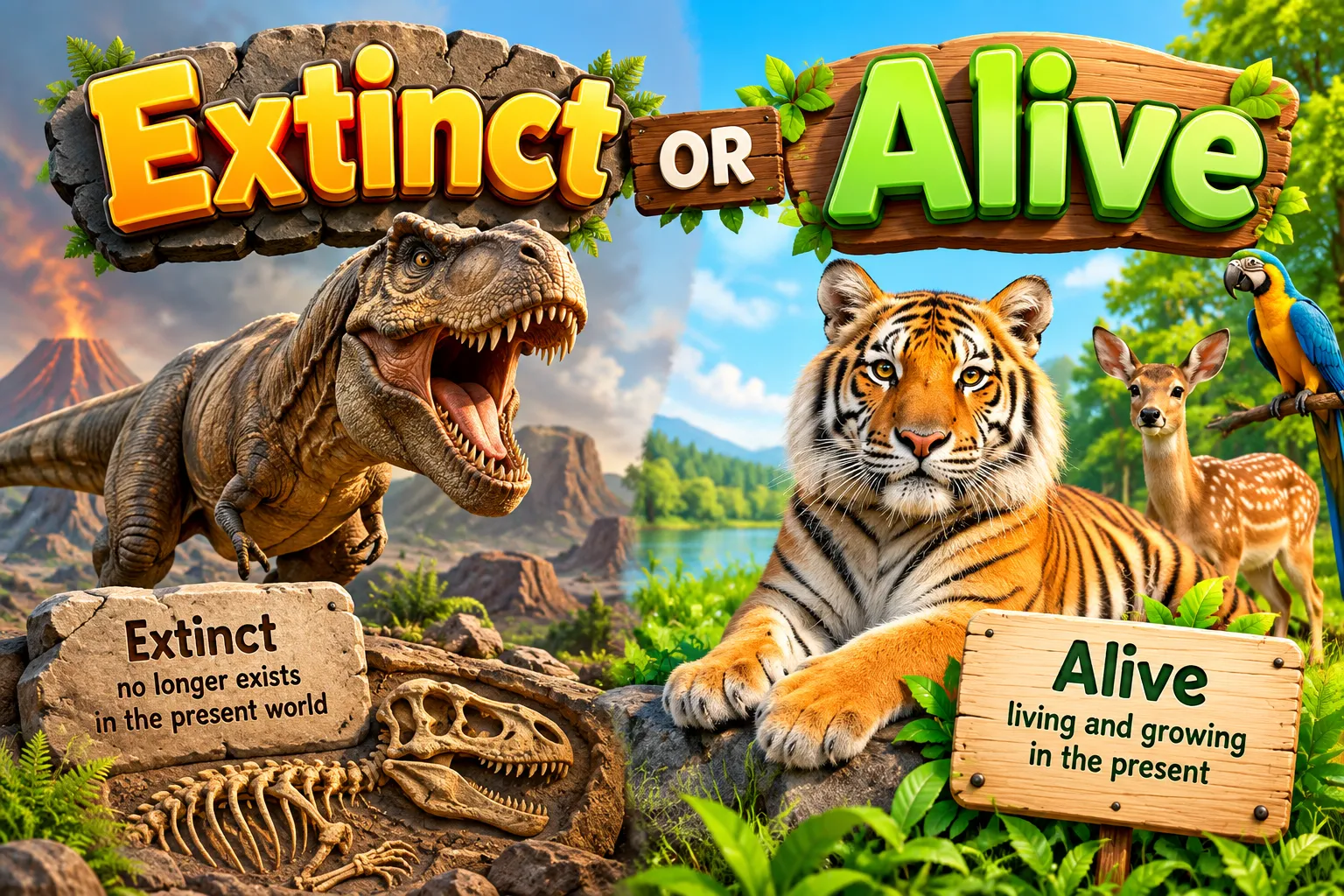
Extinct means a species, group, or thing no longer exists, while alive means living or still existing.
“Extinct or alive?” sounds like a simple question, but these two words describe very different ideas. You may see them in wildlife articles, history books, science lessons, and everyday conversations.
The main difference is simple: extinct means a species or group no longer has any living members, while alive means living or still existing. For example, the dodo is extinct, while dolphins are still alive today.
The words can also be used in broader ways. Extinct may describe a language, tradition, or practice that has completely disappeared. Alive can describe something that continues to exist, remain active, or be practiced.
Understanding the difference between extinct and alive also helps you avoid confusing related terms such as endangered, threatened, living, and extinct in the wild.
Extinct vs. Alive: Key Differences
| Term | Meaning | When to Use | Example |
| Extinct | No living members of a species or group remain | For species, languages, traditions, or groups that have disappeared | The dodo is extinct. |
| Alive | Living or still existing | For people, animals, plants, or things that continue to exist | The bird is still alive. |
| Living | Currently having life or existing | As a general alternative to alive | Many living species are endangered. |
| Endangered | At risk of becoming extinct | For species that still exist but face serious threats | The species is endangered. |
| Extinct in the Wild | Survives only outside its natural habitat | In conservation and biology | The species is extinct in the wild. |
| Extirpated | No longer found in a particular area but survives elsewhere | In ecology and conservation | The wolf was extirpated from the region. |
In short:
Alive = still living or existing
Endangered = still alive but at risk
Extinct = no living members remain
Now that the basic difference is clear, let’s look at what extinct and alive mean in more detail.
.
Extinct or Alive Quick Answer
Extinct means that no living members of a species or group remain. Alive means living, or in some contexts, continuing to exist or operate.
Examples:
- The dodo is extinct.
- Many species are still alive today.
- The museum has a model of an extinct animal.
- The ancient tradition is still alive in some communities.
The key difference is simple:
Extinct = no longer existing as a living species.
Alive = living or still existing.
The Origin / Background of Extinct or Alive
The word extinct comes from Latin exstinguere, meaning “to extinguish” or “put out.” English later adopted the word to describe something that had been extinguished or had ceased to exist. Merriam-Webster traces extinct to Latin roots and records its use in English from the 15th century.
The word alive has a different history. It developed from Middle English forms related to the phrase “on life” or “in life.” Merriam-Webster defines it as being in a state of living or having life.
In biology, extinct has a more specific meaning than simply “dead.” A single animal can die, but a species is described as extinct when there are no surviving individuals.
That distinction is important.
Extinct or Alive Explained Key Differences
| Term | Meaning | When to Use | Region/Context |
| Extinct | No longer existing as a living species or group | Talking about species or things that have disappeared | Biology, science, history |
| Alive | Living or having life | Talking about people, animals, plants, and other living things | Everyday and scientific English |
| Living | Currently alive or existing | Describing something that has life | General English |
| Endangered | At risk of extinction | Talking about threatened species | Conservation and biology |
What does “extinct” mean?
Extinct describes something that has completely disappeared.
For example:
The passenger pigeon is extinct.
This means the species no longer has any living members.
You can also use extinct in non-biological contexts:
That old custom is now extinct.
Here, it means the custom has disappeared or is no longer practiced.
What does “alive” mean?
Alive means having life.
The bird is still alive.
It can also mean that something continues to exist or remain active:
The old tradition is still alive.
This broader meaning makes alive useful outside biology.
Extinct vs. Endangered: Don’t Mix Them Up
One of the most important differences is between extinct and endangered.
An endangered species still has living members but faces a significant risk of extinction.
An extinct species has no surviving members.
Think of the progression like this:
Alive → Threatened → Endangered → Extinct
This is a simplified way to understand the concepts. Conservation categories are more detailed in formal systems.
The International Union for Conservation of Nature (IUCN) uses categories such as Critically Endangered, Endangered, Vulnerable, and Extinct in its Red List framework. (iucnredlist.org)
Which Version Should You Use?
For students
Use alive when something is living now.
The animal is alive.
Use extinct when a species or group has completely disappeared.
The species is extinct.
For science writing
Be precise.
Do not say a species is dead when you mean the entire species has disappeared. Extinct is the more precise biological term.
For everyday English
Alive has several useful meanings.
You can say:
- The patient is alive.
- The plant is alive.
- The project is still alive.
- The tradition is alive.
Extinct is more strongly associated with species, historical groups, languages, customs, and practices that have disappeared.
For global or neutral English
Both words are standard across major varieties of English. The main issue is not regional spelling. It is using the word that matches the meaning.
Common Mistakes with Extinct or Alive
1. Mistake: “The species is dead.”
Better: “The species is extinct.”
If you mean that no members of the species remain, extinct is the precise term.
2. Mistake: “The endangered animal is extinct.”
Correction: “The animal is endangered.”
If living members still exist but face a serious threat, it is not extinct.
3. Mistake: “Extinct means one animal has died.”
Correction: Extinct normally describes the disappearance of an entire species or group.
One dead animal does not make a species extinct.
4. Mistake: “Alive” only refers to animals.
Correction: Alive can describe people, animals, plants, and figurative things.
The old tradition is still alive.
5. Mistake: “The dinosaur is extinct.”
Better: “Non-avian dinosaurs are extinct.”
When discussing dinosaurs scientifically, remember that modern birds are living dinosaurs in evolutionary terms. The phrase “the dinosaurs are extinct” is common in general speech, but scientific wording can be more precise.
Extinct or Alive in Real-World Examples
Professional email
The conservation team confirmed that the population is still alive, although it remains at risk.
News article
Scientists continue to investigate whether the species is truly extinct.
Social media post
It is amazing to learn that some animals once thought extinct are still alive today!
Formal report
The assessment classified the species as endangered rather than extinct because surviving populations remain.
History article
The ancient language is considered extinct because it no longer has native speakers.
Extinct or Alive Data, Trends & Usage
The search intent behind “extinct or alive” is primarily informational. Readers may use the phrase when researching animals, plants, languages, historical groups, or species believed to have disappeared.
Exact monthly search-volume figures depend on the country, SEO platform, and date. Google Trends can show relative search interest over time, but it does not provide a fixed universal monthly search count.
Extinction is a major scientific topic
The IUCN Red List is one of the major global resources used to assess species extinction risk. Its categories help scientists and conservationists describe how threatened species are.
A key language point is that endangered does not mean extinct. An endangered species still exists. Extinction means the species has disappeared completely.
Why does this topic matter?
Climate change, habitat loss, invasive species, pollution, overexploitation, and other pressures can affect biodiversity. Understanding terms such as alive, endangered, threatened, extinct, and extinct in the wild helps readers understand conservation news more accurately.
The term extinct in the wild is especially useful because it shows that extinction can have different conservation meanings.
A species can disappear from its natural habitat while surviving in captivity or controlled environments.
Extinct or Alive: Why “Extinct” Does Not Always Mean “Gone Forever”
In everyday language, people may think extinct means something can never return.
Biologically, the term describes the absence of living members, based on the evidence available. Scientists sometimes rediscover species that were believed to be extinct. These are often called Lazarus species in popular scientific discussion.
That does not mean extinction is normally temporary. It means that determining whether the last individual has died can be extremely difficult.
This is one reason scientists carefully assess evidence before declaring a species extinct.
Extinct or Alive: A Useful Vocabulary Ladder
If you are writing about wildlife, these words can help you be more precise:
Alive
The organism is living.
Threatened
The organism faces risks that could harm its survival.
Endangered
The species faces a high risk of extinction.
Critically Endangered
The species faces an extremely high risk of extinction.
Extinct in the Wild
The species survives only outside its natural habitat.
Extinct
No living members of the species are known to remain.
These terms should not be used as casual synonyms. Each has a different meaning in conservation science.
FAQs About Extinct or Alive
Q: What does extinct mean?
A: Extinct means that a species or other group no longer has any living members. In conservation, it is a specific status rather than simply another word for “dead.” (iucnredlist.org)
Q: What does alive mean?
A: Alive means having life or being in a living state. It can also describe something that continues to exist or remain active.
Q: Is extinct the opposite of alive?
A: In a broad sense, they can represent opposite states. However, extinct normally describes an entire species or group, while alive can describe an individual organism.
Q: What is the difference between extinct and endangered?
A: An endangered species still has living members but faces a risk of extinction. An extinct species has no known surviving members.
Q: Can an extinct species come back?
A: A truly extinct species has no living members, so it cannot naturally reproduce and return. However, species once thought extinct can sometimes be rediscovered if surviving individuals were missed.
Q: Can a language be extinct?
A: Yes. A language may be called extinct when it no longer has speakers. Linguists may use more specific terms, such as dead or dormant, depending on the situation.
Q: Is “alive” a noun or adjective?
A: Alive is primarily an adjective. It describes someone or something that has life or continues to exist.
Q: Is “extinct” an adjective?
A: Yes. Extinct is an adjective. It describes something that has ceased to exist, especially a species or group that has disappeared.
Conclusion: Extinct or Alive Made Easy
The difference between extinct or alive is simple once you focus on what is being described.
Alive means living or continuing to exist. Extinct means that a species or group has completely disappeared, with no known living members remaining.
Do not confuse extinct with endangered. An endangered species is still alive, but it faces a risk of disappearing. You should also remember that extinct in the wild has a special conservation meaning because a species may survive under human care even after disappearing from nature.
For everyday English, use alive for people, animals, plants, and things that continue to exist. Use extinct when something has disappeared completely, especially a species, language, or historical practice.
Once you understand that distinction, choosing between the two becomes easy.
Bookmark this guide and share it with someone who wants to understand the difference between extinct, endangered, and alive.
Read More:
Laying or Lying: The Easy Guide to Correct Use

I’m **Rubab Naaz**, an English language content writer with over 10 years of experience creating educational and SEO-focused articles. I specialize in spelling comparisons, grammar, vocabulary, synonyms, commonly confused words, and English usage. My passion is helping students, writers, and professionals improve their language skills through accurate, well-researched, and easy-to-understand content. Every article I write is designed to make learning English simple, practical, and engaging.