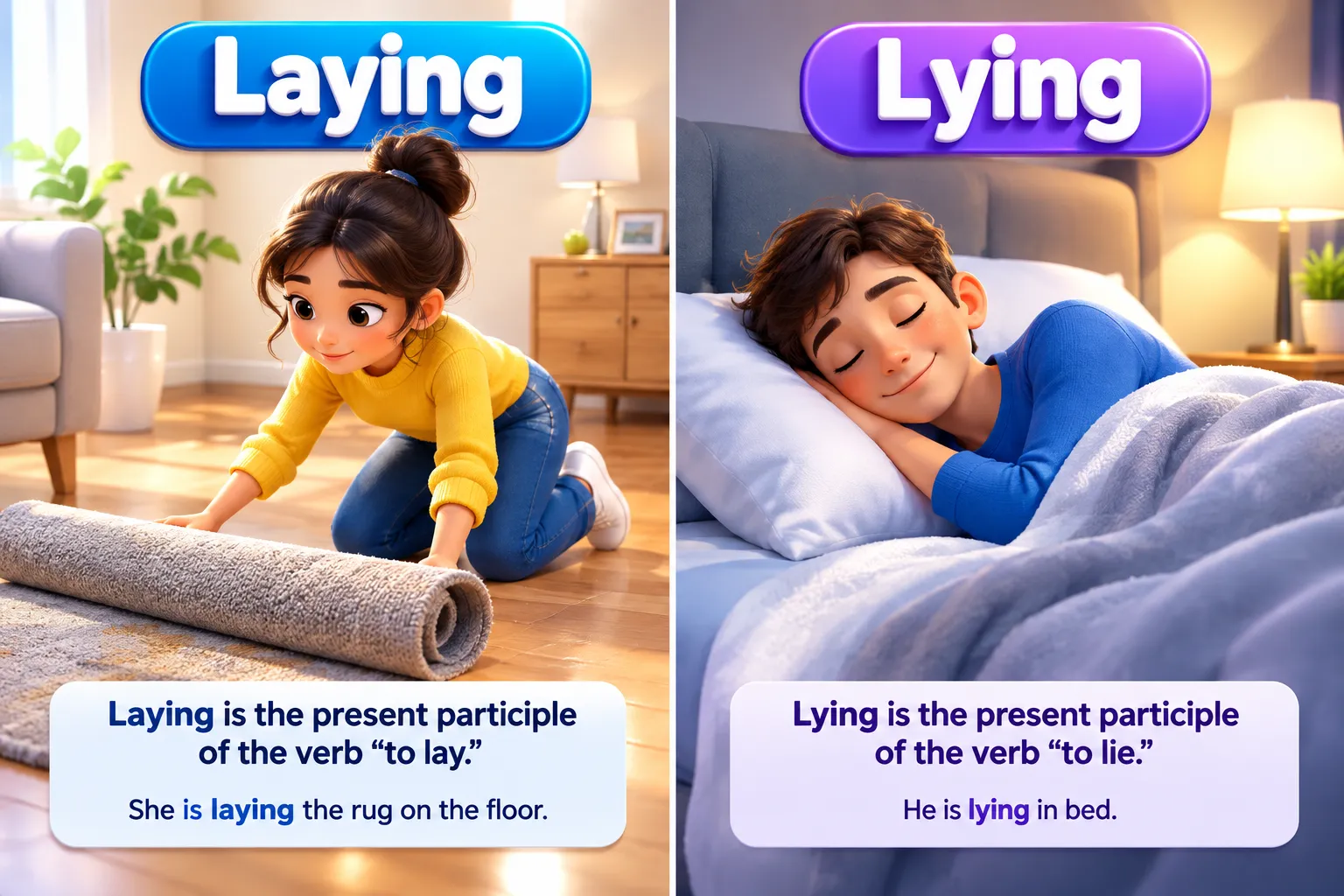
Laying means putting or placing something somewhere, while lying means being in a flat or resting position. Lying is also the present participle of lie, meaning to tell an untruth.
Few English word pairs cause as much confusion as laying or lying. The problem is not just spelling. These words come from different verbs, and the correct choice depends on what is doing the action.
I have often seen learners write, “I am laying on the bed,” when they mean “I am resting on the bed.” The correct sentence is “I am lying on the bed.” But if you say, “I am laying the book on the table,” laying is correct because you are placing something somewhere.
That one difference solves most of the confusion.
The challenge becomes greater because the verb forms change over time. Lie → lay → lain → lying, while lay → laid → laid → laying. The past tense of lie is actually lay, which makes the pair even trickier.
This guide breaks everything down with simple rules, examples, tables, common mistakes, and memory tricks.
Laying or Lying Quick Answer
Use lying when a person or thing is resting or positioned in a flat or horizontal position.
I am lying on the sofa.
Use laying when someone is putting or placing something somewhere.
She is laying the blanket on the bed.
The key question is:
Are you placing something? → laying
Are you resting yourself or something is already in a position? → lying
The Origin / Background of Laying or Lying
The confusion comes from two different English verbs: lay and lie.
According to Merriam-Webster, lay can mean to put or place something in a particular position. Its forms include lay, laid, laid, laying.
Lie, when it means to rest or recline, has the forms lie, lay, lain, lying.
That produces an annoying overlap:
Lie → lay → lain → lying
The past tense of lie is lay.
But:
Lay → laid → laid → laying
The past tense of lay is laid.
Cambridge Dictionary also distinguishes lie as being in a horizontal position from lay as putting something into a position.
So the words are related in form but are not interchangeable.
Laying or Lying Explained Key Differences
| Term | Meaning | When to Use | Example |
| lying | Resting or being in a flat position | When no object is being placed | I am lying on the floor. |
| laying | Putting or placing something | When there is an object | She is laying the keys on the desk. |
| lie | To rest or recline | Present tense | I lie down after work. |
| lay | To put or place | Present tense | I lay the papers on the table. |
| laid | Put or placed | Past tense of lay | He laid the jacket on the chair. |
| lain | Rested or remained in a position | Past participle of lie | She had lain there for an hour. |
Lying = resting
Use lying when the subject is resting or positioned somewhere.
- The cat is lying under the table.
- He is lying on the grass.
- The child is lying in bed.
You do not need a direct object after lie in this meaning.
Laying = placing
Use laying when the subject places something.
- She is laying the plates on the table.
- He is laying his clothes on the chair.
- The worker is laying bricks.
Here, notice the objects:
- laying the plates
- laying his clothes
- laying bricks
That is a useful clue.
The Golden Rule: Look for an Object
Here is the simplest grammar test:
Lay something.
Lie down.
The verb lay normally takes a direct object.
She is laying the baby in the crib.
The baby is the object.
But:
She is lying in the crib.
There is no object receiving the action.
Try this question
Ask:
“What am I laying?”
If you can answer it, laying may be correct.
What am I laying?
The book.
So:
I am laying the book on the desk.
If you cannot name an object because you are simply resting, use lying.
I am lying on the bed.
Which Version Should You Use?
For students
Remember:
Lay = place something.
Lie = rest yourself.
This basic rule will help you in most everyday sentences.
For everyday conversation
Say:
“I am lying down.”
Not:
“I am laying down.”
The second sentence is a very common mistake when lay is incorrectly used for lie.
For professional writing
Pay close attention to the verb’s tense.
For example:
The documents were laid on the director’s desk.
Not:
The documents were lain on the director’s desk.
Why? Someone laid the documents there.
For global English
Use the standard verb patterns:
Lie: lie → lay → lain → lying
Lay: lay → laid → laid → laying
Learning these four forms for each verb is much safer than relying only on sound.
Common Mistakes with Laying or Lying
1. Mistake: “I am laying on the bed.”
Correction: “I am lying on the bed.”
You are resting, not placing something.
2. Mistake: “She is lying the book on the desk.”
Correction: “She is laying the book on the desk.”
She is placing an object.
3. Mistake: “I laid down for an hour.”
Correction: “I lay down for an hour.”
When talking about the past, however, this can become confusing because lay is also the past tense of lie.
4. Mistake: “The dog is laying on the floor.”
Correction: “The dog is lying on the floor.”
The dog is resting. It is not placing another object.
5. Mistake: “He has laid there all morning.”
Correction: “He has lain there all morning.”
Lain is the past participle of lie.
Laying or Lying in Real-World Examples
Professional email
I am laying the revised documents on your desk for review.
News article
Rescue workers found the missing equipment lying near the damaged building.
Social media post
Just lying on the couch and enjoying a quiet evening.
Formal report
The materials were laid carefully across the inspection area.
Everyday conversation
“Are you lying down? You sound tired.”
Each sentence uses the form that matches the verb’s meaning and grammatical role.
Laying or Lying Data, Trends & Usage
The search intent behind “laying or lying” is strongly informational. People usually search this phrase when checking grammar, writing an assignment, proofreading, or trying to understand why lie and lay have confusing forms.
Exact monthly search volume changes over time and varies by country and SEO platform. Google Trends provides relative search-interest data rather than a fixed monthly search count, so precise volume figures should not be invented without a specified SEO data source and timeframe.
Why is this pair so difficult?
The biggest problem is that lay has two roles that look confusingly similar:
- lay = present tense of the verb meaning “put”
- lay = past tense of lie
Compare:
I lay the book on the table every morning.
Present tense of lay.
Yesterday, I lay on the sofa.
Past tense of lie.
That overlap is one reason learners often mix the verbs.
A useful language insight
English has many irregular verbs whose forms do not follow a simple -ed pattern. Lie and lay are especially challenging because one verb uses lay as its past tense while the other uses lay as its present tense.
Laying vs. Lying: Standalone Comparison Table
| Term/Variant | Meaning | Region/Context | Best Used When |
| lying | Resting or being positioned | Standard English | Someone or something is already in a position |
| laying | Placing something | Standard English | An object is being put somewhere |
| lie | Rest or recline | Standard English | Present tense |
| lay | Put or place | Standard English | Present tense with an object |
| lay | Rested or reclined | Standard English | Past tense of lie |
| laid | Put or placed | Standard English | Past tense/past participle of lay |
| lain | Rested or remained | Standard English | Past participle of lie |
The verb chart to memorize
| Verb | Present | Past | Past Participle | -ing Form |
| lie | lie | lay | lain | lying |
| lay | lay | laid | laid | laying |
This table is worth saving. It explains almost every laying vs. lying problem.
A Simple Memory Trick for Laying or Lying
Try this:
Lay = place
You lay something somewhere.
Lay the phone on the table.
Lie = recline
You lie down.
Lie down and rest.
Then remember:
Laying = placing
Lying = resting
If you remember only one thing, remember “laying needs an object.”
FAQs About Laying or Lying
Q: Is it “lying down” or “laying down”?
A: When you mean reclining or resting, the standard form is lying down. Laying requires an object, such as “laying the blanket down.”
Q: Is “I am laying on the bed” correct?
A: No, not when you mean that you are resting. The standard sentence is “I am lying on the bed.”
Q: Is “laying” a real word?
A: Yes. Laying is the present participle of lay, meaning to put or place something. For example, “She is laying the books on the shelf.”
Q: Is “lying” always about resting?
A: No. Lying can also be the -ing form of lie meaning to tell an untruth. For example, “He is lying about what happened.”
Q: What is the past tense of lie?
A: When lie means to rest or recline, its past tense is lay. Its past participle is lain.
Q: What is the past tense of lay?
A: The past tense of lay is laid. Its past participle is also laid.
Q: Why is “lay” so confusing?
A: Lay is both the present tense of the verb meaning “put” and the past tense of lie meaning “rest.” Context tells you which meaning is intended.
Q: Is “laying eggs” correct?
A: Yes. Laying eggs is correct because the subject produces or deposits eggs. For example, “The hen is laying eggs.”
Conclusion: Laying or Lying Made Easy
The difference between laying or lying becomes much clearer when you focus on the action.
Use lying when someone or something is resting or remaining in a position:
The baby is lying in the crib.
Use laying when someone is putting or placing something:
The mother is laying the baby in the crib.
The most useful shortcut is:
Lay something. Lie down.
Also remember the verb forms:
Lie → lay → lain → lying
Lay → laid → laid → laying
Yes, the overlap is confusing. That is why even experienced writers sometimes pause over these words. But once you identify whether there is an object being placed, the correct choice becomes much easier.
Don’t worry if you have made this mistake before. It is one of English’s most confusing verb patterns, not a sign of poor writing.
Bookmark this guide and use the verb chart whenever you hesitate between “laying” and “lying.”
Read More:
Flier or Flyer: The Easy Guide to Correct Use

I specialize in English grammar, spelling, word choice, and language usage. My content is based on research from grammar references, style guides, dictionaries, and real-world usage to ensure it is accurate and practical.
At Spelling Comparison, I write guides that explain why words are confused, how they are used, and which form is correct in context. I also include proofreading tips, examples, and writing advice readers can apply immediately.
My goal is to publish clear, reliable content that helps readers make better writing decisions. Each guide is written for accuracy, clarity, and usefulness in school, work, business, and everyday communication.