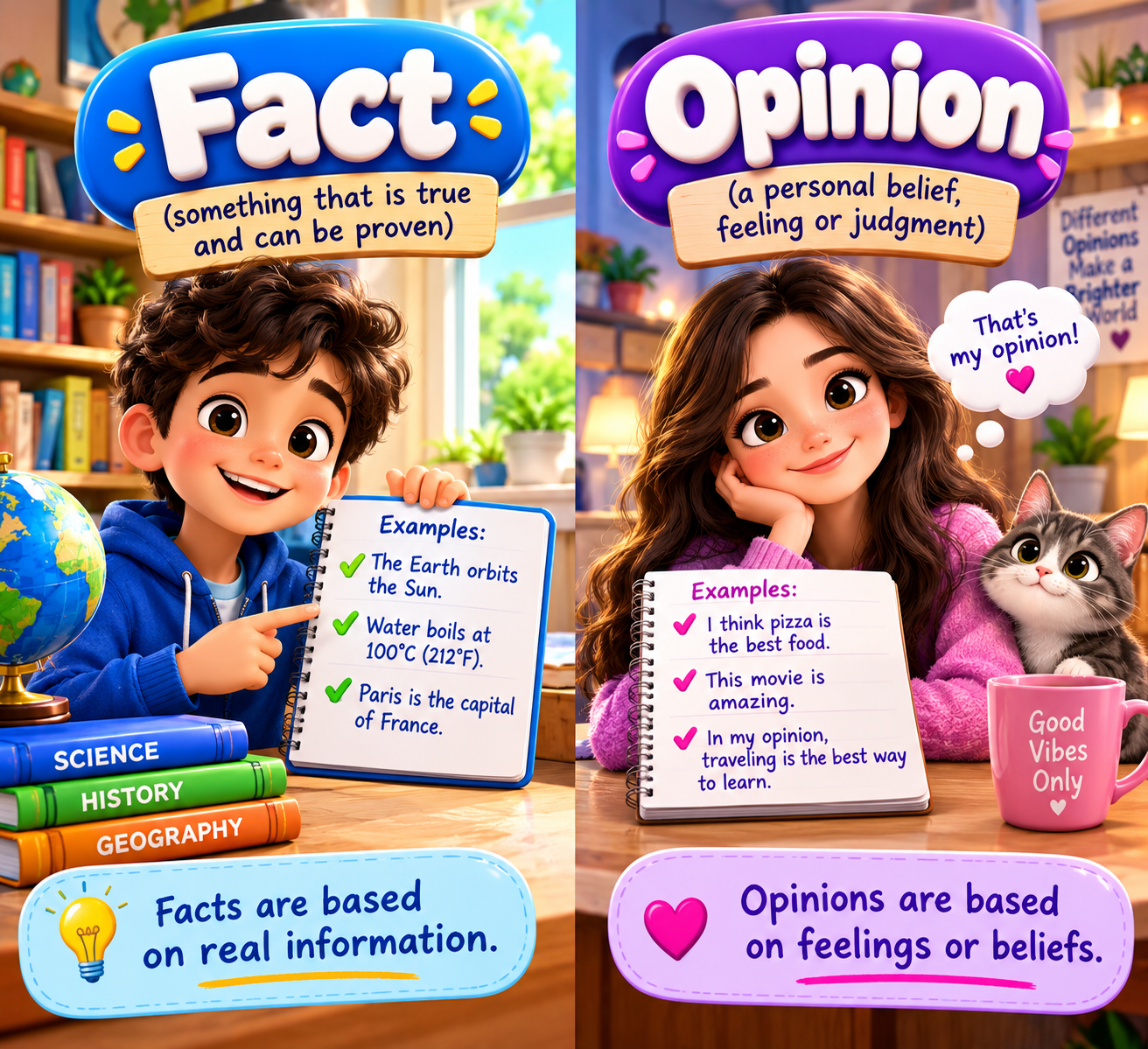
Fact or opinion asks whether a statement can be supported as true with evidence or expresses a personal belief, judgment, or viewpoint
I’ve often found myself reading a sentence and wondering, “Is this actually true, or is this just someone’s opinion?” I’ve had that doubt while reading articles, scrolling through online posts, and helping learners improve their writing. At first, some statements sound so confident that I assume they must be facts. But when I look more closely, words such as best, beautiful, boring, or should often reveal a personal judgment.
I’ve learned that this small difference can change the meaning of a sentence.
A fact is something I can check against reliable evidence, while an opinion reflects what someone thinks, believes, feels, or judges. I’ve also noticed that the line between the two is not always obvious. An opinion can be based on facts, and a factual statement can be used to support an opinion.
That is why I now look beyond how confident a sentence sounds. I ask whether there is evidence to support it and whether the writer is stating information or expressing a viewpoint. In this guide, I’ll share the simple ways I use to tell fact or opinion apart and avoid common mistakes.
Fact or Opinion Quick Answer
A fact is a statement that can be verified with reliable evidence. An opinion is a personal belief, feeling, judgment, or point of view.
Consider these two statements:
- Fact: Water freezes at 0°C under standard atmospheric pressure.
- Opinion: Winter is the most enjoyable season.
The first statement can be tested. The second depends on personal preference.
A useful question is:
Can I prove this statement with reliable evidence?
If the answer is yes, it may be a fact. If the statement mainly tells you what someone thinks or feels, it is likely an opinion.
However, not every statement is easy to classify. Some claims sound factual but need evidence. Others combine facts and opinions in the same sentence.
The Origin and Background of Fact or Opinion
The words fact and opinion have different meanings and roles in English.
The noun fact refers to something known to have happened or to exist. Cambridge Dictionary also uses fact for real events and experiences rather than imagined ones.
Opinion, on the other hand, refers to a thought, belief, or judgment. It can belong to one person or to a group. Cambridge also lists point of view, standpoint, viewpoint, and outlook among related terms. These ideas are closely connected to critical thinking.
When you read a claim, you should not only ask what the writer says. You should also ask:
- What evidence supports it?
- Can the claim be checked?
- Is the writer describing something or judging it?
- Does the sentence contain emotional language?
- Is the writer presenting a belief as though it were proven?
This is why fact vs. opinion is often taught in English classes, reading lessons, journalism, research, and media literacy.
Fact or Opinion Explained Key Differences
The easiest way to separate the two is to focus on evidence versus judgment.
| Term | Meaning | When to Use | Context |
| Fact | A statement that can be verified with evidence | When presenting checkable information | Academic, news, everyday writing |
| Opinion | A belief, feeling, or judgment | When expressing a personal or group viewpoint | Conversations, reviews, essays |
| Factual claim | A claim presented as something that can be checked | When making a statement about reality | Research, journalism, reports |
| Inference | A conclusion drawn from available evidence | When evidence suggests something but does not directly state it | Analysis and critical thinking |
Example of a fact
The Earth has one natural satellite, the Moon.
This is a factual claim because scientific evidence can be used to verify it.
Example of an opinion
The Moon is the most beautiful object in the night sky.
That statement expresses a judgment. Someone else may disagree.
Example of an inference
The streets are wet, so it probably rained recently.
The wet streets are observable. The conclusion about rain is an inference, not necessarily a directly observed fact.
This third category is useful because real-world writing is not always limited to a simple fact-or-opinion choice.
Which Approach Should You Use?
The right approach depends on what you are writing.
For students
Separate evidence from your own interpretation.
For example:
The survey found that 70% of participants preferred online classes.
That is a factual report of a survey result.
You could then write:
This result suggests that online classes may be more convenient for many students.
The second sentence is an interpretation based on the first.
For professional writers
Use precise language.
Instead of writing:
Our new service is the best in the market.
You could write:
Our new service received the highest customer rating in our internal survey.
The second version makes a specific claim that can be checked.
For opinion writing
Make your viewpoint clear.
Useful phrases include:
- In my opinion, …
- I believe …
- I think …
- In my view, …
- It seems to me that …
- From my perspective, …
Cambridge specifically gives “in my opinion” as a way to show that someone thinks or believes something.
For neutral writing
Separate evidence from judgment.
This is especially useful in reports, research papers, and news-style writing.
Common Mistakes With Fact or Opinion
1. Treating a strong statement as a fact
Mistake:
This is the best restaurant in the city.
Better:
This restaurant received the highest rating in the survey.
The first sentence gives a judgment. The second provides a measurable claim.
2. Assuming every opinion is false
An opinion is not automatically wrong.
Someone can have a reasonable opinion based on experience and evidence. It is still an opinion if it expresses a judgment or viewpoint.
3. Confusing an expert opinion with a proven fact
Mistake:
The doctor said this treatment is the best, so it is a fact.
Better:
The doctor recommended this treatment based on the patient’s circumstances.
An expert opinion can be valuable, but expert opinion and factual evidence are not identical concepts.
4. Ignoring evidence
Mistake:
Everyone knows that this method works.
Better:
A 2025 study reported positive results from this method.
The second sentence gives the reader something that can be investigated.
5. Missing opinion words
Words such as these can signal judgment:
- best
- worst
- beautiful
- terrible
- boring
- amazing
- should
- better
- unfair
They do not automatically make a sentence an opinion, but they deserve closer attention.
Fact or Opinion in Real-World Examples
The difference becomes easier when you see how each type appears in everyday writing.
Professional email
Fact: The meeting is scheduled for 10:00 a.m. on Tuesday.
Opinion: I think the new meeting time is more convenient for our team.
News headline
Fact: The company opened three new stores this year.
Opinion: The company’s expansion is a major success.
The first statement reports something measurable. The second evaluates it.
Social media post
Fact: The museum has more than 50,000 visitors each year.
Opinion: This is the most interesting museum in town.
The first claim can be checked against visitor records. The second reflects personal judgment.
Formal report
Fact: The survey included 500 respondents.
Opinion: The results show that the program is highly effective.
The sample size is a factual detail. The conclusion about effectiveness may require additional evidence and analysis.
Fact or Opinion Data, Trends & Usage
Search interest in fact or opinion is best understood as an informational search topic. People commonly use the phrase when they want to learn how to identify, classify, or distinguish statements.
Exact monthly search volume changes by country, keyword tool, and date. Google Trends also reports relative search interest rather than a fixed number of searches, so it should not be treated as an exact monthly search count.
For this reason, it would be misleading to present an invented figure such as “50,000 searches per month” without access to a specific Ahrefs, Semrush, Google Ads, or other keyword dataset.
The stronger and more useful trend is the continuing need to distinguish evidence, claims, beliefs, and judgments.
That skill matters in:
- School assignments
- Research papers
- Online articles
- News reports
- Social media
- Advertising
- Workplace communication
- Media literacy
- AI-generated content
The rise of easily shared online information makes this distinction especially useful. A statement can look authoritative without actually providing evidence.
Another important point is that facts and opinions can appear together. A writer may begin with a verifiable statistic and then add an interpretation. Good readers learn to separate the two instead of treating the entire paragraph as one category.
Fact or Opinion: Standalone Comparison Table
| Term/Variant | Meaning | Context | Best Used When |
| Fact | Verifiable information about reality | Objective description | You can support the statement with evidence |
| Opinion | Personal or group belief or judgment | Subjective viewpoint | You are expressing what someone thinks |
| Claim | A statement presented as true | Argument or discussion | You want to examine whether a statement is supported |
| Evidence | Information used to support a claim | Research and analysis | You need to demonstrate why a claim should be accepted |
| Inference | A conclusion drawn from evidence | Critical thinking | The conclusion goes beyond what is directly observed |
This distinction can improve your reading skills. A claim is not automatically a fact. It may still need proof.
Frequently Asked Questions
Q: What does fact or opinion mean?
A: Fact or opinion refers to the difference between verifiable information and a person’s belief, feeling, or judgment. A fact can be checked with evidence, while an opinion expresses a viewpoint.
Q: How can I tell if a statement is a fact?
A: Ask whether reliable evidence could confirm or disprove it. Dates, measurements, documented events, and recorded results are common examples of information that can be fact-checked.
Q: How can I identify an opinion?
A: Look for language that expresses personal judgment, preference, belief, or evaluation. Phrases such as “I think,” “in my opinion,” and “I believe” can make the writer’s viewpoint clear.
Q: Can an opinion be based on facts?
A: Yes. A person may use several facts to form an opinion. The supporting facts remain factual even though the conclusion or judgment is an opinion.
Q: Is an expert opinion a fact?
A: Not automatically. An expert opinion may be informed by training, experience, and evidence, but it is still an opinion unless the specific claim can independently be established as a fact.
Q: What is the difference between a fact and a claim?
A: A fact is information that can be verified as true. A claim is a statement presented for consideration or argument and may still require evidence before it can be accepted as factual.
Q: Can one sentence contain both fact and opinion?
A: Yes. For example, a sentence might give a verified statistic and then describe the result as “excellent.” The number may be factual, while the word excellent expresses judgment.
Conclusion
Learning the difference between fact or opinion is a simple skill that can make your reading and writing much stronger.
A fact is information that can be checked. An opinion communicates a belief, feeling, preference, or judgment. The two can appear side by side, so you should examine each part of a statement rather than judging an entire paragraph at once.
When you are unsure, ask one simple question: What evidence supports this claim? If reliable evidence can verify the statement, you may be dealing with a fact. If the statement mainly expresses someone’s viewpoint, it is more likely an opinion.
Also remember that claim, evidence, and inference are useful terms when a simple fact-versus-opinion test is not enough.
The goal is not to dismiss opinions. Opinions are a normal and useful part of communication. The goal is to recognize them for what they are and avoid presenting personal judgments as proven facts.
Bookmark this guide and use it whenever you need to separate facts from opinions in your writing or reading.
Read More:
Spay or Neuter: A Simple Guide for Pet Owners

I’m **Rubab Naaz**, an English language content writer with over 10 years of experience creating educational and SEO-focused articles. I specialize in spelling comparisons, grammar, vocabulary, synonyms, commonly confused words, and English usage. My passion is helping students, writers, and professionals improve their language skills through accurate, well-researched, and easy-to-understand content. Every article I write is designed to make learning English simple, practical, and engaging.










