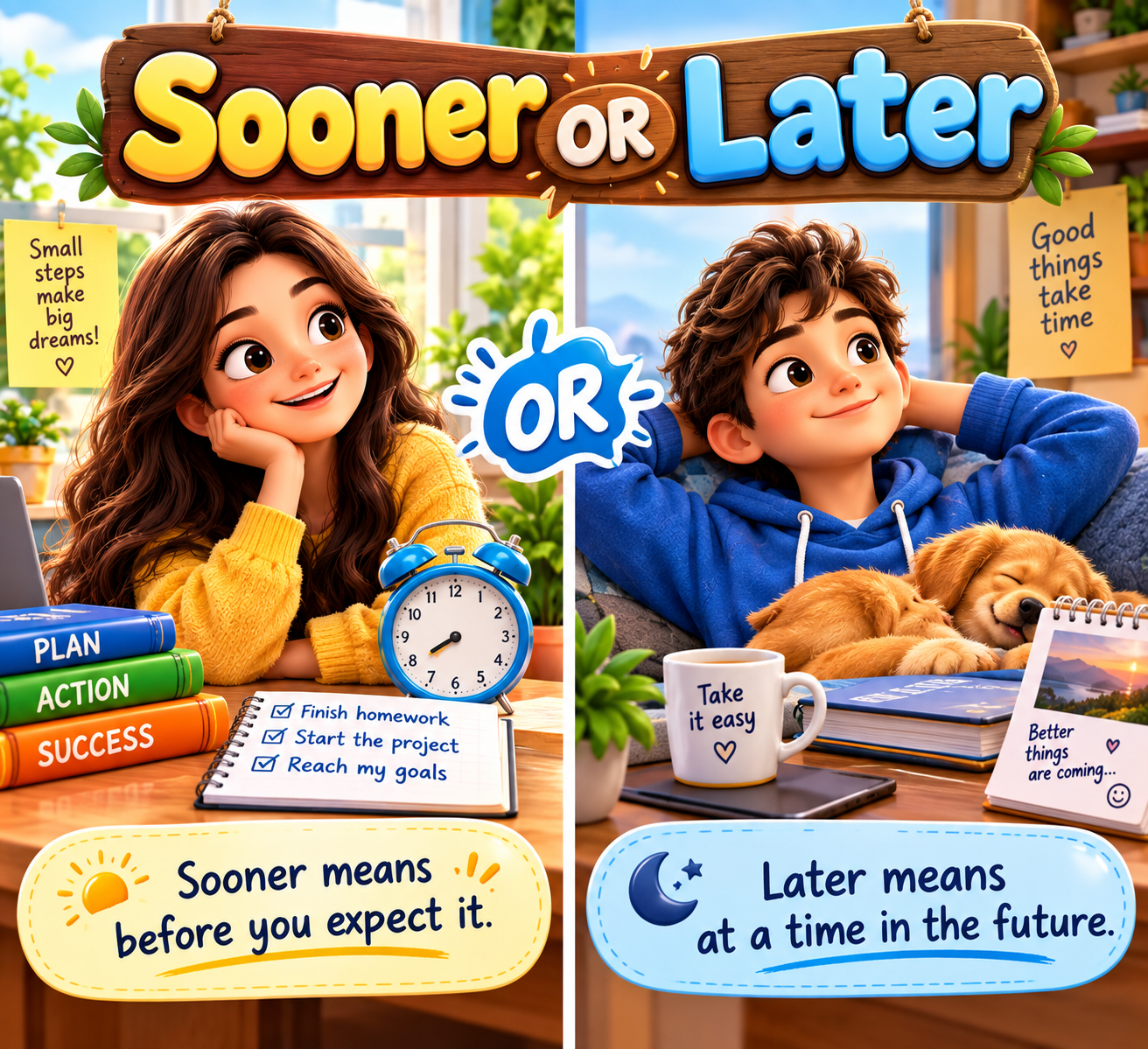
Sooner or later means at some time in the future, although the exact time is unknown. It often suggests that an event is expected or certain to happen eventually.
I’ve often written “sooner or later” and then stopped to wonder why English uses two comparative words instead of simply saying “soon or late.” I’ve noticed this phrase in my everyday writing, casual messages, and formal articles, and each time, I’ve found its simple structure surprisingly interesting.
I’ve learned that sooner or later does not simply compare two points in time. In most cases, I use it to express the idea that something will eventually happen, even when I do not know exactly when. Understanding this small difference has helped me use the phrase more naturally.
I’ve also noticed that I sometimes need to think twice when choosing between “sooner or later,” “soon,” “eventually,” and “later.” Although these expressions are related, they do not always mean the same thing.
Over time, I’ve developed a simple way to understand and use sooner or later correctly. In this guide, I’ll share what I’ve learned about its meaning, grammar, history, and common mistakes so you can use this everyday expression with confidence.
Sooner or Later Quick Answer
Sooner or later is an English idiom that means eventually or at some point in the future.
Cambridge Dictionary defines it as an expression used when you do not know exactly when something will happen but are certain that it will happen.
For example:
- Sooner or later, you will need to make a decision.
- She will understand the lesson sooner or later.
The phrase does not give an exact date or time. Instead, it focuses on the idea that an event will happen at some future point.
There is also an important difference between the phrase and the ordinary words sooner and later.
Compare:
I arrived sooner than expected.
Here, sooner means earlier than expected.
But:
You will hear from him sooner or later.
Here, sooner or later works as a fixed expression meaning eventually.
So, when you see the complete phrase, think “eventually, at an unknown future time.”
The Origin and Background of Sooner or Later
The history of sooner or later is older than many modern learners might expect.
The Oxford English Dictionary lists sooner or later from 1577, with the sense “at some time or other.”
Etymonline also dates the idiomatic expression to the 1570s, explaining that it means “at some undetermined future time but inevitably.”
The word soon itself has an even older history. Etymonline traces Middle English sone to Old English sona, meaning ideas such as “at once” or “immediately.” Over time, the meaning shifted toward the modern idea of something happening within a short time.
That history helps explain why the modern phrase can feel slightly unusual.
Why “sooner” and “later”?
Both sooner and later are comparative forms.
- soon → sooner
- late → later
In ordinary grammar, these forms often compare one time with another:
She arrived sooner than I expected.
The meeting started later than planned.
In sooner or later, however, the two words form a familiar idiomatic expression. The phrase does not require a specific comparison.
That is one reason learners may find it confusing.
The phrase has also appeared in English for centuries. Historical evidence shows early uses where sooner or later could refer either to an eventual event or to an event happening at an earlier or later time, depending on context.
Sooner or Later Explained Key Differences and Variations
The meaning becomes much easier when you compare sooner or later with similar expressions.
| Term | Meaning | When to Use | Region/Context |
| Sooner or later | Eventually; at an unknown future time | When you expect something to happen | Standard English |
| Eventually | At some point after a period of time | When focusing on the final result | Standard English |
| Soon | In a short time | When something is expected relatively quickly | Standard English |
| Later | At a time after now or another reference point | When the exact future time is not immediate | Standard English |
| One day | At some future time | When talking about an uncertain future event | Casual and formal |
| Early or late | At an earlier or later time | When the timing itself is the main concern | Standard English |
1. Sooner or later
Use this phrase when the event is expected to happen eventually.
Sooner or later, everyone faces difficult choices.
The exact time is not given.
2. Eventually
Eventually has a similar meaning, but it often focuses more strongly on the final outcome.
After several attempts, the machine eventually worked.
Here, the emphasis is on what happened after a period of effort.
3. Soon
Soon normally suggests a relatively short period.
The bus should arrive soon.
You expect the bus in the near future.
4. Later
Later simply places an event after another time.
I will call you later.
This does not necessarily suggest that the event is inevitable in the same way sooner or later can.
A useful rule
If you mean:
“I do not know when, but I expect it to happen eventually,”
then sooner or later is usually a natural choice.
Which Version or Approach Should You Use?
Choosing the right expression depends on what you want to communicate.
For beginners and ESL learners
Use sooner or later when you want to say “eventually.”
It is common, natural, and easy to understand.
Sooner or later, you will get used to the new routine.
For academic writing
Eventually may sometimes sound more precise, especially when describing a process or result.
The researchers eventually identified the source of the error.
That does not mean sooner or later is incorrect in formal writing. It simply has a more conversational and idiomatic feel.
For everyday conversation
Sooner or later works very well.
You can use it in conversations, emails, messages, interviews, and general writing.
You’ll have to talk to her sooner or later.
For neutral global English
Choose the expression based on the exact meaning you want.
- Use soon for the near future.
- Use later for a time after now.
- Use eventually for a final result.
- Use sooner or later when an event is expected to happen at some point.
This small distinction can make your writing much clearer.
Common Mistakes with Sooner or Later
Mistake 1: Writing “sooner and later”
❌ Sooner and later, he will understand.
✅ Sooner or later, he will understand.
The standard idiom uses or, not and.
The conjunction or presents two possible points in time: sooner or later.
Mistake 2: Using “soon or later”
❌ Soon or later, the truth will come out.
✅ Sooner or later, the truth will come out.
Soon or later may appear in historical or unusual writing, but sooner or later is the established modern idiom.
For normal English writing, use the standard form.
Mistake 3: Treating it like an exact time
❌ The package will arrive sooner or later at 3 p.m.
The problem is that the two ideas do not fit well together.
Sooner or later leaves the future time open, while 3 p.m. gives a precise time.
Better:
✅ The package should arrive by 3 p.m.
Or:
✅ The package will arrive sooner or later.
Choose one based on whether the time is known.
Mistake 4: Assuming “sooner” always means “very soon”
In the phrase sooner or later, sooner does not mean that the event will definitely happen shortly.
You will understand the reason sooner or later.
This means eventually, not necessarily “within a few minutes.”
Mistake 5: Replacing the phrase with “later”
These are not always interchangeable.
I will speak to him later.
means you plan to speak to him at a later time.
I will speak to him sooner or later.
suggests that the conversation will happen eventually, although the timing is uncertain.
That difference is small but useful.
Sooner or Later in Real-World Examples
Seeing the phrase in different settings makes its function easier to understand.
Professional email
We may not have all the answers today, but sooner or later, we will need to decide how to handle the project.
Here, the phrase shows that a decision will become necessary at some point.
News headline or article
Experts say the industry will sooner or later need to adapt to changing consumer habits.
The phrase presents adaptation as an expected future development without giving a precise date.
Social media post
Keep learning and keep trying. Sooner or later, your hard work will show.
This is a natural motivational use.
Formal report
If the current trend continues, the organization may sooner or later face pressure to revise its policy.
The phrase works in formal prose when the writer wants to describe an uncertain but possible future point.
Everyday conversation
You cannot avoid that conversation forever. Sooner or later, you have to have it.
This use sounds natural because the expression often appears when someone expects an unavoidable future event.
Sooner or Later Data, Trends and Usage
There is strong historical evidence that sooner or later is an established English expression rather than a recent internet phrase.
The Oxford English Dictionary records the phrase from 1577 with the meaning “at some time or other.”
Etymonline places the idiomatic expression in the 1570s as well.
Modern dictionary evidence also shows that the expression remains active. Cambridge classifies sooner or later as an idiom and gives contemporary corpus examples from areas such as science, society, and everyday communication.
What about exact search volume?
Exact monthly search volume for “sooner or later” versus related phrases such as “eventually” requires access to a live SEO platform such as Ahrefs, Semrush, or Google Keyword Planner. Those figures can change by country and month, so a fixed number should not be presented as current without a verified dataset.
For this reason, it is safer to describe the phrase as a well-established, high-recognition English idiom rather than inventing a monthly search figure.
Search intent
The main search intent behind “sooner or later” is informational.
People commonly search the phrase to learn:
- What does sooner or later mean?
- Is sooner or later an idiom?
- How do I use sooner or later?
- What is the difference between sooner or later and eventually?
- Is sooner or later formal or informal?
- How do you translate sooner or later?
Cambridge’s English–Urdu Dictionary gives the translation , which shows that the phrase is also relevant to English learners who use bilingual dictionaries.
Why the phrase still matters
English learners often meet sooner or later in conversation, books, news writing, and online content. Because it combines two comparative adverbs, it can look like a grammar puzzle even though its meaning is simple.
Understanding the difference between the literal words and the complete idiom helps you read and write English more naturally.
Standalone Comparison: Sooner or Later vs. Similar Expressions
| Term/Variant | Meaning | Region/Context | Best Used When |
| Sooner or later | Eventually; at an uncertain future time | General English | You expect something to happen |
| Eventually | In the end or after some time | General English | You want a concise, neutral expression |
| At some point | At an unspecified time | General and professional English | You do not want to suggest certainty |
| One day | At an unspecified future time | Everyday and narrative English | Talking about a possible future event |
| In the long run | Over a longer period | Business, academic, and general English | Discussing long-term effects |
| Soon | In the near future | Everyday English | The event is expected relatively quickly |
One key distinction is certainty.
Sooner or later often suggests that the speaker expects the event to happen. At some point, by contrast, can sound more neutral and does not always carry the same sense of inevitability.
Frequently Asked Questions
Q: What does “sooner or later” mean?
A: It means eventually or at some future time. The speaker does not know the exact time but expects the event to occur. Cambridge gives this same core meaning in its dictionary entry.
Q: How do you use “sooner or later” correctly?
A: Put the phrase before or after the main clause.
Sooner or later, she will find out.
You can also place it later in the sentence:
She will find out sooner or later.
Both patterns are natural.
Q: Is “sooner or later” the same as “eventually”?
A: They are close in meaning, but the tone can differ. Eventually often sounds more neutral, while sooner or later can emphasize that something is expected to happen at an uncertain time.
Q: Is “sooner or later” correct in formal writing?
A: Yes. The expression is grammatically acceptable and can appear in formal writing. However, eventually or at some point may be preferable when you want a more neutral or precise tone.
Q: Should I write “sooner or later” or “soon or later”?
A: Use sooner or later in normal modern English. It is the established idiomatic form and has been documented for centuries. The Oxford English Dictionary records the expression from 1577.
Q: Where does “sooner or later” come from?
A: The phrase is documented in English from the 16th century. The Oxford English Dictionary gives 1577 as an early recorded date, while Etymonline also places the idiomatic expression in the 1570s.
Q: Can I use “sooner or later” in an email?
A: Yes. It works well in both personal and professional emails when you mean that something will happen eventually. For highly formal documents, consider whether eventually gives you a more direct tone.
Conclusion: How to Use Sooner or Later Correctly
Sooner or later is one of those English expressions that looks more complicated than it really is. Once you understand its function, the phrase becomes easy to use.
Remember these four points:
- Sooner or later means eventually or at some uncertain future time.
- It is an established idiom, not just two unrelated words placed together.
- Use or, not and, in the standard expression.
- It can work in conversation, emails, articles, and formal writing, although eventually may sometimes sound more neutral.
Its long history also explains why the phrase feels so natural to modern English speakers. The Oxford English Dictionary records it as far back as 1577, and modern dictionaries continue to list it as a common idiom.
The easiest way to remember it is this: when you mean “I don’t know exactly when, but I expect it to happen,” sooner or later is often the right phrase.
Bookmark this guide so you never second-guess “sooner or later” again.
Read More:
Fact or Opinion: Easy Guide to Tell the Difference

I’m an English language educator and content writer with more than 10 years of experience helping learners improve their English skills. I specialize in spelling differences, grammar, vocabulary, synonyms, commonly confused words, and English usage. My goal is to create accurate, easy-to-understand articles that make learning English simple, practical, and enjoyable for students, writers, and professionals around the world.