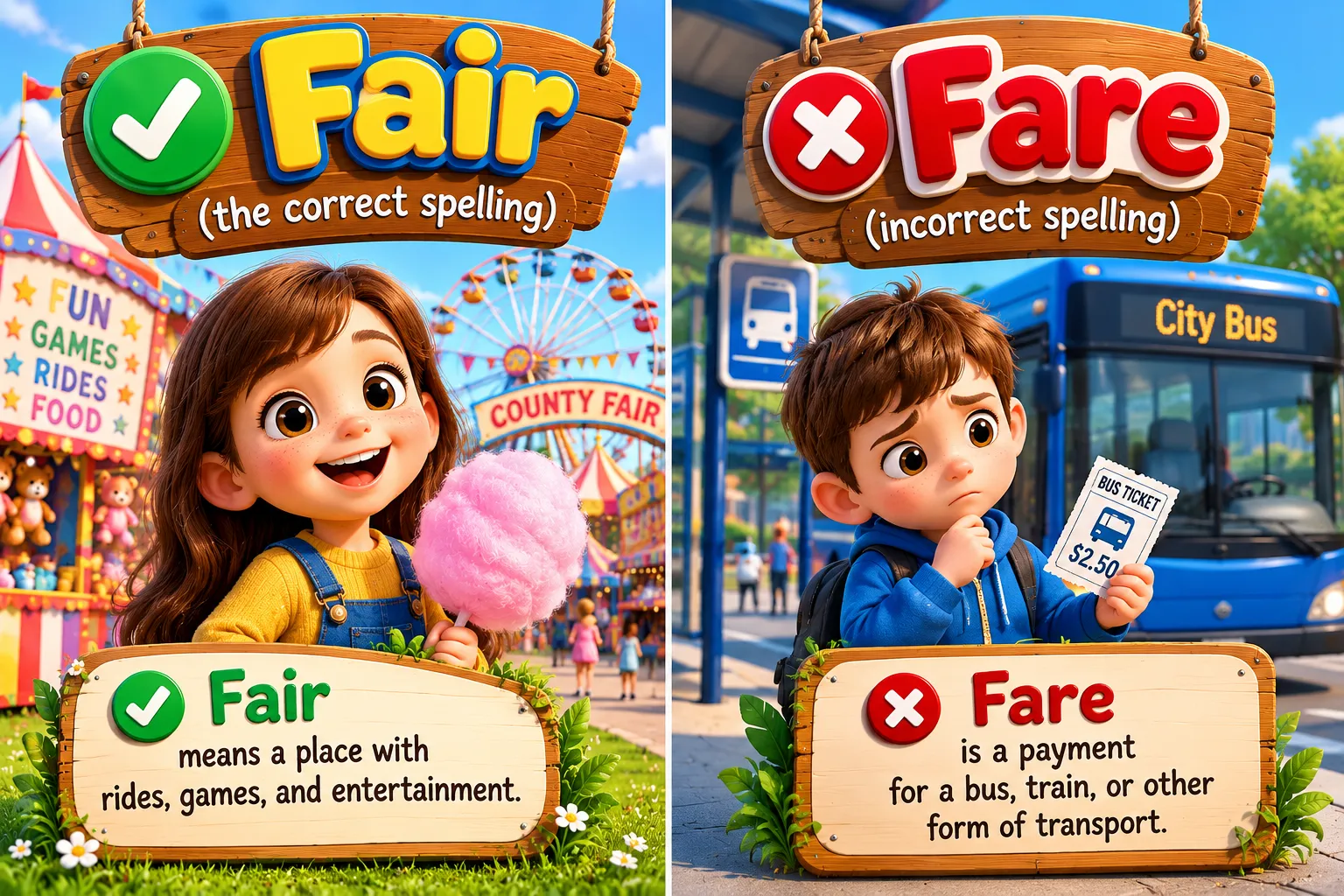
Fair usually means just, reasonable, attractive, or a public event, while fare means a travel cost, a type of food, or how someone progresses.
I have caught myself stopping over the words fair and fare more than once. They sound the same, so your ears give you no useful clue. The spelling is what changes the meaning.
One small letter can also change the whole sentence. A fair price is a reasonable price. A bus fare is the money you pay to ride the bus. Write bus fair, and the meaning becomes unclear.
This is why fair or fare appears so often in English-learning searches. Both words are common. Both are pronounced the same in many varieties of English. Yet they belong to different parts of speech and work in different situations.
I have found that the easiest way to remember them is not to memorize a long grammar rule. Instead, connect each word with its main meaning.
Fair is strongly linked with ideas such as justice, equality, appearance, weather, and events.
Fare is strongly linked with travel, payment, food, and progress.
Once you see those groups, the spelling becomes much easier to choose.
Fair or Fare Quick Answer
Fair and fare are homophones. They sound alike but have different spellings and meanings.
Use fair when you mean something is reasonable, equal, pleasant, light in color, or connected with an event.
For example:
The teacher gave every student a fair chance.
Use fare when you mean the money paid for transportation.
The train fare increased this month.
There is another useful meaning of fare. As a verb, it can describe how someone or something performs or progresses.
How did you fare in your interview?
Cambridge Dictionary lists fair as an adjective, noun, and adverb with several meanings. It lists fare as a noun and verb, including the cost of travel and the idea of progressing or being in a particular condition.
So the simplest memory rule is:
Fair = reasonable, equal, event, appearance, weather
Fare = travel cost, food, or progress
The Origin and Background of Fair and Fare
| Word | Origin & History | Meaning Developed Over Time | Key Point |
|---|---|---|---|
| Fair | The adjective fair comes from Old English fæger, meaning pleasing to the sight or beautiful. | Its meanings expanded to include just, equal, reasonable, favorable, and more. | Fair has several meanings depending on context. |
| Fair (noun) | The noun fair, meaning a public market or event, developed through Anglo-French and Old French forms associated with markets and feast days. | It came to mean a public event, market, or gathering. | This is a separate historical sense of fair. |
| Fare | Fare comes from Old English fær, referring to a journey, road, or passage. | It later developed meanings related to food and the cost of transportation. | Fare is historically distinct from fair. |
| Fair vs. Fare | The two words have different origins and histories. | They developed separate meanings and uses despite having the same pronunciation. | They are homophones, not alternative spellings of the same word. |
| Similar Homophones | English contains many words with different spellings but identical or similar sounds. | Examples include pair/pear, right/write, sea/see, and flower/flour. | Context determines which spelling and meaning is correct. |
on context.
Fair or Fare Explained Key Differences
The easiest way to understand the difference is to look at the main meanings of each word.
| Term | Meaning | When to Use | Region/Context |
| fair | Just, equal, or reasonable | Talking about treatment, prices, decisions, or rules | Standard English |
| fair | Light in color | Describing hair or skin | Standard English |
| fair | Pleasant or clear | Describing weather | Standard English |
| fair | A public event or market | Talking about entertainment, goods, or services | Standard English |
| fare | Money paid for transportation | Talking about buses, trains, taxis, or flights | Standard English |
| fare | Food or a type of food | Describing food served or available | Formal/general English |
| fare | To progress or manage | Asking how someone or something is doing | Standard English |
1. Fair means reasonable or equal
This is one of the most common uses of fair.
The manager made a fair decision.
Here, fair means reasonable and impartial.
Cambridge defines this sense as treating people in a right or reasonable way and not allowing personal opinions to affect judgment.
2. Fair can describe appearance
Fair can also refer to pale skin or light-colored hair.
She has fair hair and blue eyes.
This meaning is different from the idea of justice. The surrounding words tell you which meaning is intended.
3. Fair can describe weather
You can use fair to describe pleasant or dry weather.
The forecast says we should have fair weather tomorrow.
This use is common in weather reports and traditional expressions.
4. Fair can mean an event
A fair can be a public event where people buy goods, enjoy entertainment, or take part in activities.
We visited the book fair on Saturday.
Cambridge and Oxford both list this noun meaning.
5. Fare means transportation cost
This is probably the meaning that causes the most spelling mistakes.
The bus fare is higher during peak hours.
Here, fare means the money paid for a journey by bus, train, taxi, plane, or another vehicle.
Oxford defines fare as the money paid to travel by transport such as a bus, plane, or taxi.
6. Fare can mean food
In formal or literary English, fare can refer to the type of food served.
The restaurant is known for traditional Italian fare.
This meaning is less common in basic everyday conversation, but you may see it in reviews, articles, and descriptions of restaurants.
7. Fare can be a verb
This is another important difference.
Fare can mean to progress or to experience a particular result.
The new team fared well during the competition.
You can also ask:
How did you fare on the test?
This is why fare is not only a noun.
Which Version Should You Use?
The right choice depends on what you mean.
For fairness or equality → use fair
Use fair when you are talking about:
- equal treatment
- reasonable decisions
- fair prices
- rules
- opportunities
- honest judgment
Example:
Every applicant deserves a fair opportunity.
For transportation costs → use fare
Choose fare when discussing:
- bus fares
- train fares
- taxi fares
- air fares
- travel costs
- ticket prices
Example:
I checked the train fare before booking my ticket.
For food → use fare
Use fare when describing a type or style of food.
Example:
The café serves simple local fare.
For performance or progress → use fare
Use fare as a verb when asking or explaining how something went.
Example:
The project fared better than expected.
For a public event → use fair
Use fair for events such as:
- book fairs
- job fairs
- craft fairs
- school fairs
- trade fairs
- county fairs
Example:
The university is hosting a career fair next week.
Common Mistakes with Fair or Fare
Mistake 1: Writing “bus fair”
❌ The bus fair is expensive.
✅ The bus fare is expensive.
A transportation payment is a fare.
Mistake 2: Writing “fair price” as “fare price”
❌ They offered a fare price.
✅ They offered a fair price.
A reasonable price is a fair price.
Mistake 3: Confusing “How did you fare?” with “How did you fair?”
❌ How did you fair in the exam?
✅ How did you fare in the exam?
The verb meaning “perform” or “progress” is fare.
Mistake 4: Using “fare” for an event
❌ We went to a school fare.
✅ We went to a school fair.
A public event is a fair.
Mistake 5: Using “fair” for transportation
❌ What is the taxi fair?
✅ What is the taxi fare?
The amount charged for the ride is the fare.
Fair or Fare in Real-World Examples
Seeing the words in different settings can make the distinction easier to remember.
Professional email
We believe the revised contract offers a fair arrangement for both sides.
News headline
Rail Operator Announces Changes to Regional Fares
Social media post
I finally found a fair deal on my new laptop!
Formal report
The committee reviewed whether the selection process was fair and consistent.
Travel website
Compare air fares before choosing your flight.
Restaurant review
The menu offers modern fare with several vegetarian choices.
Education
Students were asked to explain how they fared during the final assessment.
Notice how the meaning determines the spelling every time.
Fair or Fare Data, Trends & Usage
The search intent behind fair or fare is mainly informational. People usually want to know which spelling fits a sentence and how the two homophones differ.
Exact current monthly search volumes from paid SEO platforms such as Ahrefs or Semrush were not available from the authoritative public sources checked for this guide. Because of that, specific monthly numbers would be misleading if presented as verified data.
There is, however, useful evidence about why this confusion matters.
A 2024 paper published in the Proceedings of the AAAI Conference on Web and Social Media studied automated transcription errors involving English speech. The researchers built a corpus containing 194 hours of English monologues from 846 TED Talk speakers and examined transcription accuracy across several platforms. The study is relevant to homophones because speech-recognition systems must often determine the intended spelling from context rather than sound alone.
That gives fair or fare a modern angle. Voice typing and automatic transcription can produce the correct sound while leaving the writer to choose the correct written word.
Dictionary evidence also shows how broad the difference is:
- Fair has adjective, noun, and adverb uses.
- Fare functions mainly as a noun and verb.
- Fair can describe justice, appearance, weather, and events.
- Fare commonly relates to transportation, food, and progress.
Searches for the pair therefore have strong educational value for ESL learners, students, writers, and anyone using speech-to-text tools.
Fair vs. Fare: Standalone Comparison Table
| Term/Variant | Meaning | Region/Context | Best Used When |
| fair | Just or reasonable | General English | Describing equal treatment |
| fair | Light-colored or pale | General English | Describing hair or skin |
| fair | Pleasant or clear | Weather language | Describing conditions |
| fair | Public event or market | General English | Referring to a fair, exhibition, or event |
| fare | Transportation payment | Travel English | Talking about ticket or journey costs |
| fare | Food or cuisine | Formal/general writing | Describing a type of food |
| fare | Progress or perform | Verb usage | Explaining how someone or something did |
| fayre | Older-style spelling of fair or fare | Mainly traditional British usage | Deliberately giving a traditional or old-fashioned feel |
The last form, fayre, is worth knowing but should not be confused with ordinary modern spelling. Oxford and Cambridge both describe it as an old-fashioned spelling that can represent either fair or fare in certain British contexts.
Frequently Asked Questions
Q: What does fair mean?
A: Fair has several meanings. It can describe something that is just or reasonable, a light color, pleasant weather, or a public event.
Q: What does fare mean?
A: Fare commonly means the money paid for transportation. It can also mean a type of food or function as a verb meaning to progress or perform.
Q: What is the difference between fair and fare?
A: They are homophones, so they sound alike but have different meanings and spellings. Fair covers ideas such as equality and events, while fare often relates to travel, food, or progress.
Q: Is “bus fare” or “bus fair” correct?
A: Bus fare is correct when you mean the amount of money paid for a bus journey. The word fair does not normally have this transportation-cost meaning.
Q: Is “fair” correct in formal writing?
A: Yes. Fair is standard English and is widely used in formal writing. Phrases such as fair treatment, fair price, and fair process are common in professional contexts.
Q: Is “fare” only used for transportation?
A: No. Fare has several meanings. Besides transportation costs, it can refer to food and can work as a verb meaning to progress or manage.
Q: Where do fair and fare come from?
A: They have different histories. The adjective fair comes from Old English fæger, while fare is connected to Old English fær, meaning a journey or passage. Their separate histories help explain why they are different words despite their similar pronunciation.
Q: How do I remember fair or fare?
A: Think of fair as connected with fairness and events. Think of fare as connected with travel costs, food, or how things go.
Q: Is “How did you fare?” correct?
A: Yes. Here fare is a verb meaning to perform, progress, or experience a particular result. For example, you can ask someone how they fared in an interview or examination.
Conclusion
Choosing between fair or fare becomes much easier when you focus on meaning instead of pronunciation.
Remember fair for ideas such as justice, equality, reasonable treatment, light colors, pleasant weather, and public events. You can write about a fair decision, fair hair, fair weather, or a school fair.
Use fare when you mean transportation cost. A bus fare, train fare, taxi fare, or air fare all refer to the money paid for travel. Fare can also describe food, as in traditional fare, or work as a verb when you talk about how someone or something performs.
The two words are homophones, so listening alone will not help you choose the spelling. Context is your best guide.
If you are writing about fairness, choose fair. If you are writing about travel costs or how something went, fare is usually the word you need.
Keep these simple connections in mind, and you will be far less likely to mix them up.
Bookmark this guide so you never second-guess fair or fare again.
Read More:
Calves or Calfs: The Simple Spelling Rule

I specialize in English grammar, spelling, word choice, and language usage. My content is based on research from grammar references, style guides, dictionaries, and real-world usage to ensure it is accurate and practical.
At Spelling Comparison, I write guides that explain why words are confused, how they are used, and which form is correct in context. I also include proofreading tips, examples, and writing advice readers can apply immediately.
My goal is to publish clear, reliable content that helps readers make better writing decisions. Each guide is written for accuracy, clarity, and usefulness in school, work, business, and everyday communication.










