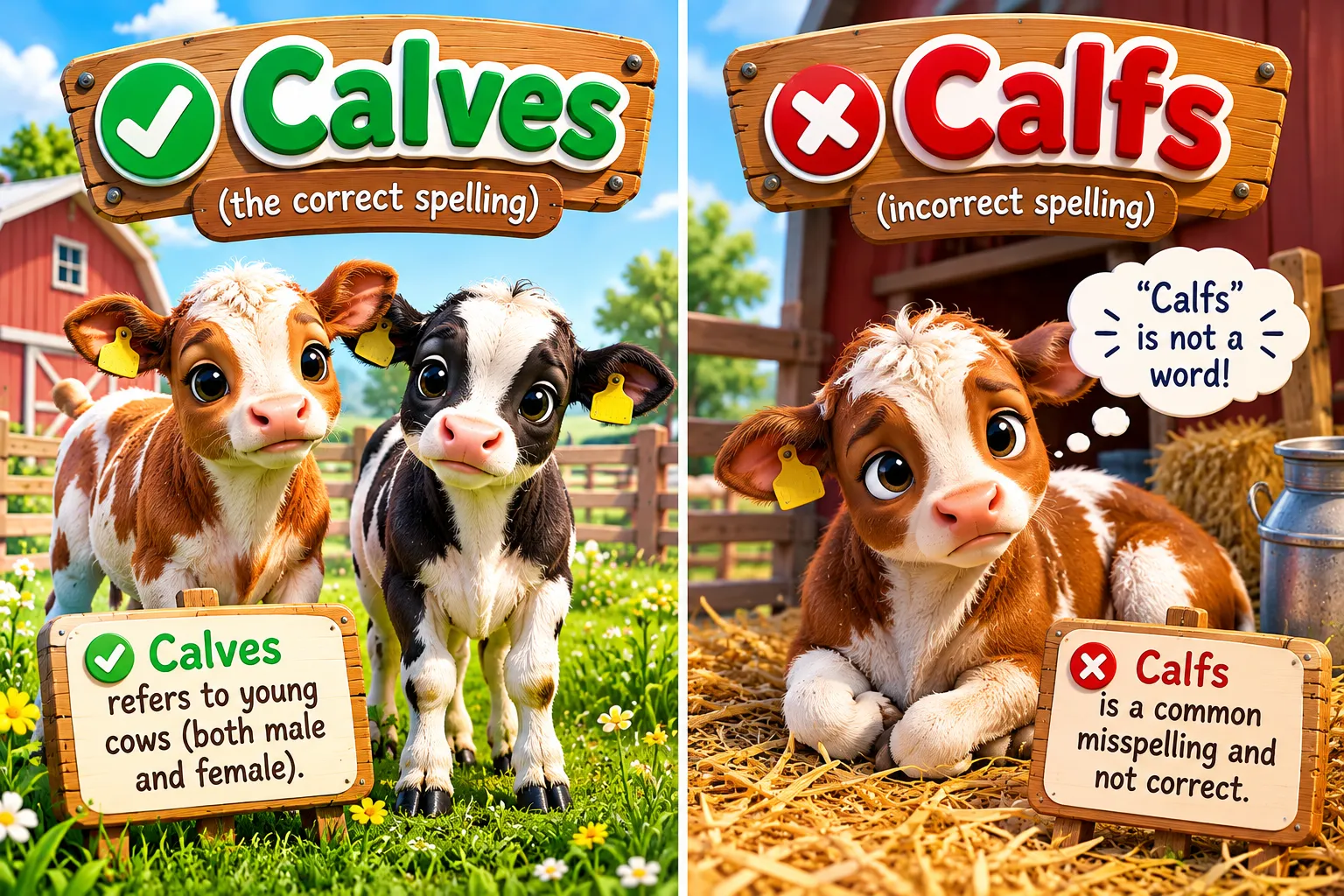
Calves is the standard plural of calf for young animals and the back parts of the legs. Calfs is not the normal plural, though some dictionaries record it in the specialized sense of calf hides
I have noticed that calves or calfs can cause a surprisingly common spelling pause. The word calf looks like many English nouns that simply take -s in the plural. So it is natural to wonder why calf becomes calves instead of calfs.
I have seen this confusion in student writing, fitness notes, and everyday sentences about animals. The problem becomes even more interesting because calf has more than one meaning. It can describe a young cow, the young of some other large mammals, or the fleshy part at the back of the lower leg.
The good news is that the main rule is simple. When you mean more than one animal or more than one lower leg, use calves. There is also a small dictionary-related detail about calfs that is worth knowing, especially if you are studying vocabulary closely.
Once you understand that detail and the history behind the spelling, the choice becomes much easier.
Calves or Calfs Quick Answer
The standard plural of calf is calves.
| Point | Explanation | Example |
|---|---|---|
| Singular form | Calf refers to one animal or one lower leg area. | One calf |
| Plural form | Calves is the standard plural form of calf. | Two calves |
| Animal meaning | Calves can refer to several young animals. | A young elephant → several elephant calves |
| Whale meaning | Calves can also describe young whales. | A young whale → several whale calves |
| Animal example | Use calves when talking about more than one young animal. | The farmer moved the calves into a larger field. |
| Body-part meaning | Use calves for the lower-leg muscles or areas on both legs. | Her calves were tired after the long hike. |
| Dictionary usage | Cambridge lists calves as the plural of calf, and Oxford also gives calves as the plural form. | calf → calves |
| Specialized form | Calfs can appear in a specialized context related to the hides or leather of calves. | Specialized hide or leather terminology |
| Simple rule | For normal modern English, use calf for one and calves for more than one. | One calf → two calves |
The Origin and Background of Calves
The spelling calves has a long history.
According to the Online Etymology Dictionary, the animal word calf comes from Old English cealf, meaning a young cow. It is related to words in several Germanic languages, including Old Norse kalfr and German Kalb.
Oxford gives a useful extra detail. The animal sense comes from Old English, while the body part sense comes from Middle English and has a different Old Norse origin.
That means the two modern meanings of calf have different histories even though they now share the same spelling.
The plural form also reflects older changes in English pronunciation and spelling. Instead of simply adding -s, the word developed the form calves.
This is similar to several other English plurals:
- leaf → leaves
- knife → knives
- wolf → wolves
- half → halves
However, you should not treat this as a rule that works for every word ending in -f.
For example:
- roof → roofs
- chief → chiefs
- belief → beliefs
English has many historical patterns and exceptions. That is why learning each common plural form is safer than relying on one simple rule.
Calves or Calfs Explained Key Differences
The main difference is grammatical.
Calf is a singular countable noun. Calves is its normal plural form.
| Term | Meaning | When to Use | Region/Context |
| calf | One young animal | One animal | Standard English |
| calves | More than one young animal | Two or more animals | Standard English |
| calf | Back part of one lower leg | One leg | Standard English |
| calves | Back parts of both or several lower legs | Two or more legs | Standard English |
| calfs | A specialized plural referring to calf hides in some dictionary usage | Specific leather/hide context | Specialized usage |
Cambridge defines calf as a young cow or the young of certain large mammals. It also defines calf as the thick or curved part at the back of the leg.
Oxford gives the same two major meanings and lists calves as the plural.
Examples of the animal meaning
The mother cow stayed close to her calves.
Several elephant calves remained near the adult herd.
Examples of the body part meaning
The cyclist developed pain in both calves.
Regular stretching can help loosen tight calf muscles.
Notice something useful here: calf muscles remains correct even when you are talking about both legs.
That is because calf is being used as a noun modifier in calf muscles.
Which Version Should You Use?
For almost every ordinary writing situation, choose calves.
For students
Use calves in homework, essays, tests, and school assignments.
The farmer counted six calves.
This is the standard plural taught in English grammar.
For professional writers
Use calves in reports, emails, websites, articles, and business documents.
The report recorded the number of calves born during the season.
For fitness writing
Use calves when talking about the muscles behind the lower legs.
The workout targets the calves and hamstrings.
For farming and animal writing
Use calves for multiple young cattle or other animals described with the word calf.
The veterinary team examined the calves before transport.
For a global audience
Calves is the safest choice. There is no normal British-versus-American spelling split here like colour/color or organise/organize.
Cambridge and Oxford both use calves as the plural in their English dictionaries.
What about calfs?
Do not normally replace calves with calfs.
There is a useful dictionary nuance, however. Collins includes calfs in a specialized entry associated with calf hides, while its normal entries give calves as the plural.
So the practical rule is:
Animals or legs → calves
Specialized hide/leather terminology → calfs may appear
Common Mistakes with Calves or Calfs
1. Adding only -s
Incorrect: The farmer owns five calfs.
Correct: The farmer owns five calves.
The mistake happens because many English plurals simply add -s.
2. Using calfs for leg muscles
Incorrect: My calfs are sore after training.
Correct: My calves are sore after training.
The plural remains calves when calf means the back part of the leg.
3. Using calves for one animal
Incorrect: One calves was standing near the gate.
Correct: One calf was standing near the gate.
Remember the basic number difference:
one calf
two calves
4. Confusing calf and calve
These words have different grammatical jobs.
Calf is a noun.
The calf followed its mother.
Calve is a verb.
The cow may calve in early spring.
Collins also lists calve as the verb for giving birth to a calf.
5. Assuming every -f noun becomes -ves
That shortcut can create new mistakes.
calf → calves
leaf → leaves
But:
roof → roofs
chief → chiefs
English plural spelling depends on the individual word.
Calves in Real-World Examples
Here are fresh examples showing how calves works in different settings.
Professional email
Please send the updated health records for all calves before Friday.
News headline
Local Dairy Farm Welcomes a New Group of Calves
Social media post
Finished today’s leg workout, and my calves definitely felt it!
Formal report
The survey recorded 38 calves across the three participating farms.
Fitness article
Strong calves can play an important role in walking, running, and jumping.
Wildlife report
Researchers observed several whale calves traveling close to adult animals.
These examples show why calves is useful across very different subjects. The spelling does not change with the context.
Calves or Calfs Data, Trends & Usage
This topic has a clear informational search intent. People who search calves or calfs are usually trying to check spelling, understand the plural form, or learn why the word changes from -f to -ves.
What does dictionary usage show?
The major dictionary sources checked for this guide consistently list calves as the ordinary plural:
- Cambridge: calves
- Oxford: calves
- Collins: calves in its standard entries
There is one interesting lexical edge case. Collins’ American English material records calfs in connection with calf hides, showing why a simple “calfs is never seen anywhere” claim would be too broad.
Search-volume data
Exact current monthly search volumes for calves and calfs from Ahrefs or Semrush are not available in the public sources checked for this article. It would therefore be misleading to invent a numerical search-volume comparison.
The search itself is still easy to classify:
Primary intent: informational
Main question: Which plural spelling is correct?
Related searches: calf plural, calves meaning, calfs or calves, plural of calf
Corpus and dictionary evidence
Cambridge’s dictionary page includes multiple examples of calves from the Cambridge English Corpus, including examples from farming, animal research, and scientific writing.
That broad use is useful evidence that calves is established across several areas of written English.
Why the topic matters
Spelling tools do not always explain why a word has an unusual plural. Knowing the pattern helps you remember it rather than simply correcting it.
It also helps English learners connect calves with related forms such as leaves, wolves, and knives, while remembering that words such as roofs behave differently.
Calves vs. Calfs: Standalone Comparison
| Term/Variant | Meaning | Region/Context | Best Used When |
| calf | One young animal | All major English varieties | Referring to one animal |
| calves | More than one young animal | British and American English | Referring to multiple animals |
| calf | One lower-leg area or muscle | British and American English | Referring to one leg |
| calves | Multiple lower-leg areas or muscles | British and American English | Referring to both legs or more |
| calf muscle | Muscle in the lower leg | Fitness, anatomy, general writing | Describing the muscle as a noun modifier |
| calfs | Specialized plural related to calf hides in some dictionary usage | Specialized leather/hide context | Only when that specific technical usage is intended |
The key point is that calves covers the normal plural needs of both major meanings of calf.
Frequently Asked Questions
Q: What does calves mean?
A: Calves is the normal plural of calf. It can refer to several young animals or the back parts of two or more lower legs.
Q: How do you use calves correctly?
A: Use calves when you mean more than one calf. For example, you can talk about several young cows or both lower-leg muscles as calves.
Q: Is calfs correct?
A: Calfs is not the normal plural form used for animals or leg muscles. Some dictionary material records calfs in a specialized sense connected with calf hides, so the word can appear in specific contexts.
Q: What is the difference between calf and calves?
A: Calf is singular, while calves is plural. You use calf for one and calves for two or more.
Q: Is calves used in both British and American English?
A: Yes. Cambridge lists calves for both British and American pronunciation and usage, and Oxford also gives calves as the plural.
Q: Where does the word calf come from?
A: The animal sense comes from Old English cealf and has Germanic relatives. Oxford notes that the body-part sense has a separate Middle English origin from Old Norse.
Q: Should I write calf muscles or calves muscles?
A: Write calf muscles when the phrase describes the muscles as a group or type. When the noun itself is plural, use calves, as in “My calves are sore.”
Conclusion
The choice between calves or calfs is easier once you separate the normal plural from the specialized dictionary usage.
For everyday English, calves is the form you want. Use it when talking about several young cows, elephants, whales, or other animals called calves. Use it too when referring to the lower-leg muscles on both sides of the body.
The spelling is not a British-versus-American difference. Both varieties use calves as the standard plural. Cambridge and Oxford both support this form.
The interesting exception is calfs, which can appear in specialized terminology related to calf hides. That does not make it the normal plural for animals or legs. Collins records this narrower usage, so it is worth knowing if you encounter the word in specialist material.
The easiest memory trick is simple:
One calf → two calves.
Keep that pattern in mind, and you will avoid one of the most common spelling mistakes with this irregular plural. Bookmark this guide so you never second-guess calves or calfs again.
Read More:
Period or Miscarriage: Easy Signs to Understand

I’m an English language educator and SEO content writer having experience creating clear, accurate, and engaging English learning content. I specialize in spelling differences, grammar, vocabulary, synonyms, commonly confused words, and English usage. My goal is to publish well-researched, easy-to-understand articles that help students, writers, educators, and professionals improve their English with confidence through practical explanations and real-world examples.