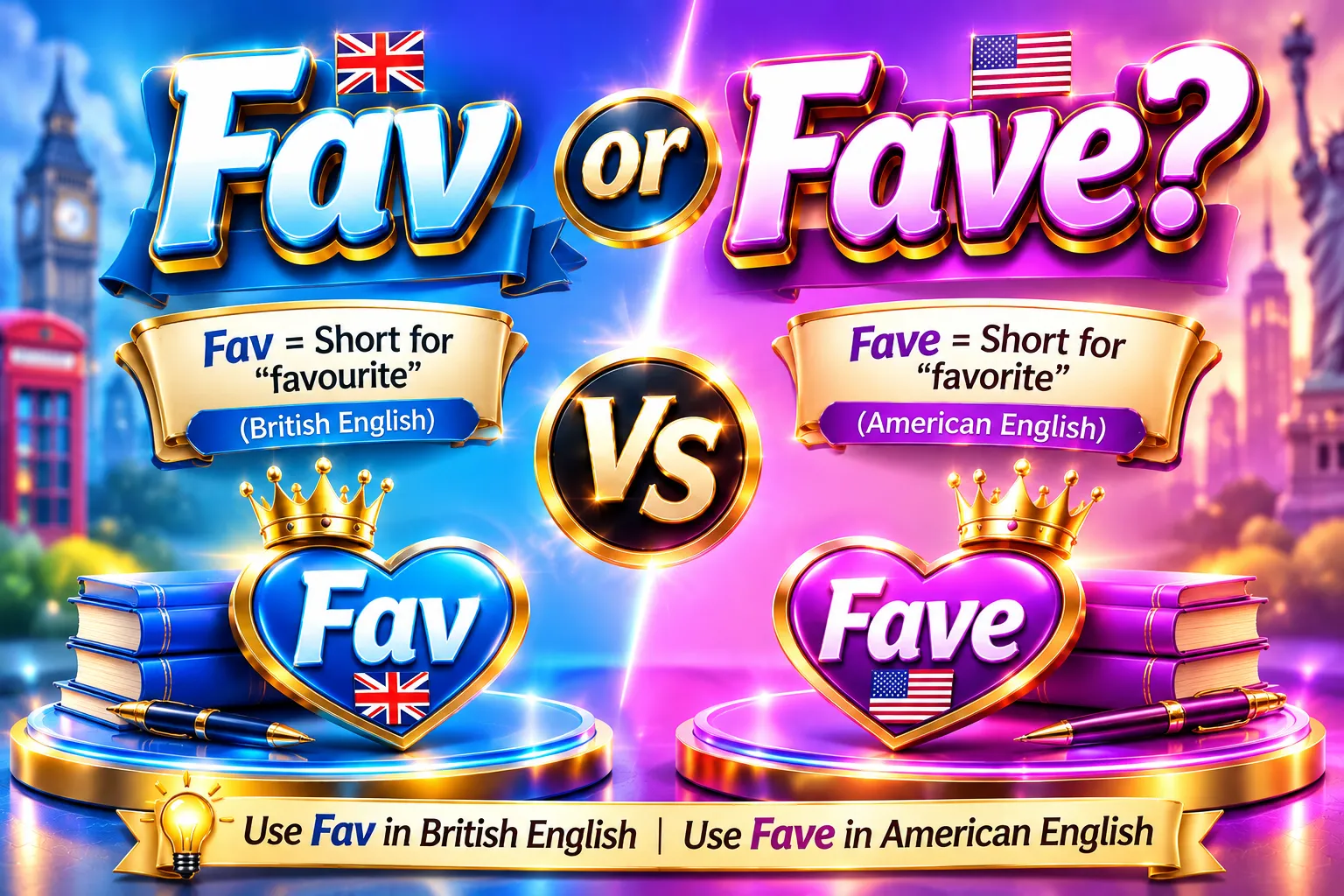
Fav and fave are both correct informal forms of favorite (or favourite in British English).
- Fav is shorter and more clipped.
- Fave is slightly more conversational and playful.
- Favorite/Favourite is the standard form for formal writing.
Examples:
- “Pizza is my fav food.”
- “Pizza is my fave food.”
- “Pizza is my favorite food.”
Use fav or fave in texts, social media posts, and casual messages. For essays, business writing, and other formal contexts, use favorite or favourite.
I remember the first time I saw someone write “my fav song” instead of “my favorite song.” I wondered if fav was a typo or simply a new way to shorten the word. Then I started seeing fave in social media posts, text messages, and casual conversations. Both forms were common, but I wanted to know if one was actually correct.
The simple answer is yes, both “fav” and “fave” are correct informal forms of “favorite.” In British English, they can also represent “favourite.” The main difference is not meaning but style and usage.
Fav is a very short, clipped form. Fave is another informal form that looks and sounds more like a shortened version of the original word. Both are common in casual English.
In this guide, you will learn the difference between fav and fave, when to use each one, common mistakes, and simple examples.
Fav or Fave: Quick Answer
Fav and fave both mean favorite or favourite.
- Fav = a short, clipped form of favorite
- Fave = an informal shortened form of favorite
- Favorite = standard American English
- Favourite = standard British English
For example:
- Pizza is my fav food. ✅
- Pizza is my fave food. ✅
- Pizza is my favorite food. ✅
The first two are informal. The third is standard English and works in both casual and formal writing.
So, if you are texting a friend, posting on social media, or writing a casual caption, fav and fave are both fine.
What Does “Fav” Mean?
Fav is an informal abbreviation of favorite. It removes most of the original word and keeps only a few letters.
You may see it in:
- Text messages
- Social media posts
- Online comments
- Short captions
- Casual conversations
- Informal blogs
For example:
“That is my fav song.”
“She is my fav teacher.”
“This is my fav restaurant.”
The word fav feels short, quick, and casual. It is especially useful when people want to type quickly or keep a message brief.
You may also see fav used as a noun:
“This one is my fav.”
Here, fav means favorite choice.
What Does “Fave” Mean?
Fave is another informal short form of favorite or favourite.
It has the same basic meaning as fav, but it can feel a little more natural or playful in casual writing.
For example:
“That is my fave movie.”
“She is my fave character.”
“This is my fave café.”
You can also use fave as a noun:
“This restaurant is my fave.”
Like fav, it is not normally used in formal writing.
Fav vs Fave: What’s the Difference?
The main difference is style, not meaning.
| Word | Meaning | Style | Common Use |
|---|---|---|---|
| Fav | Favorite | Very casual and short | Texts, comments, captions |
| Fave | Favorite | Casual and playful | Social media, messages, casual writing |
| Favorite | Preferred choice | Standard | Formal and informal writing |
| Favourite | Preferred choice | Standard British English | Formal and informal writing |
Neither fav nor fave is grammatically more correct than the other when used informally.
The choice often depends on personal preference.
Fav can feel more like a quick abbreviation.
Fave can feel more like a casual word in its own right.
For example:
- “What’s your fav movie?”
- “What’s your fave movie?”
Both sentences mean exactly the same thing.
Is “Fav” or “Fave” More Common?
Both forms are widely understood. However, usage can vary by person, platform, region, and context.
Fave is often seen in casual writing, social media, lifestyle content, and conversational English. Fav is also very common, especially in short messages and online posts.
There is no universal rule saying that you must use one instead of the other.
For example:
“This is my fav book.”
and
“This is my fave book.”
Both sound natural in casual English.
If you want the shortest possible form, fav is a good choice. If you prefer a form that looks closer to a spoken nickname, fave may feel more natural.
When Should You Use Fav or Fave?
Use fav or fave when your writing is relaxed and informal.
1. Text Messages
You can easily use either form when messaging friends:
“What’s your fav movie?”
“That’s my fave restaurant!”
2. Social Media
Both forms work well in captions and comments:
“My fave outfit this summer.”
“My fav song right now 🎵”
3. Online Comments
Informal comments often use shortened words:
“This is my fave!”
“Definitely my fav episode.”
4. Casual Conversations
You may also hear or see these forms in relaxed conversations:
“What’s your fave dessert?”
“Blue is my fav color.”
The important point is that these forms are informal.
When Should You Avoid Fav and Fave?
Avoid fav and fave when you need standard, formal English.
For example, do not normally use them in:
- Academic essays
- School assignments
- Business reports
- Formal letters
- Professional documents
- Formal applications
- Research papers
Instead, write:
- favorite in American English
- favourite in British English
For example:
Informal:
“Football is my fav sport.”
Formal:
“Football is my favorite sport.”
The meaning has not changed. Only the level of formality has changed.
Common Mistakes With Fav and Fave
Because these forms are informal, people sometimes create unusual versions that are not standard.
Mistake 1: Using “Fav” in Formal Writing
❌ “My fav subject is English.”
This may be fine in a text message, but it is not a good choice for a formal essay.
✅ “My favorite subject is English.”
Mistake 2: Using “Fave” in a Professional Report
❌ “This is the customer’s fave option.”
✅ “This is the customer’s favorite option.”
Formal writing should use the full standard word.
Mistake 3: Adding “-est”
You may occasionally see playful forms such as favest or faveest online. These are not standard forms of favorite.
Instead, use:
“This is my favorite movie.”
or, informally:
“This is my fave movie.”
Mistake 4: Thinking One Is the Correct Spelling
It is not correct to say that fav is always wrong because it is short, or that fave is the only correct informal form.
Both are established informal forms.
Fav or Fave: Examples
Here are some simple examples to show how both words work.
With “Fav”
- “That is my fav song.”
- “Pizza is my fav food.”
- “She is my fav actress.”
- “This is my fav book.”
- “What’s your fav color?”
- “He is my fav player.”
With “Fave”
- “That is my fave song.”
- “Pizza is my fave food.”
- “She is my fave actress.”
- “This is my fave book.”
- “What’s your fave color?”
- “He is my fave player.”
Notice that the meaning stays the same. Only the informal form changes.
Favorite vs Favourite
There is another spelling difference to remember.
Favorite is the standard spelling in American English.
Favourite is the standard spelling in British English and many other varieties of English.
For example:
- American English: “What is your favorite movie?”
- British English: “What is your favourite movie?”
When shortened, both can become fav or fave in informal communication.
So the regional spelling does not create a major difference between fav and fave.
Is “Fav” Slang?
Fav is best described as an informal abbreviation or shortened form of favorite. It is common in casual digital communication.
It is not a good choice when you need formal standard English.
For example:
“This is my fav.”
works perfectly well in a casual message.
But in a formal article, you would normally write:
“This is my favorite.”
The same idea applies to fave.
Is “Fave” Slang?
Yes, fave is also informal. It is commonly used as a shortened form of favorite or favourite.
It is especially natural in conversational writing:
“That’s my fave!”
This sounds friendly and relaxed.
However, for formal writing, use favorite or favourite instead.
Fav or Fave: Which One Should You Use?
The choice is simple.
Choose fav if you want a very short and casual form.
Choose fave if you prefer a slightly more expressive and conversational form.
Use favorite or favourite when you want standard English.
Here is an easy rule to remember:
Texting or social media → fav or fave
Formal writing → favorite or favourite
You do not need to worry about choosing the “correct” informal form. Both fav and fave are understood.
Frequently Asked Questions
Is “fav” correct English?
Yes. Fav is a recognized informal abbreviation of favorite or favourite. It is suitable for casual communication but not usually for formal writing.
Is “fave” correct English?
Yes. Fave is an informal shortened form of favorite or favourite. It is common in casual speech and writing.
Is fav or fave more correct?
Neither is more grammatically correct. Both are informal forms of the same word.
Is fave more common than fav?
Usage varies by person, region, and context. Fave is very common in casual writing, but fav is also widely used. There is no universal rule that makes one better.
Can I use fav or fave in an essay?
It is best to avoid both in formal essays. Use favorite in American English or favourite in British English.
What is the plural of fav or fave?
In casual writing, you may see favs or faves. For example:
“These are my favorite books.”
In formal writing, it is better to use the full word rather than the abbreviation.
Conclusion
So, fav or fave—which one is correct? The answer is both.
Fav and fave are informal shortened forms of favorite or favourite. They have the same basic meaning, but they can have a slightly different feel. Fav is shorter and more clipped, while fave can sound a little more conversational and playful.
Both work well in texts, social media captions, comments, and casual messages.
For formal writing, however, stick with favorite in American English or favourite in British English.
The easiest rule is:
Fav = informal and very short.
Fave = informal and conversational.
Favorite/Favourite = standard English.
So if you are texting a friend, either “my fav song” or “my fave song” is perfectly fine.
Read More:
Groomsman or Groomsmen: Easy Guide to Correct Usage

I specialize in English grammar, spelling, word choice, and language usage. My content is based on research from grammar references, style guides, dictionaries, and real-world usage to ensure it is accurate and practical.
At Spelling Comparison, I write guides that explain why words are confused, how they are used, and which form is correct in context. I also include proofreading tips, examples, and writing advice readers can apply immediately.
My goal is to publish clear, reliable content that helps readers make better writing decisions. Each guide is written for accuracy, clarity, and usefulness in school, work, business, and everyday communication.