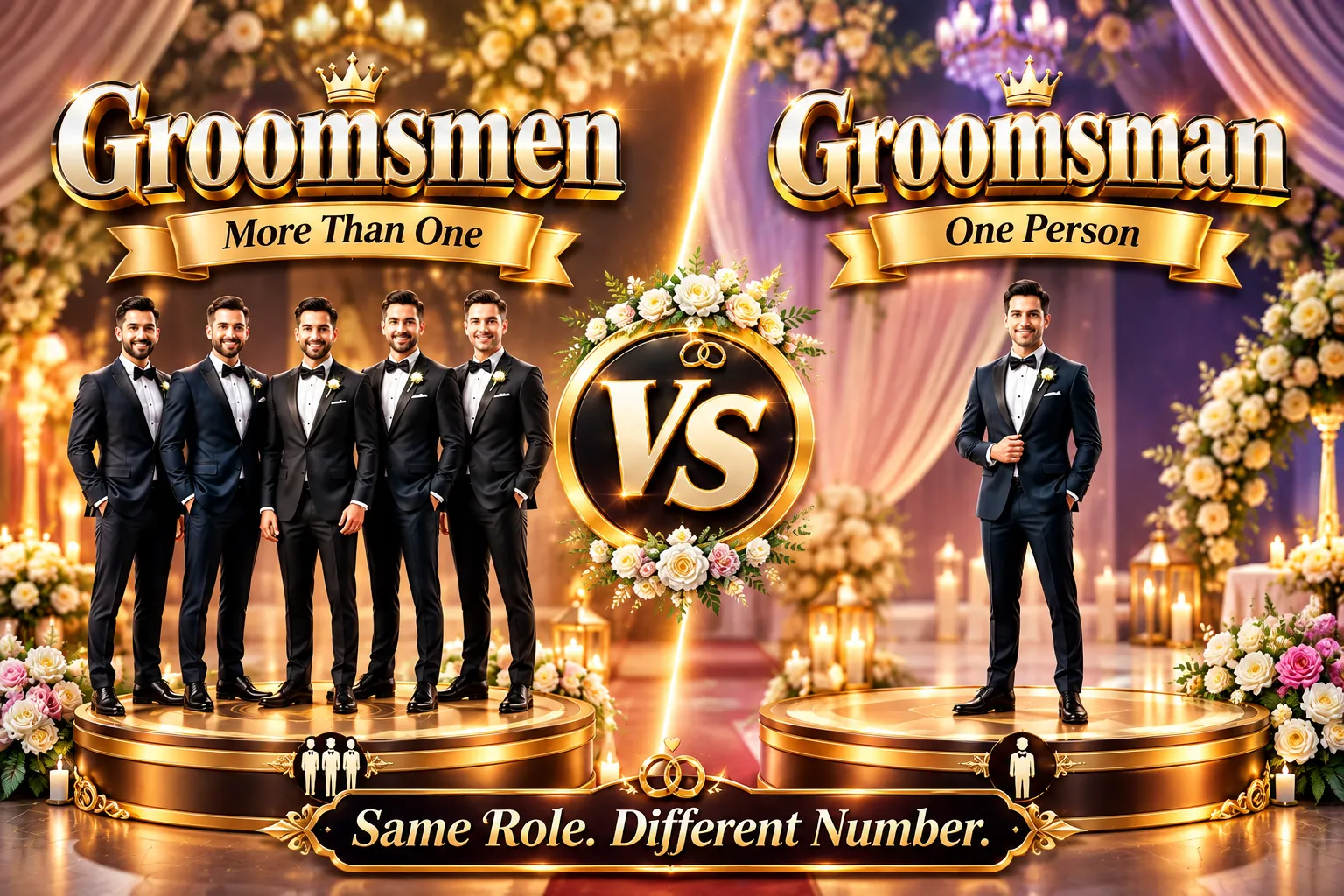
Groomsman means one person in the groom’s wedding party, while groomsmen is the plural form for two or more people.
I remember helping with wedding-related writing and stopping at a simple question: should I write “groomsman” or “groomsmen”? The words look almost identical, so it is easy to use the wrong one, especially when you are writing a wedding invitation, speech, program, or social media post.
The good news is that the rule is simple. Groomsman is singular. Groomsmen is plural. The spelling changes from -man to -men, just as man becomes men.
There is another detail that makes this topic more interesting. Traditional wedding language uses groomsman for a man who supports the groom. Modern weddings, however, are not always built around traditional gender roles. Some couples use terms such as wedding attendant or member of the wedding party instead.
So, which word should you use? It depends on how many people you mean and the language your wedding uses.
Let’s make the difference clear with simple rules, examples, grammar tips, and real wedding situations.
Groomsman or Groomsmen: Quick Answer
Use groomsman when you mean one person. Use groomsmen when you mean two or more people.
Cambridge Dictionary defines groomsman as a friend of a man getting married who has special wedding duties. It lists groomsmen as the plural form.
For example:
Alex is a groomsman at his friend’s wedding.
But:
Alex and Ryan are groomsmen at their friend’s wedding.
The difference is grammatical number:
- One person → groomsman
- Two or more people → groomsmen
Do not write groomsmans as the plural. The correct plural is groomsmen.
The Origin and Background of Groomsman
The word groomsman is built from groom + ’s + man. Collins dates the word to around 1690–1700 and gives its word origin as “groom + ’s + -man.”
Here, groom means a man who is getting married. A groomsman traditionally refers to a man who attends and supports the groom at a wedding.
Collins gives the traditional definition as a man who attends the bridegroom at a wedding.
The plural follows a familiar English pattern:
- man → men
- woman → women
- spokesman → spokesmen
- groomsman → groomsmen
This is a grammar rule based on number, not a difference in meaning. The singular word names one person. The plural names a group.
Modern wedding language can be more flexible. Cambridge also recognizes attendant as a wedding term for someone who helps a bride or groom, including a bridesmaid or groomsman.
Groomsman vs. Groomsmen: Key Differences
| Term | Meaning | When to Use | Region/Context |
|---|---|---|---|
| Groomsman | One person supporting the groom | When referring to one person | Wedding language |
| Groomsmen | Two or more people supporting the groom | When referring to a group | Wedding language |
| Wedding attendant | A person who helps the bride or groom | When you want a broader term | Inclusive wedding language |
| Members of the wedding party | People taking part in the wedding party | When gender is not relevant | General and inclusive |
Groomsman
Use groomsman for one person.
Chris was chosen as a groomsman.
Each groomsman received a wedding-day schedule.
Notice the words each and a. Both point to one person.
Groomsmen
Use groomsmen for a group.
The groomsmen arrived early.
Several groomsmen helped prepare the reception area.
Words such as several, many, and all normally signal a plural noun.
Wedding Attendant
If you do not want to use a gendered title, wedding attendant can work well.
Morgan is a wedding attendant.
For a group:
The wedding attendants gathered before the ceremony.
This is not simply a spelling alternative. It is a broader term for people who support the bride or groom at a wedding.
Which Version Should You Use?
The choice is easy once you know what you are describing.
For One Person
Use groomsman.
My brother is a groomsman.
For Two or More People
Use groomsmen.
My brothers are groomsmen.
For a Gender-Neutral Option
Use wedding attendant or member of the wedding party.
My sibling is a member of the wedding party.
For a Wedding Program
Follow the terminology chosen by the couple. If they use traditional titles, groomsman and groomsmen are perfectly suitable.
If the wedding party includes people of different genders or the couple prefers neutral language, wedding party or wedding attendant may be clearer.
The best rule is simple: match the noun to the number of people and the couple’s preferred terminology.
Common Mistakes with Groomsman and Groomsmen
1. Writing “Groomsmans”
Wrong:
We have five groomsmans.
Correct:
We have five groomsmen.
English changes man to men in this traditional compound.
2. Using Groomsmen for One Person
Wrong:
My cousin is a groomsmen.
Correct:
My cousin is a groomsman.
One person needs the singular form.
3. Using Groomsman for a Group
Wrong:
The groomsman are ready.
Correct:
The groomsmen are ready.
The plural noun needs a plural verb.
4. Using the Wrong Verb
Compare:
The groomsman is waiting outside.
The groomsmen are waiting outside.
This is ordinary subject-verb agreement.
Groomsman → is
Groomsmen → are
5. Confusing Groomsmen With Best Man
The best man is traditionally the groom’s principal attendant. The groomsmen are the other members of the groom’s party.
The best man may also be counted among the groomsmen in casual usage, depending on how the wedding party is described.
If you are writing a formal wedding program, follow the couple’s chosen titles.
Groomsman or Groomsmen in Real-World Examples
Professional Email
Subject: Wedding Schedule for Groomsmen
Hi everyone, please review the schedule before Friday so all groomsmen know where to meet before the ceremony.
Here, groomsmen is correct because the email addresses several people.
News Headline
Groomsman Helps Couple Recover Lost Wedding Rings
The headline uses groomsman because it describes one individual.
Social Media Post
So grateful to have my closest friends standing beside me as my groomsmen on the big day!
The plural works because the post refers to a group.
Formal Document
Wedding Party: Best Man, three Groomsmen, Maid of Honor, and four Bridesmaids.
Here, groomsmen refers to three people.
Wedding Program
Groomsman: Daniel Parker
Only one person’s name appears, so the singular form is appropriate.
Groomsman or Groomsmen: Data, Trends & Usage
This topic has both informational and commercial search intent.
People search for the terms because they want to:
- check the correct plural
- write wedding invitations
- prepare wedding programs
- understand wedding roles
- choose wedding-party titles
- shop for groomsmen gifts
Current keyword data also shows strong interest around the broader wedding term. A RankHero keyword report updated in August 2026 estimates about 74,000 monthly searches for “groomsman” and reports seasonal movement during the previous year. It is Etsy-focused data, so it should be treated as an approximate marketplace keyword estimate, not a universal Google search-volume figure.
The same report shows the United States as the largest listed country source for that keyword, followed by the UK and Australia.
Related wedding searches are also commercially important. For example, a separate RankHero report estimates around 33,100 monthly searches for “groomsmen gift”, with the United States accounting for most of its listed search demand.
This helps explain why people may search for groomsman vs. groomsmen while also looking for wedding roles, gifts, clothing, speeches, and planning ideas.
For SEO, this means an article should answer the grammar question first, then naturally cover related terms such as groomsman duties, groomsmen responsibilities, best man, wedding party, wedding attendant, and groomsmen gifts.
Groomsman vs. Groomsmen: Standalone Comparison
| Term/Variant | Meaning | Region/Context | Best Used When |
|---|---|---|---|
| Groomsman | One traditional member of the groom’s party | Wedding English | Referring to one person |
| Groomsmen | Two or more traditional members | Wedding English | Referring to a group |
| Best man | Principal traditional attendant of the groom | Wedding tradition | Naming the groom’s chief attendant |
| Wedding attendant | Someone supporting the bride or groom | Inclusive wedding language | Avoiding gender-specific titles |
| Wedding party member | Any person included in the wedding party | General/inclusive | Speaking broadly about the group |
This table shows an important point: groomsman and groomsmen are not competing spellings. They are singular and plural forms of the same noun.
Frequently Asked Questions
Q: What does groomsman mean?
A: A groomsman is traditionally a man who supports the groom and has a role in the wedding. Cambridge describes the role as a friend of the man getting married who has special wedding duties.
Q: What is the plural of groomsman?
A: The plural is groomsmen. The ending changes from -man to -men, just as in the pair man → men. Collins also lists groomsmen as the plural form.
Q: Is groomsman or groomsmen correct?
A: Both are correct. Use groomsman for one person and groomsmen for two or more.
Q: Is “groomsmans” correct?
A: No. The standard plural is groomsmen, not groomsmans.
Q: What is the difference between a groomsman and a best man?
A: A groomsman is a member of the groom’s wedding party. The best man is traditionally the groom’s main or chief attendant.
Q: Can a woman be a groomsman?
A: Traditionally, groomsman refers to a man. Modern couples may use groomswoman or a broader term such as wedding attendant, depending on personal preference.
Q: What is a gender-neutral alternative to groomsman?
A: Wedding attendant and member of the wedding party are useful neutral alternatives. Cambridge uses attendant for someone who helps a bride or groom at a wedding.
Q: Is groomsmen singular or plural?
A: Groomsmen is plural. Use it for two or more people. For one person, use groomsman.
Final Verdict: Groomsman or Groomsmen?
When I first stopped to question groomsman and groomsmen, the words seemed easy to mix up. Once you connect them with one person versus a group, the rule becomes much easier.
Use groomsman for one member of the groom’s wedding party. Use groomsmen for two or more. The plural is irregular because man changes to men.
There is also a useful style choice to remember. Traditional wedding language uses gendered terms such as groomsman and groomsmen. Modern couples may prefer broader terms such as wedding attendant or member of the wedding party. The right choice depends on the couple and the people involved.
So, before sending a wedding invitation or publishing a wedding article, check three things: number, grammar, and preferred terminology.
One person? Choose groomsman.
A group? Choose groomsmen.
Want neutral wording? Choose wedding attendant.
Bookmark this guide so you never second-guess groomsman or groomsmen again.

I specialize in English grammar, spelling, word choice, and language usage. My content is based on research from grammar references, style guides, dictionaries, and real-world usage to ensure it is accurate and practical.
At Spelling Comparison, I write guides that explain why words are confused, how they are used, and which form is correct in context. I also include proofreading tips, examples, and writing advice readers can apply immediately.
My goal is to publish clear, reliable content that helps readers make better writing decisions. Each guide is written for accuracy, clarity, and usefulness in school, work, business, and everyday communication.