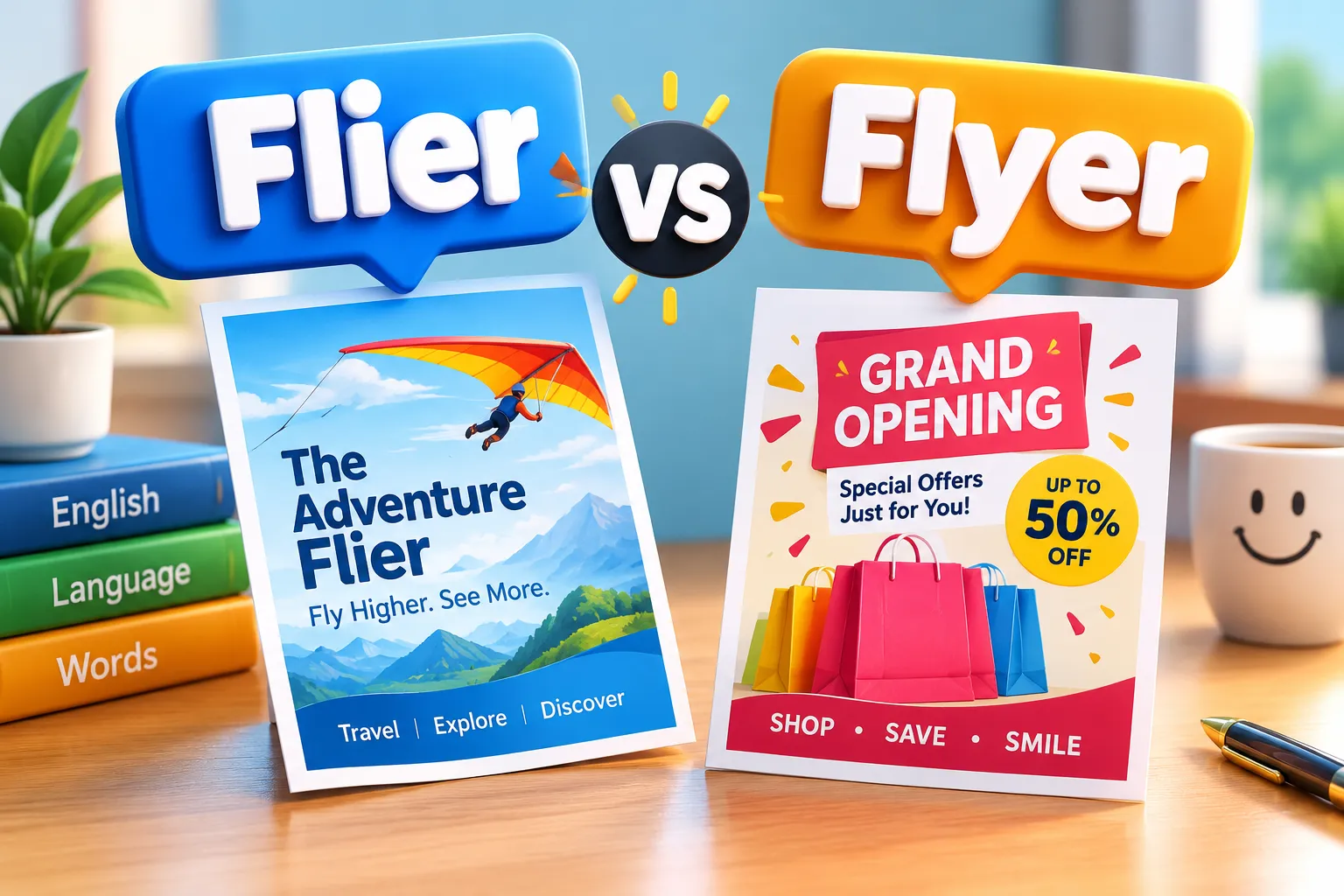
Flier and flyer are both correct spellings. Flyer is more common for a small advertising sheet, while flier is often used for a person or thing that flies.
I remember editing a short article about travel when I came across the phrase “frequent flier.” I paused because I had just used “flyer” in another piece about a promotional handout. At first, I wondered if I had made a spelling mistake. Why did one sentence use flier while another used flyer?
When I checked the usage more closely, I discovered that both spellings are correct. The difference often depends on the meaning and context. I now see flyer more often when referring to an advertising leaflet, poster, or handout, while flier is common in phrases such as frequent flier.
This is a mistake I have seen many learners and writers make. Instead of thinking of flier or flyer as a simple right-or-wrong spelling question, I recommend looking at what you are trying to say and who will read it. In this guide, I will explain their meanings, history, regional usage, common mistakes, and everyday examples so you can confidently choose the right form for your writing.
Flier or Flyer Quick Answer
Flier and flyer are both accepted English spellings. Flyer is especially common for a promotional leaflet, while flier is widely seen in terms such as frequent flier.
Examples:
- She handed out a flyer for the concert.
- He is a frequent flier with the airline.
However, these preferences are not absolute. Flier can also mean a leaflet, and flyer can refer to someone or something that flies.
The Origin / Background of Flier or Flyer
Both flier and flyer are closely connected to the verb fly.
The word flyer developed from fly plus the agent noun ending -er. Merriam-Webster lists flyer as a noun meaning, among other things, one that flies and a handbill or advertising leaflet.
Flier is another spelling formed from the same basic idea. It has been used for someone or something that flies and later developed overlapping uses.
The spelling difference is therefore not like a pair such as effected and affected, where the words have different grammatical functions. With flier or flyer, the two forms can have the same meaning.
That is why dictionaries often list both.
Flier or Flyer Explained Key Differences
| Term | Meaning | When to Use | Region/Context |
| flier | Someone or something that flies; also a leaflet | Aviation, travel, general English | Common in “frequent flier” |
| flyer | Someone or something that flies; also a leaflet | Advertising, aviation, general English | Very common for promotional material |
| frequent flier | Person who travels frequently by air | Travel | Traditional and widely accepted |
| frequent flyer | Person who travels frequently by air | Travel | Also standard and widely used |
When to use “flier”
Use flier when you want to describe a person or thing that flies, especially in established phrases.
My brother is a frequent flier.
You may also encounter:
The bird is a strong flier.
When to use “flyer”
Flyer is especially common when referring to an advertising leaflet.
The store gave me a flyer about its weekend sale.
It is also used for people or things that fly:
She is a confident flyer.
So flyer has broader everyday visibility in some contexts.
Flier or Flyer: Which Version Should You Use?
For advertising
Choose flyer as the safest general choice for a promotional sheet.
We designed a flyer for the new restaurant.
This is particularly common in American English.
For frequent air travelers
Both frequent flier and frequent flyer are accepted.
If you are following a company’s official program name, use its spelling exactly as branded.
For students
If your teacher or style guide has a preferred spelling, follow it consistently.
If there is no specific requirement, flyer is a safe general-purpose choice.
For global or neutral writing
Both spellings are understandable and legitimate. The best choice often depends on your audience, country, and style guide.
Consistency matters more than switching between forms without a reason.
Common Mistakes with Flier or Flyer
1. Mistake: Thinking “flier” is wrong
Correction: Flier is a standard English spelling.
It is not simply a misspelling of flyer.
2. Mistake: Thinking “flyer” is only for advertising
Correction: Flyer can also mean someone or something that flies.
Its meaning depends on context.
3. Mistake: Writing “frequent flyer” as the only possible form
Correction: Frequent flier is also correct.
Both versions are found in standard English.
4. Mistake: Mixing styles in the same document
For example:
Our frequent flier program includes a free flyer.
This is not grammatically wrong. However, if your publication has a preferred style, use it consistently throughout.
5. Mistake: Treating the pair like “your or you’re”
Correction: Unlike your and you’re, flier and flyer are not usually a case of one correct form and one incorrect form.
They are variant spellings.
Flier or Flyer in Real-World Examples
Professional email
I have attached the flyer for next week’s customer event.
News article
The veteran flier completed another long-distance flight.
Social media post
Grab a flyer at the entrance and check out this weekend’s special offers!
Formal document
The survey included both frequent fliers and occasional air travelers.
Travel website
Frequent flyers may qualify for additional rewards.
These examples show why context matters. The spelling can change while the basic idea remains the same.
Flier or Flyer Data, Trends & Usage
The search intent behind “flier or flyer” is primarily informational. Readers usually want to know which spelling is correct and whether the two forms have different meanings.
Exact monthly search volume changes by country, platform, and date. Public Google Trends data measures relative interest rather than giving a fixed number of monthly searches. For that reason, unsupported search-volume figures should not be presented as exact facts.
Which spelling is more common?
In modern general usage, flyer is highly visible, particularly for promotional material. Major dictionaries recognize flyer as a noun for an advertising handbill or leaflet.
Flier, however, remains firmly established. Merriam-Webster lists flier as a noun and gives examples involving someone who flies and someone who takes chances.
A useful usage insight
If you are talking about a piece of advertising, flyer is often the most natural choice.
If you are talking about an air traveler, both frequent flier and frequent flyer occur in standard usage.
So there is no universal rule that says one spelling has replaced the other.
Flier vs. Flyer: Standalone Comparison Table
| Term/Variant | Meaning | Region/Context | Best Used When |
| flier | Person or thing that flies | General English | Referring to someone who flies |
| flyer | Person or thing that flies | General English | General use or when preferred by your style guide |
| flyer | Advertising leaflet | Especially common in American English | Promotions and marketing |
| flier | Advertising leaflet | Standard English | When your publication prefers this spelling |
| frequent flier | Regular air traveler | Travel English | Airline and travel contexts |
| frequent flyer | Regular air traveler | Travel English | Airline and travel contexts |
The key lesson is that context and house style often determine the better choice.
Flier or Flyer: American vs. British English
There can be differences in spelling preferences across English varieties, but this pair does not divide neatly into “American = one spelling” and “British = the other.”
Both flier and flyer are used in different English-speaking regions.
For professional writing, the safest approach is to check the dictionary or style guide used by your target audience.
For example, if you are writing for an American marketing audience and mean an advertising handout, flyer is a very natural choice.
FAQs About Flier or Flyer
Q: Is “flier” or “flyer” correct?
A: Both are correct. They are recognized spelling variants, although flyer is especially common for an advertising leaflet.
Q: Is “flyer” the American spelling?
A: Flyer is very common in American English, especially for promotional material. However, flier is also used in American English.
Q: Is “flier” a British spelling?
A: Flier is used in British English, but it is not exclusively British. Both spellings occur across major varieties of English.
Q: Which is correct: frequent flier or frequent flyer?
A: Both are correct. Many organizations and dictionaries use frequent flyer, while frequent flier is also an established form.
Q: Should I write “flyer” for an advertising leaflet?
A: Flyer is a strong choice, particularly in American English. It clearly refers to a printed or digital promotional handout.
Q: Does “flier” mean someone who flies?
A: Yes. Flier can refer to a person or thing that flies. It can also have other meanings, depending on context.
Q: Does “flyer” mean someone who flies?
A: Yes. Flyer can describe someone or something that flies. It can also mean an advertising leaflet.
Conclusion: Flier or Flyer Made Easy
The choice between flier or flyer is much easier once you know that both spellings are correct.
Use flyer when talking about an advertising leaflet if you want the most familiar modern choice. For air travelers, both frequent flier and frequent flyer are acceptable. If you are describing someone or something that flies, either form may work depending on context and style.
The biggest mistake is assuming that one spelling is always wrong. It is not. These are variant spellings, and English allows both.
If you are writing for a company, publication, school, or website, check its preferred style and stay consistent. When no style guide is provided, flyer is often the easiest general choice, especially for promotional material.
English spelling does not always give us one neat answer. Sometimes, knowing when each form is preferred is the real skill.
Bookmark this guide and share it with someone who still wonders whether “flier” or “flyer” is correct.
Read More:
Affected or Effected: Learn the Difference Easily ✍️

I’m an English language educator and content writer with more than 10 years of experience helping learners improve their English skills. I specialize in spelling differences, grammar, vocabulary, synonyms, commonly confused words, and English usage. My goal is to create accurate, easy-to-understand articles that make learning English simple, practical, and enjoyable for students, writers, and professionals around the world.