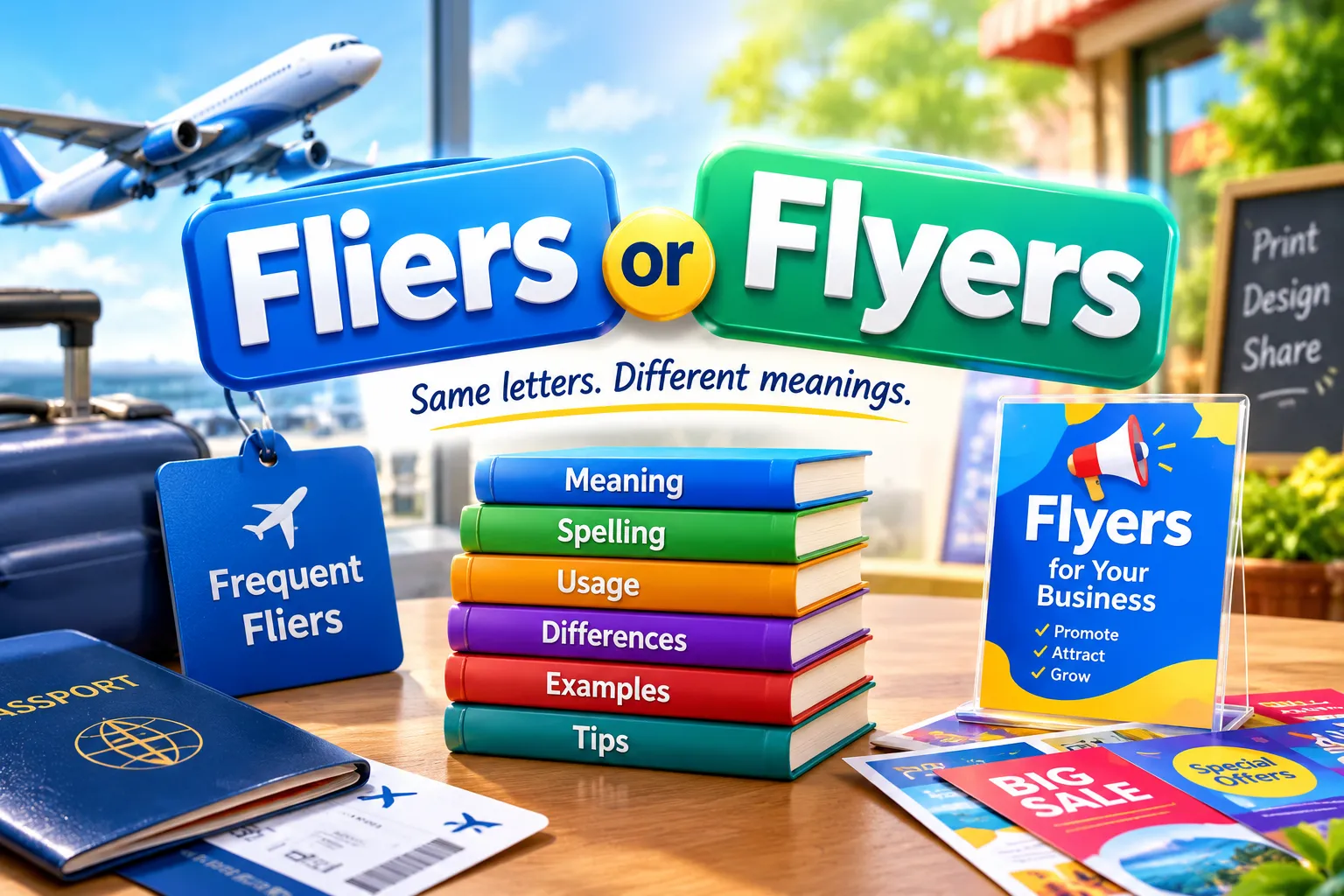
Fliers and flyers are both correct plural forms of flier/flyer. Flyers is especially common for advertising leaflets, while fliers is often used for people or things that fly and for risky ventures.
I remember writing about air travel and suddenly pausing over a simple word: fliers or flyers? It looked like an easy spelling choice, but the more I checked, the more interesting it became. Both forms are correct, yet each can feel more natural in certain contexts.
I have noticed this confusion often when people write about air travelers, advertising materials, or business promotions. For example, a company might hand out flyers to advertise a new service, while a travel article might describe frequent fliers. But you may also see flyers used for people who travel by air.
That is what makes these two spellings tricky. Fliers and flyers are both accepted English spellings, and their meanings can overlap. The preferred form often depends on the context, regional usage, or the style guide being followed.
In this guide, we will look closely at fliers vs. flyers, including their meanings, differences, examples, plural forms, and common uses. By the end, you will know which spelling to choose and when.
Fliers or Flyers Quick Answer
Both fliers and flyers are accepted English words.
Use flyers when you mean printed promotional sheets, such as advertisements for a sale, concert, or event. Fliers can also have this meaning, but flyers is a very clear choice in modern marketing.
For people or things that fly, fliers and flyers can both be used.
Examples:
- The store distributed flyers for its weekend sale.
- Several skilled fliers joined the air show.
Merriam-Webster also recognizes fliers as the plural of flier and notes that flyers is a variant.
There is another useful distinction: the expression take a flier commonly refers to taking a risk or making a speculative choice.
The Origin and Background of Fliers and Flyers
The story begins with the verb fly.
The noun flyer dates back to the mid-15th century and originally referred to something that flies. Etymonline traces it to fly plus the agent suffix -er.
The verb fly itself is much older. Merriam-Webster gives its origin as Old English flēogan, meaning to move through the air.
Over time, the noun developed several meanings.
It could describe:
- A person who flies.
- A bird or other flying creature.
- Something that moves quickly.
- A person who travels by air.
- A risky business or financial venture.
- A printed advertising sheet.
The advertising meaning developed later. Etymonline records flyer meaning a small handbill or advertising sheet from the late 19th century.
This history helps explain why modern English has more than one meaning and more than one spelling.
The spelling variation is not a modern mistake. Flier and flyer have existed as alternative forms for a long time.
Fliers vs. Flyers Explained Key Differences
The safest way to understand these words is to look at their meaning and context.
| Term | Meaning | When to Use | Region/Context |
| fliers | People or things that fly | Aviation, birds, aircraft, general writing | Broad English |
| flyers | People or things that fly | Aviation and general use | Broad English |
| flyers | Promotional sheets | Ads, events, sales, marketing | Very common |
| fliers | Promotional sheets | Advertising and printed notices | Also accepted |
| fliers | People who take risks | “take a flier” or risky venture | Especially common in American English |
Oxford lists flyer as a person who flies an aircraft, a passenger, a flying bird or insect, and a small advertising sheet. It also lists flier as an alternative form.
When talking about advertising
Flyers is usually the clearest choice.
The restaurant printed colorful flyers for its new lunch menu.
You may also see:
The volunteers handed out fliers at the station.
That sentence is grammatically correct. However, many readers now associate flyer strongly with promotional material.
When talking about people who fly
Both forms work.
The experienced fliers practiced before the competition.
Or:
The experienced flyers practiced before the competition.
Oxford specifically records both spellings for people who fly aircraft or travel by plane.
When talking about risk
Flier has a special use in the phrase take a flier.
The investor took a flier on the young company.
Here, flier means a risky or speculative action. Etymonline traces this sense to the idea of taking a “flying leap.”
Which Version Should You Use?
Your best choice depends on your audience and meaning.
For advertising and marketing
Choose flyers.
It is instantly clear when you mean promotional sheets.
Example:
We need 500 flyers for the new gym opening.
For aviation
Either fliers or flyers can work.
If your organization has a house style, follow it consistently.
Example:
Experienced fliers often know how to stay calm during turbulence.
For a risky decision
Use flier in the established phrase take a flier.
Example:
She decided to take a flier on the unusual investment.
For global or neutral writing
If you mean an advertising sheet, flyer is often the simplest choice.
If you mean a person who flies, either flier or flyer is acceptable. Oxford’s American dictionary treats flyer and flier as equivalent forms.
The key rule is simple: choose one spelling for a given document and stay consistent.
Common Mistakes with Fliers and Flyers
1. Thinking one spelling is always wrong
Mistake:
“Fliers” is incorrect.
Correction:
Fliers is a standard English plural form.
Merriam-Webster and Oxford both recognize the spelling.
2. Using “flyers” for every meaning without thinking
Mistake:
Using flyers when a specific established expression calls for flier.
Better:
The company took a flier on the new technology.
The phrase take a flier has a risk-related meaning.
3. Switching spellings in the same document
Mistake:
We printed 200 flyers. Later, we distributed 300 fliers.
Better:
We printed 200 flyers. Later, we distributed 300 flyers.
Unless there is a meaningful reason to change forms, consistency makes your writing cleaner.
4. Confusing “flyer” with “fly”
A flyer can be a person, animal, object, or advertising sheet.
A fly can be a verb, noun, or adjective with several different meanings.
They are related words, but they do not serve the same grammatical role.
5. Assuming spelling decides the meaning
Context matters more than the extra y.
The flyer landed safely.
Here, flyer refers to something or someone that flies.
The shop created a flyer.
Here, it means a promotional sheet.
Fliers or Flyers in Real-World Examples
Professional email
Subject: Event Flyers for Next Week
Please review the attached flyers before we send them to local businesses.
News headline
Local Volunteers Distribute Flyers Ahead of Community Event
Social media post
Our new summer menu is here! Pick up one of our flyers and see this week’s special offers.
Formal report
The campaign used printed flyers alongside digital advertising to reach local residents.
Aviation context
The training program helps new fliers develop confidence and safe flying habits.
Risk-taking context
The entrepreneur took a flier on the small startup after seeing its early results.
Notice that the spelling changes with the context, but the meaning remains easy to understand.
Fliers or Flyers Data, Trends & Usage
There is strong evidence that both forms are established, but exact search-volume comparisons need care.
Google explains that its Trends tool treats search terms literally. It does not automatically combine spelling variations, synonyms, singular forms, or plural forms. Users can deliberately compare spelling variants, but the results should not be treated as a complete measure of language use.
That matters for fliers vs. flyers.
A search for flyers may include strong interest in advertising materials, while fliers may attract searches connected with aviation or risk-taking. A simple search-volume number could therefore mix different meanings.
What the available evidence tells us
- Search intent: Primarily informational for queries such as “fliers or flyers,” but commercial intent can appear when users search for advertising flyers.
- Advertising usage: Flyers is a very common choice for promotional sheets.
- Aviation usage: Both fliers and flyers are accepted.
- Risk meaning: Flier remains established in expressions such as take a flier.
- Dictionary evidence: Major dictionaries recognize both spellings.
- Current relevance: Digital marketing has not removed the word flyer. Businesses still use the term for printed and digital promotional material.
Exact monthly search volumes for fliers and flyers can change by country and month. Without a live Ahrefs, Semrush, or Google Ads keyword dataset, giving a specific monthly number would create false precision.
For SEO work, the better approach is to target the main phrase naturally while also covering related searches such as flier vs flyer, flyers meaning, fliers meaning, frequent flyer, and take a flier.
Fliers vs Flyers: Standalone Comparison
| Term/Variant | Meaning | Region/Context | Best Used When |
| fliers | Plural of flier | General English | Talking about people or things that fly |
| flyers | Plural of flyer | General English | General flying contexts |
| flyers | Advertising sheets | Marketing, business | Promoting an event, product, or service |
| fliers | Advertising sheets | General English | When following a style that uses flier |
| frequent flyers | People who travel often by plane | Travel | Airline and passenger contexts |
| take a flier | Take a risk | Informal/business | Describing a speculative decision |
The phrase frequent flyer is especially common in travel English, while frequent flier is also accepted. Oxford lists the passenger meaning under both forms.
Frequently Asked Questions
Q: Are fliers and flyers both correct?
A: Yes. Both are accepted spellings. The best choice depends on meaning, style, and context. Oxford lists flier and flyer as alternative forms.
Q: Is “flyers” better than “fliers” for advertisements?
A: Flyers is often the clearest choice for advertising sheets. However, fliers is not grammatically wrong and is also found in dictionaries.
Q: Which is correct for airline passengers: fliers or flyers?
A: Both can describe people who travel by plane. The phrase frequent flyer is especially familiar in travel and airline language, but frequent flier is also valid.
Q: Is “fliers” acceptable in formal writing?
A: Yes. Fliers is a standard dictionary word. Your choice should match the meaning and the style of the document.
Q: Where do fliers and flyers come from?
A: Both forms developed from fly with the agent-forming ending -er. Etymonline dates the noun to the mid-15th century.
Q: Is “take a flier” correct English?
A: Yes. Take a flier means to take a chance or make a risky choice. This meaning is well established in English.
Q: Can I use “flyers” in a formal report?
A: Yes. If you mean promotional sheets, flyers is completely acceptable. For example, a report can discuss the number of flyers distributed during a campaign.
Q: Should I use both fliers and flyers in one article?
A: You can, but consistency is usually better when the meaning is the same. Choose the spelling that fits your audience and maintain it throughout the document.
Final Thoughts on Fliers or Flyers
The fliers vs. flyers question looks small, but it shows how flexible English spelling can be. Neither form is simply “wrong.”
If you mean advertising material, flyers is often the clearest and most familiar choice. If you are describing people or things that fly, fliers and flyers are both accepted. When you mean taking a risk, flier has a special role in the phrase take a flier.
The deeper lesson is to look at meaning and context, not just spelling. Major dictionaries such as Oxford and Merriam-Webster support both forms, while historical sources show that the variation has existed for centuries.
So, the next time you hesitate between fliers and flyers, ask yourself what you are describing. A promotional sheet? Choose flyers. A person who flies? Either can work. A risky decision? Take a flier.
Bookmark this guide so you never second-guess fliers or flyers again.
Read More:
Lier or Liar: The Easy Guide to Correct Usage

I’m an English language educator and content writer with more than 10 years of experience helping learners improve their English skills. I specialize in spelling differences, grammar, vocabulary, synonyms, commonly confused words, and English usage. My goal is to create accurate, easy-to-understand articles that make learning English simple, practical, and enjoyable for students, writers, and professionals around the world.