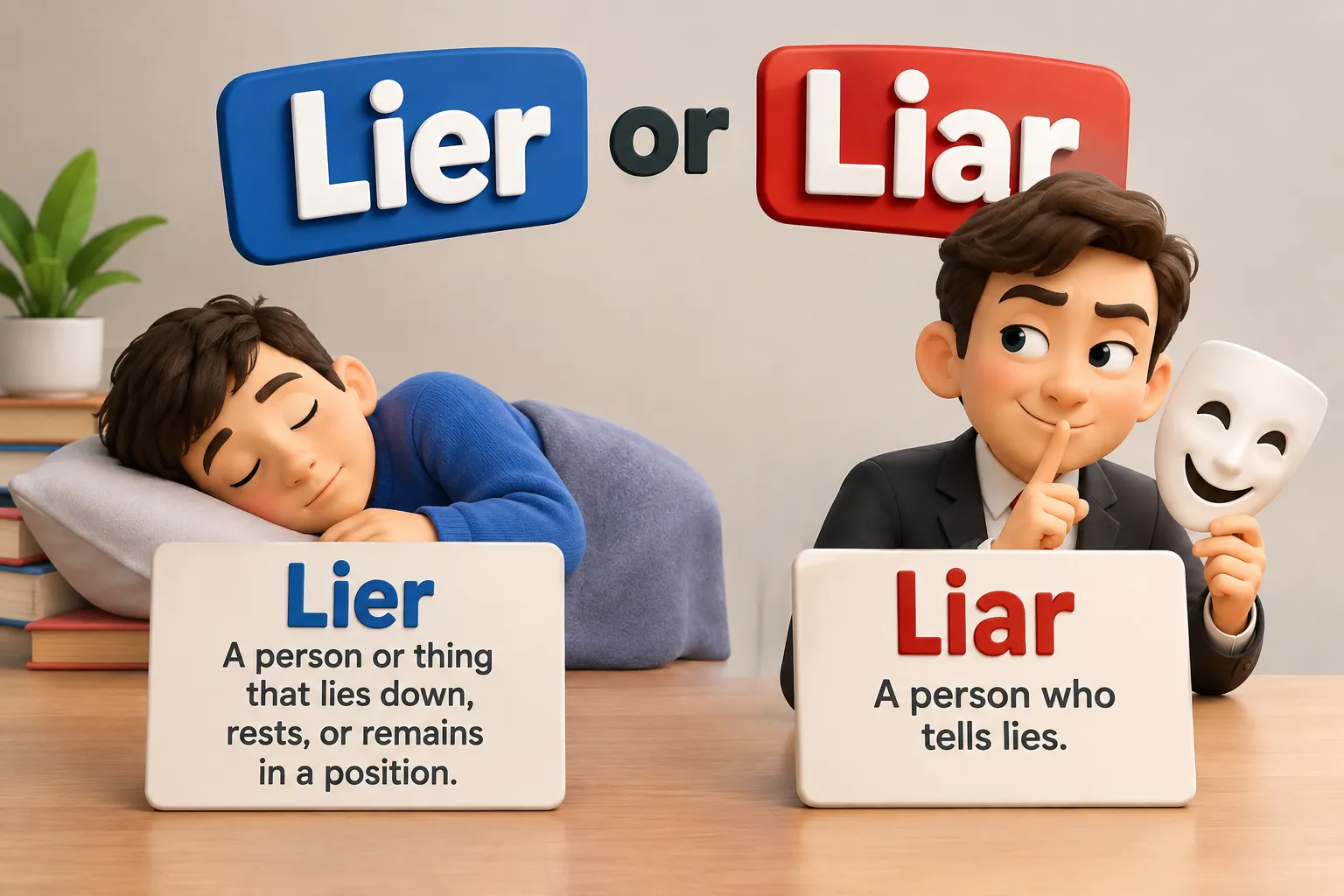
Liar is the correct word for a person who tells lies. Lier is a real but rare word for someone or something that lies down, rests, or remains in a position.
I remember the first time I noticed someone write “lier” when they meant “liar.” It caught my attention because the mistake seemed understandable. The two words look almost identical, and when you already know words like writer, reader, and teacher, it is easy to assume that someone who tells a lie should be called a lier.
Since then, I have come across this confusion several times while reviewing English writing. The tricky part is that both words are connected to the verb lie, but they do not have the same meaning. Liar refers to a person who tells an untruth, while lier refers to someone or something that is lying down or remaining in a particular position.
Once I understood this difference, the spelling became much easier to remember. In this guide, I’ll explain lier vs. liar, including their meanings, pronunciation, origins, common mistakes, and practical examples, so you can confidently choose the correct word.
Lier or Liar Quick Answer
Use liar when you mean a person who tells lies.
For example:
- Everyone knew that the witness was a liar.
- He called his brother a liar after hearing the false story.
Cambridge Dictionary defines liar as someone who tells lies. It lists the word as a noun and gives both UK and US pronunciations.
Lier, meanwhile, is a legitimate English noun, but it has a very different meaning. It can refer to someone or something that lies down, rests, or remains in a position. Merriam-Webster defines it as “one that lies,” such as one lying in ambush, and gives its first known use as 1583.
So, if you are writing about dishonesty, choose liar.
The Origin and Background of Lier and Liar
The difference becomes clearer when we look at their etymology.
Where does liar come from?
Liar has a long history in English. The Online Etymology Dictionary traces it to the early 13th century and connects it with Old English leogere, meaning a liar, false witness, or hypocrite. It developed from the verb related to lie, meaning to speak falsely.
The modern word therefore developed from the idea of a person who lies or tells an untruth.
Where does lier come from?
Lier developed from the other English verb lie—the one meaning to recline or be in a horizontal position.
Etymonline traces lier to the 1590s and explains that it is an agent noun formed from this sense of lie.
Merriam-Webster gives its first known use as 1583, while Collins also connects the word with lie + -er.
This is a useful lesson in English linguistics: the same spelling lie can represent two different verbs. One means to tell something untrue. The other means to recline or be in a position.
That is why lier and liar look so similar but have different meanings.
Lier vs. Liar Explained Key Differences
The easiest way to remember the distinction is to focus on the action behind each noun.
| Term | Meaning | When to Use | Region/Context |
| Liar | A person who tells lies | Talking about dishonesty or false statements | Standard modern English |
| Lier | Someone or something that lies down or remains in a position | Rare contexts involving reclining, resting, or lying in wait | Uncommon/formal or specialized |
| Lying person | A person who is lying down or telling an untruth, depending on context | Use when the meaning needs to be made clear | Modern everyday English |
Examples of liar
- The detective discovered that the suspect was a liar.
- Nobody believed the story because he had a reputation as a liar.
Here, liar describes a person associated with telling falsehoods.
Examples of lier
- The old poem describes a lier resting beside the river.
- The soldiers watched for a lier hidden near the road.
These uses are unusual in modern everyday English. If your meaning is simply “a person who is lying down,” a phrase such as person lying down will usually sound more natural.
Collins defines lier as a person who lies down and also gives the sense of someone or something lying in wait or ambush.
Which Version Should You Use?
For most readers, the answer is simple.
For students and English learners
Use liar when you mean someone who tells lies.
It is the normal modern word and appears in everyday speech, writing, dictionaries, and formal contexts.
For professional writing
Use liar when discussing a person who deliberately gives false information.
However, remember that calling someone a liar can sound strong or accusatory. In a sensitive report, terms such as misleading, inaccurate, or false statement may be more appropriate.
For unusual literary or historical contexts
Lier can be correct when it means someone who lies down or remains concealed.
Still, it is uncommon. Readers may assume that lier is a spelling mistake for liar, so choose a clearer phrase when possible.
For general English
Liar is the safe choice when the subject is dishonesty.
A simple memory trick is:
Liar → lie → untruth.
Lier → lie → rest or remain.
Common Mistakes with Lier and Liar
1. Writing lier for a dishonest person
❌ He is a lier.
✅ He is a liar.
The first sentence uses the rare noun incorrectly if you mean someone who tells falsehoods.
2. Assuming lier is simply a shorter spelling
❌ Lier is another spelling of liar.
✅ Lier and liar have different meanings.
Although historical dictionaries may record lier as an obsolete spelling of liar, modern standard usage distinguishes the two.
3. Confusing liar with lying
❌ She is a liar to the manager.
✅ She lied to the manager.
Liar is a noun. Lied is the past tense of the verb lie when lie means to tell an untruth.
Cambridge gives lied as the past tense and past participle of this sense of lie.
4. Using lier when a clearer phrase works better
❌ The lier was sleeping on the sofa.
Better:
✅ The person lying down was sleeping on the sofa.
The rare noun may be technically possible, but ordinary English usually favors a clearer construction.
5. Confusing lie with lay
This is a related grammar problem.
- Lie = to recline or rest.
- Lay = the past tense of that sense of lie.
- Lain = the past participle.
- Lie/lied = to tell an untruth, with lied as the past tense.
Cambridge distinguishes these meanings and forms clearly.
Lier or Liar in Real World Examples
Professional email
The report contains several claims that appear to be false, but I would prefer to verify the facts before calling anyone a liar.
Here, liar refers to a person accused of dishonesty.
News headline
Witness Denies Claim That He Is a Liar
The word works naturally in a headline because it identifies someone accused of telling lies.
Social media post
If someone keeps changing their story, people may quickly label them a liar.
This is a common everyday use of liar.
Formal report
The investigation found that the employee had provided inaccurate information on several occasions.
A formal report may avoid liar because it is a strong personal accusation. Describing the specific conduct can sound more neutral and professional.
Lier or Liar Data, Trends & Usage
There is a major difference in practical usage between these two words.
Liar is a normal modern English noun. Cambridge includes it in its learner and general dictionaries, and its corpus examples show the word being used in ordinary discussions of truth, deception, and credibility.
Lier is much less common. Merriam-Webster lists it as a dictionary word, but its definition is tied to the physical or positional sense of lie, such as lying in wait.
The available dictionary evidence therefore gives a clear usage insight: liar is the everyday word for dishonesty, while lier occupies a narrow and uncommon meaning.
Exact monthly Google search-volume figures can change by country, date, and SEO tool. Because a reliable current keyword-volume dataset was not available from the authoritative sources checked for this article, it would be misleading to invent a number.
The search intent is mainly informational. People searching lier or liar are usually trying to decide which spelling is correct.
This distinction also matters for English learners and grammar tools. Spell-checkers may flag lier depending on context, even though the word itself exists. Understanding the meaning behind the spelling is more reliable than depending only on an automated correction.
Standalone Comparison: Lier, Liar, and Related Forms
| Term/Variant | Meaning | Region/Context | Best Used When |
| Liar | Person who tells lies | Standard modern English | Discussing dishonesty |
| Lier | Person or thing that lies down or remains | Rare/specialized | Describing a reclining or waiting position |
| Lie | To speak falsely or to recline | Standard English; two different verbs | Talking about the action |
| Lied | Past tense of lie meaning “to tell an untruth” | Standard English | Describing a past false statement |
| Lying | Present participle of lie | Standard English | Describing someone currently telling an untruth or reclining |
One useful point is that lier is not a general-purpose alternative to liar. Its existence in dictionaries does not make it interchangeable with liar.
Frequently Asked Questions
Q: What does liar mean?
A: Liar means a person who tells lies. Cambridge Dictionary defines it as someone who tells lies.
Q: Is liar or lier correct?
A: Both are dictionary words, but they do not normally mean the same thing. Use liar for someone who tells untruths and lier for someone or something that lies down or remains in a position.
Q: Is lier a real word?
A: Yes. Lier is a real English noun. Merriam-Webster defines it as one that lies, including in the sense of lying in ambush.
Q: Is lier a misspelling of liar?
A: Not always. In modern English, lier has its own rare meaning connected with lying down or remaining in a position. However, using lier when you mean a dishonest person is a spelling error.
Q: Can I use liar in formal writing?
A: Yes, liar is grammatically correct in formal writing. However, because it can be a strong accusation, formal reports may use more neutral wording when discussing disputed facts.
Q: Where does the word liar come from?
A: Etymonline traces liar to the early 13th century and Old English leogere, connected with the verb meaning to tell an untruth.
Q: What does lier mean in a sentence?
A: It can describe someone who lies down or someone who lies in wait. For example, a historical or literary text might refer to a person concealed in ambush as a lier.
Conclusion
The difference between lier and liar becomes simple once you focus on meaning rather than spelling.
Liar is the word you will need in normal writing when you mean a person who tells lies. It is the familiar modern noun used in everyday conversation, journalism, and general writing. Cambridge Dictionary confirms this core meaning.
Lier is also a legitimate word, but it is rare. Its meaning connects to the other verb lie: to recline, rest, or remain in a particular position. Historical and modern dictionaries record this specialized use.
So remember the simple rule: a liar tells lies; a lier lies down or lies in wait.
When you are writing about dishonesty, choose liar. If you encounter lier in an old, literary, or specialized text, check the surrounding sentence before assuming it is a spelling mistake.
Bookmark this guide so you never have to second-guess lier or liar again.
Read More:
Acknowledgement vs. Acknowledgment: Which Is Correct?

I’m **Rubab Naaz**, an English language content writer with over 10 years of experience creating educational and SEO-focused articles. I specialize in spelling comparisons, grammar, vocabulary, synonyms, commonly confused words, and English usage. My passion is helping students, writers, and professionals improve their language skills through accurate, well-researched, and easy-to-understand content. Every article I write is designed to make learning English simple, practical, and engaging.